Best Thermal Clip-On Scopes 2026: AGM, Pulsar & SIG Compared

If you already have a quality daytime scope dialed in, a dedicated thermal rifle scope means starting from scratch — new zero, new mount, new everything. A thermal clip-on goes in front of your existing optic. Your zero stays. Your reticle stays. You flip it on at dusk, hunt, flip it off, and your rifle is back to its daytime setup without touching a turret.
That’s the real reason hunters choose clip-ons. Not because they’re cheaper (they often aren’t), but because they preserve what you’ve already built. This page covers seven clip-on thermals across a wide price range, with real notes on what each one does well and where it falls short.
Quick picks
Comparing a clip-on versus a dedicated thermal monocular? Our thermal monoculars buyer’s guide covers the top standalone options. For a full overview of AGM, Pulsar, and SIG’s broader lineups, our night vision brands guide goes brand by brand.
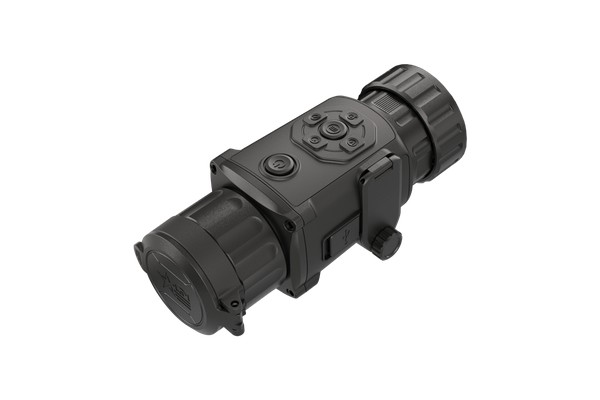
AGM Rattler TC19-256
256×192 sensor, 19mm lens. The most affordable entry into thermal clip-on territory that doesn’t feel like a toy. Works well on scopes up to about 6x magnification.
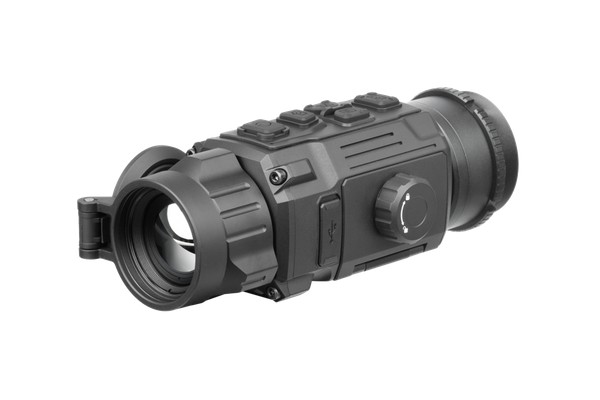
AGM Rattler TC35-384
384×288 sensor, 35mm lens. The step up to a higher-resolution sensor makes a noticeable difference past 150 yards. Still priced well under the Pulsar tier.
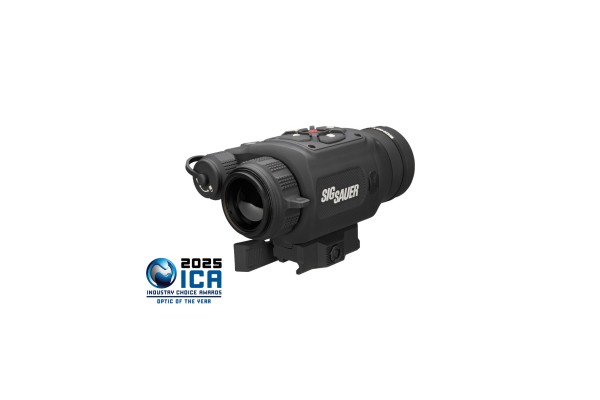
SIG Sauer ECHO CV25
Military-grade build, refined controls, and image quality that competes above its listed price point. For hunters who want the best and aren’t counting dollars closely.
Why clip-on instead of a dedicated thermal?
Dedicated thermal rifle scopes have come a long way. But there are practical reasons clip-ons continue to outsell them in certain hunting segments.
You keep your daytime zero. A dedicated thermal means a second rifle, or removing your daytime scope when you switch to night hunting. A clip-on mounts in front of your existing optic — the objective end — and doesn’t change your point of impact. Once you confirm the clip-on doesn’t shift your POI, you’re done. Flip it on, hunt. Flip it off, you’re back to day use.
One scope does two jobs. Your Nightforce, Leupold, or Vortex that you spent years getting right stays on the rifle. You use its magnification, its reticle, its turrets. The clip-on handles thermal imaging. This matters when you’re hunting the same property at different times of day without time to swap optics.
The downside is real. Clip-ons force you to use your scope’s magnification, which can limit effective range (see the FAQ below). Image quality is always passing through two optical systems. And some clip-ons are physically bulky — check front clearance before you buy. They’re not for every setup.
Comparison: all seven clip-on thermals
| Model | Sensor | Lens | Pixel pitch | Price (approx.) |
|---|---|---|---|---|
| AGM Rattler TC19-256 | 256×192 | 19mm | 12 µm | $1,295–1,495 |
| AGM Rattler TC35-384 | 384×288 | 35mm | 12 µm | $1,995–2,195 |
| Pulsar Krypton XQ38 | 384×288 | 38mm | 17 µm | ~$2,400 |
| Armasight Contractor 320 3-12x | 320×240 | 35mm | 17 µm | ~$2,600 |
| Steiner C35 Gen II | 320×240 | 35mm | 17 µm | ~$2,700 |
| SIG Sauer ECHO CV25 | 320×240 | 25mm | 17 µm | ~$3,000 |
| Pulsar Krypton 2 FXG50 | 640×480 | 50mm | 12 µm | ~$4,500 |
Individual reviews
AGM Rattler TC19-256 — compact budget clip-on
The TC19 is where a lot of hunters start with thermal clip-ons, and it’s a reasonable starting point. At $1,295–1,495, the 256×192 sensor won’t resolve detail the way higher-resolution units do, but it detects heat signatures clearly at ranges where most deer hunting actually happens — inside 200 yards in open country, or closer in timber. The 19mm lens keeps the unit compact and physically short, which helps with objective bell clearance on larger scopes.
Pros: Low price of entry, compact form factor, quick attachment and detachment, light enough that it doesn’t dramatically change rifle balance.
Cons: 256×192 resolution limits target identification at distance. Not the right tool for open-country hunting beyond 200 yards. Video recording isn’t a strength.
AGM Rattler TC35-384 — best value in the lineup
The jump from 256×192 to 384×288 is more noticeable than the numbers suggest. You get clearer separation between an animal and background at 150–250 yards, and the 35mm lens brings more reach than the TC19. At under $2,200, this is the clip-on I’d recommend to most hunters who want usable performance without paying Pulsar prices.
The TC35-384 runs on AGM’s standard thermal platform, which means familiar menus if you’ve used other AGM products. Battery life is adequate for a full evening hunt. The attachment system is straightforward — this isn’t a unit that requires fifteen minutes to mount.
Pros: Strong resolution-to-price ratio, 35mm lens gives meaningful reach, solid build for the price bracket.
Cons: Heavier than the TC19 — noticeable on lighter rifles. 12 µm pixel pitch means you’re generating more heat internally; in very warm weather, this occasionally shows up as baseline noise in the image.
Pulsar Krypton XQ38 — established brand, 384×288
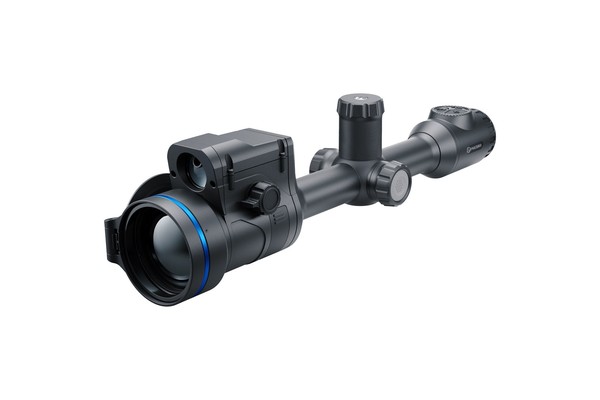
Pulsar built their reputation on reliable, field-proven thermals, and the Krypton XQ38 carries that forward. The 384×288 sensor with a 17 µm pixel pitch produces a smooth image with good contrast. The 38mm lens is a practical focal length for hunting — not so short that you’re squinting at blobs, not so long that the unit becomes unwieldy.
The Krypton line integrates with Pulsar’s app ecosystem, which some hunters find useful for firmware updates and Wi-Fi streaming. For hunters who want to stay within one brand’s ecosystem, Pulsar is a logical choice.
Pros: Proven Pulsar reliability, good image quality, established dealer network and support.
Cons: Noticeably more expensive than the AGM TC35-384 for similar sensor specs. The 17 µm pixel pitch gives slightly softer edges compared to 12 µm designs at equivalent resolution.
Armasight Contractor 320 3-12x — optionally a standalone scope
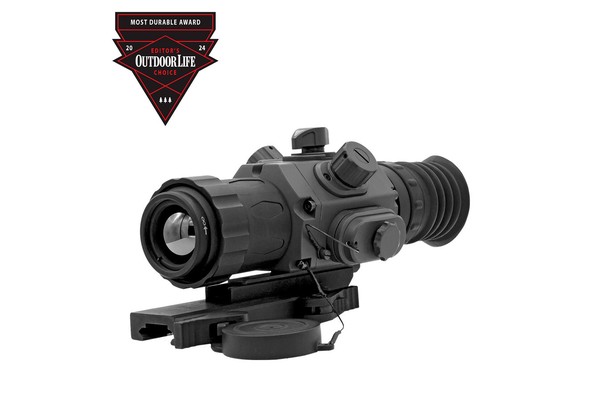
The Contractor 320 is interesting because it functions as both a clip-on and a standalone thermal scope with its own built-in 3-12x magnification. This makes it more versatile than pure clip-ons, but it also means you’re carrying more weight and paying for features you may not use in clip-on mode.
The 320×240 sensor is a step back from 384×288 on paper, but real-world performance at hunting distances is competitive. Armasight builds for durability — this is a company with strong military and law enforcement sales, and it shows in the construction.
Pros: Dual-use capability (clip-on or standalone), rugged construction, strong US-based support.
Cons: Lower resolution sensor than competitors at this price. The standalone magnification feature adds bulk and cost if you only want clip-on use.
Steiner C35 Gen II — German-engineered build
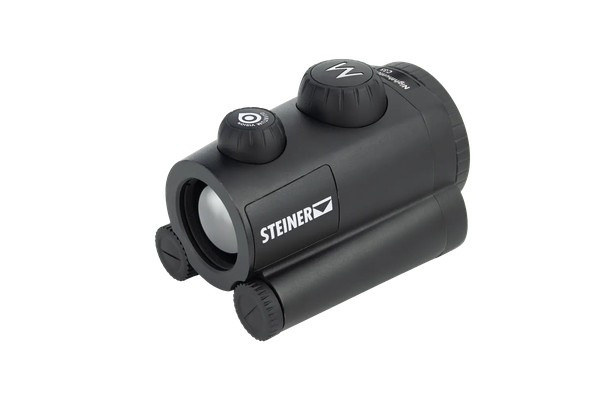
Steiner has been making optics for hard use for decades, and the C35 Gen II reflects that background. The fit and finish are noticeably better than budget units. Controls are deliberate and tactile — you can operate them with gloves, which matters more than you’d think at 4 a.m. in November.
The 320×240 sensor at 17 µm is mid-tier on specs, but thermal image quality depends on more than sensor resolution — the germanium lens quality and image processing both matter, and Steiner’s optics heritage is visible here. Detection range is strong for the sensor class.
Pros: Excellent build quality, glove-friendly controls, good detection range, strong warranty and US support.
Cons: $2,700 for a 320×240 sensor is harder to justify when 384×288 units exist at similar prices. Heavier than some competitors.
SIG Sauer ECHO CV25 — military-grade thermal
The ECHO CV25 is SIG’s entry into thermal clip-ons, and it comes with the quality controls you’d expect from a company supplying optics to military and law enforcement contracts. The 25mm lens makes this one of the more compact options at the $3,000 tier, which helps with clearance on shorter objective-to-eyepiece distances.
Image processing on the ECHO is particularly good — edge definition and polarity switching are clean. The controls layout is logical. Battery access isn’t awkward. These details matter when you’ve been awake since 3 a.m. and your fingers are cold.
Pros: Excellent build and quality control, clean image processing, compact for the price tier, strong recoil resistance.
Cons: 320×240 sensor at $3,000 means you’re paying for build quality and brand, not raw resolution. The 25mm lens limits detection range compared to 38mm or 50mm alternatives.
Pulsar Krypton 2 FXG50 — top-tier 640×480
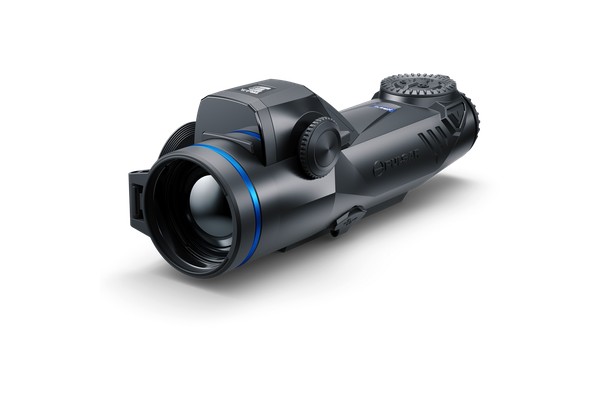
The Krypton 2 FXG50 is where you go when you’ve decided resolution matters and money is not the deciding factor. A 640×480 sensor at 12 µm is a meaningful step up from anything else on this list. The 50mm lens extends usable detection range considerably — you will see animals at distances where 384×288 units are showing you a warm smear.
At $4,500, this is a serious purchase. But for predator hunters covering open ground, or anyone who regularly shoots past 300 yards at night, the image quality difference justifies the cost. The Krypton 2 also inherits Pulsar’s solid build and app integration.
Pros: Best image resolution on this list, 50mm lens for long-range detection, Pulsar reliability, excellent for open-country use.
Cons: $4,500. The size and weight of a 50mm unit will feel significant on lighter rifles. The lens diameter also means you need significant clearance ahead of your objective bell.
How to choose a thermal clip-on
Start with your scope’s magnification
Most thermal clip-ons work best at 1x to 6x magnification. Higher magnification — 12x, 16x — amplifies the pixelation of the thermal sensor and reduces image quality. If you hunt with a fixed 10x or a high-power variable, a clip-on is not ideal. If you’re on a 1-6x or a 2.5-10x, you have practical range to work with.
Sensor resolution vs. lens focal length
These two factors together determine how useful the unit is at different distances. A 384×288 sensor with a 19mm lens will underperform a 256×192 sensor with a 35mm lens at longer ranges, all else being equal. Bigger lens = more magnification and better detection range. Higher resolution = better detail at any given range. The best clip-ons balance both — the Pulsar Krypton 2 FXG50 leads here, the AGM TC35-384 is the value leader.
Pixel pitch: 12 µm vs. 17 µm
Smaller pixel pitch (12 µm) means more pixels packed into the sensor area — higher resolution potential. Larger pixel pitch (17 µm) means each pixel captures more thermal energy — potentially better sensitivity in cold or low-contrast conditions. In practical hunting use, the difference is noticeable mainly at longer ranges and in cold weather. Both work fine for most hunting applications.
Weight and clearance
Measure the distance from the front of your scope’s objective bell to the muzzle end of your suppressor or barrel. Many clip-ons need 3–4 inches of clearance. A 50mm unit like the Krypton 2 FXG50 is also significantly heavier than a 19mm unit like the TC19. Both of these are practical concerns that spec sheets don’t address.
Frequently asked questions
Does a thermal clip-on affect point of impact?
It can, but it doesn’t have to. A well-designed clip-on attaches to your scope’s objective bell without adding stress or bending the optical axis. Most quality clip-ons shift POI by less than 1 MOA, and some users report no shift at all. The standard practice is to confirm your zero with the clip-on attached before your first hunt. If you’re seeing more than 1–2 MOA of shift, check whether the attachment is fully seated and level. Recoil isn’t usually a factor once you’ve verified the mount is secure.
What magnification works best with a clip-on thermal?
The practical range is 1x to 6x for most clip-ons. Below that range, you lose the benefit of your scope’s optical system. Above 6x, thermal sensor pixelation becomes visible through the scope eyepiece, and image quality degrades. Some hunters find 3–4x to be the sweet spot — enough magnification to positively identify animals and place shots, without the pixelation problems that show up at high power. Fixed-power scopes at 4x are a popular pairing for clip-on thermal setups.
Can I use a thermal clip-on with a suppressor?
Yes, but check physical clearance first. The clip-on attaches to the front of your scope’s objective bell, so the relevant measurement is from the bell to the front of your suppressor, not muzzle to suppressor. Some suppressors extend significantly in front of the muzzle. Compact clip-ons like the TC19 or the SIG ECHO CV25 have smaller footprints and are easier to fit in tight clearance situations.
Do clip-ons work in rain or fog?
Thermal imagers detect heat, not visible light, so rain doesn’t affect them the way it affects night vision. Light rain has minimal effect on thermal image quality. Heavy rain can create thermal noise, and fog — being warmer and wetter than clear air — reduces detection range for the same reason it does for visible-light optics. Performance in light precipitation is one area where clip-ons actually outperform standard night vision attachments.
Is a clip-on better than buying a dedicated thermal rifle scope?
Depends on how you hunt. If you hunt exclusively at night or in low light and have no attachment to a particular daytime scope, a dedicated thermal scope is often better value for the money at equivalent price points — you get a purpose-built optical system. If you switch between day and night hunting, hunt different species at different times of year, or have invested heavily in a daytime scope you don’t want to replace, a clip-on is the more practical choice. The ability to switch setups in under a minute without touching your zero is a real operational advantage.
Ready to pick?
For most hunters, the AGM Rattler TC35-384 sits at the best intersection of price and performance. The sensor resolution is adequate for hunting inside 300 yards, the lens focal length gives useful reach, and the price leaves room for other gear. If you’re tight on budget, the TC19-256 works and is genuinely compact. If you want top image quality and range, the Pulsar Krypton 2 FXG50 is the unit to beat — you’ll just pay for it.
Comparing a clip-on versus a dedicated thermal monocular? Our thermal monoculars buyer’s guide covers the top standalone options. For a full overview of AGM, Pulsar, and SIG’s broader lineups, our night vision brands guide goes brand by brand.
AGM Rattler TC19-256
256×192, 19mm — compact, affordable, works well inside 200 yards.
AGM Rattler TC35-384
384×288, 35mm — the clearest step up in performance per dollar.
Pulsar Krypton 2 FXG50
640×480, 50mm — best resolution and range on this list, no compromises.