
Best night vision monoculars 2026: a buyer’s guide
Prices listed are approximate ranges as of early 2026 and change frequently. Always verify current pricing with vendors before purchase. This guide covers image-intensifier (analog) NV monoculars and digital alternatives. For thermal monoculars, see our thermal monoculars buyer’s guide.
What is a night vision monocular?
A night vision monocular is a single-tube device you use with one eye. That’s the short version. The longer version matters when you’re deciding whether to buy one over goggles or binoculars.
Binoculars give you two tubes, two eyes, with better depth perception and less eye fatigue over long observation sessions. Goggles are binoculars configured for helmet mount, with the same two-tube advantage. So why do monoculars dominate the market?
Weight and cost. A single-tube PVS-14 runs 12.4 oz. Dual-tube goggles like the GPNVG-18 run $15,000–40,000 and over 2 lbs with batteries. For hunters, land managers, security personnel, and serious outdoors people, a single-tube monocular gives 80% of the capability at 40% of the cost.
The monocular is also more flexible. You can run it handheld, on a helmet J-arm, behind a red dot sight on a rifle, or on a camera adapter. That flexibility is why the PVS-14 form factor dominates roughly 80% of the civilian and professional NV market today.
To understand how image intensification actually works (photons to electrons to green or white light), read our explainer at nvguideusa.com: how night vision technology works.
Quick picks by budget
Budget / casual use: Sightmark Ghost Hunter 1×24
Gen 1 technology, around $100–150. Gets you outside after dark, but range is limited to 50–75 yards in good conditions and the IR illuminator is required. Suitable for casual curiosity, not hunting or field use.
Price range: $100–280 depending on model
Digital / versatile: Sionyx Aurora Pro
CMOS-based, records color video, streams to your phone, travels internationally without ITAR issues. At $999 it is the most capable digital monocular available. Performance in zero ambient light does not match Gen 3, but for most real-world conditions it holds its own.
Price range: $999–1,162
Mid-range Gen 2+ or budget Gen 3: AGM PVS-14 NL2 or used/blem Gen 3
At $1,700–2,700 you have two real options: a new AGM PVS-14 NL2 (Gen 2+ Photonis tube, $2,695) or a used Gen 3 tube with a quality housing (tube $900–1,200 plus housing ~$750). The used route takes research but gets you into genuine Gen 3 performance.
Price range: $1,700–2,700
Full Gen 3: Armasight PVS-14 Bravo or TNVC Duty Grade
Entry point for new Gen 3 PVS-14s from reputable integrators. The Armasight Bravo allows up to 11 cosmetic blemishes in the tube. TNVC’s Duty Grade runs 1,800–2,000 FOM with 8+ weeks lead time. Either will serve you for decades.
Price range: $2,200–3,500
Key specs explained
Generation
Gen 1, Gen 2+, Gen 3, digital: these are not marketing tiers, they reflect actual tube technology. Gen 1 uses electrostatic focusing and has poor resolution with barrel distortion at the edges. Gen 2+ adds a microchannel plate for amplification. Gen 3 adds a gallium arsenide photocathode and ion barrier film for substantially better sensitivity in low light. Digital (CMOS) uses a camera sensor with IR illumination, not image intensification.
Figure of Merit (FOM)
FOM = Signal-to-Noise Ratio × Resolution (lp/mm). Higher FOM means better image in low light. Typical ranges: Duty Grade Gen 3 = 1,800–2,000 FOM; High Performance = 2,000–2,200 FOM; premium tubes = 2,200+ FOM. Always request the tube spec sheet with actual measured values, not just a minimum spec.
Weight
Standard PVS-14 body: 12.4 oz (350g) without accessories. A J-arm and helmet mount add another 8–12 oz. For helmet-mount use, weight distribution matters more than raw weight. A well-designed J-arm keeps the optic at the correct eye relief without pulling the helmet forward.
Battery
The PVS-14 runs on a single AA battery. Runtime varies significantly: 12 hours with the IR illuminator running constantly, up to 40 hours in passive mode with a fresh lithium AA. Keep lithium batteries in the unit (not alkaline in cold weather) and carry two spares minimum.
Mount compatibility
All PVS-14 form factor devices share the same mounting footprint. A J-arm from one brand fits a housing from another. Standard mounts (Wilcox, Norotos, TNVC) work with PASGT, ACH, FAST, and OPS-Core helmets. The skull crusher head harness works without a helmet. Weapon adapters exist; see the weapon-mount section below for caveats.
PVS-14 deep dive
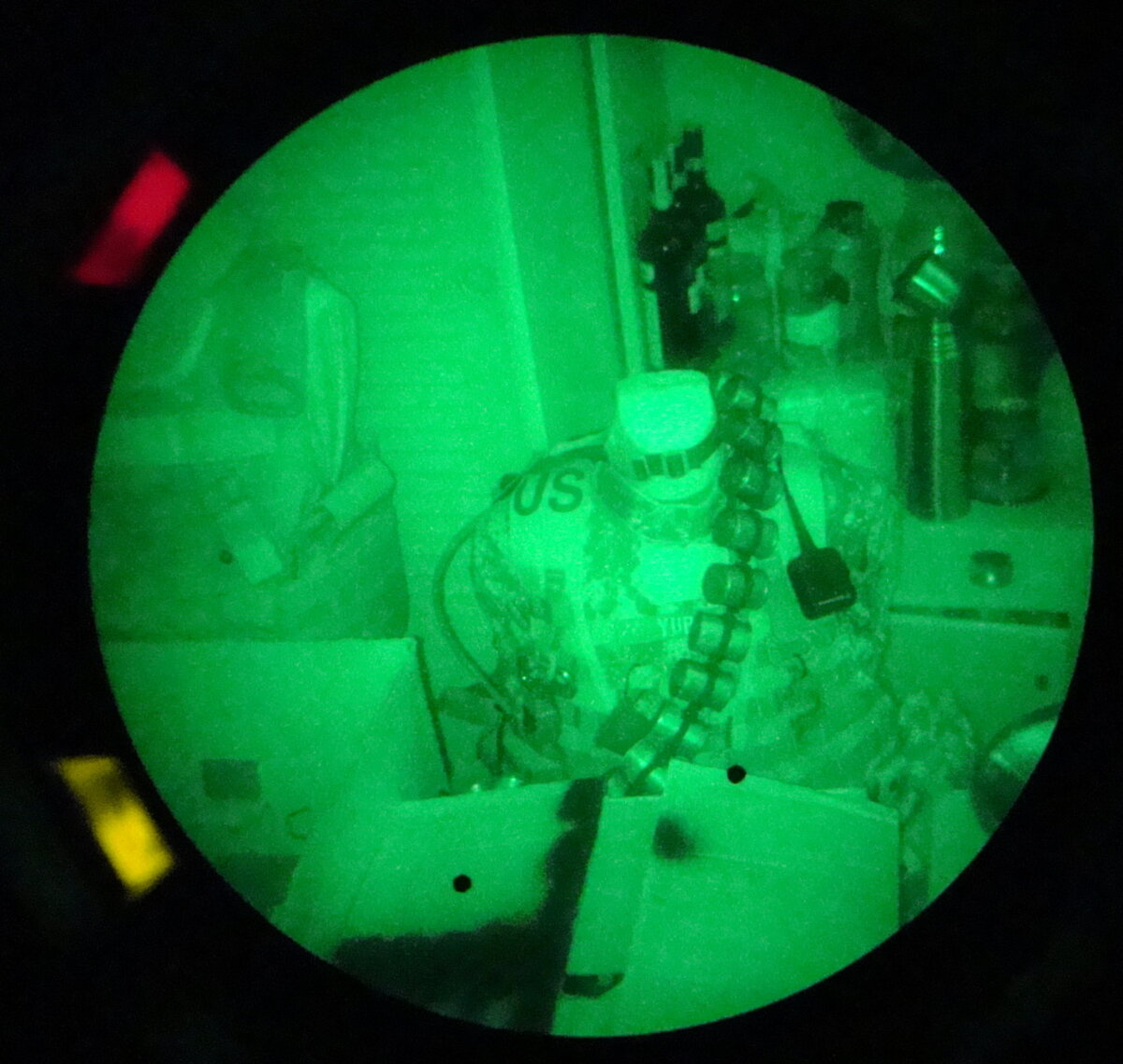
The PVS-14 is not a brand; it’s a form factor. Any device meeting the MIL-SPEC PVS-14 housing dimensions accepts the same accessories, mounts, and lens attachments. What you’re buying when you “buy a PVS-14” is a housing plus a tube, combined by one of several integrators.
Housing vs tube: what varies
The tube is what you’re really paying for. Premium tubes come with a documented spec sheet showing actual FOM, SNR, resolution, and cosmetic grade. Budget units often have no documentation; you’re trusting the seller’s word on tube quality.
The housing affects durability, seal quality, and control feel. Premium housings (TNVC, Steele Industries) are CNC-machined aluminum with tight tolerances on the O-ring seal. AGM housings are functional but assembled overseas. Both meet MIL-STD-810G on paper; field durability over 5+ years is where the difference shows.
TNVC TN/PVS-14
TNVC (Tactical Night Vision Company) builds each unit semi-custom using L3Harris and Elbit Systems tubes, which explains the 8+ week lead time. Tube grades: Duty Grade (1,800–2,000 FOM, ~$2,800–3,200), High Performance (2,000+ FOM, ~$3,200–3,800), Hand Select Elbit (2,200+ FOM, aviation cosmetics, ~$3,800–4,500), and SuperGain L3 (2,200+ FOM, 100,000–120,000 fL/fc luminous gain, ~$4,500+).
Armasight PVS-14
Armasight offers three Gen 3 tiers. The Bravo allows up to 11 cosmetic blemishes in the tube, which don’t affect performance. The Pinnacle guarantees 2,000+ FOM with a cleaner center image area, white phosphor only. The Pinnacle 2376 guarantees a minimum 2,376 FOM; that specific number is a tested spec, not a floor estimate. All complete units include J-arm, head harness, lens caps, and a 3-year limited warranty.
One verified buyer: “I had one when I was deployed years back. Great glass and fantastic tube for the money. You can mount on a helmet, use it with a Holo sight on your rifle, even night photography with a DSLR.”
See nvguideusa.com/brand/armasight/ for the full Armasight lineup.
AGM PVS-14 Gen 2+
AGM uses European-made Photonis tubes, which are not ITAR-controlled. The NL2 ($2,695) is the better tube grade despite the lower price; the NL1 ($2,995) designation refers to a specific Photonis tube type, not a quality tier. If the Photonis tube is a 4G variant, community consensus is that it “can absolutely hold its own in practical scenarios” against lower-tier Gen 3, and outperforms it in higher ambient light conditions.
See nvguideusa.com/brand/agm/ for current AGM pricing and specs.
White phosphor vs green phosphor
Green phosphor is the traditional output. White phosphor produces a gray-scale image with 15–20% better light transmission through the film coating, which translates to more contrast detail. USSOCOM and JSOC now take white phosphor tubes exclusively. Worth the slight premium if you have a choice.
Top models compared
Prices are approximate ranges as of early 2026. Verify current pricing before purchase.
| Model | Generation | FOM | Phosphor | Weight | Battery | Price range |
|---|---|---|---|---|---|---|
| Sightmark Ghost Hunter 1×24 | Gen 1 | N/A | Green | ~11 oz | 2x AA | $100–150 |
| Sionyx Aurora Black | Digital CMOS | N/A | Color | ~10 oz | Li-ion | $499–699 |
| Sionyx Aurora Pro | Digital CMOS | N/A | Color | ~9.8 oz | 2x Li-ion | $999–1,162 |
| AGM PVS-14 NL2 | Gen 2+ | 55–72 lp/mm | Green or White | <12.4 oz | 1x AA | $2,695 |
| AGM PVS-14 NL1 | Gen 2+ | Photonis tube | Green or White | <12.4 oz | 1x AA | $2,995 |
| Armasight PVS-14 Bravo | Gen 3 | Not specified (up to 11 blem) | Green or White | 12.4 oz | 1x AA | $2,200–2,600 |
| Armasight PVS-14 Pinnacle | Gen 3 | 2,000+ FOM | White only | 12.4 oz | 1x AA | $3,000–3,500 |
| TNVC TN/PVS-14 Duty Grade | Gen 3 | 1,800–2,000 FOM | White | 12.4 oz | 1x AA | $2,800–3,200 |
| TNVC TN/PVS-14 Hand Select | Gen 3 | 2,200+ FOM | White | 12.4 oz | 1x AA | $3,800–4,500 |
For a complete side-by-side of night vision goggle systems (dual-tube), see our night vision goggles buyer’s guide 2026.
Digital night vision monoculars: Sionyx Aurora
Digital NV is a different technology from image intensification. There’s no tube, no photocathode, no high voltage: just a CMOS sensor and an IR illuminator. The Sionyx Aurora Pro is currently the best civilian digital monocular available, and it does something no analog NV device can: it shows color at night.
That color capability comes from Sionyx’s proprietary sensor, which has unusual sensitivity to visible light at very low lux. In conditions with any ambient light (parking lots, urban environments, moonlit fields) the Aurora Pro shows terrain in actual color. In total darkness it switches to monochrome and relies on the IR illuminator. Performance in genuine zero-ambient-light conditions does not match Gen 3.
The other thing the Aurora Pro does that no PVS-14 does: it records. 256GB microSD, built-in WiFi and Bluetooth for app streaming, iOS/Android live view. If you’re documenting wildlife, running security camera duties, or creating hunting content, this matters.
What it is good for:
- Hunting in legally-permitted states where you need to identify what you’re shooting
- International travel (not ITAR-controlled, so you can take it on a plane)
- Documentation, content creation, wildlife observation
- Budget-conscious buyers who want real-world capability without $3,000+ investment
What it is not good for:
- Operations in complete darkness without adding a powerful external IR illuminator
- Weapon-mount use (not designed for it)
- Situations where Gen 3 sensitivity margin matters
Aurora Black (~$499–699) cuts team mode, AR features, and some connectivity; the core optic performance is similar. For most users, the Black is enough.
See nvguideusa.com/brand/atn/ for ATN’s digital NV line as a comparison option.
Which setup for which use case
Helmet-mount / patrol
You need Gen 3 here. The PVS-14 J-arm setup was designed for moving through terrain at speed with a weapon in hand. Budget $2,800–3,500 for a complete setup: tube, housing, J-arm, and a Rhino or Wilcox helmet mount. The skull crusher head harness works if you don’t run a helmet.
Handheld observation / recon
Any NV monocular works here. For wildlife work or property surveillance, digital is often more practical: it records, shows color, and requires no phosphor acclimation. If you already own a PVS-14, a 3x afocal lens extends it to useful observation range past 300 yards.
Weapon-mount
The PVS-14 can mount behind a red dot or holographic sight via a Picatinny adapter. L3Harris tubes are weapons-rated for shock; the housing is not rated for heavy caliber recoil. Stick to pistols and AR-platform rifles, not .308 and above. Use a sacrificial window to protect the objective lens from blast and debris. Add an IR laser (PEQ-15 or MAWL) for aiming, since standard visible sights are unusable under NV.
Don’t put an expensive Gen 3 tube on a rifle until you’ve practiced with it handheld. Depth perception under monocular NV is different from binocular vision, and distances are harder to judge.
Frequently asked questions
Is Gen 1 night vision worth buying?
For most real-world applications, no. The r/NightVision community is blunt on this: “Don’t buy Gen 1. You’ll be disappointed and want to upgrade immediately.” Gen 1 has poor resolution, barrel distortion at image edges, and limited range. The Sionyx Aurora Black at $499–699 gives dramatically more capability for $350 more.
Can I take my Gen 3 NV device on an international trip?
No. Gen 3 NV devices are controlled under ITAR, specifically USML Category XII. You cannot take them out of the US by any means: plane, boat, car, or train. TNVC’s FAQ is direct: “Doing so is in direct violation of ITAR.” Gen 2+ (Photonis) and digital (Sionyx) are not ITAR-controlled and can travel internationally.
What FOM should I look for in a Gen 3 tube?
For duty use, 1,800 FOM is functional. For better low-light performance, 2,000+ FOM is a meaningful step up. Above 2,200 FOM you’re in premium territory. The Armasight Pinnacle 2376 guarantees a minimum 2,376 FOM; that specific number is a tested spec, not a marketing floor. Always ask for the tube spec sheet before purchasing any complete unit.
Is Gen 2+ actually comparable to Gen 3?
Depends on the tube. Standard Gen 2+ is clearly below Gen 3 in very low light. The Photonis 4G tube, which AGM uses, is different. Community consensus: “If it’s a Photonis 4G, those are very comparable in most conditions to Gen 3. And better in higher light situations.” In genuine starlight with no moon and no light pollution, Gen 3 still has an edge.
What is the difference between a housing and a tube?
The tube is the image intensifier: the glass and electronics that amplify light. The housing is the aluminum body that holds the tube, mounts to accessories, and contains the controls. You can buy them separately. A common approach: source a blemished Gen 3 tube ($900–1,200) plus a Steele Industries housing ($750–800) plus a J-arm, and get into Gen 3 for $1,700–2,200 total.
What battery does the PVS-14 use?
Single AA. Use lithium chemistry (Energizer L91 or equivalent). Alkaline batteries lose capacity fast in cold weather. In passive mode expect 30–40 hours; with the illuminator running, around 12 hours. Carry two spares minimum.
Can I use a PVS-14 with a rifle?
Yes, using a weapon adapter that mounts behind a red dot or holographic sight. The L3Harris tube is weapons-rated for shock; the housing is not rated for heavy calibers. Stick to pistols and AR-15 platforms. Add an IR laser (PEQ-15 or MAWL) for aiming since standard visible sights are unusable under NV.
Related guides
Price disclaimer: All prices in this guide are approximate ranges based on early 2026 market data. Night vision pricing fluctuates with tube availability, vendor promotions, and used market conditions. Verify current pricing with vendors before making any purchase. This site does not guarantee pricing accuracy.