Best Thermal Scope for Ranch Security
Last updated: February 26, 2026
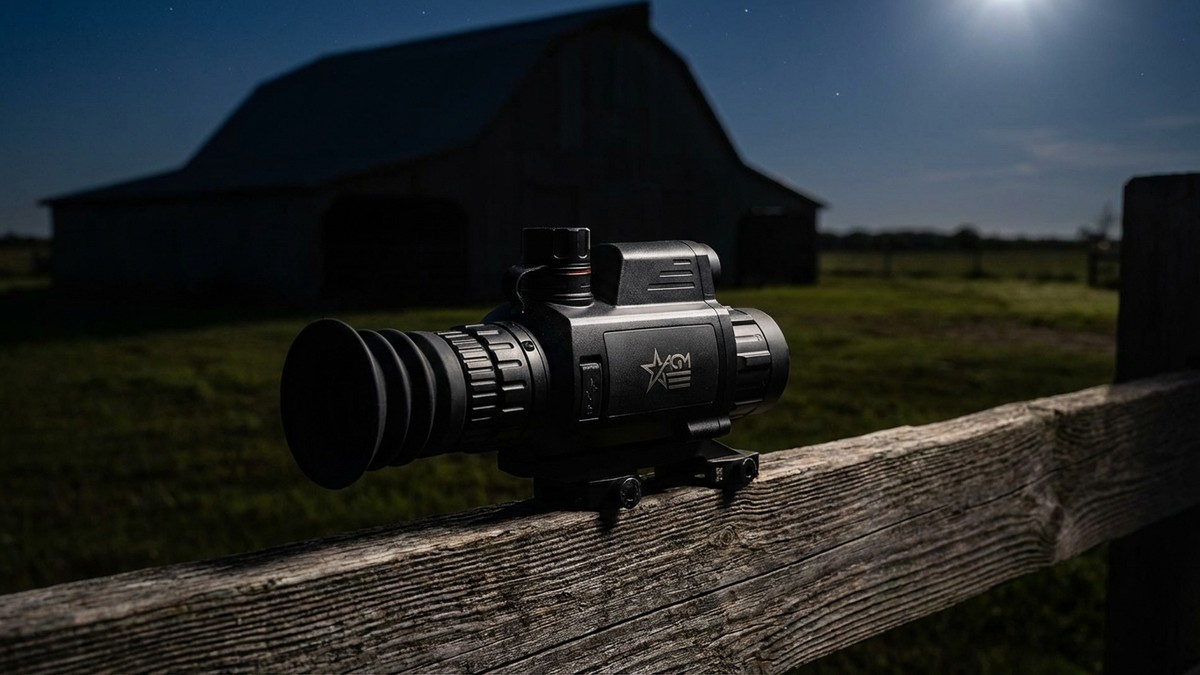
Ranch security is a different use case than hunting, and the thermal optic requirements reflect that. Perimeter monitoring, predator deterrence, and property surveillance put different demands on a scope than a predator hunting setup does. Detection range and wide coverage matter more than fast target acquisition at close range. You may be scanning from an elevated fixed position rather than shooting from field sticks at a moving target. And the people doing this work are often tired — operating late at night after a full day of ranch work — which makes a scope that operates simply and reliably more valuable than one with a deep feature set that requires menu navigation under fatigue. This guide covers the best thermal scopes for ranch security use specifically, with emphasis on detection range, reliability, and practical field operation.
Ranch security overlaps with predator hunting on some criteria — long-range detection, night operation, durability — but diverges on others. If you’re primarily hunting coyotes rather than monitoring property, the hunting-focused guide may be a better match: best thermal scope for coyote hunting — detection range and shot performance.
Quick picks
AGM Adder V2 35-384
Traditional tube design, 384-core sensor, 35mm lens. Detection range over 1,100 yards on human-sized targets. Long battery life, reliable in cold. Purpose-built for range work from a fixed position.
$2,595
AGM Rattler V2 TS35-640
640-core sensor with 35mm lens. Identifies targets at ranges where 384-core scopes struggle. For large properties where perimeter detection at 800+ yards matters.
$3,295
AGM Varmint V2 LRF TS35-384
384-core sensor with integrated laser rangefinder. Instantly confirms distance to a detected target — critical for security work where you need to know if something is at 200 yards or 600.
$2,795
Why thermal works for ranch security
A standard night vision device — whether digital or Gen 3 image intensifier — relies on ambient or artificial light to produce an image. For ranch security, this creates problems. IR illuminators have range limits, broadcast your position, and can be defeated by someone who knows you’re using them. White-light flashlights alert intruders to your position. Motion-sensing lights cover a limited area and trigger on wind and wildlife equally. Thermal imaging works on heat, not light — it detects warm bodies against cool backgrounds regardless of darkness, weather, or whether the target knows they’re being watched.
For coyote and predator deterrence specifically, thermal allows you to identify what’s moving on the perimeter without committing to a shot at an unknown target. A 640-acre ranch at night can have a lot of warm-bodied things moving across it — deer, cattle, the neighbor’s dogs, ranch hands. The ability to identify what you’re looking at before acting is as important as the ability to see it. Thermal with a 384 or 640-core sensor gives you identification capability at 400–700 yards that a 256-core scope or digital NV simply doesn’t.
Detection range requirements for ranch security scale with property size. On a 100-acre property where the perimeter is 300–500 yards from a central observation point, a 384-core scope with a 25mm lens covers the job. On a multi-thousand-acre operation where threats could originate from half a mile out, a 640-core sensor with a 35mm or 50mm lens is the more appropriate tool. Sizing the optic to the actual property dimensions — rather than choosing the cheapest thermal available — is the most important decision in this buying process.
Ranch security thermal use also benefits from features that hunting applications don’t always prioritize: integrated laser rangefinders (to instantly confirm distance to a detected target), video recording (for documentation of incidents), and WiFi/app streaming (if you want to monitor from inside a structure). The AGM Varmint V2 LRF series covers the rangefinder need at a price point well below purpose-built surveillance systems.
For more context on the technology itself before getting into specific products, see: thermal vs. digital night vision — what each technology does and where each one fits.
Comparison — all products
| Product | Sensor | Lens | Detection range | LRF | Price | Link |
|---|---|---|---|---|---|---|
| AGM Adder V2 35-384 Best Overall | 384×288, 12µm | 35mm | ~1,100 yd | No | $2,595 | Check price |
| AGM Varmint V2 LRF TS35-384 Best Value | 384×288, 12µm | 35mm | ~1,100 yd | Yes | $2,795 | Check price |
| AGM Rattler V2 TS35-640 Best Detection | 640×512, 12µm | 35mm | ~1,400 yd | No | $3,295 | Check price |
| Pulsar Thermion 2 XQ35 | 384×288, 17µm | 35mm | ~1,400 yd | No | ~$2,999 | Check price |
| Bering Optics Super Hogster A3 | 384×288, 12µm | 35mm | ~1,000 yd | No | ~$2,850 | Check price |
| AGM Adder V2 50-384 | 384×288, 12µm | 50mm | ~1,500 yd | No | ~$2,995 | Check price |
Detailed reviews
AGM Adder V2 35-384 — best thermal scope for ranch security overall
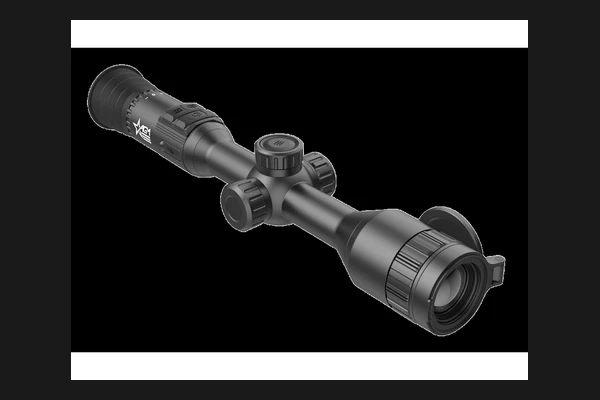
The Adder V2 35-384 uses a traditional cylindrical tube design — 30mm tube body — that distinguishes it from the Rattler’s more compact platform. The 384×288 12-micron LWIR sensor delivers detection on human-sized targets at approximately 1,100 yards and deer-sized game at 900+ yards. The 35mm germanium lens produces a narrower field of view than shorter lens options, which is actually an advantage in a fixed observation position — the tighter frame lets you scan a specific sector of fence line or tree line at range without losing target detail in too wide a FOV.
For ranch security, the Adder V2 35-384’s behavior in extended use matters as much as peak detection numbers. Battery life runs 5–6 hours on the internal lithium pack at room temperature; add an external USB battery and you can run it all night from a fixed blind. The controls work with gloves. The zero holds through temperature swings from warm afternoons to cold nights, which matters when a scope sits in a vehicle or blind for days at a time. At $2,595, this is the most directly useful thermal riflescope for ranch perimeter work at ranges inside 1,000 yards.
AGM Varmint V2 LRF TS35-384 — integrated rangefinder for security applications
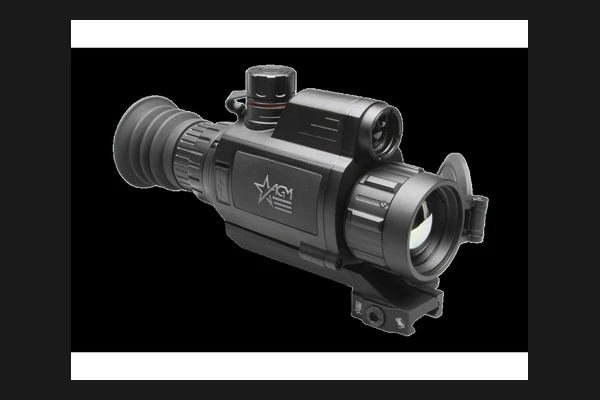
The Varmint V2 LRF TS35-384 adds an integrated laser rangefinder to an otherwise equivalent 384×288 12-micron sensor and 35mm lens platform. For ranch security specifically, this matters in ways hunting doesn’t always make obvious. When you detect a heat signature at the perimeter at 2 a.m. and you’re deciding how to respond, knowing whether that target is 180 yards away or 580 yards away changes the decision completely. The LRF fires a single button press and displays range in the viewfinder. No external rangefinder to locate in the dark, no second device to manage.
Thermal detection spec is identical to the Adder V2 35-384 — 384×288 12-micron sensor, 35mm lens, approximately 1,100 yards detection on human-sized targets. The LRF adds $200 to the price. For property monitoring where target distance assessment is part of every decision, that’s a straightforward addition. For pure hunting applications where range is estimated or confirmed separately, the LRF is a convenience rather than a requirement. For ranch security, it’s closer to a requirement.
AGM Rattler V2 TS35-640 — 640-core sensor for large-property perimeter work
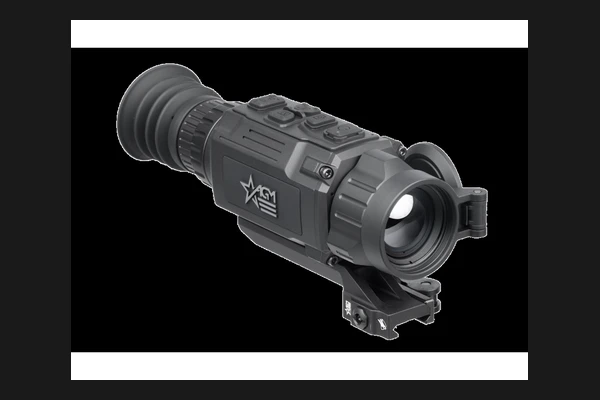
The Rattler V2 TS35-640 moves the sensor up to a 640×512 12-micron LWIR array — a 2.78x increase in pixel count over the 384×288 sensors in other scopes in this guide. The practical effect: significantly finer detail at range, detection extending toward 1,400 yards on human-sized targets, and identification at ranges where 384-core sensors show a heat blob rather than a recognizable body shape. On a property where the nearest fence line is 800 yards from the observation point, the 640-core sensor is a different tool than the 384.
The Rattler V2 platform keeps the compact form factor regardless of sensor upgrade — same tube dimensions, same mounting system, same weight class. The 35mm lens on the 640-core sensor produces a magnification and FOV combination that works well from a fixed elevated position: enough reach to see the perimeter at distance, enough FOV to scan a reasonable sector without repositioning. At $3,295, this is the highest-price item in this guide, and it earns it for large-property operators who need to identify targets at distances where 384-core scopes lose detail resolution. For smaller properties where maximum range is inside 600–800 yards, the 384-core Adder V2 at $2,595 is sufficient.
Pulsar Thermion 2 XQ35 — premium image quality for security monitoring
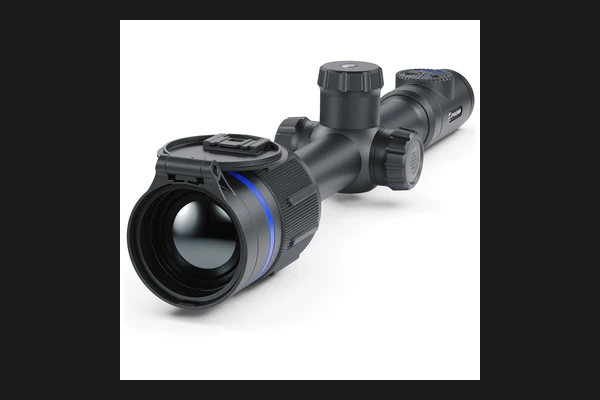
The Thermion 2 XQ35 runs Pulsar’s 384×288 17-micron sensor behind a 35mm lens. The 17-micron pixel pitch captures more IR energy per pixel compared to 12-micron designs, producing richer contrast that makes it easier to distinguish body heat from ambient background at range — particularly in conditions where the temperature differential between a warm animal and the environment is narrow (spring nights, warm evenings). For security monitoring where you’re spending extended periods scanning and trying to identify ambiguous heat signatures, that contrast advantage translates to fewer false alarms and faster identification.
The Thermion 2 series adds video recording via an integrated recorder, streaming capability through Pulsar’s Stream Vision 2 app, and a picture-in-picture display for combined observation. For security applications where documentation of incidents matters — a break-in attempt, livestock predation, property boundary violations — the integrated video recording is a practical feature. At approximately $2,999, the Thermion 2 XQ35 costs more than the AGM Adder V2 35-384 for a similar detection range but brings Pulsar’s image quality and feature set. The choice between them comes down to whether the Pulsar sensor quality and video documentation justify the premium for your specific use case.
Bering Optics Super Hogster A3 — wide detection coverage for perimeter scanning
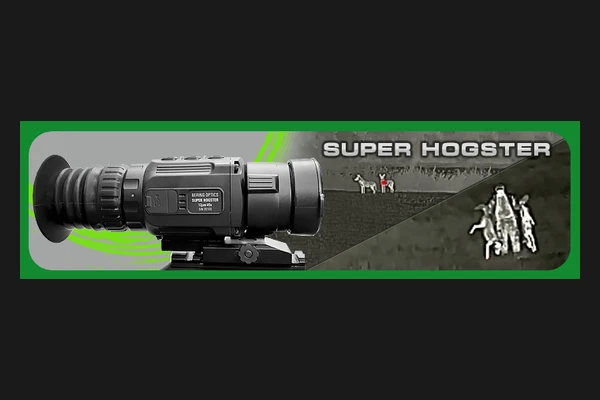
The Super Hogster A3 uses a 384×288 12-micron sensor with a 35mm lens, in a package designed with the hog and predator hunting market in mind. The 35mm focal length works for both the hunting application it was designed for and the perimeter scanning use of ranch security monitoring. Detection on hog-sized targets reaches approximately 1,000 yards. The Bering Optics interface is simpler and faster to operate than ATN’s system — fewer menus, direct access to core functions. At approximately $2,850, it’s slightly below the AGM Adder V2 35-384 and Pulsar Thermion 2 XQ35 in price.
The Super Hogster A3 lacks integrated video recording and LRF. For ranch security applications where documentation and range confirmation matter, those missing features push users toward the Pulsar or AGM Varmint LRF options. Where the Bering Optics earns its place is for ranchers who also actively hunt coyotes and predators on the same property — a scope that works for both active hunting and security monitoring without requiring a dedicated security-only device.
AGM Adder V2 50-384 — maximum range 384-core option for large properties
The Adder V2 50-384 takes the same 384×288 12-micron sensor as the 35mm version and mounts it behind a 50mm germanium lens. The result is extended detection range — approximately 1,500 yards on human-sized targets — at the cost of a narrower field of view. The 50mm version is the right tool when the security perimeter is genuinely at 1,000–1,500 yards from the observation point: large ranches where the fence line is half a mile out, open pasture where livestock may be several hundred acres away from the main structure, or elevated observation positions with clear sightlines across long distances.
For most ranch configurations where the critical perimeter is within 600–800 yards, the 35mm version is the more practical choice — the wider FOV covers more lateral ground per scan and the 1,100-yard detection range is already beyond the working distance. The 50mm earns its place on large properties with long sightlines. At approximately $2,995, it’s priced near the 35mm version with the 50mm focal length as the key differentiator. Choose based on your actual property dimensions and the distances at which you need to detect and identify.
How to choose a thermal scope for ranch security
The first decision is property size and observation distance. What’s the maximum distance from your observation point to the perimeter you’re monitoring? If it’s inside 600 yards, a 384-core scope with a 35mm lens — the AGM Adder V2 35-384 or AGM Varmint V2 LRF — covers the requirement. If the perimeter is 800–1,200 yards out, the same 384-core with 35mm lens still detects at that range but identification becomes more difficult; a 640-core or 50mm lens option gives you clearer target detail at those distances.
The second decision is whether you need an integrated laser rangefinder. For security monitoring — as opposed to pure hunting — the LRF is a more compelling feature. Knowing in real time whether a detected heat signature is 150 yards or 550 yards away changes your response calculus significantly, and doing that without a separate handheld rangefinder is operationally cleaner. The AGM Varmint V2 LRF TS35-384 at $2,795 is the most cost-effective way to get that capability in this sensor tier.
Third: video documentation. For security incidents — predator attacks on livestock, property trespass — having a recorded thermal video of the event has practical value beyond the immediate response. The Pulsar Thermion 2 XQ35 has integrated video recording. The AGM scopes can pair with an external recording device through their video output. If documentation is a priority, factor that into the selection.
The 640-core sensor (Rattler V2 TS35-640 at $3,295) is justified on large properties where detection at 1,000+ yards and identification at 700+ yards is genuinely required. On a 200-acre property where the entire perimeter is inside 600 yards of the central building, a 384-core scope at $2,595 delivers all the performance you need. Overspending on sensor resolution that doesn’t convert to operational benefit at your actual distances isn’t a good security investment.
Frequently asked questions
What detection range do I actually need for ranch security?
Measure the distance from your primary observation position to the farthest point of your critical perimeter. Add 20–30% margin for reaction time — you want to detect before you need to respond. On a 200-acre rectangular property, no fence line is more than about 550 yards from the center. On a 1,000-acre property, perimeter distances can reach 1,200–1,500 yards. A 384-core scope with 35mm lens gives approximately 1,100 yards on human-sized targets. A 640-core scope with 35mm lens gives approximately 1,400 yards. Size to your actual property, not to the largest number on a spec sheet.
Can a thermal riflescope double as a surveillance device?
It can function as one — it detects heat signatures at range regardless of light conditions. But it requires someone to look through the eyepiece, which is different from a fixed camera-based surveillance system that records continuously. For active monitoring where someone is on watch, a thermal riflescope is effective. For unattended recording or automated alerting, a thermal camera system is the more appropriate tool. The two approaches can be combined: a fixed thermal camera for passive monitoring and a thermal riflescope for active response once an alert is triggered.
Is a 384-core sensor sufficient for identifying predators at night?
For coyote identification at typical predator-deterrence ranges — inside 400 yards — a 384-core sensor is sufficient. At 200–300 yards, a coyote-sized heat signature is clearly identifiable as an animal body shape distinct from deer or dogs. At 400–500 yards with a 35mm lens, the identification is more difficult but typically clear enough for ranch management decisions. For extreme-range identification past 600 yards, the 640-core sensor gives better detail. For most ranch predator work inside 400 yards, 384 is adequate.
How does weather affect thermal performance for security monitoring?
Rain reduces thermal performance by scattering infrared radiation between the scope and the target — detection range drops roughly 20–40% in moderate rain. Fog reduces it more significantly depending on density. On a clear cold night with a large temperature differential between warm animals and cold ground, thermal performance is at its peak. For security applications, understanding these limitations means planning response protocols for weather conditions that degrade performance, not just relying on thermal as if it performs identically in all conditions.
Should I get a thermal riflescope or a thermal monocular for ranch monitoring?
For security monitoring where you may need to take a shot, a riflescope is the right tool — it mounts on the rifle, you acquire the target in the scope, and the zero is already confirmed. A monocular requires you to identify the target, lower the monocular, pick up a separate weapon, and locate the target again. That transition adds time and risk of losing the target. The exception is if you want to scan from a separate observation position before moving to a shooting position, in which case a monocular for scanning and a riflescope for the rifle covers both functions. For an all-in-one solution, the riflescope is more practical for ranch security work that includes response capability.
Final recommendation
For most ranch security applications — properties where the critical perimeter is inside 800 yards and the primary threats are predators, coyotes, and occasional trespass — the AGM Varmint V2 LRF TS35-384 at $2,795 is the most complete single tool. The 384-core sensor covers detection at the relevant ranges, the integrated laser rangefinder adds operational value for security response decisions, and the AGM Rattler V2 platform is proven in field conditions across hunting and security applications. The $200 premium over the base Adder V2 35-384 is worth it specifically for the LRF in security contexts.
For larger properties where the perimeter extends past 800 yards, or where livestock monitoring requires identification at longer distances, the AGM Rattler V2 TS35-640 at $3,295 is justified. The 640-core sensor gives you identification capability at ranges where 384-core scopes lose detail, which directly improves security decision-making when a heat signature appears at distance and you need to know what it is before responding.
If budget is the hard constraint and property size is moderate, the AGM Adder V2 35-384 at $2,595 is the base case recommendation. Same 384-core sensor and 35mm lens as the LRF version, minus the rangefinder. Still a fully capable security and hunting tool with 1,100-yard detection on human-sized targets and proven field reliability.
Affiliate disclosure: This page contains affiliate links. If you purchase through an AGM Global Vision link on this page, USA Night Vision may earn a commission at no additional cost to you. Competitor product links use href=”#” placeholders and do not earn commissions. All product recommendations are based on research and editorial judgment. See our full affiliate disclosure policy.