Thermal vs Night Vision for Hog Hunting: What Works Better
Every new hog hunter faces the same fork in the road: thermal or night vision? The question sounds simple. The answer depends on where you hunt, how you hunt, and what you’re willing to spend.
This isn’t a product recommendation page. If you want specific thermal scope models and prices, that’s covered in our best thermal scopes for hog hunting guide. What this covers is the technology comparison — what each category actually does in the field, where each one breaks down, and how to match the technology to your terrain.
The Three Technologies, Briefly
Before getting into hog-specific performance, it helps to understand what you’re actually comparing.
Analog night vision (Gen 2+ and Gen 3) amplifies existing ambient light — moonlight, starlight, distant artificial light — and converts it into a visible image. It doesn’t create light or detect heat. It requires some light source to work. In complete darkness under heavy cloud cover, it struggles without an infrared illuminator.
Digital night vision uses a CMOS sensor (similar to a digital camera) to capture low-light images and display them on a screen. Most digital NV units can work in near-total darkness with an IR illuminator, and they typically produce a black-and-white image. They’re generally the most affordable category.
Thermal imaging detects heat radiation — it doesn’t amplify light at all. It produces an image based entirely on temperature differences between objects. An animal’s body heat stands out against cooler surroundings regardless of available light, making thermal effective in total darkness, overcast skies, and through some vegetation.
Each technology has real advantages. The question is which advantages matter for hog hunting specifically.
Feeder Setup: The Most Common Hog Hunting Scenario
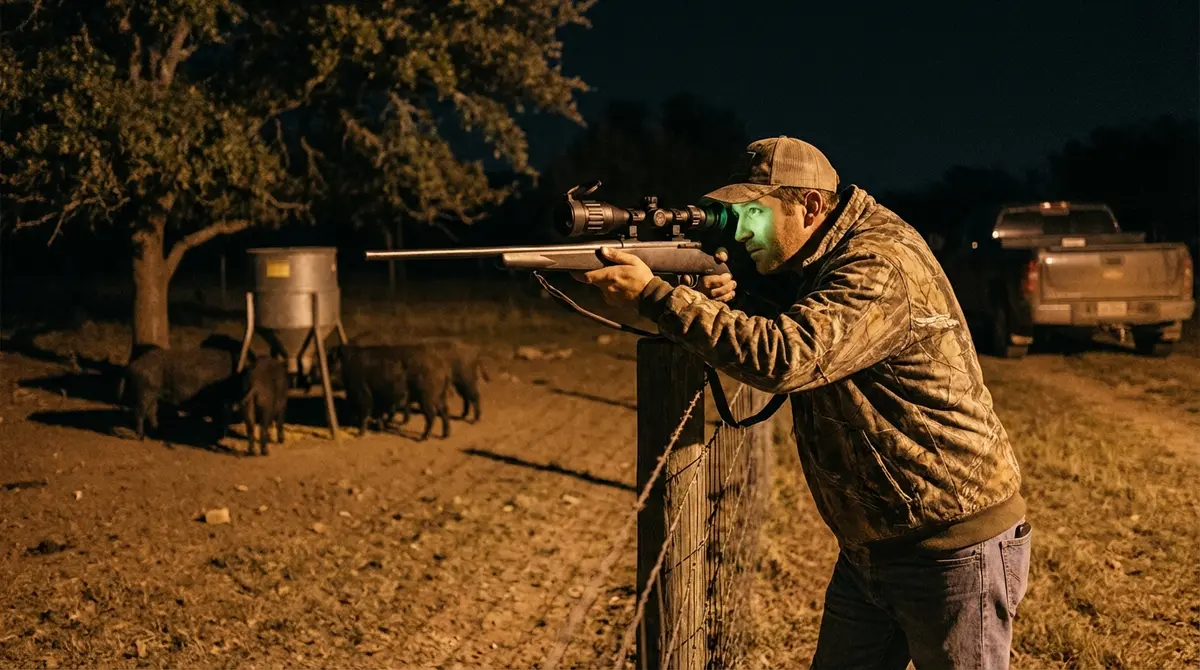
Most recreational hog hunters in the South are hunting feeders — either a corn feeder or a protein feeder on a lease or private property. The setup is a stand at 50-150 yards, waiting on a sounder to come in.
In this scenario, thermal wins — not by a little. The reasons are practical. Hogs run hot. They’re the size of a refrigerator. Even a low-end thermal shows them clearly at feeder distances. But the bigger advantage is what thermal does before the sounder commits to the feeder: it shows you animals staging in the brush at 200-300 yards.
Traditional night vision can’t see through vegetation. Thermal can. A hog standing behind a mesquite thicket at 180 yards is invisible to analog or digital NV. Thermal reads its body heat through the branches. That staging intelligence changes how you hunt — instead of hearing hogs before you see them and scrambling, you see them coming in with enough time to get ready.
Digital NV performs adequately at feeder setups when there’s an IR illuminator. The problem is range. Most digital units with IR illumination are effective to about 100-150 yards. Beyond that, the IR doesn’t reach, and the image degrades. If your feeder is 75 yards away and hogs come straight in, digital NV works. If you’re hunting a larger property where hogs approach from distance, the range limitation matters.
Analog NV at a feeder under moonlight is surprisingly capable. Gen 2+ or Gen 3 gives you a good image at 100-200 yards with ambient moonlight — the hogs show up clearly, identification is easy, and shots are straightforward. The limitation appears when the moon is down or obscured. On new moon nights or overcast conditions, analog NV at a feeder requires an IR illuminator, which adds cost and one more thing to manage.
Open Field Hunting
Open fields — big Texas pastures, bean fields, harvested grain fields — change the calculus somewhat. The key variable is light availability.
On clear nights with a half moon or better, analog NV (especially Gen 3) performs excellently in open country. The ambient light is sufficient to give a clean image at 200-300 yards without any illuminator. Hogs crossing a field in moonlight through Gen 3 glass look nearly as clear as daytime. In these conditions, the performance gap between analog NV and thermal narrows considerably.
The problem is that you can’t control the conditions. You have three days off work and the moon is new. That’s when thermal’s light-independence becomes a decisive advantage. It doesn’t care about moon phase, cloud cover, or time of year. The image quality is consistent regardless of ambient light.
Digital NV in open fields beyond 100 yards struggles without strong IR illumination. The CMOS sensor picks up IR light efficiently, but IR light doesn’t travel like visible light — beam spread and range drop off fast. For open-field hog hunting beyond 150 yards, digital NV typically isn’t the right tool.
Dense Brush and Heavy Cover
This is where the comparison becomes one-sided. South Texas mesquite, Arkansas river bottoms, Florida palmettos and palmetto flats — this is thermal territory and there’s no real debate about it.
Traditional NV (analog or digital) cannot see through vegetation. Period. A hog standing 30 yards inside a mesquite thicket is completely invisible to it. You hear them — you can hear a sounder of hogs from 200 yards — but you can’t see them until they step into the open.
Thermal reads body heat through brush. Not completely, not magically — a hog buried in solid cover won’t show clearly. But a hog moving through brush at the edge of a sendero, or staging just inside the treeline, will show you body heat signatures that give you location, count, and direction of travel. That information gap between the two technologies is enormous in dense cover.
If the majority of your hunting is in heavy brush, the choice between thermal and any form of traditional NV isn’t really a choice. Get thermal.
Technology vs Technology: Honest Pros and Cons
| Category | Analog NV (Gen 2+/Gen 3) | Digital NV | Thermal |
|---|---|---|---|
| Performs in total darkness | No (needs IR or ambient light) | With IR illuminator | Yes |
| Sees through vegetation | No | No | Partially |
| Detection range (hog-sized) | 300-500 yards (Gen 3, open) | 100-200 yards with IR | 400-1000+ yards (sensor-dependent) |
| Image detail at close range | Excellent | Good | Limited (no texture detail) |
| Moon-independent | No | Mostly (IR dependent) | Yes |
| Works in rain/fog | Fog degrades performance | Fog degrades performance | Light rain OK, heavy rain/fog degrades |
| Entry price point | $1,200-1,500 (Gen 2+) | $300-700 | $500-800 (entry thermal scopes) |
| Legal restrictions | Most states: legal | Most states: legal | Some states restrict for deer |
When Analog NV Makes Sense for Hog Hunting
There are real use cases where traditional night vision holds its own.
You already own a quality daytime scope. Analog NV — specifically a monocular in a clip-on configuration — lets you use your existing glass for shooting while adding night observation. This keeps costs down if you’re already invested in daytime optics.
Open property, consistent moonlight. If you’re hunting the same 200-acre pasture every weekend under decent ambient light, Gen 2+ handles the job without the higher cost of thermal. The performance gap is smallest in good light conditions.
Budget constraints. A quality Gen 2+ monocular runs $1,200-1,600. Entry thermal rifle scopes are in a similar range, but thermal monoculars for spotting add more. If you’re equipping one gun on a tight budget and hunting clear-night feeders, analog NV is a legitimate choice.
Battery life. This is an underrated advantage of analog NV. A PVS-14 style monocular runs 40+ hours on a single AA battery. Thermal devices run 6-12 hours on built-in batteries. All-night hog sits — the kind where you’re out from 9 PM to 4 AM — favor analog NV in this regard.
When Thermal Is the Clear Answer
You’re hunting heavy brush. This one ends the conversation. Thermal detects body heat through cover; analog NV doesn’t.
Inconsistent hunting conditions. If you’re hunting when you can — weekends, days off, whenever you get access — thermal doesn’t care what the moon is doing or whether it’s overcast. You get consistent performance regardless of conditions.
Multiple animals, fast target acquisition. A sounder of 15 hogs in a field is a chaotic scene. Thermal shows you every heat signature at once, helping you track the group and pick shots. Analog NV in those conditions — especially if moonlight is patchy — can make it harder to track a scattered sounder.
You want one tool for scouting and shooting. A thermal scope with handheld scanning mode (or a thermal monocular paired with a thermal scope) gives you detection, identification, and shooting capability with a single technology. Analog NV typically requires an IR illuminator as a separate piece of kit to reach full performance, adding weight and management.
What About Suppressors?
Worth mentioning because it’s relevant to how the technology choice plays out. A suppressor — where legal — keeps a sounder from scattering after the first shot. Hogs don’t fully associate suppressed gunfire with danger the way they do with a full-power muzzle blast. You can take three or four animals from a group with a suppressed rifle before they break.
This matters to the technology discussion because it changes how much you need to track scattered animals. With a suppressor and thermal, you can work through a group methodically. Without a suppressor, the group scatters after shot one, and thermal’s ability to track running heat signatures through broken cover becomes more valuable.
The Practical Recommendation
For hunters who primarily chase hogs in brushy country, thermal is the right technology. The ability to detect heat through vegetation, the light-independence, and the speed of target acquisition in a hog-hunting scenario give thermal a consistent edge that traditional NV can’t match in those conditions.
For hunters in open country with reliable moonlight and an existing investment in traditional NV, analog NV (particularly Gen 3) is a legitimate tool. It’s not a compromise forced by budget — it genuinely performs well in the right conditions.
Digital NV is the entry point. It works at feeder setups inside 150 yards with an IR illuminator, and the price makes it accessible. It’s where a lot of hunters start before stepping up.
For specific thermal scope recommendations for hog hunting, including current models and prices, visit our best thermal scopes for hog hunting page. For a broader look at night hunting strategy across species, the night vision hunting guide covers terrain, setup, and shot selection in more detail.
Related reading:
For handheld thermal options beyond weapon-mounted scopes, see the thermal monoculars buyer’s guide. If you’re considering head-mounted NV for hands-free hog hunting, the NV goggles buyer’s guide covers PVS-14 and binocular options.

Can You Use a Thermal Scope During the Day? Daylight Use/Sun Safety and Zeroing Tips.

Night Vision Range Explained: Detection, Recognition, Identification, and Real Hunting Distance

How to Set Up an IR Illuminator for Night Vision: Placement, Beam Width, and Field Mistakes