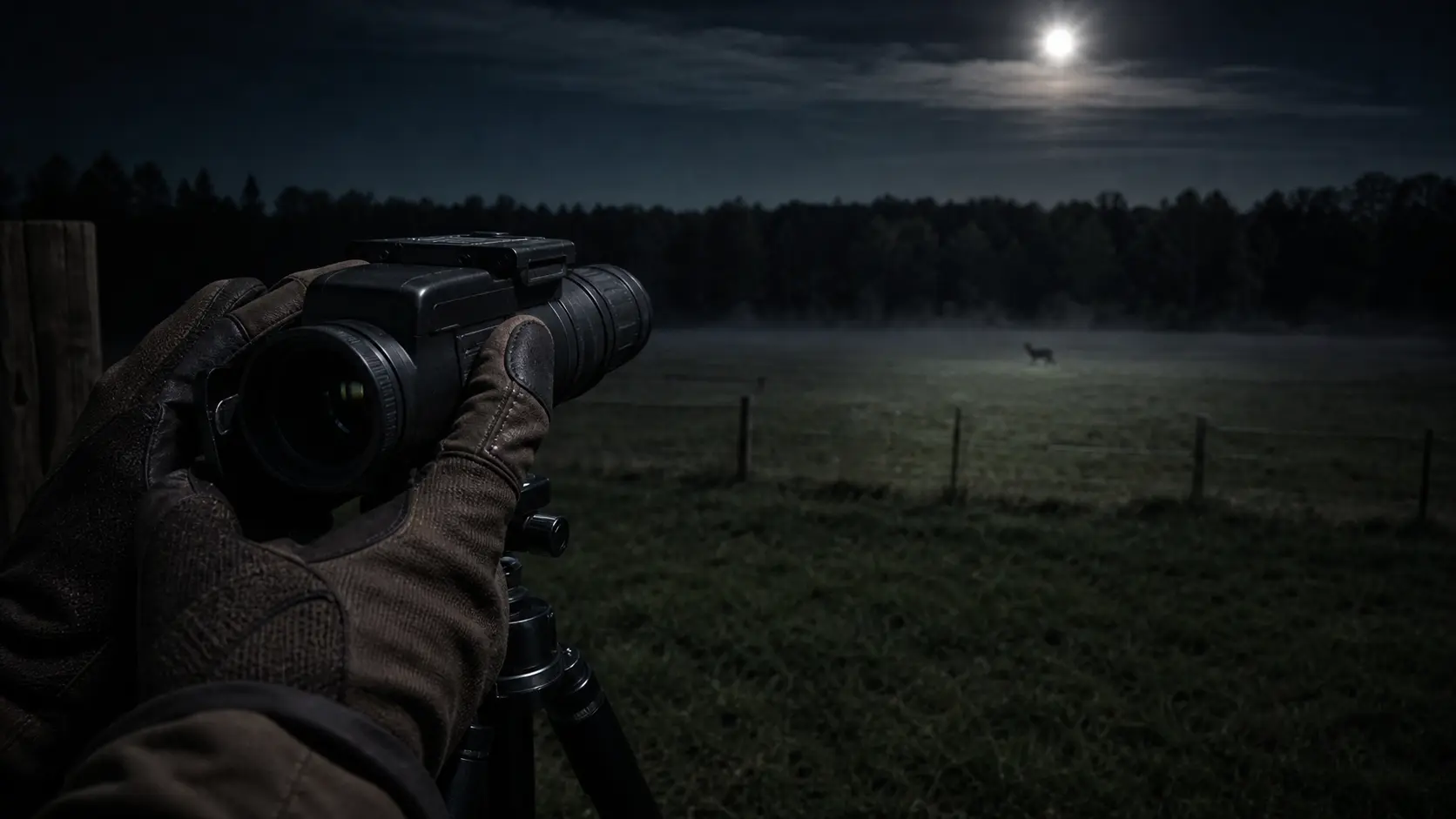
Night Vision Range Explained: Detection, Recognition, Identification, and Real Hunting Distance
Understanding the terms in the night vision range is essential for comprehending the capabilities of these devices.To understand what a night vision range can do, you need to digest the terms used in it: detection, recognition, identification, and real hunting distance.
One of the most misunderstood specs in night hunting is the range of vision at night. On a product page, there might be several hundred yards mentioned. The word in a forum post can say even more. Then the hunter enters a dark pasture, spots a form close to the fence line and thinks to himself, “Can I see something?
The questions are “What is it and what is causing it and should I do something about it?
It’s where detection, recognition and identification are important. Often, the light given off by an NVD will show movement farther out than it will allow a safe hunting decision. Bad expectations, missed opportunities and unsafe choices all happen in the middle of those two distances.
This guide will help to break down night vision range in the field for hunters, predator callers, ranch owners, and first time buyers. It incorporates the variables of how far night vision will allow you to see, the differences between Gen 3, Gen 2 and digital night vision, IR illuminator range and how it affects the picture and how you can test your own range of night vision identification prior to a hunt.
The range of night vision is not just one number.The night vision range is not a single number.
There is not a single, straightforward universal range number for night vision. It has multiple ranges and each is different.
Detection, Recognition and Identification are not the same.Detection, Recognition, Identification are NOT the same.
DETECTION: You can determine that something exists. This could be a moving body, the bright eye flash or a dark shape moving across a pasture or a bright or dark shape moving within a digital display. Detection is insufficient to make a shooting decision.
Recognition is being able to make a reasonable category call. You might be able to recognize that this shape is probably a 4-legged creature rather than a human, livestock, stump, or a shadow of a brush. Coyotes may look familiar to you as they cross open fields or a bunch of pigs may be seen moving together.
Identification is when you can confirm the target you have for your purpose. With hunting, consider night vision ID range as the distance at which you can identify the animal, exclude non-targets, determine what is around the animal, and ensure a safe backstop. This is the only range that is important when deciding whether a shot is on the table or not.
This is what detection vs identification is all about seeing motion is not identification.
There are a number of reasons that Manufacturer Range Claims can mislead hunters.There are several reasons why Manufacturer Range Claims can mislead hunters.
Range claims made by the manufacturer are frequently based on good conditions. This means a clear night, an obvious background, a known target size, controlled light and a stable rest. Real fields are dirtier.
A coyote slinking through the wet grass on the edge of a pasture is more difficult to assess than a stationary target on a clear berm. A “hog in brush” is more difficult than a “hog in an open lane”. When attempting to extend a device beyond its range of identification, a ranch gate, feeder leg, calf, deer, dog, or fence post can all cause confusion.
While range claims are not useless, they must be put in perspective. Inquire about the type of range: night vision detection range, night vision recognition range, or night vision identification range.
The Safe Field Rule is to Identify Before You Decide.The Safe Field Rule is to Identify Before You Decide.
The field rule is simple: detect early, recognise carefully, identify before you decide.
If you only can detect that something moved, approach the object, wait, improve the lighting and/or change your position. Avoid making detection a shooting solution. Even with the bright look of the hunting equipment, ethical night hunting identification is still done with confirmation and backstop first.
Be sure to review state and local regulations prior to any night hunting. Night vision, thermal, IR lights, artificial light, weapon mounted illumination, public land, private land, species rules can all vary.
Quick Answer: How Far Can Night Vision See?How far can night vision see?
When conditions are good, quality night vision will see farther than most hunters can see responsibly. Detection number is typically higher than what is useful in night vision hunting.
Typical real world ranges by device type.Typical real world ranges by device type.
Movement might be seen at long field distances with a good glass and clean focus gen 3 night vision device under the light of the moon, particularly in open areas. It has a number of factors that affect its identification range—tube quality, magnification, light, target size, contrast, and supplemental IR.
Typically the Gen 2 night vision range is shorter, particularly in low-light conditions. Can still be useful around feeders, wood lines, gates and moderate pasture distances, but may require assistance from an IR illuminator in darker conditions.
Sensor quality, display processing, magnification and IR are key elements of digital night vision range. While many of these digital scopes will be just as effective for hunting with a controlled illuminator, weak or misaligned IR can make them feel worse than what the spec sheet may indicate.
The real question most hunters should ask is, “how far can night vision see” – and the answer is – farther than you should shoot without a positive ID. Set your hopes on identification rather than detection.
We noted that Gen 3, Gen 2 and Digital NV behaved differently.There was a reason that we mentioned that Gen 3, Gen 2 and Digital NV behaved differently.
Analog night vision technology relies on an image intensifier tube to boost the light available. Typically, Gen 3 night vision devices will be better in low light conditions than Gen 2 devices, though this varies from device to device and from tube to tube. For those looking at analog NV, USA Night Vision’s night vision tube specs explained post is a great read.
Digital night vision equipment consists of a sensor and display. It may provide recording, reticles, menus and lower entry cost, but it relies more heavily on IR illumination for distance. However, that doesn’t mean that digital is useless. It simply requires determining digital night vision range as a system: scope, lens, IR, batteries, focus, and field.
A clear image at 300 yards may not be an easy shot.If you can clearly see the image at 300 yards, it doesn’t mean that it is an easy shot.
The fact that an image looks clear doesn’t mean it’s a safe image. In the distance, you can’t see small details. It may be more difficult to separate a shape that is standing (a deer, a calf, a dog, a coyote) than you thought. Behind the animal may be concealed by brush and terrain.
Your range of vision with your night vision scope may only be as far as the edge of a field, but your decision range may be quite small. The rule for when you don’t know the animal and you are not sure about backstopping is to “hold off” or to move.
The actual night vision range is determined by the following factors:
The range of night vision varies depending on the situation. What looks great on one night, may look weak on another.
Ambient Light: Moon, Stars, Cloud Cover, and Tree Canopy
In ambient light night vision performance, you have what you’re given in the sky. Typically, the moonlight night vision performance is greater than the no-moon performance. Heavy cloud cover is not preferred over a clear starlit night. Open pasture is more easily managed than timber. A feeder lane in or under tree canopy may be quite dark when the field is not.
In order to see in the dark, light must be amplified or gathered. In very dark conditions, night vision with IR illuminator support may be necessary.
Tube Quality/Sensor Quality.
With analog devices, tube quality is an issue. The amount of detail you can use depends on the resolution, signal to noise, gain, blemishes and overall tube performance. When it comes to digital night vision, sensor quality, display quality, image processing and latency are all important.
Don’t just consider a device based on generations or megapixels. Two Gen 3 units won’t react in the same way, and two digital scopes with the same description can differ in their field reactions.
The objective lens size, magnification, and field of view are related.There is a relationship between the objective lens size, magnification, and field of view.
Increasing the magnification can also increase the ability to see detail at distance, but it will reduce the night vision field of view. This compromise is important when a coyote is taking a circle around a fence, hogs are leaving brush or when you must watch a feeder and both fence lines.
Large objective lenses collect more light, but may make the device heavier, affect balance, and make it slower to handle. A confined field of view may appear to be strong, but it makes it more difficult to see the movement.
Focus, Diopter, Eyebox, and Shooter Position
Range harmony is lost when there is poor focus. Adjust the diopter to the proper setting for your eye, focus the objective to the proper distance and check the image from the planned position. A bench test will not necessarily simulate sitting on a tripod, kneeling at a gate, or leaning on a blind window.
Don’t assume that the device is to blame if your picture is soft. The first are focus, diopter, cleanliness of lens, battery level, and IR alignment. For a more extensive fault list, check out USA Night Vision’s night vision troubleshooting guide.
Focus on Size, Motion and Background Contrast
Large Hog in open sendero is easier than small coyote in grass. This can be easier to detect but is not always easier to identify if the animal is moving. An animal is more difficult to spot when it is dark and the background is dark rather than when the animal is dark and the background is light.
Contrast is important in the background more than many buyers realize. So does angle. Information is much more readily gained from a broadside animal than from the head-on animal that slips into the brush.
IR Illuminators and Usable Distance.
When controlled, an IR illuminator can push night vision range, however. Don’t assume more IR equals more.
The Identification Range is extended when IR is used.The Identification Range is extended as IR is used.
IR is useful in situations where there is not much light around and the device requires more light reflecting off the scene. It can enhance details at feeders, at the edge of fields, at gates, barns, in shaded lanes and at no-moon pastures.
IR illuminator range is a function of wavelength, beam focus, power, target reflectivity, terrain, weather and device sensitivity. Refer to the USA Night Vision blog on how to use an IR illuminator with night vision for set up instructions.
Flood vs Spot Beam for Distance
A flood beam provides context. It is good for brush, near feeders and for scanning of close ground. Spot beam provides coverage in open pasture and may result in tunnel vision.
When using for distance, tighten beam only necessary. If the beam is too narrow, that is, if you can see a bright circle, but lose the animal when it moves, the beam is too narrow.
850nm vs 940nm Range Tradeoff
Often times, an 850nm IR illuminator provides a better practical range with many NV devices, but there may be a slight trace of visible red light from the front of the emitter. A 940nm illuminator will typically result in a lesser amount of visible emitter glow, however it may provide decreased range and brightness.
Don’t presume one is always best. Practice with your device, land and your hunt.
Excessive IR can cause degradation of the image.Too much IR can degrade the image.
Excessive IR can cause a loss of detail. Light can bounce back into the device, as with wet grass, fog, rain, feeder legs, fence wire, suppressors, scope bodies, blind windows and brush nearby.
Turn on IR and if the image gets worse, decrease the power, increase the beam width, change the angle and search for reflection. More IR can aggravate the problem in night vision conditions with fog or rain.
This is the distance that could be achieved by a hunter using an NV device, depending on the hunting scenario.
The optimal guess of the range begins with the terrain, not the product page.
Close woods, feeders, and brush.
Close cover is typically an identification issue, rather than a detection issue. Eyes or movement may be evident in a short time, but brush can obscure body shape and back stop. Wider beam, lower IR power and take the time to be sure of what is in the lane.
Open fields and edges of pastures.
Open pasture allows the room for night vision to work. Gen 3 night vision range, magnified digital scopes, and controlled IR can really shine here. However, at the extreme edge, when the animal is small, at an angle or when the animal has a dark background, identification can be lost.
Hog Hunting
Getting night vision for hog hunting frequently occurs around feeders, crop edges, senderos, and brush lines. Hogs can cluster together, move around all the time and come in and out of cover. The animal, other animals, fence lines, livestock and backstop should be identified.
Coyote and Predator Calling
A lot of night vision coyote hunting is about seeing motion and identifying the coyote on a smaller target. Coyotes can move quickly, spin around, or stop on the outer edge of effective detail. Don’t try to catch a narrow spot beam in some field. Maintain sufficient field of view for reading movement.
Ranch Security and Property Observation
Night vision range is fine for observing but identification is still important for ranch gates, barns, equipment yards and fence lines. Shadows of a person, dog, calf, deer and equipment may vary when moving position, adding IR, or moving closer.
Night Vision Scope vs Monocular vs Goggles.
The device type affects the usage of range.
When it comes to rifle scopes, the higher the magnification, the less scanning freedom.In the case of rifle scopes, the greater the magnification, the less the scanning freedom.
A night vision rifle scope might provide greater magnification and a smoother workflow to aiming, but don’t solely use a rifle-mounted optic for scanning. Remember muzzle safety! Check out USA Night Vision’s night vision rifle scopes under $3000 guide for purchasing information.
Range sensing and terrain reading is safer when using monocular.Safer range sensing and terrain reading with monocular.
Night vision monocular range is beneficial because the monocular is able to scan without pointing a rifle. A PVS-14 range expectation must be realistic: Excellent movement, terrain reading and observation if the conditions are right, but limited by light, lens, focus and identification requirements. The best night vision monoculars guide of USA Night Vision features device choices.
Navigation first, shooting support second is the goggles range principle.The goggles range principle is Navigation first, Shooting support second.
When people ask, “how far can night vision goggles see”, keep in mind their primary purpose is for movement, navigation and awareness. Goggles can be used to walk, scan, read terrain, and control equipment. They are not to be used as a substitute for a fixed, magnified identification device at a distance. The context about setting up is available in the night vision goggles buyer’s guide.
The clip-on night vision and day scope are included.The clip-on night vision scope and the clip-on day scope are provided.
The clip-on night vision relies on the clip-on, the day scope, the magnification, the focus and the IR. Excessive day scope magnification may result in dim images or make the image harder to see. Be sure to check out your actual recognition and identification distance with the magnification you intend to hunt with.
Some common causes of poor night vision are listed below:
Most range issues are simple setup issues.
The ambient light is weak and has insufficient IR.Ambient light is weak and has insufficient IR.
Diminished light on no moon nights, in heavy clouds and in timber. Slowly increase the IR and see if it enhances details.
Inadequate focus or dioptre setting.
Put the eyepiece against your eye and focus the objective on the scene. Recheck following change of distance.
If the lens is dirty, fogged or wet.
Dust, fingerprints, condensation, rain, and wet vegetation all diminish the amount of detail that can be used. Properly clean the lenses and remember that in poor weather the range will be shorter.
IR (beam) misalignment/splashback is a common issue.IR Beam Misalignment/Splashback is one of the common problems.
Don’t guess, center the beam through the device. Be on the lookout for shiny barrels, suppressors, rails, fences, shiny windows and brush.
Though the digital zoom is fantastic, it can cause over-magnification (artifact zoom).
Digital zoom can increase the size of the image with no additional information. When the view becomes blocky or unstable, zoom out and get closer (where possible).
In the field, you would need to perform a test to determine your actual ID range.In the field, you would need to conduct a test to find out your actual ID range.
Avoid learning your range’s first time on a live animal.
Be sure to create a Daylight Baseline First.Be sure to create a Daylight Baseline First.
Do a walking tour of the property during the day. Mark fence boundaries, gates, feeders, safe backstops, livestock locations, buildings, roadways and frequent paths.
Use known landmarks and safe backstops.Utilise known landmarks and safe backstops.
Mark range landmarks while it’s still light outside. Mark feeder leg and tree line, berms, gates and pasture edges. Know where a safe shot could and could not exist.
Test With IR and Without IR.Test With IR & Without IR.
Test the same landmarks using only ambient light at night, then use IR. Experiment with Flood and Spot settings. Use realistic positions such as sitting or standing, tripod, blind and vehicle-side observation (if legal and safe).
Write down the Distance at which you can ID, NOT just DETECT!
Record the farthest distance at which you are able to see details consistently. That is your ID distance for those conditions. It could vary based on the moon, weather, battery life, terrain and season.
What about Night Vision vs Thermal at distance?How about Night Vision vs Thermal at range?
Night vision and thermal are two different solutions to different problems.
Why Thermal Finds Heat Faster
Thermal is independent of IR illumination and finds out heat differences. Great for detecting animals in fields, edge of brush and rough ground. Hence many hunters are using thermal technology.
When using night vision, it is possible to see more detail at closer distances.Night vision may allow you to see more detail at closer distances.
However, when there is sufficient light, the visible detail of body shape, terrain, eyeshine, fences, branches and equipment can be seen with night vision. When it’s nearer it can assist with confirmation.
When Hunters Should Use Both
The typical operating scenario is thermal for detection and night vision for detail, navigation, or for specific identification. Both tools are not a substitute for judgment. If you want to go even further, check USA Night Vision’s thermal scanner vs thermal scope night hunting article.
Here is a practical range checklist for before a night hunt:
- Current hunting laws were verified for species, type of land, night vision, thermal, IR and artificial light.
- Device batteries fresh
- Spare batteries carried
- Lenses clean
- Diopter set
- Objective focus checked
- IR illuminator mounted securely
- Beam centered through the device
- Flood and spot settings tested.
- Known landmarks ranged
- Safe backstops confirmed
- Risk for weather and fog has been taken into account.
- Identification range known for the night.
- Be prepared to move closer instead of forcing the shot
Final Takeaway
Unless you specify the type of range you are talking about, night vision range is not particularly helpful. Detection means that it is there. With recognition you can get an idea if it’s a particular type. Identification provides sufficient information to make a safe and ethical decision.
Best hunters are conservative with that difference. They check their own equipment, exercise caution with IR, take into account their weather and terrain constraints, and get closer if they do not have sufficient detail in their image.
Don’t only purchase night vision based on the longest range number. Purchase and use it in the vicinity of your true identification distance.
FAQ
How many yards is the range of Gen 3 Night Vision?
Under good conditions, often Gen 3 night vision can see movement at long distances due to the presence of moon light and open terrain. The practical Gen 3 range for hunting is a function of the quality of the tube and lens, magnification, IR support, the weather, target size, and identification requirement.
How much distance does a digital night vision device provide?
The Digital Night Vision range is dependent on the sensor, lens, display, magnification, and IR illuminator used. Many digital scopes rely heavily on IR for distance and take the whole system into consideration.
In total darkness can night vision see?
Old fashioned night vision requires a little light to amplify. It might require an IR illuminator in very dark conditions. Digital night vision can also require IR at times when the light is too faint.
An IR illuminator extends the range of night vision.
When the scene is too dark, an IR illuminator can be used to extend the useful range, provided there is beam alignment and control. Excessive IR, bad beam focus, fog, rain, damp grass or other reflections can decrease image quality.
Is the detection range equal to the shooting range?Does the detection range equal the shooting range?
No. Detection range – the ability to discover the presence of something. Identifying the target and backstop are a must when shooting. Detection range should never be used as a stand-alone night vision hunting range.
Is night vision better than thermal for identification?Is night vision better than thermal for identification?
Sometimes, particularly when distance is short enough that the detail can be discerned, or the lighting circumstances are favorable. Thermal typically offers a quicker search for heat signatures while night vision will provide visual detail and terrain. While many hunters use both, neither can be a substitute for positive identification and safe backstop confirmation.

Can You Use a Thermal Scope During the Day? Daylight Use/Sun Safety and Zeroing Tips.

How to Set Up an IR Illuminator for Night Vision: Placement, Beam Width, and Field Mistakes

Thermal Scope Pre-Hunt Checklist: Batteries, Zero, Settings, Mounts, and Weather Checks