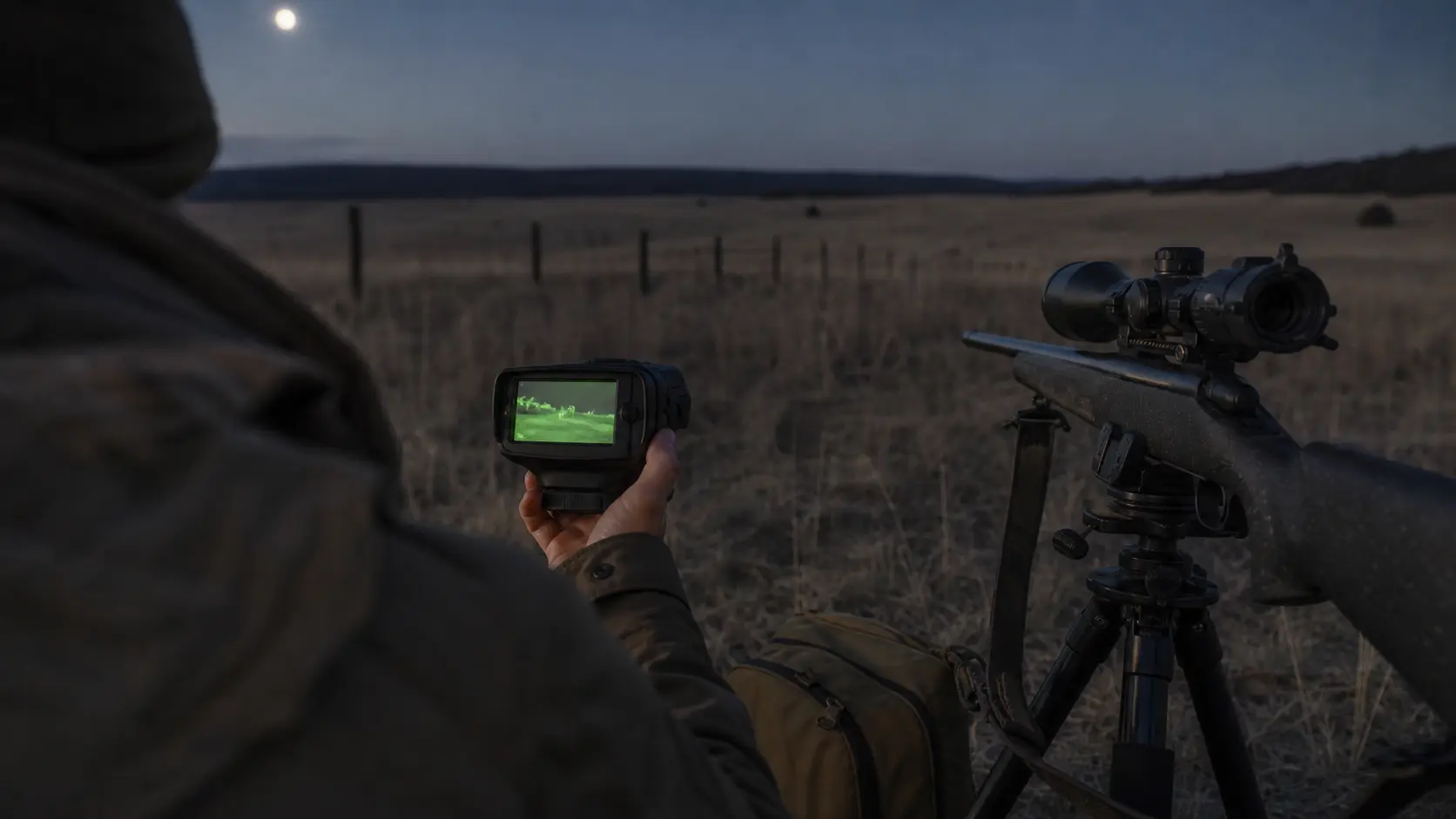
Thermal Scanner vs Thermal Scope: What Should Night Hunters Buy First?
A thermal scanner is a good tool that will help you locate animals safely without being too close to them. A thermal scope is a tool to assist with the shot. Whether or not you have a legal shooting solution, how you hunt, and how much scanning you do before the rifle should ever come up determines the right first purchase.
Thermal scanner vs thermal scope is one of the initial costly choices a night hunter needs to make. It’s also where I see many buyers blowing their budget.
One hunter purchases the first thermal scope for a rifle and attempts to use it for every purpose: scanning fields, looking for brush lines, watching ranch roads and finally shooting. Another purchases a hand-held thermal scanner for hunting and is able to catch more animals than he ever has, only to discover that he still needs a night hunting weapon. Both tools are important, but they have different functions. Thermal monoculars are an observation device used for predator hunting or hog hunting. Rifle with thermal scope is a weapon used for shooting.
Quick Answer: Buy the Scanner First or the Scope First?
If you already have a legal night shooting solution, purchase the scanner first. Using a handheld device allows for safer, faster and more ground to be covered while maintaining the rifle in a safe direction until it becomes necessary to shoulder the rifle.
However, if you can’t practically aim at night, a night hunting thermal scope might need to be first. This is particularly the case with feeder pigs, crop damage and shooting lanes. In the long run, a first thermal for hunting is typically a component of a full thermal scanner and rifle lineup: scanning with the hand-held and firing with the rifle.
Check out USA Night Vision’s best thermal monocular for hunting guide and complete thermal monocular buyer’s guide for handheld options. The scope-first buyers should begin with how to choose your first thermal scope.
What a Thermal Scanner Actually Does
Typically, a scanner is a hand-held thermal monocular. To put it simply, thermal monocular vs thermal scope is a handheld observation tool versus a rifle mounted aiming optic.
Detection, Situational Awareness, and Safer Scanning
The primary duty of a scanner is to detect and be aware. It assists in detecting heat on a feeder pen, brush line, creek bottom, pasture edge or ranch road without having to aim a firearm at everything you want to check.
Thermal will not penetrate solid brush. Weather, terrain, animal size, size of the lens, sensor resolution, NETD, distance and background temperature influence the image. Detecting is not positive identification. You must know what it is, what’s around it, what’s behind it, and whether the shot is legal and ethical.
Why Handheld Thermal Is Less Fatiguing Than Raising a Rifle
Thermal scope scanning can be tedious. Compared to a monocular, a rifle with the scope mount, suppressor, sling, magazine and battery is very heavy. Carrying it with each sound or heat signature means you are slowly killing your shoulders and making hasty decisions.
The handheld thermal imaging scanner for hunting offers the flexibility to hunt from the chest, seat or tripod without the development of unsafe muzzle habits.
Where a Scanner Struggles: Identification Distance, Magnification, and Battery Life
Scanning is not magic. Some handheld models are good at detecting heat but don’t have magnification or detail to identify it for a longer amount of time. Some units do not have as much runtime as hunters would like. Don’t promise universal distances; the 384 sensor in humid brush is not the 640 sensor with a bigger lens on an open winter field.
What a Thermal Scope Actually Does
A thermal scope is designed to be used for rifle shooting. It’s capable of detecting heat, but its main task is to execute shots.
Aiming, Reticle, Zero, and Shot Execution
A scope provides the reticle, zeroing system, mount and sight picture to make a shot once the animal has been identified and the background checked. That may be the first problem to solve for a known feeder or a controlled crop-damage lane for hogs.
Why a Rifle-Mounted Thermal Is Not a Primary Scanner
Thermal scope on a rifle is a bad main scanner as the rifle moves with the scope. This can include sweeping roads, gates, livestock, equipment, partners or adjacent property. I’m not fond of creating a hunting strategy around observation from a rifle mounted view, even when being set up and unloaded.
Field of View and Safety Limits When Scanning With a Weapon-Mounted Optic
FOV is dependent on the size of the lens, base magnification, sensor resolution and display behavior. The scope designed for shooting may be too restricted for wide scanning. USA Night Vision elaborates on this in more detail in thermal scope field of view explained.
Thermal Scanner vs Thermal Scope: Side-by-Side Comparison
| Category | Thermal Scanner | Thermal Scope |
|---|---|---|
| Primary job | Finding heat and reading the field | Aiming and shot execution |
| Safety | Better for observation with rifle down | Poor as a primary scanner |
| Field of view | Easier for broad searching | Often narrower at base magnification |
| Identification | Depends on sensor, lens, weather, and distance | Often better detail once rifle is up |
| Shooting ability | No rifle zero or reticle | Built to shoot |
| Fatigue | Easy to hold for long scans | Heavy for continuous scanning |
| Tripod use | Useful for long observation | Useful for stable shots; see thermal scope tripod setup |
| Cost | Can be cheaper than a scope | Often takes more budget |
| Best use case | Finding hogs, coyotes, and movement safely | Finishing the shot |
| Beginner mistake | Treating detection as identification | Scanning with a loaded rifle-mounted optic |
Hog Hunting: Which Should Come First?
When using thermal scanners for making decisions on hunting for hogs, begin on the property.
Feeder and Sounder Setups
Using scope first may be appropriate if the hogs are regularly coming into a known feeder area with a known backstop. Lanes can be tested prior to darkness and be prepared when the sounder is outside.
Scanning Treelines, Brush, and Staging Areas
Not all the time do hogs follow the plan every night. Can stage in brush, fence or by water. A scanner allows you to see those areas without having to swing the rifle in the entire field.
When a Scope-First Setup Still Makes Sense
Scope first is practical for immediate crop damage, feeder pigs and controlled lanes. In the case of spot-and-stalk work, a scanner is the first tool to educate you on the whereabouts of pigs, if the work is to be undertaken on a wide-spot basis. Check out best thermal scopes for hog hunting for scope options.
Coyote Hunting: Which Should Come First?
I shoot with scanner first for thermal scanner for coyote hunting.
Calling Stands and Downwind Approaches
Coyotes can react from the other side, circle downwind or hang up at the edge of cover. If you’re only wearing a thermal on the rifle you’re either late on seeing them or moving the rifle around a lot.
Why a Scanner Helps Before the Rifle Comes Up
A scanner detects motion early on – a body moving across a terrace, a head going up over a fence, or heat moving behind the caller. Then, only when the lane and background makes sense, the rifle comes up.
Open Country vs Tight Cover
Open country enhances detail of the scanner. Field of view and quick handling are the traits of tight cover. Either way, handheld thermal makes the stand calmer and safer. Refer to best thermal scopes for coyote hunting 2026 for rifle selection.
Budget Paths for Real Hunters
Under $1,500: What to Prioritize
Never purchase two weak tools simply for the sake of having both. If you have already got a shooting solution, opt for a helpful scanner. If you don’t have an aim at night, still continue to save for a scope.
$1,500-$3,000: Scanner + Entry Scope or Better Scope First?
This range is a compromise. Together a scanner and entry scope can make a complete night hunting thermal system, but there may be some restrictions. A better scope will provide better shot execution, but at the cost of scanning poorly. As a single person hunter I would like one solid device, and a clear upgrade path.
$3,000+ Setup: Balanced Scanner and Rifle Scope Pairing
Balance is an issue at this level. Do not buy too much scope, and neglect the scanner, mounts, batteries, tripod and range practice.
Where Not to Overspend on Specs
Avoid high magnifications when scanning. Excessive base magnification will reduce the field of view. Don’t overlook ergonomics, battery life, service and mount quality, either.
Can One Device Do Both Jobs?
Using a Compact Thermal Scope as a Scanner: Tradeoffs
Is there a way to make a small scope into a scanner? Physically, yes. When installed on a rifle, is it your standard way? Usually no. Safety issue persists.
Clip-Ons and Multi-Use Thermal Devices
In some systems, clip-ons and multi-use devices can help but they introduce mounting, repeatability, eye relief, day optic and zero considerations. That’s what USA Night Vision covers in thermal clip-on vs dedicated thermal scope.
Why "Can" Does Not Always Mean "Should"
Night hunting punishes awkward systems. Technically a scanning and shooting device may end up being slower, less safe, or less comfortable than two built for the purpose devices.
Scanner + Scope Field Workflow
Before Dark: Landmarks, Lanes, and Safe Directions
Mark feeders, gates, terraces, roads, water, brush gaps and no shoot directions before sundown. Verify any distance if it can and determine the safe direction of the rifle.
On Stand: Scan First, Rifle Second
Always keep the rifle in a safe direction. Use the handheld to scan. If you sense heat, observe for movement, shape, size and activity. Only go to the rifle when target terrain and background warrant it.
Two-Person Setups: Spotter and Shooter Roles
When two people are working together, it helps if there is no confusion about who is doing what. The spotter reads out and verbally provides direction. The shooter remains behind the rifle and does not attempt to pursue all heat signatures.
Follow-Up Shots and Recovery
Once the animal has been shot, the scanner will assist in monitoring the movement, marking where the animal has run and retain the field picture. This assists with sounders, coyote doubles and recovery in uneven pasture.
Common Buying Mistakes
Spending Everything on the Scope and Having No Way to Find Animals
A quality scope of vision will not compensate if you can never see animals until they are going away. Allocate money for scanning.
Buying Too Much Magnification for Scanning
When a high magnification is impressive, it is not so great when you need to see a large field. FOV is an important consideration when scanning.
Ignoring Battery Runtime and Cold Weather
Batteries are used up by cold, recording, WiFi, high screen brightness and long stands. Provision for power for scanner and scope. For scope-side planning, check the thermal scope battery life guide.
Treating Detection as Positive Identification
Detection, only indicates that there is something warm present. Does not certify species, legality, background or shot ethics.
Forgetting Local Night Hunting Laws
Each state has different regulations for each species, season, type of land, device, and weapon. Review local and state laws; USA Night Vision provides a guide on night vision laws by state 2026.
Final Recommendation
So when you ask yourself whether you should get a thermal monocular or thermal scope first, ask yourself this question: Do you have the gear to take a legal, ethical night shot right now?
If so, purchase the scanner first. It will make you see more animals, hunt safer and learn your property quicker. If not, purchase the scope before, but don’t imagine it’s the whole system. Get a handheld scanner as soon as possible. A scanner finds the night. A scope finishes the shot.
FAQ
Can I use a thermal scope as a scanner?
Yes, but a weapon mounted optic shouldn’t be your first choice of scanner. It is exhausting, very constricting and can cause unsafe muzzle direction.
Is a thermal monocular the same thing as a thermal scanner?
Typically, when talking about hunting, yes. The handheld device that is most commonly used by hunters as a scanner or spotter is a thermal monocular.
Do I need both a thermal scanner and a thermal scope for hog hunting?
Ultimately, both are good. Controlled feeder or crop-damage setup may be followed by a scope. A scanner is useful for locating hogs in brush, where they like to stage, along fences and from unanticipated lanes.
What should I buy first for coyote hunting at night?
If you already know which shooting solution you are using, purchase the scanner first. Coyotes frequently approach from unusual angles, circle downwind or hang up. Before the rifle comes up, a scanner allows you to see that.
Is handheld thermal safer than weapon-mounted thermal for scanning?
Yes. With handheld thermal, you can view without pointing a rifle at what you’re looking at. Safe firearm handling and positive target identification are still necessary prior to firing.
What resolution is enough for a first thermal scanner?
This depends on various factors such as terrain, lens size, animal size, weather, distance and expectations. The lower resolution works for closer use on a hog or ranch, and the higher sensor detail and optics work for open country predator hunting.

Can You Use a Thermal Scope During the Day? Daylight Use/Sun Safety and Zeroing Tips.

Night Vision Range Explained: Detection, Recognition, Identification, and Real Hunting Distance

How to Set Up an IR Illuminator for Night Vision: Placement, Beam Width, and Field Mistakes