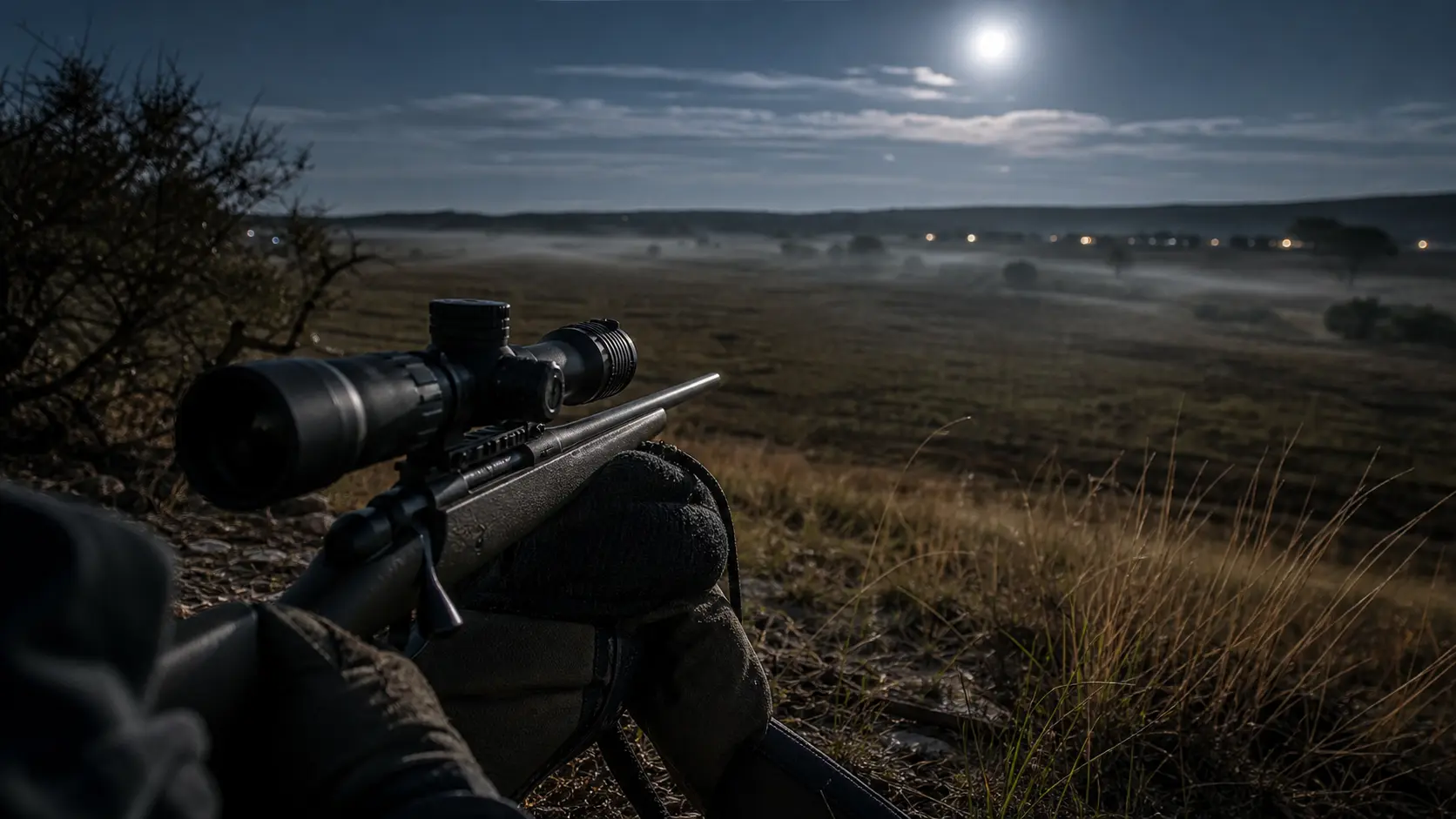
Thermal Scope Field of View Explained: Wide vs Narrow FOV for Hunting
When it comes to hunting with a thermal scope, one of the key considerations is the field of view (FOV). Field of view is a crucial aspect of a thermal scope for hunting.
Quick Answer: What Field of View Should a Thermal Scope Have?
The thermal scope field of view required will depend on a variety of factors including where you hunt, how close the animals will appear and if your rifle scope is also going to be your scanner. A wide field of view thermal scope is typically best for close up hogs, brush, timber, feeder setups, fast moving animals and to see multiple heat signatures after the initial shot. A narrower thermal scope FOV might make sense in open fields, long pastures and coyote stands where detail and base magnification are more apparent.
Never purchase just based on the magnification or detection range. So just because a scope’s numbers on a spec sheet sound impressive, doesn’t mean that it is when it comes to hogs breaking at 60 yards. Another scope may be less powerful at low magnification, but may provide more assistance in locating animals and maintaining orientation in the field.
Judge FOV with thermal scope base magnification, thermal scope lens size, thermal scope sensor size, pixel pitch, detection range, and identification range. It’s not just an optics number. It’s how much of the hunt you can see before the animal moves.
What is the Field of View of a Thermal Scope?
Field of view (FOV) is the amount of ground that is visible through the thermal scope at a given time. A broader view shows additional pasture, brush line, feeder pen, sendero or hillside. A more narrow view will include less of the landscape, but the animal seen may seem larger due to the fact that the scope is using a higher base magnification.
FOV, basically, determines the speed at which you locate animals, the effortlessness of tracking movement, and the amount of awareness you maintain on the target. That’s important during the night when there may be only one clear shot of the scene on your screen.
Degrees vs Feet at 100 Yards
FOV may be expressed as degrees, in feet at 100 yards, in meters at 100 meters, or in horizontal by vertical angle. Feet at 100 yards field of view is typically the easiest to imagine for a U.S. hunter. A degrees field of view scope spec is still a good thing, but make like-for-like comparisons before determining whether one scope is really wider than the other.
Horizontal FOV vs Vertical FOV
The horizontal FOV and vertical FOV are not always the same value. Horizontal FOV is the width of the image from side to side. It is important in scanning the edges of a field, when monitoring a moving coyote and for viewing hogs crossing a crop field. Vertical FOV is the vertical height from top to bottom. It is significant in the vicinity of hills and ditches, feeders, fences, and rough ground. While most buyers will look at the horizontal FOV first, the full shape of the image is what will determine how natural the scope feels.
Wide FOV Thermal Scopes: Strengths and Tradeoffs
A wide FOV thermal view provides more context. More ground, more movement, more animals around the target. That makes the scope feel more responsive and forgiving.
Wide FOV facilitates rapid scanning, quick target reacquisition after recoil, tracking running animals, and viewing multiple animals in a sounder, without the tunnel vision effect that new users of thermals can find frustrating.
When Wide FOV Helps Most
Wide FOV comes in handy when the hunt is hot: hog sounders at feeders, pigs running in the crops, stalking in brush, small fields, creek bottoms and close predator calling. If the majority of shots occur at practical hunting distances, a wide FOV thermal scope for hog hunting may prove more beneficial than a higher magnification optic.
Width is also preferred for handheld scanning applications and for security sweeps on ranches. A good thermal monocular field of view will allow for easier and less frequent panning when viewing an area for a long time.
Where Wide FOV Can Feel Weak
Most of the time, wide FOV translates to lower base magnification. Distant coyotes and small targets will appear smaller if the sensor, lens, focus, NETD and display are not strong. A wide image shot on a weak system can seem soft at a distance. This is where thermal scope specs explained as a complete system comes into play.
Narrow FOV Thermal Scopes: Strengths and Tradeoffs
A narrow FOV thermal scope provides a smaller portion of landscape. It can often be combined with a higher base magnification, making animals look bigger. This can be beneficial in open fields, on longer pastures and when observing smaller targets at a distance.
The compromise is speed. Narrow FOV isn’t as forgiving when it comes to close hogs, crossing animals, follow-ups and when the rifle optic is the hunter’s only scanner.
When Narrow FOV Makes Sense
When the terrain provides time, narrower FOV makes sense. A more compressed image can be useful in open-country coyote hunting, crop fields, travel lanes that are predictable, and stands that typically provide opportunities in which animals are spotted long distances away. It also functions more effectively when using a separate scanner as the search isn’t all being done by the rifle scope.
When Narrow FOV Becomes a Problem
At close range, high-speed and unpredictable animals create a challenge for narrow FOV. Pigs are very capable of quickly breaking a tight picture under 100 yards. Recoil makes follow up shots more difficult. When you’re using the rifle scope as your scanner, overly high magnification can make the entire hunting experience slow.
Field of View vs Base Magnification
There is a relationship between thermal scope magnification and FOV. The lower the base magnification, the wider the FOV usually is. Increasing the base magnification typically reduces the FOV. The exact numbers may vary with different optical designs, but the field behavior is predictable and consistent, and should be considered by the buyer.
Base magnification is the initial magnification before digital zoom. If the scope starts too tight for your terrain, you cannot zoom out to recover the lost view.
Why a 3x or 4x Thermal Can Feel Too Tight
A 3x or 4x thermal may look appealing due to the illusion of a larger animal. That assists in open country. The same range can seem tight and difficult to monitor in timber, brush, feeder areas, and even in small fields.
A common mistake among buyers is to opt for a higher base magnification for "more range" and find out that the scope is not suitable for their property.
Why 1x or 2x Can Be More Useful Than It Looks
While it may seem like a weak option in theory, a 1x or 2x thermal can be easier to hunt with. Scanning, quick target pickup and movement tracking are easier with lower base magnifications. The lower starting point can be an asset when combined with a strong 640-class sensor, clean processing and usable picture-in-picture or digital zoom.
Field of View vs Lens Size: Do Bigger Lenses Equal Wider FOVs?
A larger lens does not necessarily mean a larger field of view. The size of the thermal scope lens, the focal length, the geometry of the sensor, the pixel pitch and the optical design all complement one another.
Larger lens classes will typically allow for more reach and higher base magnification, and this can result in a more narrow FOV in many hunting scopes. Smaller lens categories can feel more "open" and "fast", but at the expense of some identification detail at a distance.
25mm, 35mm, and 50mm Examples
Close and mid-range work around feeders, woods and small fields often works best with a 25mm thermal scope. For those that hunt in a combination of mixed hog, coyote and ranch use, a 35mm thermal scope is probably the balanced option. For open fields and longer lanes, a 50mm thermal scope may be better at extending reach and offer a tighter field of view. The millimeter number isn’t everything, check the FOV and base magnification.
Field of View vs Sensor Resolution: 384, 640, and 1280
The usefulness of a particular FOV depends on the sensor resolution. A wider view expands the scene across the sensor. More pixels will allow more usable detail to be captured in that larger image, of course, but that’s not the only factor: lens quality, focus, NETD, display quality, firmware and image settings will all play a part.
Why 640 Can Handle Wider FOV Better Than 384
A 640-class sensor can sometimes support a larger FOV with more detail about targets than a sensor with less resolution. A 384-class scope still works well but may need a tighter optical system to give apparent detail at distance. This narrower configuration will decrease FOV.
To put this into perspective, check USA Night Vision’s articles about thermal scope sensor size and thermal scope pixel pitch.
Digital Zoom and FOV
Digital zoom is a narrowing effect that is created in the image. It can be used for aiming purposes or to look at something more closely, but does not add any additional sensor detail. When the base image is not sufficient, only what is already in the image will be magnified.
Field of View and Detection vs Identification Range
FOV should not be confused with the detection range of thermal scopes. Detection is the act of noticing a heat source. Recognition is the general type of object that you understand. Identification is verification of sufficient information for an ethical and legal determination.
A scope can detect heat at a distance but without sufficient detail to be positive in identification. Another scope might show distant details better, but be cumbersome close up. Separate FOV, thermal scope identification range and detection claims. USA Night Vision has written a guide for this, which can be found at detection vs recognition vs identification range.
Why a Wide View Can Help You Find Animals Faster
A larger FOV does not necessarily mean that the scope has a longer reach. It increases the amount of ground you can cover in one view. This can make the animals easier to locate as you’re not dividing the field into small strips.
Why a Tight View Can Help With Distant Detail
The narrower the FOV, the bigger the distant target will look. That facilitates the study of body form, movement or behavior at a distance. The balance is offset by reduced awareness and tracking space for quick movement.
Best Field of View by Hunting Scenario
| Scenario | FOV Bias | Why it Works | Watch Out For |
|---|---|---|---|
| Close hog hunting | Wider | Tracks sounders and follow-up movement | Less apparent detail if shots go far |
| Mixed hog and coyote hunting | Balanced | Fields, edges, and some distance | Avoid extremes unless terrain requires it |
| Open-country coyote hunting | Balanced to narrower | Helps with smaller distant targets | Can feel slow if coyotes come close |
| Brush, timber, small fields | Wider | More rapid pickup of targets and orientation | Range claims are less important in tight cover |
| Open fields and long pastures | Balanced to narrower | More useful detail at distance | Close shots may be more difficult |
| Ranch security and scanning | Wider or separate scanner | Covers more ground with less fatigue | Rifle scopes are not very conducive to constant scanning |
| Handheld thermal monoculars | Wider | Better search tool | Rifle optic may still need more detail |
Hog Hunting
FOV is a key usability specification for a thermal scope for hog hunting. Swine frequently travel in herds, and the access is fleeting. Broad or open FOV is typically more practical than an extremely narrow scope unless you’re going to hunt large open fields.
Coyote and Predator Hunting
The answer depends on the stand for a thermal scope for coyote hunting. More base magnification in open country might be rewarded. Too much magnification can be a problem in brushy stands and when the calling is close.
Brush, Timber, and Small Fields
In thick cover, FOV is more important than detection claims at a distance. The hunter must locate the animal, maintain orientation, and keep the animal in the screen.
Open Fields and Long Pastures
A narrow FOV has more space to work in open terrain. A tighter view is helpful if the animals are normally farther away and you have time to observe them.
Ranch Security and Property Scanning
A wider view when scanning gates, barns, fence lines, livestock areas and property can help reduce fatigue. A handheld thermal scanner can be useful if you are scanning frequently, rather than using the rifle scope for all scans.
Handheld Thermal Monoculars
Thermal monocular field of view should typically be wider than a rifle scope. The handheld is primarily a search tool. It should assist with finding heat, figuring out movement and determining if it is time to switch to the rifle optic.
How to Read FOV on a Thermal Scope Spec Sheet
Before purchasing, read through this checklist:
- Compare FOVs in the identical manner, in degrees, feet at 100 yards or meters at 100 meters.
- Determine if it is a horizontal FOV, vertical FOV or both.
- Check the base magnification first, before digital zoom.
- Do not just compare objective diameter; compare lens size and focal length.
- When checking resolution, consider sensor resolution and pixel pitch.
- Consider not just the longest shot you may take, but your most likely one.
- Determine if the rifle scope needs to be a dual purpose scanner.
- Discuss FOV vs detection, recognition, and identification requirements.
- For moving animals, consider thermal scope refresh rate.
- For low contrast and challenging weather conditions, think of thermal scope NETD.
Common Mistakes Buyers Make With Thermal Scope FOV
Chasing Detection Range and Ignoring Close-Range Usability
Detection range is easy to promote. Close-range usability is what you feel during the hunt. If the majority of shots are near feeders, trails, brush lines or small fields, don’t buy solely based on the highest shot number on the box.
Assuming Bigger Lens Means Better for Every Hunt
A bigger lens will assist a proper hunter in the correct terrain. It can also cause the scope to be tighter, the rifle heavier and slower up close. A larger lens isn’t necessarily better.
Using the Rifle Scope as a Scanner Without Enough FOV
Many hunters begin by scanning with the scope on the rifle. If so, then FOV is even more significant. A tight rifle scope isn’t a very convenient search tool to use. A standalone scanner works better to address this separately.
Buying Advice: Wide FOV or Narrow FOV?
Use more FOV when shooting in close hogs, brush, timber, feeders, tight sendero, small fields, moving sounders, or rifle-scope scanning.
Decide on balanced FOV for mixed terrain, mixed hog and coyote hunting or one primary thermal scope for general ranch use.
If a handheld scanner is already in use, select a narrower FOV for open fields, longer pastures, predictable lanes or far off coyotes.
Best thermal scope field of view is the field of view that allows you to locate the animal, identify it properly, follow the animal through the shot and maintain control.
FAQ
What is an adequate thermal scope FOV?
Terrain and target distance are important factors in determining a good field of view. The larger the FOV the better for close range hogs, brush, scanning and moving animals. A smaller FOV can be beneficial in open fields and at greater distances.
For hog hunting, is it better to have a wide field of view or not?
Often, yes. A larger FOV assists with follow-up tracking, animals in brushy areas or at crop sides, and sounders. A more balanced or tighter perspective may be warranted by very open hog hunting.
Does a narrow field of view help the coyote hunter?
Sometimes. A smaller FOV can be helpful for coyotes that are farther away as the animal will be bigger. If coyotes come in close or stands include brush, too much magnification can make the scope more difficult to use.
Why is it that magnification decreases the field of view?
Usually, yes. In general, the greater the base magnification, the smaller the field of view. Digital zoom also serves to reduce the view and does not actually add sensor detail.
Would a 640 thermal scope have a larger FOV than a 384?
Not automatically. FOV is also a function of lens, focal length, pixel pitch and optical design. When it comes to FOV, you can sometimes be better served with a 640 sensor as there’s more to work with.
Does field of view give advantage to the detection range?
Field of view determines how much area of the terrain can be scanned at once, but it is not necessarily a detection range. Detection is dependent on the entire thermal system, target size, conditions, lens, sensor, processing and contrast.
Is there a handheld scanner that has a larger FOV that you recommend purchasing?
Yes, if you scan frequently. A handheld thermal scanner with a larger FOV may be a good idea because it allows you to hunt efficiently and then switch to the rifle scope when it’s time to make a positive identification and shoot.

Can You Use a Thermal Scope During the Day? Daylight Use/Sun Safety and Zeroing Tips.

Night Vision Range Explained: Detection, Recognition, Identification, and Real Hunting Distance

How to Set Up an IR Illuminator for Night Vision: Placement, Beam Width, and Field Mistakes