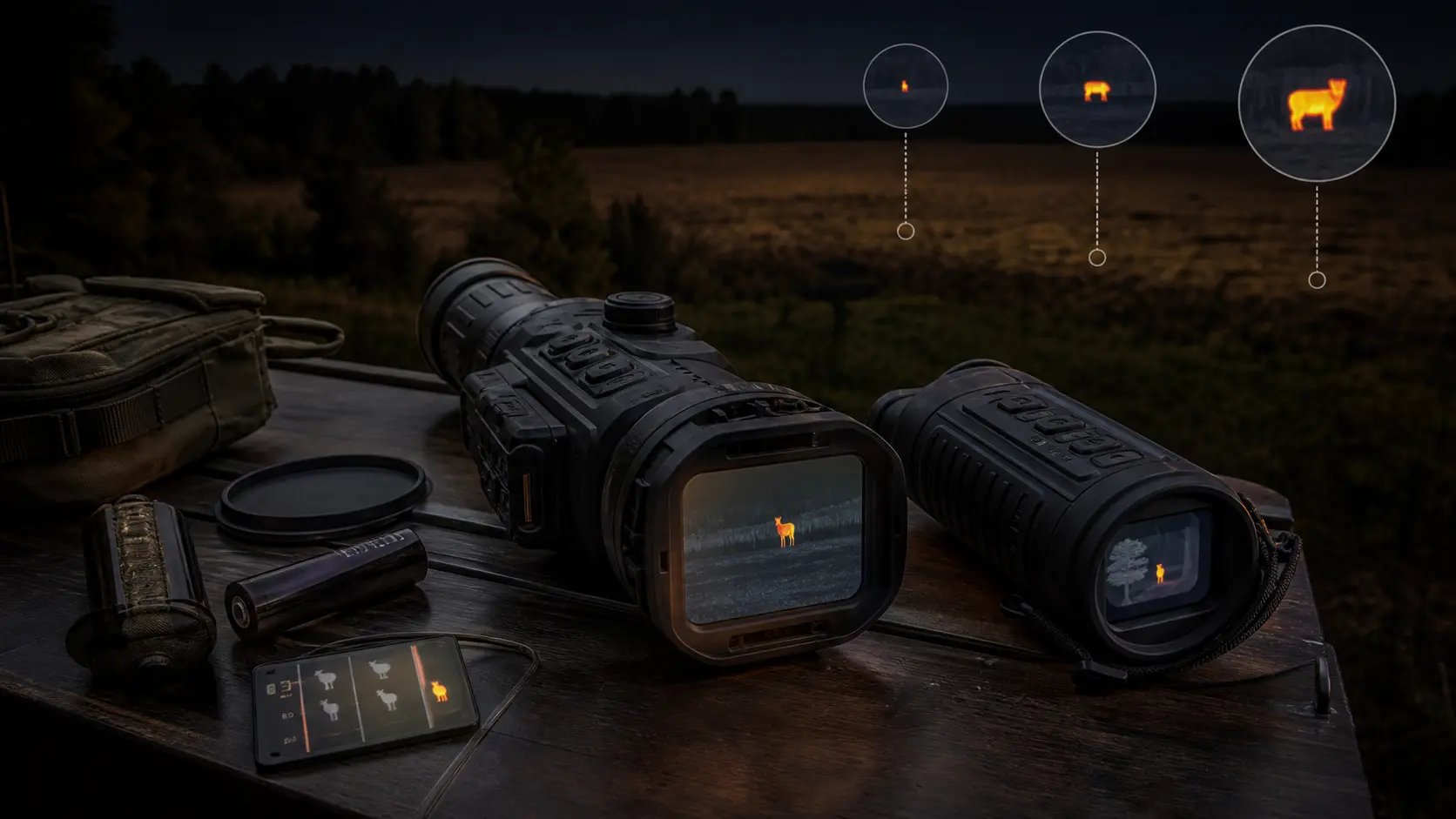
Detection vs Recognition vs Identification: Thermal Scope Range Explained for Hunters
Thermal scope range specifications can be misleading.
You might see that a particular thermal scope offers 1,800 yards detection range or even 2,500 yards. That sounds amazing. However, don’t jump on it yet! It’s easy to be deceived.
Detection range, recognition range, and identification range aren’t the same thing. Hunters can end up making a big mistake buying a thermal device based on the biggest range number available on the product description.
Quick answer
Detection means that you can see an object in front of the scope but may not be able to understand what kind of object it is. Recognition allows you to figure out whether the object is, for example, an animal or a vehicle. Identification provides enough detail to determine whether you can take the shot legally and safely.
For hunting applications, it’s important to distinguish between all three concepts and choose the thermal scope based on your needs and hunting practices. Don’t fall for the marketing tricks!
Detection range
Detection range defines the distance where a thermal device shows that there is a heat source within the scope.
As you can easily guess from the explanation above, the device detects the presence of a target at a certain distance but doesn’t necessarily allow to identify that target.
According to the Pulsar website, detection range refers to the ability of the device to detect a heat source that fits into at least two thermal sensor pixels.
For instance, the Pulsar Ultra-Thermal Imager manual mentions that an adult sized target is detectable at distances between 1300m and 1900m depending on the environmental conditions.
FLIR and other manufacturers of thermal devices provide similar explanations for detection range, although they can have different approaches to estimating the number of necessary pixels in their products.
In other words, detection range shows that an object is detected but not necessarily identified.
The Pulsar manual states that the critical dimensions of the objects are the following: a human-sized target – 0.5 meter x 0.25 meter, a person riding a horse or sitting in a car – 1 meter x 0.5 meters, a standing cow – 2 meters x 1 meter.
So, a thermal scope claiming its detection range at 2000 yards can detect a target at this distance but doesn’t mean that you can see enough to shoot at.
Recognition range
Recognizing that there is an animal or a person in the field of view is a significant improvement for the hunter.
However, recognition range still doesn’t give a full picture and allow taking a shot. Instead, recognition can be used to understand whether further actions are required.
Typically, recognition allows identifying whether a heat source belongs to the following categories:
- animal
- human
- vehicle
- stationary heat source
So, if you see a human-like figure in the field of view, you need to figure out whether it is a person or an animal. If it’s a stationary heat source, you may need to determine whether it’s an animal or a tree stump. Etc.
Although recognition is helpful for a lot of hunting purposes, you can’t rely on it when aiming and shooting.
Identification range
Identification range provides the possibility to identify a heat source as a specific animal rather than just an animal in general.
This definition allows making a final decision on the legality of shooting and the safety of the action.
Identification allows figuring out the following attributes of the target:
- animal size
- movement direction
- species
- number of animals in the area
- backstop
To make a more specific assessment and determine whether the target is legal to shoot, Pulsar states that identification involves evaluating “the characteristic features.”
According to FLIR, detection determines that something is there, recognition determines that it’s a person, and identification allows distinguishing whether this person is carrying an object.
The key point here is to make sure that your decision isn’t rushed and is based on sufficient thermal imagery data and your hunting knowledge.
It’s important to note that thermal scopes can’t show colors, antlers, or patterns. So, the identification process requires more caution.
Why detection range is always the biggest number
Detection range is relatively easy to demonstrate as it’s the easiest range to obtain. At this distance, the thermal camera can see that there is a heat source in front of the scope.
This explains why the detection range is always greater than the recognition range that requires more pixels to be obtained and more details on the object to be estimated.
As you may have noticed, recognition requires more effort than detection does.
Similarly, identification range is always less than recognition range as more information is required for recognizing the target. More information means more detail and higher quality of thermal imagery.
Let’s compare all three ranges in a table below:
When the scope only has the detection range mentioned in its characteristics, it’s necessary to take this specification with a grain of salt.
Johnson Criteria and pixels on target
Johnson criteria, detection recognition identification (DRI) criteria, and other similar techniques are commonly used to define the range types and detectability of an object.
Based on the approach described, we can conclude that more pixels are required at identification and recognition ranges. In other words, the detection range requires the smallest number of pixels while the identification one is demanding the greatest number of pixels for proper detection.
This explains why thermal devices with the same specifications can demonstrate different performances when used with various lenses.
For example, two 640 thermal scopes with identical specifications but with 50mm lens and 25mm lens respectively can show different results. With the former device, you’ll get a better identification and recognition but will lack scanning capabilities compared to the latter device. In turn, the scope with a shorter lens provides more convenient scanning but poor identification of targets in the field of view.
What actually affects thermal scope range
Sensor resolution
The sensor resolution plays a crucial role in obtaining detailed thermal imagery.
For example, the 640 thermal scope provides a greater amount of detail compared to 384. This doesn’t mean that you shouldn’t choose thermal scopes with lower resolution. However, it can be helpful for some tasks.
Lens size
Lens size affects range capabilities significantly.
Generally speaking, a thermal device with a larger lens allows seeing further in the field of view. Thus, if you’re planning to hunt animals in the fields, 50mm lens is a decent choice. If you’re going to hunt in the forest, a lens with lesser size can be more preferable.
Note that lens size also influences magnification. The greater is lens size, the higher magnification is. This is also something that needs to be considered when choosing a device for certain uses.
Pixel pitch
Pixel pitch is another parameter that needs to be taken into consideration when buying a thermal scope.
Today, the pixel pitch of 12 microns is common among modern thermal riflescopes. Some scopes feature greater pixel pitch, e.g., 17-micron.
However, the size isn’t the only criterion that needs to be estimated when evaluating thermal device performance. It’s also essential to consider other parameters.
NETD
NETD stands for noise equivalent temperature difference. It describes the thermal sensitivity of the device.
If you’re going to operate in tough atmospheric conditions, NETD value is essential as it determines the device’s ability to distinguish an animal from its surrounding environment in difficult conditions.
For instance, the thermal device with lower NETD value will be able to distinguish an animal from the background during a foggy day while a thermal device with greater NETD won’t succeed in performing this task.
Display resolution
Display resolution can provide a significant advantage to thermal scopes. High-quality displays, for example, 2560×2560 displays, help users estimate the obtained information better.
Image processing
Modern thermal scopes provide various image processing options. Image processing helps enhancing thermal imagery and detecting targets more quickly.
Although image processing can be useful, it isn’t able to compensate for bad thermal lens performance or sensor resolution. Moreover, it can’t make an infrared signal visible if the signal wasn’t received by the thermal sensor at first place.
Focus
If you’ve found the scope with all the desired features including high pixel pitch, great image processing, high-resolution display, and etc., make sure to check its focusing abilities as well.
If focusing isn’t good, you won’t get sufficient thermal imagery at distance and, therefore, won’t be able to make an accurate decision.
Why real hunting range is shorter than listed detection range
Spec sheets are written in a special condition where all possible factors are controlled and known. Unfortunately, hunting can’t take place under these ideal circumstances.
There are numerous factors that influence thermal range. For instance, thermal performance can change depending on the following environmental conditions:
- humidity
- rain
- fog
- dust
- smoke
- heat shimmer
- background temperature
- target size
- target movement
- vegetation
- terrain
- focus
- display settings
- user experience
Thus, you shouldn’t compare a thermal scope performance in your area with that claimed by its seller. Even if a device has a 2000 yard detection range, it may perform significantly worse in your hunting area.
Besides, you should also keep in mind that a thermal scope may detect an animal of a certain size in its field of view while failing to detect smaller animals.
In this case, you can’t claim that the device has 2000 yards detection range for all animals regardless of their size and shape.
Detection range examples from current scopes
Now let’s have a closer look at some of the current scopes to see the difference in performance provided by thermal devices with different specifications.
Firstly, let’s talk about AGM Rattler V3 LRF 50-640. According to AGM, it has a 640×512 12-micron sensor, sub-15 mK sensitivity, 50 Hz frame rate, 50mm f/1.0 lens, in-lens laser rangefinder, 2560×2560 OLED display, and the distance for detection of an adult person is stated in miles.
Secondly, Pulsar Trail 3 LRF XR50 comes with 640×480 12-micron thermal sensor, F50/1.0 lens, 3x to 24x magnification, 50 Hz frame rate, 1920×1080 AMOLED display, and a detection range for a deer-sized object equals about 2,300 meters.
Lastly, ATN lists ThOR 6 LRF 640 with 640×512 resolution, 12-micron sensor, extremely low NETD values, and detection ranges varying according to the device model and its magnification configuration.
All these examples show us that detection range isn’t enough for hunting. Firstly, you shouldn’t be distracted by the impressive numbers provided on the manufacturer’s website. Secondly, you should consider your own hunting conditions before purchasing a thermal scope.
How hunters should interpret range numbers
For scanning
It’s crucial to distinguish that detection range numbers are helpful for scanning and finding heat signatures.
Thus, you may need a thermal scope with a maximum detection range for such activities as ranch security or hunting hogs in the field.
However, scanning isn’t the ultimate stage when hunting. You may need to proceed to recognition and identification later on.
For deciding what animal it is
After scanning a territory for heat sources, you may need to evaluate whether the heat source is worth further investigation or not.
This means that you’ll have to recognize what animal or person is presented in the field of view. The next steps depend on the recognition results and your own decision.
For shooting
If a thermal scope allows identifying a heat source as an animal that you intend to shoot, the next step for you is taking a shot.
It should be noted that a thermal device can’t replace your own skills and experience. Therefore, a thermal scope with impressive detection numbers may not provide sufficient details required to make a final decision on shooting.
Detection range vs ethical range
While the hunting ethics are determined by hunters themselves, there’s also ethical range of a certain scope that you should consider before using a thermal device.
Even though the thermal scope may detect an animal at a specified distance, it may not allow making an accurate decision on shooting. In this case, the ethical range may be shorter than the detection range.
This range is important to know as the distance allowed by the device isn’t always enough for making an ethical decision on shooting.
Lens size and field of view tradeoff
Lenses with larger size can be beneficial for long-range hunting. For example, 50mm lenses provide great identification possibilities at distance while the field of view may be restricted.
In case you hunt hogs in brush or in dense forests, a 25-35mm lens would be a better choice. It will allow seeing more in the field of view despite the reduced magnification.
So, the scope with great identification range and poor scanning properties may not be suitable for your needs despite its detection range.
384 vs 640 for identification
A thermal scope with 384 resolution can be quite effective for hunting. However, 640 thermal scope may offer better results due to the increased number of pixels.
With higher number of pixels, you’ll be able to detect targets better. Besides, a scope with a higher resolution provides better image stability in digital zoom mode. As a result, a scope with higher resolution gives more convenience.
This doesn’t mean that a scope with lower resolution won’t be able to provide good results. A good thermal scope can help you detect and shoot hogs or coyotes even if its resolution is relatively low.
You can choose a scope according to your specific hunting needs.
If you hunt hogs in the brush, the field of view plays the main role. In this case, you may consider buying the scope with lesser magnification and higher resolution.
If you plan to hunt in the open country, a thermal scope with higher resolution and a larger lens can be helpful.
Why digital zoom doesn’t create identification
Digital zoom increases the size of the pixels. As a result, you may aim better and get additional advantages when scanning and analyzing heat signatures.
However, you shouldn’t forget about the basics of infrared detection. Only the scope capable of collecting enough heat data will provide you with additional advantages via digital zoom. Otherwise, thermal imagery won’t become sharper and more detailed.
Environmental conditions matter
It’s impossible to predict exact detection range values when you have to consider the effects of various environmental conditions. The following factors can influence thermal performance:
- weather (rain, humidity)
- heat shimmer
- dust
- smoke
- wet ground
These are only the basic factors. If you hunt in a certain area for many years, you can easily understand what environmental factors influence your thermal range negatively.
Unfortunately, the detection range number doesn’t provide sufficient information regarding these factors. That’s why it’s essential to take your time and try the thermal device you’re going to purchase beforehand.
How to test your own thermal range
If you want to estimate your detection range in the field of view, follow these steps:
- Set certain distances for testing, e.g. 50, 100, 150, 200, 300, 500 yards.
- Put certain warm animals at these distances.
- Change conditions of testing.
- Maintain the same focus setting and color palette settings.
- Check how far you can detect a heat signature, recognize it, and identify a certain target.
- Try scanning on different terrains: open fields, forests.
- Estimate handheld detection range and rifle mounted detection range.
These tests may seem to be complicated. However, they’ll give you a comprehensive view of the capabilities of your thermal device in hunting conditions.
The identification range for your specific thermal scope will likely be lesser than a detection range provided on the product page.
Buying advice by hunting style
Hog hunting
Hog hunting requires a thermal scope that provides excellent detection abilities. Usually, hogs move in groups. That’s why wide field of view is preferred. If you intend to shoot in the distance, go for 640 thermal scope with a large lens and low magnification.
Otherwise, if shots are mostly taken within 150 yards, field of view is more important than detection range.
Coyote hunting
The coyote hunting may benefit from greater range as coyotes tend to hunt in groups and spread at large distances.
A thermal device with greater detection and recognition capabilities will give an advantage to you when hunting coyotes. Thus, you may want to get a thermal device with 640 resolution.
If shots are taken within 200-300 yards, you shouldn’t worry much about magnification. However, if you hunt long distance, make sure that a thermal scope provides sufficient magnification.
Deer recovery
Recovery can be done with the help of thermal monocular rather than with the thermal rifle scope. The purpose of such operation isn’t shooting.
A device for deer recovery should detect a wounded animal and help you find its track. So, detection range is important here. The identification range won’t play the main role in this case.
Ranch security
Ranch security requires great detection and recognition ranges as you may need to understand whether it’s an animal, human, vehicle, or other heat source.
Identification can be limited as a rancher wants to know about any disturbance in his/her property.
Common mistakes
Treating detection range as shooting range
As we’ve already discussed in the article, detection doesn’t necessarily mean that a thermal device can allow you to shoot at the target.
Detection range only shows whether the device can detect a heat source in the specified distance.
Ignoring target size
When considering detection range for a thermal scope, you should keep in mind that it’s valid for certain size of the target. For example, the device with great detection range can fail to detect smaller targets (e.g. hawks, raccoons, crows).
Buying the highest magnification scope for every hunt
Magnification and lens size determine your detection range and scanning comfort. Thus, it’s important to estimate your hunting needs properly. For example, you may need a thermal device with greater magnification for shooting in the distance.
However, this device may become inconvenient for hunting in dense terrains. That’s why it’s always important to make a balanced choice.
Overusing digital zoom
While it’s useful for aiming and increasing clarity of thermal imagery, you shouldn’t exaggerate and overestimate digital zoom as an independent tool.
Not considering weather
It’s crucial to understand what weather conditions may influence your thermal detection capabilities. Fog and rain may decrease your detection range drastically. That’s why you should think about weather in advance.
Comparing detection numbers across brands without context
It’s essential to remember that all manufacturers use different criteria while calculating detection range. Thus, you shouldn’t focus on the detection range number only.
Instead, pay attention to other specifications and compare the performance of various thermal devices accordingly.
What to look for in a spec sheet
When buying thermalscope, check:
- sensor resolution
- pixel pitch
- objective lens size
- base magnification
- field of view
- NETD
- refresh rate
- display resolution
- focus type
- detection range target type
- LRF availability
- ballistic tools
- battery system
- warranty
If the spec sheet lists detection range but does not explain target size or conditions, treat the number as a rough comparison point, not a promise.
Bottom line
Detection, recognition, and identification are not the same thing.
Detection tells you something is there. Recognition tells you what general type of thing it may be. Identification gives you enough detail to make a more specific decision.
For hunters, identification range matters most. Detection range is useful, but it is not a shooting distance.
The best thermal scope is not the one with the biggest detection number. It is the one that gives you enough usable detail, field of view, sensitivity, and confidence at the distances and conditions where you actually hunt.

Can You Use a Thermal Scope During the Day? Daylight Use/Sun Safety and Zeroing Tips.

Night Vision Range Explained: Detection, Recognition, Identification, and Real Hunting Distance

How to Set Up an IR Illuminator for Night Vision: Placement, Beam Width, and Field Mistakes