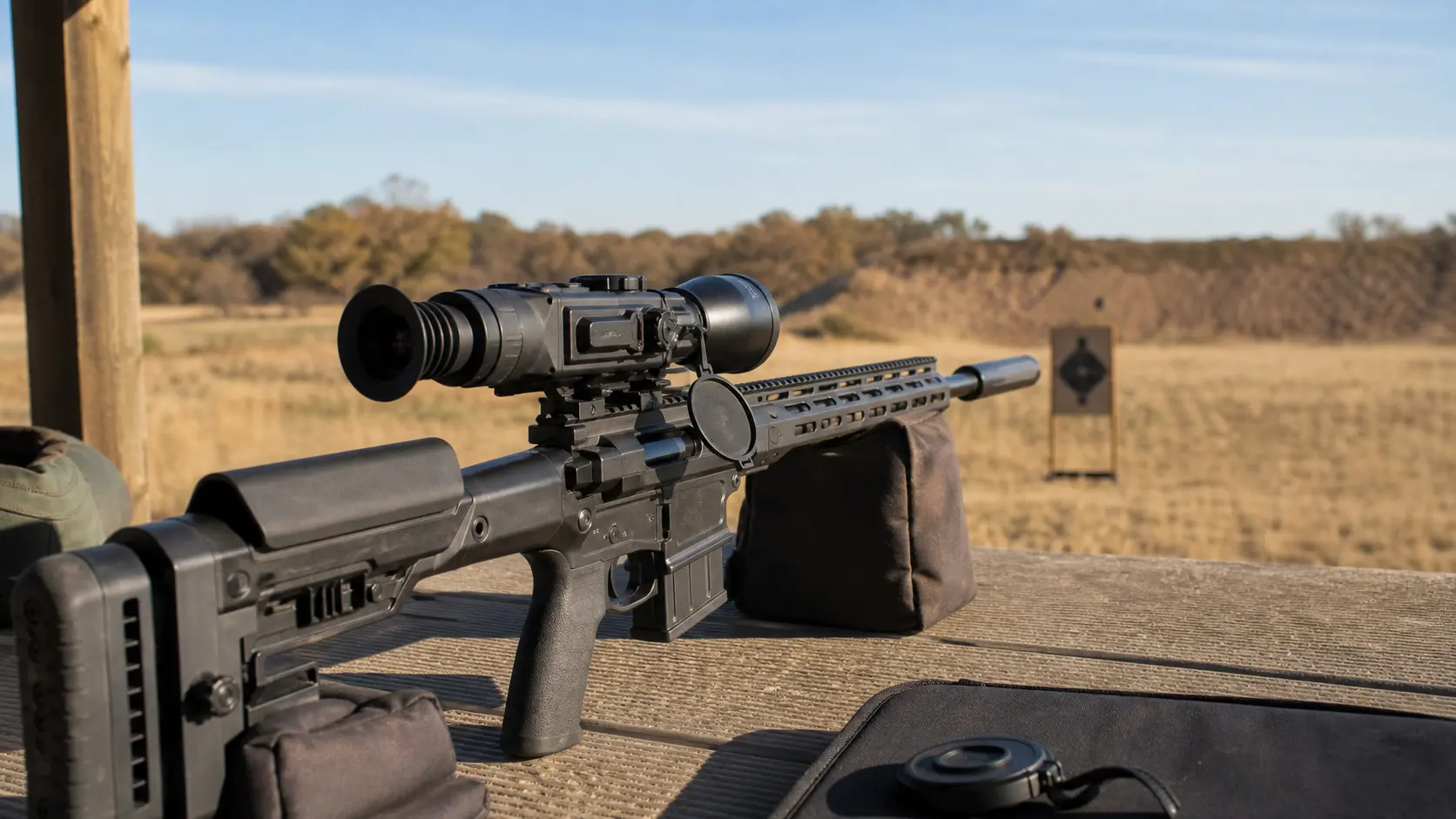
Can You Use a Thermal Scope During the Day? Daylight Use/Sun Safety and Zeroing Tips.
Can you use a thermal scope during the day?
Yes, a thermal scope can be used during the day time. Thermal scope does not require darkness as it is measuring infrared heat contrast, not visible light. It does not suffer from "flaring" like conventional light-amplifying night vision can when exposed to bright light.
The field comes down to the length of the answer: daytime use of the thermal scope is safe and beneficial, as long as the manufacturer’s manual is followed, the scope is not pointed directly at the sun into the objective, and you understand that a hot daytime scene may look flatter than a cool night field. Thermal scope heat contrast decreases with sun warmed grass, rocks, gates, rooftops and dirt. The outline might not be as clear, but a hog, coyote, or zeroing target can still be present.
I rely on daylight primarily for set up; testing power, focus, NUC/FFC, menu set up, zero profile and mount stability and checking point of impact before heading out at night. It’s also a good time to show a new user the real life performance of their new thermal imaging device in the daylight.
Yes, a thermal scope can be used during the day, but it is best known for nighttime use.
A thermal scope can operate in daylight since it is seeing energy of heat, not light. So if someone asks you can you use a thermal scope during the day, the answer is yes, but notwithstanding the sun, the normal parameters of thermal imaging remain in force.
Day light can be used for:
- Battery, Button, Focus, NUC/FFC, Brightness, Contrast Check.
- Verifying correct load, suppressor set up and zero point.
- Zeroing to an adequate thermal scope target (point).
- Pre Hunt thermal scope check.
- Understanding the effect of terrain, shade, humidity and heat soak on image.
Warm background, heat shimmer, wet vegetation, glass surfaces, reflective surfaces, humidity and target ID range are limitations with daylight use. A thermal scope flat image or thermal scope washed out image at noon does not necessarily indicate that the optic is damaged.
Thermal Scope vs Night Vision in Daylight
Thermal and night vision, even if they’re sold to the same hunters, don’t see the same world. Traditional image-intensifier night vision relies on the amplification of visible and/or near-infrared light. Many night vision systems are sensitive to bright daylight and may not work as well if not properly protected and used as specified in the manual.
Thermal scope creates an image based on temperature differences. That is why the answer to can thermal scopes work in daylight is not the same as ‘can I use night vision in daylight?’ In general, daylight use of the thermal scope is possible, because the scope is not reliant on darkness.
The compromise comes in the form of contrast. A big boar at night in a cold pasture can freeze. That same pasture would be warm in full sun and the animal would be more camouflaged. To remember for practical use of the thermal scope vs night vision in daylight: For thermal to work well, there must be contrast in heat, and a safe target identification must be made; in daylight, thermal is generally more daylight capable.
Does the Sun Affect a Thermal Scope?
Practice caution around here. Be sure to follow the instructions for your specific optic and don’t assume that all brands are created equal when it comes to sun exposure.
Normal daylight use is different from aiming the objective directly at the sun. When the sensor is subjected to very high sources (direct sun, lasers, welding arcs, fire, hot exhaust, other high heat/energy sources) the risk increases. If a scope can seem to take it once, that doesn’t mean it’s a good idea in the field.
Thermal sun damage prevention is easy:
- Do not point the objective at the sun.
- When the optic is not in use, keep the lens cap on it.
- Never leave the scope baking on a dashboard, black truck bed or tailgate.
- Allow the optic to acclimate from air conditioning to hot outdoor air.
- Use manufacturer’s storage, operating, cleaning and transport limits.
When zeroing or testing in the sun, place the bench and target so that the rifle is never pointed near the sun. Remember, it’s valuable electronic sensor equipment. These are basic thermal scope safety tips that are very dull, but they are necessary to save the optic as well as others around the firing line.
Why Daytime Heat Can Make the Image Look Flat
Thermal scopes will detect the variations in heat. They don’t display “hot” alone all by itself. As everything gets closer in temperature, either the ground, brush, metal and the target itself, the image gets dulled.
Some of the most common issues that occur in the day are the following:
- Soil, rocks, posts, panels and gates warmed by the sun.
- Heat shimmer over fields, roads, rooftops and dry ground.
- Wet grass/humid air for softening edges.
- When the animal is in brush and the surrounding temperature surfaces are similar.
- Bright display settings causing washed out display.
Don’t assume that the problem is the optic, check sunlit versus shaded areas, near versus far, early morning versus afternoon, and different palettes. A scope that is not doing much has the potential of being quite nice at last light. If you need a further in-depth look, check out USA Night Vision’s post on why a thermal scope looks blurry.
Is It Possible to Zero a Thermal Scope in the Daytime?
Yes, it is possible to zero a thermal scope during the day provided the target can be seen by the scope and normal range safety is followed. You may be able to see your rifle, tools, target stand, backstop, and the shooting position easily during thermal scope daytime zeroing, which may be easier than night zeroing.
Thermal contrast is the key. What you see is a paper bullseye, which you can see but the thermal can’t. Zero using an appropriate thermal scope target (commercial thermal target, foil or reflective thermal target, safe heated or cooled aiming point, other range approved target with a clear thermal signature).
Never use an unsafe heat source. A good zero target should provide a good aiming point without being a fire hazard, a ricocheting hazard or be confusing on the firing line.
Daytime Zeroing Workflow
Set up the rifle unloaded. Direct muzzle in a safe direction, clear work area of ammunition, ensure optic and mount are secured as per manufacturer instructions. When the rifle fit doesn’t feel the same, check out thermal scope mount height and cheek weld before pursuing zero.
Then, check the rifle, load, distance, suppressor, reticle and zero profile. The purpose of multiple profiles is to have the current one correct. Before assuming that the daylight zero is at fault, follow the thermal scope losing zero and POI shift guide if your optic has exhibited point of impact shift.
Adjust the diopter so that the reticle and menu are clear, focus the objective on the distance of the target object and carry out NUC/FFC if the image is uneven after warm-up. Now fire a careful group from a secure position, make scope adjustments as per the manual, check with other group and check again from realistic firing positions where possible. For reticle and profile set up, look for the USA Night Vision’s thermal scope reticle and zeroing guide.
Best Daytime Uses for a Thermal Scope
Daylight thermal is not a substitute for binoculars or daylight glass. A preparation and diagnostic tool.
The best daytime applications are before hunting, to make sure things are operating correctly, zero confirmation, training a new user, checking the visibility of a target in the shade vs. sun, and finding out how wet grass or humidity affects target outline. Before heading out, follow the thermal scope pre hunt checklist for a complete field routine.
For daytime hunting, consult the local regulations if using thermal. Thermal legality may vary by state, species, season, public or private property, and if mounted to a firearm.
Settings to Adjust First for Daytime Thermal Scope Use
Don’t change all the menu options at once. My routine with my thermal scope is: First focus, second brightness, third contrast, fourth palette, fifth – when picture changes – calibration.
Focus
Set objective for actual distance. In this case, a scope set up for 50 yards might appear weak at 200 yards. Adjust the diopter individually to make the reticle and the menu clearly visible.
Brightness and Contrast
Depending on the level of brightness it may be too dim in daylight or the max brightness can obscure fine detail. The same applies to contrast; if there’s not enough, the image will appear gray, but if there’s too much, the mid-tones that make up the terrain and animal shapes will be lost.
Palette and NUC/FFC
The practical starting points are still white hot and black hot. Some daytime scenes may benefit from the use of color palettes, but they may clutter up heat-soaked terrain. Use NUC/FFC when the image is unbalanced, streaked, smeared, or suddenly lacks contrast after a thermal change; especially helpful when transitioning from a cool truck to hot sun during the day using a thermal scope.
Most Frequently Encountered Daylight Thermal Errors
- Directing the scope towards the sun. Never use the sun as a test object, move the telescope across the sun’s path or point the telescope up without the cap.
- All flat images are failures. A good scope, that is good on a cool day, can look bad on a hot one because of the heat soaked ground.
- When the target is low. The sharper the thermal’s aiming point is, the more reliable your groups and adjustments will be if it’s not crisp.
- Failing to remember the active zero profile after changing rifles, ammunition, suppressors and/or profiles.
- Using detection to identify. Target ID, awareness of the backstop, adherence to the rules and shot discipline still remain necessary.
- Thermal is thinking that he can penetrate glass. The answer is most thermal scopes aren’t able to penetrate standard glass like novices believe. To learn more read can a thermal scope see through glass and windows?.
Daylight-Use Checklist
Use this prior to a range session or a night hunt:
1. Read the manual of your exact optic.
2. Unload the rifle while setting up and cleaning.
3. Cap the objective when it is not being used.
4. Do not point the optic at the sun or heat sources.
5. Monitor battery level/external power. For those who have a pack, check the cable routing by following the thermal scope external battery pack guide.
6. Adjust the diopter until the reticle and menu are in good focus.
7. Adjust the objective to the target distance.
8. If the image looks uneven, run NUC / FFC.
9. Confirm Rifle, Load, Suppressor and ZERO Profile.
10. Zero with correct thermal target.
11. Check point of impact from a fixed position.
12. Recheck in realistic field conditions, where possible.
13. Obey range rules, gun safety rules and local hunting laws.
FAQ
Do Thermal Imaging Devices Function Well in the Sunshine?
Yes. Thermal scopes can be used during daylight hours, as they are not looking for light, but instead infrared heat contrast. Background temperature, humidity, focus, setting and distance influence the image quality.
Will a Thermal Scope Get Damaged From Sunlight?
Unless otherwise specified by the manufacturer, exposure of direct sunlight into the objective should be avoided. Do NOT direct the scope at the sun, and follow the instructions that accompany the scope for normal daylight use; keep the lens cap on the scope when it is not being used.
Can Thermal Scopes Be Zeroed During Daylight Hours?
Yes. Zeros can be made during the daytime using a correct thermal-visible target and safe range procedure. Verify rifle, load, distance, suppressor status and zero profile before adjusting.
Why Is My Thermal Scope Washed Out During the Day?
This is typically due to a low thermal contrast. The heat shimmer from sun-heated ground, the hot rocks, the warm vegetation, the dampness, and the heat itself can cause the image to be flattened. Experiment with NUC/FFC, changes in brightness and contrast, changes in focus and changes in time of day and shade.
Can Thermal Be Used in the Day?
It may be helpful for setting up, scouting context, ranch work and legal hunting situations, but it cannot take the place of target identification, backstop awareness, compliance with local laws and regulations.
Does Thermal Perform Better Than Night Vision During the Day?
In terms of daylight, thermal is usually more useful since it is not amplification of light. Thermal detects differences in temperature; night vision captures light and detail that is reflected. They solve various problems.
When Using NUC, Should I Run It During the Day?
Run NUC/FFC if an image becomes uneven, streaky, smeared or flat after temperature changes. It is a standard operating thermal procedure on many models, but cannot compensate for inadequate target contrast, poor focus, or unrealistic range expectations.
Bottom Line
A thermal scope can be used during the day, and one of the best times to check the set-up before a night hunt is during daylight. Use it to verify focus, settings, battery power, zero profile, mount stability and point of impact.
Please observe the limits. Never aim the optic towards the sun. A hot summer field will not appear like a cold winter night. Distinguish between detection and identification. So if you think of daylight thermal as a practical hunt setup tool rather than magic vision, it is one of the simplest ways to avoid challenges prior to the hunt.

Night Vision Range Explained: Detection, Recognition, Identification, and Real Hunting Distance

How to Set Up an IR Illuminator for Night Vision: Placement, Beam Width, and Field Mistakes

Thermal Scope Pre-Hunt Checklist: Batteries, Zero, Settings, Mounts, and Weather Checks