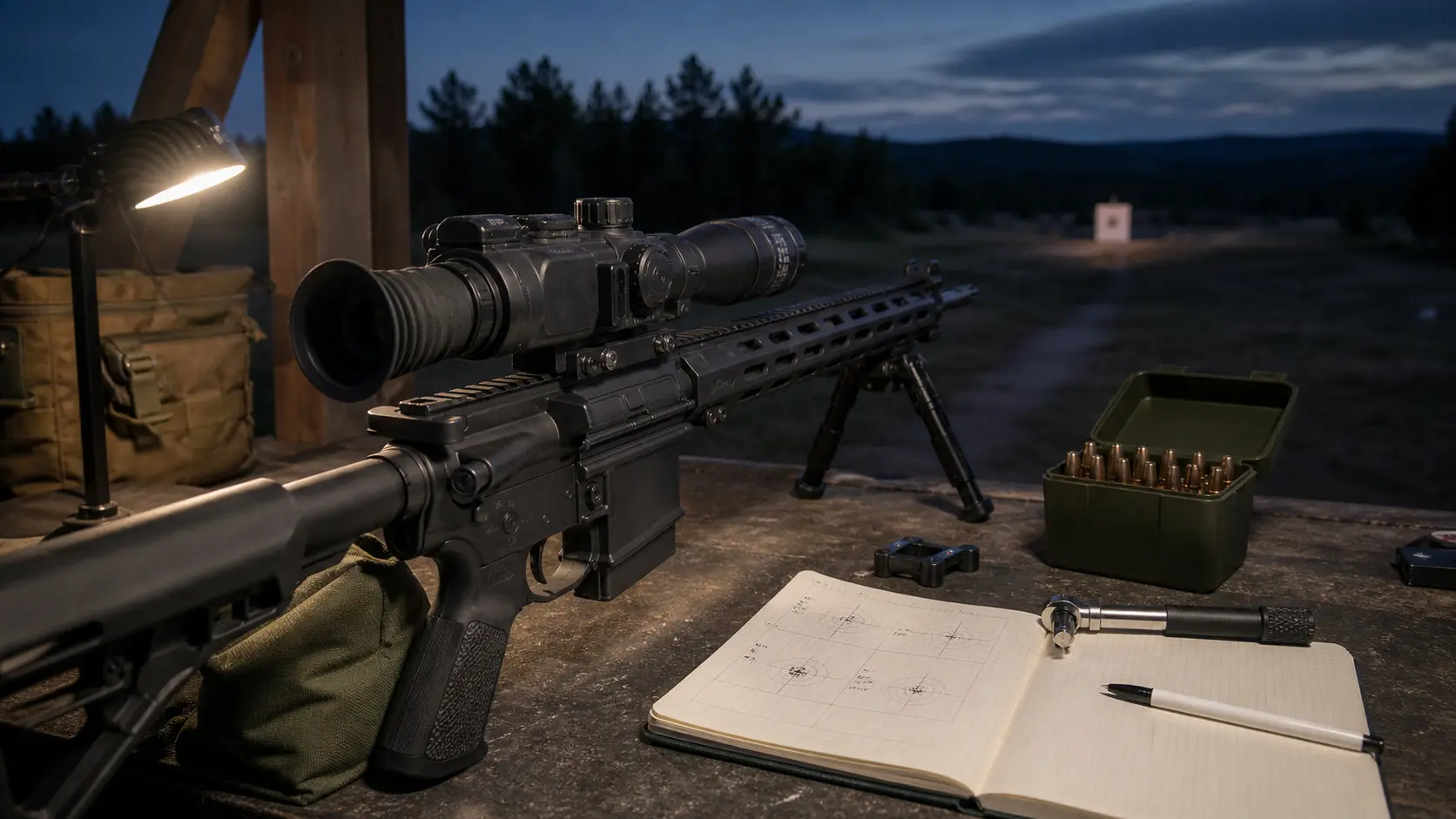
Thermal Scope Losing Zero? How to Diagnose POI Shift, Mount Issues, Profiles and Recoil Issues
A clean rifle zeroed and begins to miss hogs or coyotes a few nights later, and it’s easy to think, “Oo, must be the optic.” In some instances, it’s truly time for scope service. However, in the field, most of the reasons for a thermal scope ‘losing zero’ are due to some other factor: incorrect profile, loose mount, rail movement, ammo change, suppressor change, poor thermal target, recoil revealing a weak setup or inconsistent shooting position.
The challenge is to distinguish between a true thermal scope POI shift and a process issue that mimics optic failure. Prior to handling the optic, mount, battery compartment, cables or accessories, unload the rifle, remove the magazine, open the action and confirm the chamber is empty. Handle the muzzle in a safe direction throughout the inspection.
Quick Answer: Your thermal scope is losing zero because of several reasons.
The majority of apparent zero issues are the result of the following: the wrong thermal scope zero profile, a loose mount or rail, a change in ammo or suppressor, a “zero” that was never confirmed with the scope, poor thermal target contrast, recoil revealing poor hardware, or a field position that may differ from the bench.
A true thermal scope not holding zero issue is possible, but only after the rifle, mount, profile, ammo, target and shooter variables have been controlled.
The first step is to determine if it is really a zero problem or not.
The factors of night hunting are distance errors, wind, animal movement, awkward body position, fatigue, gloves, adrenaline, and a lack of feedback post-shooting. A single missed shot does not indicate that the scope moved.
One Miss Does Not Equal Zero Loss
If the rifle was bumped hard and then you miss several animals in succession check zero. However, don’t begin to tweak digital coordinates or hardware yet if one hurried shot was fired from a guess distance using a tripod. Ask for change: range, wind, rest, animal angle, ammo, suppressor on or off, or your position behind the rifle. That review can avert bogus thermal scope zero shift and thermal scope zero problems.
During the review process, confirm with a group, rather than one bullet hole.
Employ a safe range, a secure rest, and a thermal target that is discernible by the sensor. Shoot and score the group and not just one bullet hole. If the group is tight and it’s far from the point of aim, there’s actual thermal scope point of impact shift. A wide group points to consistency first.
Refer to USA Night Vision’s thermal scope reticle zeroing guide for normal setup basics. This article is about a scope which was already zeroed in and now looks like it’s moved.
Use the distance that was originally zeroed.
It is also important to confirm at the original zero distance first. A rifle set up at 50 yards might not register “dead center” at 100 yards, particularly with slower loads, subsonic ammunition or high optic over bore. Afterwards, try out real hunting distances.
To avoid potential injury, check the Zero Profile before touching the mount.
A lot of thermal rifle scopes will store zero digitally. A simple profile error can be indistinguishable from mechanical failure.
Using the wrong rifle, type of ammunition, or distance profile.
Always check the active profile before handling screws. Profile A could be for one rifle, Profile B could be for a second caliber, and Profile C could be for a suppressed rifle. An old ammo profile, different zero distance, previous range session saved coordinates or a profile made for a different rifle are common errors. Be sure to verify this before assuming it is a broken scope for a thermal scope wrong profile issue.
The reticle is adjustable. Range, ballistic and reticle settings are variable.
Some clever scopes incorporate ballistic inputs, range data, reticle modes or holdover features. Even if the base zero is correct, the aiming solution can be incorrect if those settings are wrong. Refer to the manual for your particular model.
The behavior of a profile could change with a firmware update.
Not all firmware updates will remove profiles. Models vary. However, after performing any firmware or app sync, reset or profile import/export, check the active profile and zero before hunting. When investigating a potential thermal scope firmware zero profile problem, USA Night Vision’s guide to thermal scope firmware updates, apps, zero profiles is helpful.
Mount and Rail problems are the most common mechanical issues.
If the profile is correct, check the mounting system. If the mount moves or the rail slides, the rifle can miss even with a perfect scope. Check out how to mount a thermal scope for basics.
Loose screws, rings, or QD levers may be present.
When the rifle is unloaded and safe, check the mount, rings, base screws, QD levers, risers and adapters. Check for spaces, uneven clamping, variation in lever tension or moveable hardware. Follow manufacturer’s torque specifications and thread locker instructions. Thermal scope mount loose can be caused by insufficient tension, and over tightening can cause damage.
The scope was not returned to the same rail slot.
With transport, storage or a day-time optic, the place of the rails is significant. Putting it back into a different slot will alter POI. Once it is confirmed that there is zero, mark the rail slot and place the optic back in the same place on the rail each time.
The movement of rail, receiver or adapter.
Inspect the rifle rail, receiver screws, cantilever mounts, clip-on adapters, risers and stacked mounting systems. Thermal scope rail movement is a common issue in AR set-ups.
Paint Marks and Witness Marks
After correct installation and zero confirmation, mark the positions of the rail, and the mount to the body of the mount and the mount to the rail. If marks are broken after recoil or transporting or a hard bump, something moved.
Recoil, Caliber, and Rifle set up are included.
Recoil is a test of the entire system: optic, mount, rail, receiver, stock fit and shooter position.
Recoil Rating and Caliber Compatibility
When a thermal scope loses zero after recoil, ensure that the optic and mount are suitable for the rifle and load. Heavy recoil and lightweight rifles show weak mounting immediately. Review the published thermal scope recoil rating and thermal scope caliber compatibility and read USA Night Vision’s article on thermal scope recoil rating and caliber compatibility.
Guide to suppressors, muzzle devices, barrel harmonics.
Adding or removing a suppressor can affect the point of impact when the optic is on zero. As can changes in muzzle devices. Consider the thermal scope suppressor zero shift as a rifle setup variable and then confirm with the specific setup you use when hunting.
AR Platforms vs Bolt Guns
For AR platforms, you should monitor things like charging-handle clearance, rail position, stock length and repeatable head position. In bolt guns inspect rails, bolt clearance, comb height and mount stability.
Thermal Scope Failure Can Be Ammo and Load Changes.
Most of the time it is not optic failure, but a thermal scope ammo change zero problem. Various load types can be printed at various locations.
The weight of the bullets and their velocity will change according to the lot.
POI can be shifted due to the use of different bullet weights, velocities, bullet designs or even due to the use of different ammunition lots. If you change ammo between zeroing, return to the original load. If the rifle goes back into center, the scope is not to blame.
Setups come in three varieties: subsonic, supersonic, or suppressed.
Trajectories can be very steep with both subsonic and suppressed setups. Make sure it is confirmed at real hunting ranges, not just the easiest range bay.
Analysis of the temperature and cold-bore effects.
A gun can act one way on a warm day at the range and another way on a chilly night in the field. Log patterns rather than assuming failure of the optic.
Thermal Target and Zeroing Process Mistakes
Thermal optics require a target which the sensor can clearly resolve.
Poor Thermal Contrast
Paper alone does not look good. Hand warmers can be of assistance but if they are too big or blooming, the center is difficult to define. However, backers that have been exposed to the sun or a sloped background can also cause a cloudy aiming point.
One-shot zero and freeze zero are useful, but not final proof.
Thermal scope one shot zero and thermal scope freeze zero can be helpful to get on target quickly, but they should not be considered definitive. Take a group and only save the profile when the rifle is correct.
The zoom function is digital, offering precision aiming.
Digital zoom may be used to zoom to a small target, however, this may cause the image to be blocky and amplify wobble. Be certain to magnify enough to get a good target, and then make an honest assessment of the group.
Understanding how the shooter is positioned can make all the difference in achieving consistent impacts.
Zero confidence is based on a repeatable rifle position.
Cheek Weld and Eye Relief, Scope Position.
Thermal scopes are typically mounted differently than daytime optics. Change in head position may be shot to shot if eye relief/stock position/cheek weld is awkward. If you’re stretching out or fighting the image, review the information from USA Night Vision on the eye relief of thermal scopes.
Bench Zero vs Field Position
Rifle grouping from bags can be different from tripod, sticks, blind window and sitting. Which is important when it comes to a thermal scope for hog hunting or a thermal scope for coyote hunting, where rests are not always ideal.
Trigger Control and Follow-Through at Night
Gloves, fatigue and adrenaline all affect the control. Don’t blame the optic, blame the rifle for not being steady on recoil.
Transport, Impacts, and Field Handling
If a rifle is bounced, dropped or packed poorly on Tuesday it can be off by Friday.
Truck Rides, Cases and ATV/UTV Vibration.
Vibrations may exacerbate any weak screws and loose connections. A hard case is helpful, however, the rifle still must be contained within the case.
Drops, bumps and hard impacts are dealt with.
If the rifle has been given a jarring blow, check all components. If dropped, it can cause the mount to move, move the rail, or damage the optic.
Battery doors, cables and accessories in contact with the scope.
Lens caps, accessories, external battery packs and cables should not pull on or obstruct the optic or mount.
Step-by-Step Diagnostic Checklist
Call a thermal scope warranty problem ONLY after using this order.
1. Unload and Make Safe Rifle
Remove the magazine, slide open the action and ensure that the chamber is empty before handling the optic, mount, batteries or accessories.
2. Check Correct Profile, Rifle, Ammo, and Zero Distance
Verify active profile, rifle, load, suppressor status and zero distance before moving hardware.
3. Check Mount, Rail Slot, Screws, Rings and QD Levers
Follow manufacturer’s instructions and torque requirements exactly. Verify rail slot and lockup.
4. The Original Zero Conditions will be recreated.
The same rifle, ammunition, suppressor setting, target range, and stable rest that were used for the original zero should be used.
5. Take a Group shot and Mark the Center.
Diagnose the group center, NOT one shot. A tight shifted group is not the same as a wide group.
6. Recheck After Recoil
Repeat this process after a few rounds and take a new group of shots. Look for the impact walk, broken witness marks, lever tension change or mount movement.
7. Save the Profile and Document.
Set down the profile name, rifle, ammo, suppressor setting, zero distance, mount slot, and Date.
8. Try from the Real Hunting Position.
Once you have completed the bench check, confirm from your tripod, sticks, blind or field position. When the issue persists, check the USA Night Vision thermal scope troubleshooting guide. Refer to thermal scope maintenance and field care for routine maintenance.
There are instances when it may be an actual scope or warranty issue.
Once you’ve controlled the rifle, the mount, the ammunition, the profile, the target and the shooter, a real optics problem is more likely.
Repeatable Shift With a Verified Rifle and Mount
If the rifle groups good, the mount and rail are verified, the profile is set up correctly, the same ammunition is used, the target is well defined and POI still moves repeatably, contact the dealer or manufacturer. A zero log is more useful than saying the thermal scope won’t hold zero (no test conditions attached).
Random Reticle/Profile Changes
It should be taken seriously if the profile gets lost without any explanation, cannot save the coordinates, or if the menu is unstable, the same profile is lost again, or the settings change on their own. Write it down and report to the support services.
Impact Damage, Water Intrusion or Electrical Symptoms.
If the device has visible damage to the exterior, fogging inside, water damage, power outage, burning odor, frequent power offs, or damage to the battery compartment, the issue is not normal troubleshooting.
Prevention: How to Maintain a Thermal Scope Zeroed.
Profile names, such as rifle, load, zero distance and suppressor status. Mark rail slot and rail mount. Check Zero after mounting removal, changes of ammo, suppressor, firmware, hard impacts, or changes of the optic to different rifles. Simple logbook entries: Date, Distance, Ammo, Suppressor, Profile, Mount slot, Weather, Group result. That log makes future Thermal Scope troubleshooting from guesswork to pattern recognition.
Final Takeaway
Since a thermal scope “losing zero” is often a process problem, it is best to treat it as such. Safety, Active Profile, Mount, Ammo, Suppressor, Target, Recoil, Shooter Setup. If the optic still does not hold zero after controlled testing, discuss the issue with the dealer or manufacturer, with notes.
FAQ
Does this mean that a thermal scope can lose zero?
Yes, but not until you have eliminated incorrect profiles, loose fits, rail shifting, ammo changes, changing suppressors, bad targets, recoil and shooter fit.
Can zero change if you remove the thermal scope?
It can, particularly if the mount does not repeat reliably, or if the scope doesn’t return to the same rail slot.
Is it possible for a thermal scope to lose zero due to recoil?
Recoil can reveal a weak mount, loose rail, incompatible set-up or optic outside of its recoil range.
Is it possible for the thermal scope zero to be changed by a firmware upgrade?
This varies from model to model and update. Always read manufacturer’s guidelines and check profiles prior to hunting.
How often should thermal scope zero be checked?
Check before season, after mounting changes, after a hard impact, after firmware/Profile changes, after ammo/suppressor changes, or anytime field impacts do not correlate with the reticle.
If my thermal scope doesn’t keep zero, should I contact support?
Yes, after verifying that all of the above factors are correct (shooter, target, rifle, mount, ammo, suppressor). Immediately contact support for impact damage, internal fogging, water intrusion, power failure or profile data that cannot be saved.

Can You Use a Thermal Scope During the Day? Daylight Use/Sun Safety and Zeroing Tips.

Night Vision Range Explained: Detection, Recognition, Identification, and Real Hunting Distance

How to Set Up an IR Illuminator for Night Vision: Placement, Beam Width, and Field Mistakes