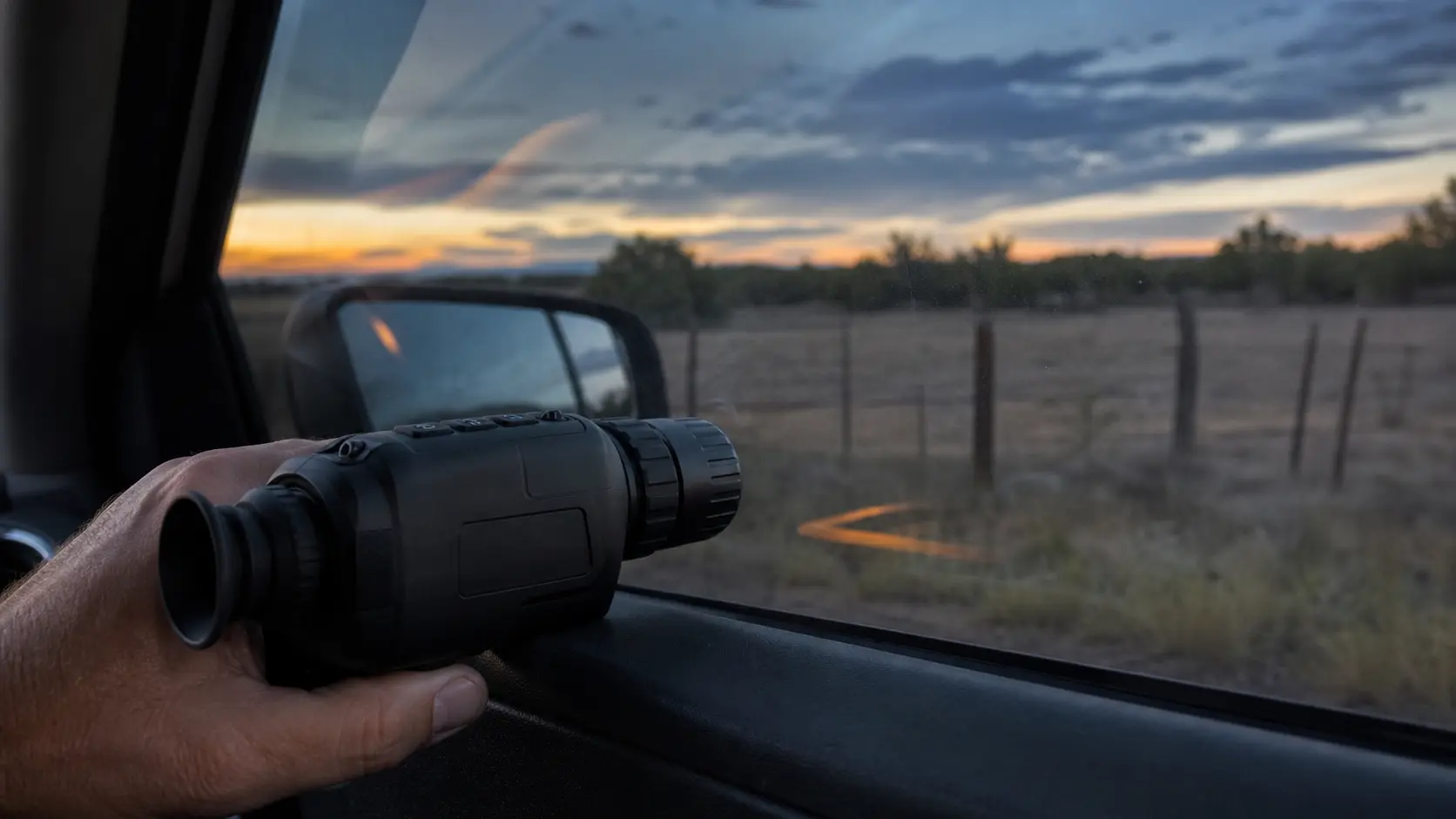
Can Thermal Scopes See Through Glass? Windows, Trucks, Blinds, and Field Limits Explained
Can thermal cameras detect through glass? What are Windows, Trucks, Blinds and Field Limits?
Do thermal scanners work on glass? The short answer is no, for normal hunting and ranch use. The long-wave infrared signal that most thermal optics use is blocked and reflected by ordinary glass, including a house window, truck windshield, box blind window or a barn window.
An inside reflection or ‘ghost’ shape may still be visible. Thermal is helpful but can’t replace X-ray vision.
No, Thermal Scopes cannot reliably penetrate ordinary glass.
The Short Answer
Typical thermal imaging devices will not detect useful animal heat signatures through standard glass, house windows, truck glass, barn windows or enclosed blind panels.
When attempting to use the thermal scope behind a glass window, bright spots, reflections or a flat image may be displayed. So, is it possible to use a thermal scope through a window? In a manner you wouldn’t want to rely on for identification purposes. The lens usually requires an open space for a usable image.
Why Regular Glass Blocks Thermal Signatures
Thermal Scopes are used to identify emitted infrared energy, NOT visible light. Most hunting thermals work with long-wave infrared radiation. To your eyes ordinary glass may look clear, but not to that part of the spectrum.
That’s why you’ll find "can thermal imaging see through glass" a different answer as compared to "can a phone camera see through glass. Animals, ground, brush, gates, buildings and equipment are sources of heat for a thermal scope to pick up. A regular glass block or reflect a significant amount of that signal.
What you might see instead: reflections, room heat and misleading shapes.
You can see the glass reflection of your face or dashboard, heater vent, blind wall, or room interior through the glass. The glass itself may be visible as well.
Shapes can deceive you. A cab reflection can appear to be motion outside the cab window. If the image moves or if it is gone when you move away from the glass, you were probably reading the barrier. This is the actual explanation for why hunters cannot view through glass like they would like to with thermal cameras. Refer to USA Night Vision’s guide for [Thermal Image Settings Explained \[2026\]](https://usanightvision.com/blog/thermal-image-settings-explained-2026/) for image interpretation questions.
Understands why a Thermal Scope doesn’t work through windows and windshields of trucks.
The side windows and windshields are not the same.Side windows and windshields are NOT equal.
A truck side window and windshield are different materials, but both are poor paths for thermal signals. Generally, a thermal scope windshield view will display blocking, distortion and cab reflections.
Side windows can be just as misleading, too. Pull into a ranch gate with the window rolled up and the pasture may appear flat. If you roll the window down, the feeder, fence, cattle, brush line or hogs may look fine. The optic didn’t change, just the glass blocking the signal was removed.
Tinted Glass, Laminated Glass, and Heated Glass
Tint is not a solution to the issue. Tint is not about the transmission of long-wave infrared, it is about the visible light and solar control. More clutter from laminated windshields, defrost lines, coatings, dirt and moisture.
Therefore, in response to “can thermal scope see through truck window”, the field is no, not in a manner you can easily rely on for identification.
The pros and cons of rolling down the window.The advantages and disadvantages of rolling window down.
The scope gets an open-air view when you roll down the window. It can now detect the heat of a hog in the pasture, a coyote close to the brush line, a person close to a gate or cattle near a fence.
However, it doesn’t imply that you should develop an unsafe vehicle shooting habit! Only use open-air scanning where legally required, it is safe to do so, and never use a rifle-mounted optic to cover something that you have not already determined is safe.
What about hunting blinds, barn windows and house windows?
Enclosed Blinds with Standard Glass or Plexiglass
A hunting blind setup thermal scope can often be impeded by closed glass or plexiglass. Many plastics are opaque or cause distortion of the useful thermal signal, while standard glass blocks it. When you ask “does plexiglass block thermal imaging”, just presume that it does unless it is tested for your optic as thermal-transparent.
With a box blind, the warm inside wall/frame, hands and/or reflection can be seen on the closed panels. The outside hogs may not come out until the window is opened.
The same applies to a thermal scope with plexiglass: The clear-looking material should not be used as an indicator of long wave infrared transmission.
Open up some windows, use shooting ports and add some mesh screens.
The open shooting port alters the image due to the thermal lens seeing open air. Thin mesh can impair clarity and can gather dew, but is not glass. Test it prior to the hunt by comparing mesh, open port and closed panel views.
Clear the muzzle from the frame (when shooting rifle). Check the lane, the background or the rules in the area before the animals arrive.
Thermal-Transparent Film or Specialty Materials May Matter When…
Certain specialty materials are more transparent to some wavelengths of infrared radiation than is ordinary glass. Random clear plastic typically won’t. If you wish to have a thermal transparent blind window, check the material and try the blind window with your real scope.
A simple, more reliable, window or shooting port is more easily established for most hunters.
Can Thermal Scopes penetrate brush, grass, smoke, rain or fog?
Brush and Tall Grass: Partial Heat Signatures, Not X-Ray Vision
Can thermal scopes see through brush? Occasionally they demonstrate some partial heat via gaps but not solid cover. A warm back is an indicator that a hog is behind thin grass. Behind mesquite or weeds a coyote may show and vanish through holes.
Brush-line heat is a clue NOT a target. Wait for an open lane if brush is obscuring shape, movement or background.
That is, can thermal scanners penetrate brush to catch animals? Only part way and only when sufficient heat is exposed through openings.
Smoke, dust and light obstructions.Smoke, dust and light obstructions.
Are thermal scopes able to penetrate smoke? But often better than visible-light optics can — albeit not perfectly. Light smoke or dust may still allow detection. Detail is reduced by heavy smoke, hot equipment and wet vegetation. Thermal is not identification, it is simply a tool to help find heat.
Rain, fog, and high humidity are conditions that are addressed in the dedicated Fog/Humidity Guide.
Rain can still affect a thermal scope, as wet lenses, wet grass and warm ground will affect the image. In fog, a thermal scope might see heat but not be able to see detail.
To learn more about the weather, check out USA Night Vision’s thermal scope fog and humidity to night hunting post.
A Field Workflow on how to scan without having glass in the way.A Field Workflow for scanning without the glass getting in the way.
From a Truck or Side-by-Side
When using a truck with a closed window to check a ranch road, gate, feeder or pasture, do not rely on a closed window thermal image.
Park in a lawful, safe location. Roll down the window or step out (if safe to do so). If possible, use a handheld scanner first. Look for prominent points: gate, feeder, fence post, trough and brush line. Be cautious of all heat sources until they have been confirmed.
Take one from a Box Blind or Ground Blind.Take one from a Box Blind or from the ground Blind.
Prior to the hunt, open the window or port you will be using and make sure of the view. Look in the feeder, lane, backstop, brush edge and livestock areas. If the blind is made of plexiglass, see if it’s in the open or closed position.
Around Barns, Gates, and Ranch Buildings
Although barn and house windows are attractive, they are not good thermal viewing windows. Instead, move to a doorway, window or porch that is wide open or a secure outdoor location.
Heat can be retained around the buildings on the ranch, on tractors, tanks, concrete, gravel and gates long after sunset.
This is a comparison of scanner and rifle-mounted scope safety.Here’s the scanner vs rifle mounted scope safety comparison.
When scanning with a rifle mounted scope then the rifle moves with the scope. It is a bad default habit around roads, homes, barns, livestock and neighbouring property.
A handheld scanner allows you to look first and then pick up the rifle once the target area is clear. That workflow is covered in thermal scanner vs thermal scope night hunting.
Please Note: Hunters are advised to follow all safety and legal regulations.
Some of these thermal scope safety and thermal scope hunting tips are intentionally conservative as improper identification, glass, reflections, and vehicles can all lead to poor decisions in the field.
Don’t mistake Thermal for "shoot anything you don’t know.
Thermal detects heat. Does not determine species, legality, sex, background, property line or intent. It cannot penetrate walls and a closed window is not a safe shooting lane.
Positive identification remains positive knowledge of the animal, background, legality and safe direction.
Different states have different vehicle, road, and property rules.There are state by state differences in vehicle, road, and property rules.
Each state and county has its own regulations for night hunting, use of thermal optics, use of vehicles, roads, land type, species and seasons.
Before the hunt, be sure to check the Local Night Hunting and Thermal Rules!
Become familiar with current state and local regulations prior to hunting. USA Night Vision’s night vision laws by state (2026) guide is a good starting point, but check local laws.
Common Mistakes
Trying to Scan Through a Windshield
You can see through the windshield, and you believe that the thermal scope windshield view should function. This is generally not the case.
The confusion of reflection for heat signature is a common mistake.It’s a common error to mistake a reflection for a heat signature.
A heat shape that moves with your body or changes with the angle of the glass is not a dependable outside target, nor is a heat shape that disappears when you open the window.
Suppose Thermal can wander through walls.Let’s make the assumption that Thermal has the ability to pass through walls.
Does thermal have the ability to see through walls? No. A thermal optic can also be used to reveal heat patterns on a wall, door, roof, or window but they are viewing the surface, not through the structure.
You can zoom in using the zoom function before confirming the target.Zoom can be used prior to confirming the target by using the zoom function.
Reflections or partial heat may appear more convincing when using high digital zoom, which will reduce field of view. Begin with the base magnification – zoom only if it is providing useful detail.
Quick Field Checklist
Before You Start Scanning
Clean up objective and ocular lenses.
- Look for condensation, dust or fingerprints.
- Check batteries, focus, NUC, palette, brightness, and contrast.
Know the safe directions, livestock, people, roads and property lines. Before believing the image open the window, port door or door.
Basic field care is important because dirt and moisture can cause a problem with glass to appear to be an optic problem. USA Night Vision’s thermal scope maintenance and field care guide explains the basics.
Take off your glasses when moving from glass to air.Remove Glasses when going from Glass to Air.
Put the focus back on after changing position. If the picture is not level, run NUC.
- Make comparisons with a familiar scene.
- Observe before making conclusions about the heat source and movement and behaviour.
Do not shoulder the rifle until there is a positive reason to do so.
When the Image Still Looks Wrong
If it still doesn’t appear correct, inspect for moisture, focus, palette, brightness, contrast, weather, battery and lens condition. If it still acts bad in clear open air, proceed to greater depth of troubleshooting.
FAQ
Do thermal cameras penetrate house windows?Are thermal cameras able to see through house windows?
No, not reliably. Most thermal scopes are designed to transmit and capture the long-wave infrared signal which is blocked and bounced off by ordinary house windows. In most homes, barns, blinds, and vehicles the answer is "can thermal scopes see through windows" is the same.
Are thermal specs able to penetrate a truck’s windshield?Are hot scopes able to see through vehicle windshields, particularly a truck?
No. A thermal scope mounted in a truck windshield typically is obscured, distorted or cluttered with cabin reflections. The field answer to the question "can a thermal scope see through a windshield" remains no for reliable identification.
Are Thermal Scopes able to penetrate through plastic?Are Thermal Scopes capable of penetrating through plexiglass?
Non-specially designed and verified ordinary plexiglass is not reliable for thermal transmission.
Can thermal scopes penetrate walls?Are thermal scopes able to pass through walls?
No, although thermal scopes can detect heat patterns on the surface of the wall, they are not able to see through walls like “X-ray vision.”
Are thermal cameras able to penetrate foliage?
Sometimes they will be able to smell out some heat through openings in brush or grass, but not solid cover.
Can thermal imagery work in fog?Are thermal cameras effective in fog?
At times they can detect heat in fog, but fog, rain and high humidity decreases contrast and identification range. But can thermal scopes work through fog and rain? They will still be able to sense heat, but the level of detail and ID confidence typically decreases.
Is it possible to use a thermal scope during the day?
Yes. Most thermal scopes will work in the daylight since they are based on heat detection. THERMAL SCOPE DAYLIGHT USE STILL NEEDS SAFE HANDLING, LAWFUL USE AND POSITIVE IDENTIFICATION.
Final Takeaway
So what is the answer to the question "why can’t thermal scopes see through glass" and the answer is the signal. While clear glass allows you to see with your eyes, it also absorbs and reflects a significant amount of long-wave infrared energy which thermal scopes operate.
When in the field, don’t use a thermal scope behind window glass, a truck windshield, a closed blind pane or a barn window. Operate in open air, utilize a handheld scanner if available, verify the scene with known landmarks, and until identification, background, safety and local rules have all been confirmed, treat each heat signature as unconfirmed.

Can You Use a Thermal Scope During the Day? Daylight Use/Sun Safety and Zeroing Tips.

Night Vision Range Explained: Detection, Recognition, Identification, and Real Hunting Distance

How to Set Up an IR Illuminator for Night Vision: Placement, Beam Width, and Field Mistakes