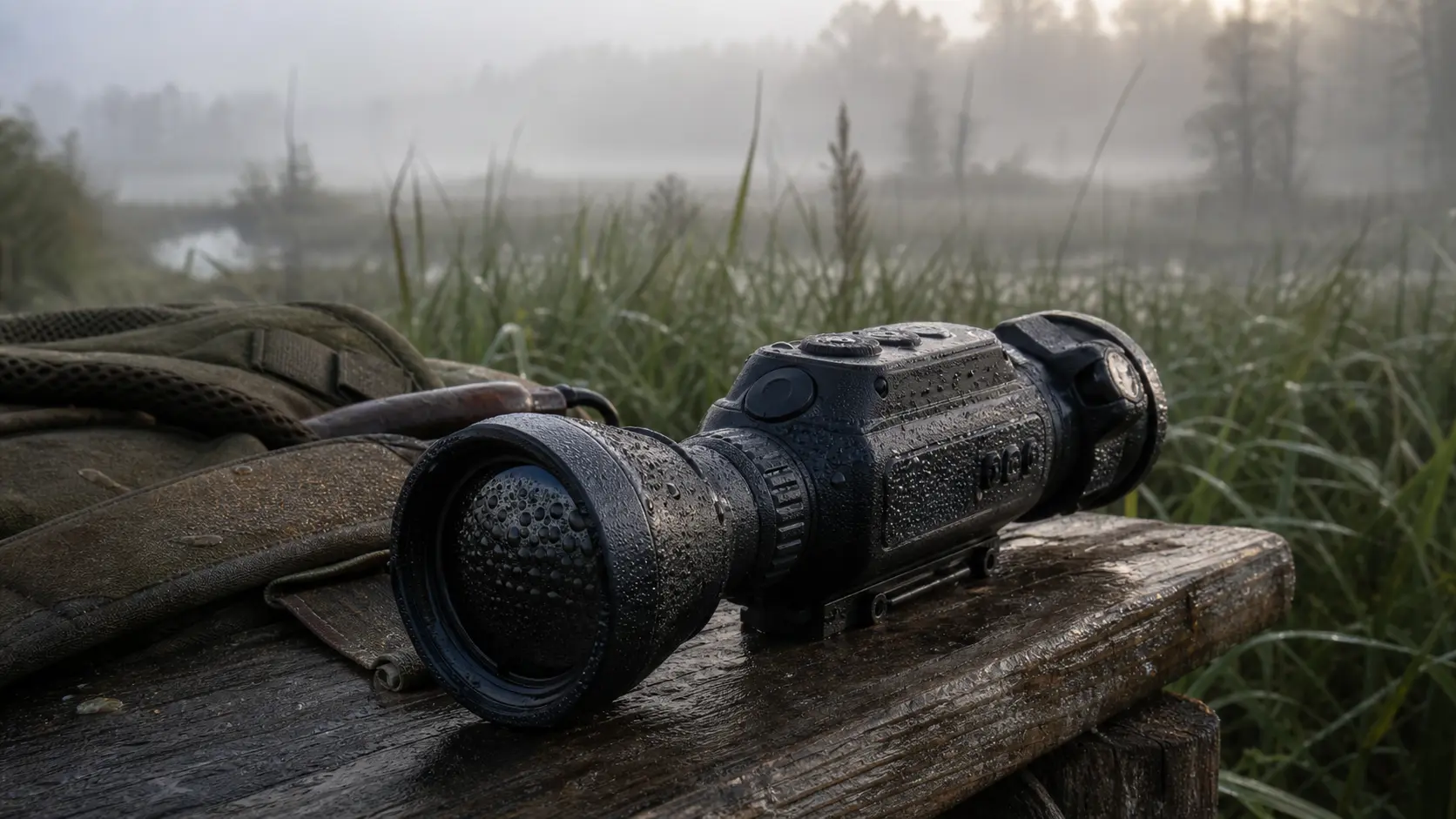
Thermal Scope in Fog and Humidity: What Night Hunters Should Expect and How to Fix a Flat Image
While fog and humidity don’t necessarily render a thermal scope ineffective, fog can make an image flat, range of identification shorter, and animals blend into the wet ground and brush. The first step to fixing it is to focus, to use a NUC, to use contrast, to choose the palette, and to be more conservative on shots.
What night hunters can expect in fog and humidity is addressed, along with suggestions for finding a good thermal image if it is flat.
A thermal scope in fog or humidity may be useful, but may not always appear as clean as it would on a cool, dry night. Wet grass, warm air, fog over a field and wet brush can result in a soft, low-contrast overall image, especially on a damp Southern evening.
That does not mean necessarily that the scope is faulty. The temperature difference required by the optic to create a sharp image has most of the time been lowered by the weather. You are expected to be able to identify settings that can be adjusted to improve the job, and those that cannot be safely adjusted.
Thermal can help you find heat in bad weather. It won’t make every foggy night a clear identification night. If the image remains flat, move closer, wait for a better angle or use another observation device or walk away.
Quick Answer: Do Thermal Scopes Work in Fog, and Does Humidity Affect Thermal Scopes?
Thermal scopes can be used in fog and humidity, but range and detail may suffer. Useful detection may be possible in light fog. Fog, mist, heavy rain, warm wet cover and thermal crossover hunting conditions can turn the picture into a blurry moving blob with little detail. That is the realistic response to the question, "do thermal scopes work in fog?": Yes, they might display heat, but not sufficient detail to take a shot.
Use the following 3-step process when thinking:
- Detection indicates that you have located a heat signature.
- Recognition is being able to tell it is probably an animal.
- Identification is to be able to confidently determine what animal it is and if it is legal and safe to shoot.
It is typically bad weather that affects identification first. A bright blob on the edge of a field is not sufficient.
Why Fog and Humidity Make a Thermal Image Look Flat
Thermal scopes require a difference in temperature
Thermal scopes create an image based on heat differences, instead of light. A warm hog in the front of a cooler pasture is a standout. The same warm creature in front of warm wet ground and brush is not as crisply defined.
On a humid night, if you see a flat image with your thermal scope, the optic may be functioning as intended in a low contrast scene.
Humid air and wet surfaces reduce the contrast
Humidity has an impact on thermal scopes because wet surfaces and moist air diminish useful separation. Wet grass, wet brush, muddy ground, tree trunks, fence posts and metal gates can all retain or release heat in different ways than on a dry night.
Those surfaces can remain warm for several hours after a hot day. Following rainfall they may cool unevenly. It’s still warmer than the background, but the edges are blurred. Thermal scope fog humidity issues have to do with the overall functionality of the whole property in terms of heat and moisture.
When it comes to field conditions, fog, mist and rain are not the same thing
Although wet nights are grouped together by hunters, the thermal scope rain fog snow performance changes with each condition. A light fog might just “soften” the image. When fog is thick, it obscures detail. Until moisture accumulates on the lens, drizzle and mist might be OK. Rain can cause loss of contrast and make controls more difficult to operate. Snow can provide good contrast, but caution is still required when the snow is wet or blowing.
The question in the field is NOT "Can thermal see through weather?" The question is: "Am I able to see enough contrast and detail right now to identify the target?"
Detection Range vs Identification Range in Bad Weather
You may still see a heat signature before you can identify it
Thermal advertising abounds with mention of detection range. Thermal scope identification range is the basis for hunters’ decisions. Those two distances can split apart in poor thermal imaging fog performance.
You may be able to detect heat throughout a field and still not be justified in shooting. Any animal or person can exhibit as heat, such as a hog, calf, dog, deer, coyote, or person. Shape, movement, size, ways it behaves, where it is, and background is all important, and in fog it might not be as obvious as usual.
This is why thermal scope detection vs identification is a safety issue, not something drawn right out of a spec-sheet.
Coyotes are more difficult in humid weather than hogs
The thermal scope for hunting hogs in humid conditions has one benefit, they are larger and tend to congregate. One sounder under a feeder or traversing a field is more easily read than a small predator on a brush line.
A thermal scope for coyote hunting in fog asks more from the optic. Coyotes are narrower and smaller and often running in cover. The description of the animal(s) viewed should be detailed enough to distinguish a coyote from a dog, fox, deer fawn, or other non-target species.
When to shorten the shot window
When the picture is becoming too dark, there’s too much background, the animal isn’t fully exposed, or the weather is changing rapidly, shorten your shot window. Some tips for making the decision tighter:
- Get closer to your farthest distance shot for that night.
- Wait for the animal to walk into an open lane.
- Scan with a handheld scanner prior to rifle up.
- Make a comparison with known objects that are located near a feeder, fence, road or field edge.
- Never shoot if in doubt of identification.
Patience is the key to night hunting in fog. Bad decisions occur when you push hard for a shot that is flat.
Field Settings to Try on Humid or Foggy Nights
Don’t jump to the conclusion that you need the top humid environment thermal scope—work through the basics first. While settings may not be able to overcome dense fog, they can salvage a usable image.
When changing all of the menu settings, start with focus first
Start with focus. Focus the diopter until the reticle and menu text are clear and in focus. Then select the focus on the objective for the distance you are hunting. Humid night, a little bit off focus is interpreted as weather failure.
When the picture is degraded, run NUC / calibration
Use NUC calibration when the image becomes uneven, smeared or grainy. A non-uniformity correction (NUC) performed by a thermal scope calibration will help reset the image response of the sensor. If it seems the image is beginning to look bad, run it early and repeat in changing humidity.
Before using brightness too much, adjust the contrast
Brightness increases the screen’s brightness. Does not remove details in the thermal profile. Excessive brightness will overpower the image display and may deteriorate a low contrast image. On thermal scope settings for humid nights, consider thermal scope contrast settings as the first setting, and use brightness to make the screen comfortable.
To learn more about the settings, check out USA Night Vision’s guide to thermal image settings.
Give a white hot, black hot and one contrast-friendly palette a shot
For all hunting purposes, still my two go-to palettes are white hot and black hot. Depending on the background, one or the other may reveal the outline. Where wet cover is present, some colour palettes may be useful, but these are only used if they aid in identification.
Avoid using digital zoom when the image becomes noisy
Digital zoom cannot make detail that the sensor didn’t capture. In low contrast, may accentuate graininess, blurriness, and blocky edges. When the low contrast issue with the thermal scope worsens as you zoom in, zoom back out.
Specs That Matter More in Fog and Humidity
NETD and thermal sensitivity
NETD is important in humid climates. In the case of thermal scope NETD humidity questions, lower NETD tends to be desirable, as the scope is capable of differentiating between smaller temperature differences, which can be beneficial when wet brush and warm ground and animals are closer together thermally. However, a low NETD number doesn’t overcome dense fog, incorrect focus, inadequate processing, a poor lens, or unsafe identification.
There are several different sensor resolutions, including 384, 640, and higher
The resolution of the sensor is important for the amount of detail that can be used. 384 sensor can operate at moderate ranges. More detail and more space for identification, cropping and moderate zoom is provided by a 640 sensor. More resolution helps retain shape in humidity, but does not make a dense fog bank transparent.
Lens size and base magnification
The size of the lens and the base magnification will influence distance as well as field of view. A higher base magnification and/or larger lens might be helpful in open areas, while feeding areas and brush may need more field of view. Correlate the optic with the property.
Image processing and scene modes
Forest, high humidity, enhanced contrast, or other scene modes are offered by some scopes. These may be useful if the processing is well optimized, but test in your real situations. Good controls are important as well: in Gloves or Rain, it’s important to be able to change settings without fighting the menu.
Common Mistakes Hunters Make in Foggy or Humid Conditions
Assuming the scope is broken
Weather can cause the thermal scope weather performance to be compromised without any fault in the optic. Compare against a cool dry night before putting the blame on the scope if it only looks bad on warm, wet, foggy nights. When the issue occurs in all conditions, employ a genuine thermal scope troubleshooting procedure.
Turning the brightness up too high
Brightness is a simple solution, but can turn a flat image into a glaring flat image. Brightness for the eye, contrast, focus, NUC and palette choice for the image.
Trusting detection without identification
Even in humidity, a thermal scope can reveal a strong heat source; however, the shape of the animal and its movement may be obscured. It’s all about positive ID: legal target, safe direction, known background, and clean shot window.
Lens moisture and external condensation are ignored
At times the issue is caused by the weather on the optic. The image may soften if there is moisture on the objective lens, eyepiece, lens cover or port area. Take note of waterproof ratings and exposure to the elements, along with basic maintenance and field care. Waterproof doesn’t equal careless.
Practical Setup Checklist Before a Humid Night Hunt
Before looking for the magic menu settings:
- Check the objective lens, eyepiece, battery cap, port covers and lens covers.
- Turn on early and allow optic to stabilize.
- Adjust the diopter to fit your eye and the ocular/objective focus for the distance you expect to measure.
- Run NUC before the stand and again if the image deteriorates.
- Consider white hot or black hot.
- Change contrast (before brightness).
- Identify target at a known distance (feeder, post, gate, or terrain marker).
- Reduce the distance of the shot if the picture still looks flat.
- Dry the optic before storing, particularly after fog, drizzle, rain or wet brush.
If you too struggle with the runtimes on wet or cold days, plan power before heading out to hunt. Here, USA Night Vision’s thermal scope battery life guide comes in handy.
If You Are a Hunter in the Humid South, Here Are a Few Tips on What to Look For
When hunting a regular basis, whether it be for hogs, coyotes or ranch properties, purchase for actual weather conditions, not for perfect test shots. Not all thermal scopes are created equal, and the best thermal scope for humid conditions is not just the one with the biggest advertised range.
Seek out lower NETD, sufficient sensor resolution for your actual ID range, adequate lens size and base magnification for your terrain, usable field of view, controls you can operate blind, useful scene modes, weather-proofing that you can depend on, battery considerations, and dealers who know the hunting world.
For the rest of you who still have to select your first setup, USA Night Vision’s guide to choosing a first thermal scope will help you make your decision. Be truthful about your hunting location. The hunter who is hunting coyotes in open, dry country may prefer a different scope than the hunter who is hunting in a wet pasture and dense timber in July.
Final Takeaway
Thermal scopes are not rendered useless by fog and humidity. They do make the work more difficult. Humid air, wet vegetation, warm ground, rain, and thermal crossover hunting conditions can cause an image to be flattened and the range of realistic identification decreased.
It’s not to “force the shot.” Start with focus. Run NUC. Adjust contrast prior to brightness. Attempt white hot, black hot and one functional palette. Reduce Digital Zoom when image becomes noisy. Progress to shorter distance until ID is confident.
While a thermal scope is a great night hunting tool, it’s still looking at what’s in front of it. On a night when it is raining and foggy and humid, the astute hunter will be more cautious about each heat and allow positive identification to determine the shot.

Can You Use a Thermal Scope During the Day? Daylight Use/Sun Safety and Zeroing Tips.

Night Vision Range Explained: Detection, Recognition, Identification, and Real Hunting Distance

How to Set Up an IR Illuminator for Night Vision: Placement, Beam Width, and Field Mistakes