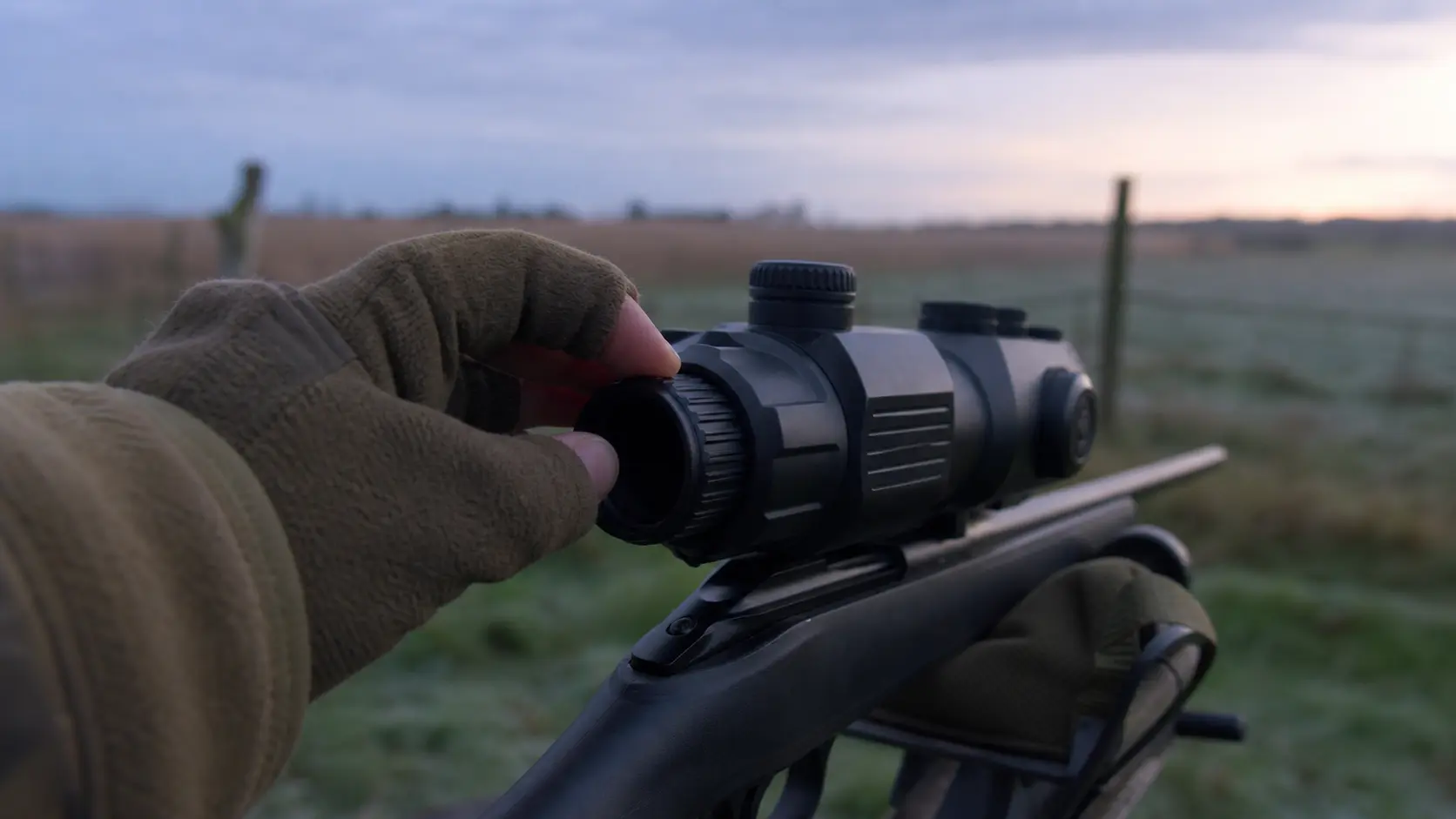
Thermal Scope Fixed Focus vs Manual Focus: Which One is Best for Hunting?
Fixed focus – it’s convenient. Manual focusing provides added flexibility. The correct selection will vary according to the distance of the hunting, the topography, the size of the target and whether you are going to adjust the scope in the field.
In this article, we will be discussing whether a thermal scope with a fixed-focus or manual focus is better for hunting.
One of those questions that is asked but seems trivial to the buyer is thermal scope fixed focus vs manual focus. The sensor may be good, the lens size may be appropriate, the NETD may be fine, and the display may be clear, but if you’re not a fan of the scope’s focusing system, you may find that the picture isn’t sharp when you need it to be.
I see this most commonly when hunters attribute resolution and/or digital zoom as the first culprit. It’s not always about the scope. In some cases the dioptre was not properly adjusted at all. Of course, at times the goal is a feeder distance shot, and the hunter is attempting to call a coyote much further away. And sometimes a fixed focus thermal scope is simply being asked to do a job it was not built to do.
There is no magic to the word Focus and it doesn’t make a budget optic a premium one. It cannot add any more detail to a sensor, cannot reduce NETD, and cannot make a questionable target legal. However, with proper thermal scope focus, you can maximize the detail the optic provides, and that can go a long way in hunting hogs, coyotes, security on a ranch and field work of mixed distances.
How about fixed focus or manual focus thermal scope?
A fixed focus thermal scope might be the more convenient option for near range hunting for hogs, feeders, brush, beginner hunting, and plain scanning. It’s more speedy, easier to operate in low-light conditions, and is appropriate if most of your viewing takes place within a reasonable range of distances.
A manual focus thermal scope is typically the best choice for coyote hunting, in crop country, mixed distance setups, when it comes to using a digital zoom, and when identification becomes more important than quick detection. If you’re using manual focus, then you have some control over the scene you’re focusing on at different distances… but only if you’re using it correctly.
The compromise is:
Fixed focus is convenience.
- Manual focus is control.
- Both are not substitutes for sensor resolution, NETD, lens quality, field judgment or legal target identification.
When considering a general purpose thermal scope to buy for hunting I would ask about terrain first and then the focus system. A hunter who hunts feeder hogs in heavy terrain and a coyote hunter looking at wide open fields have different expectations of what they will do with the optic.
What does focus actually do on a thermal scope?
Thermal scope focus varies the sharpness of the target scene at a given distance. With focus correct, lines are sharper, animal form is more discernible and the image stays together until you begin to use digital zoom. If the focus is not correct, the heat will still appear; however, the details will appear blurry.
That distinction matters. A foggy thermal picture could still reveal a warm object in field. It might not be shaped or moving enough to be identified by you in terms of what it is.
Part of the image chain is Focus. It compliments sensor resolution, pixel pitch, lens size, NETD, display quality, firmware processing, thermal scope settings and weather conditions. Don’t read too much into one spec.
Focus is not the same as resolution of the sensor.
A 384, 640 or 1280 sensor describes detector resolution. Focus controls the sharpness of the picture that we are giving to that system. Even with a higher resolution scope, proper focus is required to reveal the details that can be useful.
That’s why there are two scopes that have the same specs but feel different in the field. A crisp, focused optic might be more useful than the technically superior scope that is poorly adjusted. However, if you need to compare sensor classes, USA Night Vision has a guide on sensor size and a breakdown of 384 vs 640 thermal scopes with a focus in mind.
Focus is not NUC or image settings.
Non-uniformity correction (NUC) is to clean the uniformity of the sensor image. Brightness, contrast, sharpness and palette settings alter the appearance of the image. Those changes are important, but they don’t correct an out of focus target.
If the target scene is soft, performing thermal scope calibration can result in more even images, but will not make a scene sharper if the coyote is beyond the focus distance. Always use the optical set-up first, followed by detailed settings.
Don’t Confuse Diopter and Objective Focus!
Of the two focus adjustments available, those that cause the most confusion to hunters are diopter adjustment and objective focus. They are NOT the same thing.
Diopter Adjustment
Adjusts the thermal scope display, menu, and reticle to your eye’s best focus. Usually it is adjusted at the eyepiece. Once it is properly adjusted to your eyesight it is typically left alone except in the event of a change in your eyewear or if another shooter is using the scope.
The first step of a good diopter setup is the reticle and menu. If the menu text or reticle appears fuzzy, don’t begin spinning the objective focus ring and searching for the target scene. First correct the Display-to-Eye relationship.
Objective Focus or Focus Ring
Thermal scope objective focus is used to make the target scene sharp at distance. With many manual-focus optics, that adjustment is accomplished using the front focus ring or objective housing. When switching from a feeder-distance hog stand to a stand further away, this is the control that you can adjust.
A good way to remember this is to think “diopter” sharp to eye and “objective” focus sharp to scope.
Fixed Focus Thermal Scopes have their pros and cons.
The fixed focus thermal scope is constructed with a range of focus that the manufacturer has selected. The user does not focus the objective for each distance. It’s a help or a hindrance, depending on the position.
When Fixed Focus Helps
When speed and simplicity are more important than fine control, fixed focus is a better option. It may be suitable for:
- Hogs over feeders
- Brush, timber and close lanes
- Short-to-mid-range property scanning
- Beginner thermal users
- Budget-first setups
- Shared ranch rifles or loaner rifles
- Circumstances where a smaller number of controls function better in the dark
The optimal use of a fixed focus thermal scope for hunting is a relatively predictable range. Fixed focus might be natural if you mostly watch trails, feeders, gates or short field edges.
When Fixed Focus is a Bad Thing.
Fixed focus starts to feel limited when the target distance changes significantly or you’re seeking out details for identification. That means open field coyote hunting, small predators, mixed-distance crop fields, and heavy digital zoom.
It’s not that fixed focus scopes are bad. The issue is that they give up field control. If the distance that the optic is setting for is not the optimum distance for the judgment, the image may be good enough to detect but not good enough to recognize or identify.
Manual focus thermal scopes have their own strengths and weaknesses.
Manual focus thermal scope allows for objective focus adjustment in response to the actual scene. That control is convenient at times when distance varies but is one additional control to deal with.
When Manual Focus Helps
Most manual focus is useful when it comes to detail. It is particularly helpful for:
- Coyote and predator hunting
- Open fields and crop country
- Mixed hunt (hog and coyote)
- Higher-resolution thermals
- Digital zoom use
- Longer identification windows
- Ranch work where distances change from stand to stand.
Thermal scope hunting requires discipline, a step-by-step manual focus approach. Refocus at the actual distance before judging the optic, judging the target or zooming in very hard.
Manual focus can be irritating in certain situations.
Manual focus is not free performance. Gloves, cold hands, hard focus rings, compact rifle setups, or a moving hog can be a problem. It can also be used inappropriately. If a hunter neglects to refocus after the final stand, he might obtain a poorer image with the more complex manual-focus scope than with a simpler fixed-focus scope.
How it is mounted can make a difference, too. When the scope position, rail accessories, suppressor setup or external battery cable obstruct the focus ring, an adjustment won’t occur when it needs to be made. USA Night Vision has a guide on how to mount a thermal scope in their blog.
Fixed focus vs manual focus by Hunting scenario
| Scenario | Better Fit | Why | Watch Out For |
|---|---|---|---|
| Hogs over feeders | Fixed focus or manual focus | Often, distances are predictable and simplicity is a good fit | Never assume a heat blob is sufficient to identify a target |
| Brush and timber | Fixed focus | Often fast handling and wider, closer viewing is more important than perfection of fine focus control | A fixed-focus image could still be soft outside its optimal range |
| Mixed hunting (hogs and coyotes) | Manual focus | Target may shift rapidly from close to distant targets | Refocusing may be required when switching from close to distant targets |
| Open-field coyote hunting | Manual focus | Smaller animals and longer looks require better sharpness of the scene | Weather, motion and background contrast still present challenges to image clarity |
| Ranch security scanning | Distance dependent | Use fixed focus for close gates and barns or manual focus over longer segments | Don’t mistake detection for identification |
| First thermal scope buyer | Fixed focus for simplicity, manual focus for growth | Manual focus allows for more control as skills develop, fixed focus reduces mistakes | A diopter setup must be learned, even by a beginner |
| Use with digital zoom | Manual focus | Zoom magnifies the existing image, including focus errors | Refocus before using heavy digital zoom |
| Long identification distances | Manual focus | Better control of target sharpness, means more use of available detail | Focus does not guarantee identification range |
How focus affects detection, recognition and identification.
The focus has a direct impact on the usefulness of the image, but no effect on the distinction between detection, recognition and identification. USA Night Vision has a comprehensive guide on detection, recognition, and identification and focus falls under that guide!
Even if focus is poor, detection can still look impressive.
Detection — you saw a heat source. A bright shape can be a hog, deer, calf, dog, coyote or even a person with less focus. That’s great when you’re in the dark of night or on the screen, but it’s not sufficient on its own.
Instead, this is where the hunters fall victim of deception. A fixed-focus scope might see the heat from a distance and not see sufficient detail for a positive identification. If it is adjusted properly, a manual-focus scope might do better, but it also depends on the entire optical system.
Identification is more than just a hot shape.
Animal size, distance, angle, movement, background contrast, weather, sensor resolution, lens size, NETD, focus and shooter judgment are all important factors for identification. Other factors such as state, species, season, land type and local rules are also considerations. Check the regulations always at the hunting area.
Getting the focus right allows you to read shape & behavior. Does not make an uncertain target certain.
The blurry effect of focus and digital zoom is why a blurry image gets worse fast.
The quality of the images obtained with the thermal scope digital zoom is significantly influenced by the initial image quality. Digital zoom zooms in on the image captured by the sensor. It does not add detail.
When the objective focus is not sharp at the lowest magnification, the higher magnifications will typically not be sharp. The edges become bigger and dirtier. Heat blobs get bigger, but not more certain. That is where the manual focus comes into play for scopes used for coyote hunting, open field viewing and longer looks.
Refocus on the scene before using heavy digital zoom. Then only zoom as much as sensor, display, lens, NETD and conditions will allow.
Focus and Weather: Humidity, Rain, Fog and Warm Nights.
Focus problems and weather problems can look the same to new users. Fog, rain, wet vegetation, and low thermal contrast can result in a flattened image on warm humid nights. If it’s not a lack of focus that’s the problem, then refocusing will not fix it.
That’s where thermal scope NETD comes in. Even the best scope can have a problem when the scene affords little thermal separation to the optic.
The practical sequence is quite straightforward: check diopter, check objective focus, then check NUC, then check brightness, then check contrast, then check palette, before blaming the scope. If all of this is true, and the picture is still flat, the conditions may be playing their role.
A quick and easy field procedure for focusing a thermal scope.
Before assessing clarity of thermal scope image use this as a field focusing checklist.
Before the Hunt
- Turn on the optic and allow it to stabilize.
- Adjust the dioptre to make the reticle and the menu items clear.
- If the scope needs it or if the picture appears uneven, run NUC.
- Adjust the palette, brightness, contrast and sharpness to an acceptable baseline.
- Set objective focus at a realistic known distance for the stand.
- Ensure the rifle has an accessible focus ring, buttons, battery door and lens cap.
- View at base magnification before evaluating digital zoom.
During the Hunt
- Refocus if distance of object changes.
- Refocus before switching to a new field/lane.
- Refocus before applying heavy digital zoom.
- Before you make the determination that a scope is low on resolution, refocus.
- If grainy, streaky, or uneven image occurs; recheck NUC and settings.
- Take your time before identifying.
After Changing Users or Eyewear
If another shooter uses the rifle or if you change glasses, contacts or eye protection, recheck the diopter. If the display isn’t sharp to your eye, a scope may be focused correctly for the scene, but the image will still be blurry.
Hunters often make some common focusing errors.
If the diopter is not correct, the objective focus will not fix it.
In case the reticle or menu are blurred, adjust the diopter first. The display won’t appear sharp to your eyes because of the objective focus.
If the scope is out of focus, do not blame the resolution.
Resolution is important, but a good sensor can be made to look bad if it is not focused on the target scene. Do not assume that a scope does not have enough detail until it is focused at the true distance.
Judging a Scope at the Wrong Distance
Do not judge a fixed focus thermal scope only at distances outside its intended use. Don’t judge a manual focus thermal scope without adjusting it for the scene. Both errors result in wrong conclusions.
Using digital zoom before refocusing.
Zoom last. Focus first. Digital zoom just magnifies the softness if the image is soft at base magnification.
Leaving a manual-focus scope set for the last stand.
This happens constantly. A hunter focuses across one field, moves to a tighter stand, and does not touch the ring again. Include refocusing as part of your stand routine.
Purchase Guide: Which Focus System is right for you?
When it comes to hunting, the best thermal scope to buy isn’t necessarily the one with the most moving components. It’s the one your terrain, distance, size of goal and habits will require.
Choose Fixed Focus If…
In the event that the majority of your hunting is in close, predictable and quick action, select fixed focus. Ideal for feeder-hogs, short-lanes, brush, budget thermal imaging, and hunters seeking to reduce the amount of adjustment performed in the dark.
Fixed focus may be particularly accommodating to those who are new to the market if expectations are set accordingly. Not designed for the same distance-by-distance control as a manual-focus system.
Choose Manual Focus If…
Use manual focus for coyote hunting, open field hunting, crop country hunting, mixed distance hunting, or smaller target hunting. It is also the preferred option for those who frequently use digital zoom, for running a 640-class optic, or for those who wish to obtain the clearest possible image prior to making an identification decision.
Manual focus is effective when hunting hogs across varied fields or mixed cover. For coyote hunting, I would have to go with a manual focus more frequently, as coyotes are smaller, faster, and more unforgiving from a distance, when using a thermal scope for coyote hunting.
Other elements to compare with the rest of the system: thermal scope field of view, thermal scope lens size, base magnification, refresh rate, sensor class, battery setup and mounting. A good focus ring is no help for a poor matched optic.
Final Takeaway
Fixed focus versus manual focus isn’t a clear-cut black or white choice. Fixed focus is easier and quicker with predictable distances. Manual focus becomes more useful when the distance, size of the target, the degree of digital zoom, and identification pressure all rise.
Fixed focus can suffice if you are looking at the closer feeders and brush. Manual focus is generally worth learning when hunting coyotes in open fields, in mixed style terrain or with longer identification windows.
The field behavior is important. Adjust the diopter properly, focus at the correct working distance, use NUC if necessary, set the thermal scope parameters appropriately, and do not use a single striking capability to replace the skill of target identification.
FAQ
Is manual focus better on a thermal scope?
When you need to adjust the sharpness of your image or when your target distance changes, it is better to do it manually. However, it isn’t necessarily good if the hunter does not make the necessary adjustments or if the remainder of the optical is weak.
Can fixed focus thermal scopes work for hunting hogs?
Yes, fixed-focus thermal scopes will work for hogs, particularly in areas that are close to feeders, brush, timber, and known areas that have a predictable close-to-mid-range setting. They are less desirable when the hogs might be at vastly different distances or when it is identification detail that is desired.
Why is my thermal scope giving me a fuzzy image?
Thermal scope blurry image can be due to improper dioptre adjustment, poor objective focus, inclement weather, humidity, insufficient contrast, dirty lens surfaces, excessive digital zoom, poor settings, insufficient sensor resolution or failing to run NUC. Focus using diopter and objective first, then don’t blame the sensor.
Which ring do I turn first, the diopter or the focus ring?
First adjust the diopter to make the reticle and menu clear to you. Then use the objective focus or focus ring to focus for the distance target scene.
Does focus improve thermal scope range?
Focus optimizes apparent sharpness at the viewing distance, but does not enhance the actual resolution of the sensor, NETD or guaranteed ID range. It facilitates using the image already created by the optic.
Will digital zoom work better if I use manual focus?
Usually, yes. Digital zoom magnifies the existing image. Manual-focus scope may make zoom more useful by allowing the user to focus the base image at the target distance prior to zooming. However, this is dependent on the resolution of the sensor, the quality of the lens, the quality of the display, NETD, weather, and the distance of the target.

Can You Use a Thermal Scope During the Day? Daylight Use/Sun Safety and Zeroing Tips.

Night Vision Range Explained: Detection, Recognition, Identification, and Real Hunting Distance

How to Set Up an IR Illuminator for Night Vision: Placement, Beam Width, and Field Mistakes