Thermal Scope Sensor Size: What Do 256, 384, 640, 1280 Mean?
Thermal scope shopping is easy to get wrong if you focus on the big numbers on the side of the box. Most commonly, 640 is better than 384. But if 1280-class sensors sound tempting, you are not completely wrong either – they can provide far more image detail compared to lower-resolution thermal sensors. However, thermal resolution alone does not determine how well an optic will perform in the field.
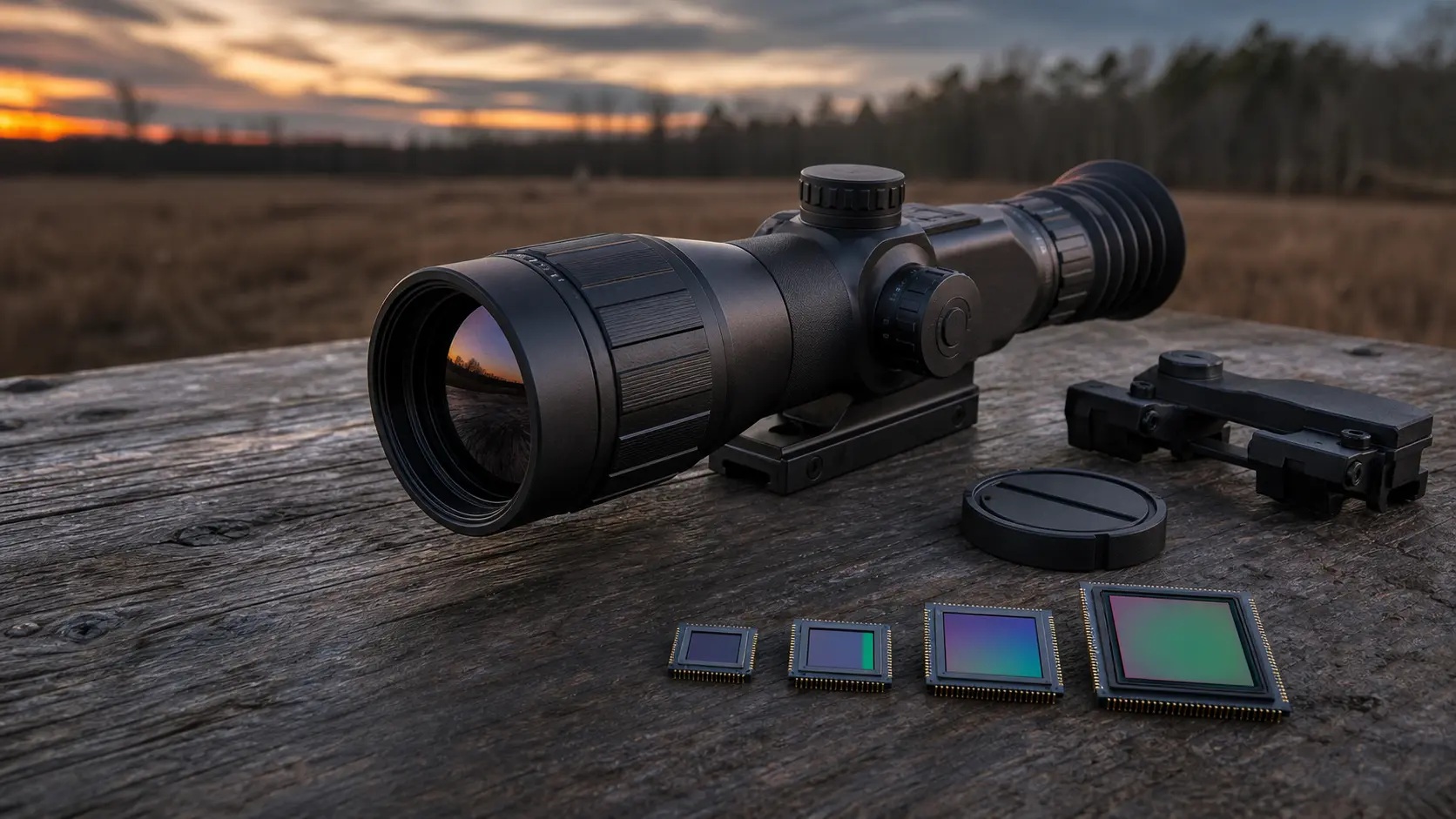
The takeaway is pretty straightforward. Thermal scope sensors differ in size. A bigger thermal scope detector gives the device more pixels to work with. More pixels often equal better detail, sharper images, better digital zoom, and more confidence in your target recognition capabilities. Yet, the resulting thermal image depends on several more factors like lens size, base magnification, pixel pitch, NETD, display quality, and processing.
Read this article to understand what 256, 384, 640, and 1280 mean for hunters.
Source reliability check
This article compares information from multiple source types:
The sources are consistent on the main point: sensor resolution matters, but it should be judged together with lens design, field of view, NETD, pixel pitch, image processing, and real weather conditions.
Thermal Scope Sensor Size Basics
When it comes to thermal detectors, the size value usually represents the number of pixels across the width of a device’s sensor. Common sizes include 256, 384, 640, and 1280 pixels.
Examples of resolutions:
As you can see, there is an incredible difference between the pixel counts. For example, a thermal detector 384×288 has around 2.25 times more pixels than 256×192. Similarly, 640×512 has close to 3 times more thermal pixels than 384×288 and around 6.7 times more thermal pixels than 256×192. 1280×1024 offers 4 times more thermal pixels than 640×512.
Simply put, a higher-resolution sensor can provide more thermal data to work with. As a result, 640 will usually give better animal recognition capabilities and clearer shapes compared to 384 or 256. 1280-class sensors can preserve even more detail, especially when the optic and image processing are built well enough to use that extra data.
256 Thermal Scope: Entry-Level Detection
256 thermal detectors are the cheapest and least capable ones. They have enough resolution for basic detection, but not enough for detailed recognition or reliable identification at greater distances.
Still, 256 sensors may serve as a decent tool for finding animals inside typical hunting ranges. However, expect blurred silhouettes instead of clear shapes and outlines. Also, do not expect much from digital zoom.
Use 256 sensors when:
- Hunting predators and hogs up-close
- On a tight budget
- Scanning and hunting on short ranges
- Looking for basic thermal detection capabilities
Don’t choose 256 pixels if you prioritize detailed recognition or digital zoom.
384 Thermal Scope Sensors: Reliable Balance Between Resolution & Price
384 thermal sensors offer the best balance between price and usability. For many hog and predator hunters, this is the best choice when you consider all the pros and cons of 256 and 640.
Even though 384 sensors have less resolution than 640, they may beat some higher-resolution rivals when working in humid conditions or when thermal contrasts are low. With the right lens and good NETD sensitivity, 384 thermal devices can be quite powerful.
Use 384 sensors when:
- You want more thermal detail without paying extra for 640
- Scanning and hunting hogs and predators
- Looking for reliable ID options within a moderate distance
- Your hunting distance doesn’t go above reasonable boundaries
384 thermal sensors are sufficient for most situations without too high magnifications.
640 Thermal Sensors: Extra Detail, Zoom & Recognition Capabilities
The next logical step up is to switch to 640 pixels. The resolution difference is enormous. With nearly three times more pixels than common 384 models, 640 thermal scopes provide much more usable detail and significantly improve the quality of digital zooming.
640 resolution alone is not the point here, though. While thermal sensors are responsible for gathering data, other factors like magnification, NETD, and pixel pitch define what you will actually see. Thus, the main benefit of 640 pixels is not better detection range, but better identification.
When talking about hunting, identification is better than mere detection. After all, a thermal image should not tell you “there is something warm out there”. Instead, it should give you enough details to recognize and distinguish the animal among others in the environment. 640 thermal detectors are more likely to achieve that.
Use 640 sensors when:
- Needing more detail, ID, and better recognition capabilities
- Scanning and shooting on long distances
- Needing better digital zoom
- Wanting maximum hunting utility with strong thermal capability
The main drawback of 640 sensors is the higher price tag and, depending on the device, greater battery consumption.
1280 Thermal Detectors: The Future Is Here
If budget and practicality are not crucial for you, 1280-class thermal detectors are a great option. In a true 1280×1024 layout, they offer about 1.31 megapixels of thermal data. That is a massive amount of information for a thermal optic.
With 1280 pixels per line of thermal information, 1280×1024 thermal detectors have around four times more pixels than 640×512 detectors. Hence, in theory, they can offer much better detail, stronger digital zoom, or a wider picture of the scene while still preserving useful resolution. The exact result depends on the lens, base magnification, pixel pitch, display, and image processing.
1280 thermal devices remain rare and relatively expensive today. Moreover, the benefits of 1280-class thermal pixels are often not worth the price and bulkiness for ordinary hunting. So, 640 resolution remains the top practical option for most premium hunting devices today.
Use 1280 sensors when:
- Wanting maximum image detail for observation
- Professional uses
- Looking for premium hunting options
- Scanning large areas without giving up too much image detail
- Requiring a lot of data and processing power
While premium, 1280 thermal sensors remain the most efficient in professional and high-end observation cases.
Why 1280 Thermal Detectors Are Valuable
One of the main selling points of 1280-class thermal sensors is the ability to give a wide field of view without losing as much resolution. At low magnifications, high-resolution detectors can cover a wide area with sufficient image detail for thermal hunters.
Unlike lower resolution classes, 1280-class detectors can serve as a combination of a wide field and high image quality. That is why some high-resolution thermal models feel more natural to use in comparison with lower-resolution scopes at similar base magnification. That said, with the right optics, a strong 640 detector can still provide excellent practical hunting performance.
1280-class and other high-resolution sensors will likely become more common as prices fall, but 640 remains the realistic premium tier for most hunters today.
Detection Range Does Not Tell You Everything
Don’t rely solely on advertised detection capabilities of a thermal scope when choosing your hunting equipment.
Usually, detection distance refers to the capability of a device to find the presence of an object. However, in many cases, you cannot ethically decide whether you can shoot the animal or not at such distances. So, the better parameter to look for is identification distance.
While 1280 thermal sensors theoretically provide better capabilities than 640 sensors, don’t assume that any 640 model is worse than a random 1280 model at identification. The same goes for comparison of 384 with 640 and 256 with 384. Lens focal length, base magnification, NETD, and pixel pitch greatly affect final results.
Why Pixel Pitch Matters
Pixel pitch is the distance between adjacent detector elements on a thermal array in microns. Typically, the size varies between 12 um and 17 um in many hunting optics.
The pixel pitch affects the size of the thermal sensor and the quality of the resulting image. Lower pixel pitch allows reducing the thermal sensor’s size, making it easier to implement compact optics. Larger pixels can gather more thermal energy per pixel, though final performance still depends on the full sensor and optic design.
That is why two scopes of the same class and resolution can greatly differ in practical results. A lower-resolution thermal device with better sensitivity, lens quality, and processing can sometimes offer more usable image detail than a higher-resolution model with weaker supporting hardware.
In thermal hunting, pixel pitch affects the geometry of the image while NETD defines the sensitivity of the sensor to temperature difference.
What NETD Means
NETD stands for Noise Equivalent Temperature Difference and is a measure of thermal sensitivity. Simply put, NETD determines how effectively the thermal scope can catch small differences in temperatures.
Lower NETD means that the device is more sensitive to small temperature differences. In general, lower NETD is better, especially in wet weather, fog, rain, warm nights, and other low-contrast conditions.
For instance, low NETD can help compensate for the lack of pixels in 384 thermal scopes, providing enough usable contrast and detail to read the animal.
Humidity May Have a Significant Impact on Hunting
In humid weather, thermal images suffer. Moisture in the air lowers thermal contrasts in the picture. The warmer the night and the more moisture there is, the fewer contrasts you will see on your device’s screen.
Thus, in such conditions, NETD becomes one of the primary parameters of hunting devices. It defines how well the device sees small temperature differences when the scene is flat and low-contrast. In particular, in warm and moist conditions, a lower-resolution scope with low NETD can sometimes show more usable contrast than a higher-resolution scope with weaker sensitivity.
How to Choose a Sensor Resolution for Hunting
Pick 256 pixels thermal detectors for cheap and reliable detection.
Pick 384 thermal detectors for a balanced experience of price and efficiency.
Pick 640 pixels detectors when you need more detail, recognition, and better identification.
Pick 1280 when you want to enjoy premium capabilities and do not mind spending extra money.
Conclusion
Thermal scope sensors vary in size and price.
256 detectors detect heat signatures but have limited usability for identification and scanning.
384 is the best resolution for a majority of hunters due to its reasonable balance between resolution and price.
640 gives more detail, zooming capabilities, and overall hunting utility.
1280 thermal devices provide excellent detail and unique capabilities at a high price.
Choose a model that perfectly matches your actual hunting needs, taking into account the parameters other than resolution.

Can You Use a Thermal Scope During the Day? Daylight Use/Sun Safety and Zeroing Tips.

Night Vision Range Explained: Detection, Recognition, Identification, and Real Hunting Distance

How to Set Up an IR Illuminator for Night Vision: Placement, Beam Width, and Field Mistakes