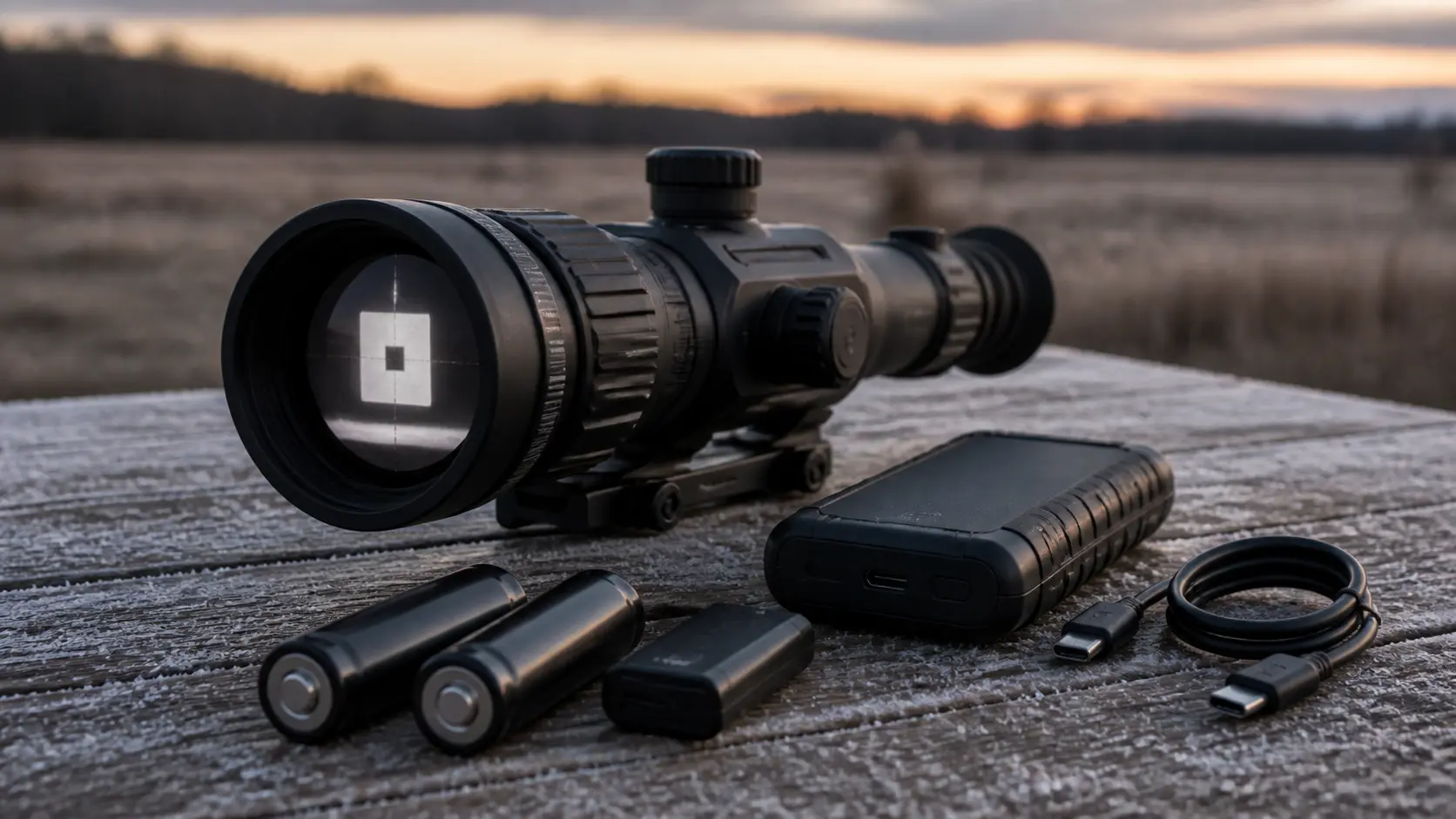
Thermal Scope Battery Life Guide: Internal Batteries, External Packs, and Cold Weather Runtime
Thermal scope battery life looks simple on a spec sheet, but it becomes more complicated in the field. A scope may advertise several hours of runtime, yet run shorter when Wi-Fi, recording, high brightness, LRF, cold weather, or constant menu use is involved. Another scope may look less impressive on paper but perform better because it uses swappable batteries or accepts external USB-C power cleanly. This guide explains how thermal scope battery life really works, when internal batteries are enough, when removable batteries matter, when to use an external battery pack, and how cold weather changes runtime.
Quick answer
For short hunts, a modern thermal scope with a healthy internal battery or removable battery can be enough. For long nights, cold weather, predator calling, or hog hunting from a stand, plan on spare batteries or an external power bank. Internal batteries are convenient but limit field recovery if they die. Removable batteries are easier to swap. External power banks give the longest runtime but add cable management, weight, and one more failure point. The safest field setup is simple: start fully charged, carry one backup power option, keep spare batteries warm, turn off features you are not using, and test the whole setup before the hunt.
Source reliability check
This guide compares multiple sources instead of relying on one runtime claim.
The sources agree on the important points: advertised runtime is only a baseline, external power is common on modern thermal optics, lithium batteries need temperature care, and cold weather can reduce usable capacity.
Why advertised runtime is only a starting point
Battery life numbers are usually measured under controlled conditions. Real hunts are not controlled. Runtime can drop when you use:
- high display brightness
- video recording
- recoil-activated video
- Wi-Fi or app connection
- Bluetooth or LRF functions
- high refresh rate modes
- frequent menu changes
- cold weather
- old or low-quality batteries
- external cables with poor fit
This is why two hunters can report different runtime from the same scope. The device may be the same, but the settings, temperature, battery age, and usage pattern are different.
Internal batteries
Internal batteries are clean and simple. There is no battery cap to lose, no spare cell to carry, and no external pack hanging from the rifle. Best for:
- short evening hunts
- lightweight rifles
- users who prefer simple setup
- scopes with strong onboard runtime
- hunters who charge gear after every hunt
Main downside: if the internal battery runs out, you cannot swap it quickly unless the scope also supports a removable battery or external power. If you forget to charge it, the hunt can be over before it starts. Internal batteries also age. After enough charge cycles, capacity drops. A three-year-old internal battery may not run like it did when new.
Removable batteries
Removable batteries are better for field recovery. If one dies, you replace it and keep hunting. Best for:
- long nights
- multi-day trips
- cold weather
- hunters who cannot recharge between stands
- users who want predictable backup power
Common removable battery formats include brand-specific packs, 18650 cells, CR123 cells, or proprietary rechargeable modules. Use the battery type recommended by the manufacturer. Do not assume all cells with the same shape are equal. The downside is management. You must keep batteries charged, labeled, protected from short circuits, and warm enough in cold weather.
External power banks
External power is the longest-runtime solution for many thermal scopes. Most modern scopes that support external power use USB-C or another external power port. Pulsar, AGM, ATN, InfiRay, N-Vision, and other brands all have models or families that support external power in some form. Best for:
- all-night hog hunting
- long predator sets
- cold weather
- recording video
- running Wi-Fi/app features
- scopes with weak internal runtime
Main downsides:
- cable snagging
- connector wear
- added rifle weight
- awkward mounting
- water/dust exposure if port covers stay open
- possible shutdown if the cable disconnects under recoil
An external battery pack is useful only if it is mounted securely and tested before the hunt.
Cold weather runtime
Cold weather reduces battery performance. This is normal for lithium batteries and is mentioned across multiple manuals and battery-care instructions. In cold conditions:
- internal battery capacity can feel lower
- removable batteries may show lower charge than expected
- charging cold batteries can reduce service life
- external packs may perform poorly if exposed to wind and freezing temperatures
- cables can stiffen and pull loose
The practical solution is not complicated. Keep spare batteries in an inside pocket. Keep the external power bank insulated. Do not charge a battery immediately after bringing it from freezing cold into a warm room unless the manual allows it. Let it warm gradually first.
Internal vs external power: what to choose
Choose internal-only if your hunts are short and the scope’s real runtime is enough. Choose removable batteries if you want clean field swaps without cable management. Choose external power if your hunts are long, cold, or feature-heavy. Choose both removable batteries and external power if the scope is mission-critical and you cannot afford a dead optic. For most hunters, the best answer is not one battery type. It is a system: charged internal battery, one spare removable battery if supported, and one compact external pack for backup.
What drains a thermal scope faster
The biggest runtime drains are usually screen brightness, recording, wireless features, LRF/ballistic functions, and constant operation. To extend runtime:
- lower display brightness when possible
- turn off Wi-Fi when not needed
- avoid unnecessary recording
- use standby mode during long waits
- avoid constant menu use
- turn off external video output if not using it
- keep batteries warm
- start with fully charged cells
Do not run the screen brighter than needed. A thermal display that is too bright can hurt both runtime and night comfort.
Battery pack size
Do not mount the biggest power bank you own just because it has more capacity. A large pack can make the rifle unbalanced. It can also stress the USB port if mounted poorly. A compact power bank mounted near the stock, handguard, or rail can be more practical than a heavy brick-style pack. Good field battery pack qualities:
- reliable 5V output if required by the scope
- short, secure cable
- low-profile mounting
- cold-weather-tested runtime
- no loose movement under recoil
- easy removal for charging
Check your scope manual before using any external power source. Voltage matters.
Cable management
Bad cable management can ruin an otherwise good setup. Use a short cable if possible. Route it away from the charging handle, bolt, safety, trigger area, sling, and moving parts. Leave enough slack for recoil, but not enough to snag. Before hunting, shoulder the rifle, cycle the action, move from standing to sitting, and check whether the cable catches anything. Then fire the rifle with the external pack connected to make sure recoil does not disconnect power.
Charging habits
Good charging habits extend battery service life. Follow these rules:
- use the charger or cable recommended by the manufacturer
- avoid damaged cables and modified chargers
- do not leave batteries in extreme heat
- avoid storing batteries fully dead
- do not charge extremely cold batteries until they warm up
- check charge the day before hunting
- label older batteries if their runtime drops
Battery problems are often preparation problems. A scope that works perfectly can still fail the hunt if the battery plan is weak.
Battery life by hunting style
Short hog hunt near a feeder: internal battery may be enough. All-night hog hunt from a stand: use external power or multiple spares. Coyote calling with several stands: removable batteries or a small external pack are smart. Cold winter predator hunt: keep spares warm and use external power as backup. Recording-heavy hunt: expect shorter runtime and carry more power. Travel hunt or multi-day trip: bring charging cables, wall charger, vehicle charger, and labeled spare batteries.
Common mistakes
The first mistake is trusting advertised runtime without testing. The second mistake is leaving Wi-Fi, recording, or high brightness on all night. The third mistake is carrying spare batteries loose in a pocket where contacts can short. The fourth mistake is using an external power bank without testing it under recoil. The fifth mistake is using the wrong cable or voltage. The sixth mistake is letting batteries get cold and then blaming the scope. The seventh mistake is charging extremely cold batteries immediately after the hunt.
Field checklist
Before the hunt:
- fully charge the scope
- fully charge spare batteries
- fully charge the external pack
- test the cable and connector
- confirm standby mode works
- turn off unneeded wireless features
- pack a short backup cable
- keep batteries warm
- verify the scope powers from external power
After the hunt:
- dry the scope and cables
- inspect the USB port and caps
- recharge batteries
- store batteries partially charged if the next hunt is far away
- replace any battery with noticeably weak runtime
Quick buying guide
Choose a thermal scope with internal-only power if you prioritize simplicity and short hunts. Choose removable batteries if you hunt longer sessions and want quick field swaps. Choose USB-C external power support if you hunt in cold weather, record video, or stay out all night. Choose a scope with both removable and external power if reliability matters more than saving a little weight. Do not compare scopes by advertised runtime alone. Compare battery type, external power support, charging method, port protection, standby behavior, and how the battery system fits your hunting style.
Conclusion
Thermal scope battery life is not just a spec. It is part of the hunting system. Internal batteries are convenient. Removable batteries are practical. External power banks give the longest runtime but require cable discipline. Cold weather reduces capacity and makes battery planning more important. For most hunters, the best setup is simple: start fully charged, carry one backup power option, keep spare batteries warm, and test the setup before the hunt. A thermal scope with a modest runtime but a solid power plan is more useful than a high-end optic that dies halfway through the night.

Can You Use a Thermal Scope During the Day? Daylight Use/Sun Safety and Zeroing Tips.

Night Vision Range Explained: Detection, Recognition, Identification, and Real Hunting Distance

How to Set Up an IR Illuminator for Night Vision: Placement, Beam Width, and Field Mistakes