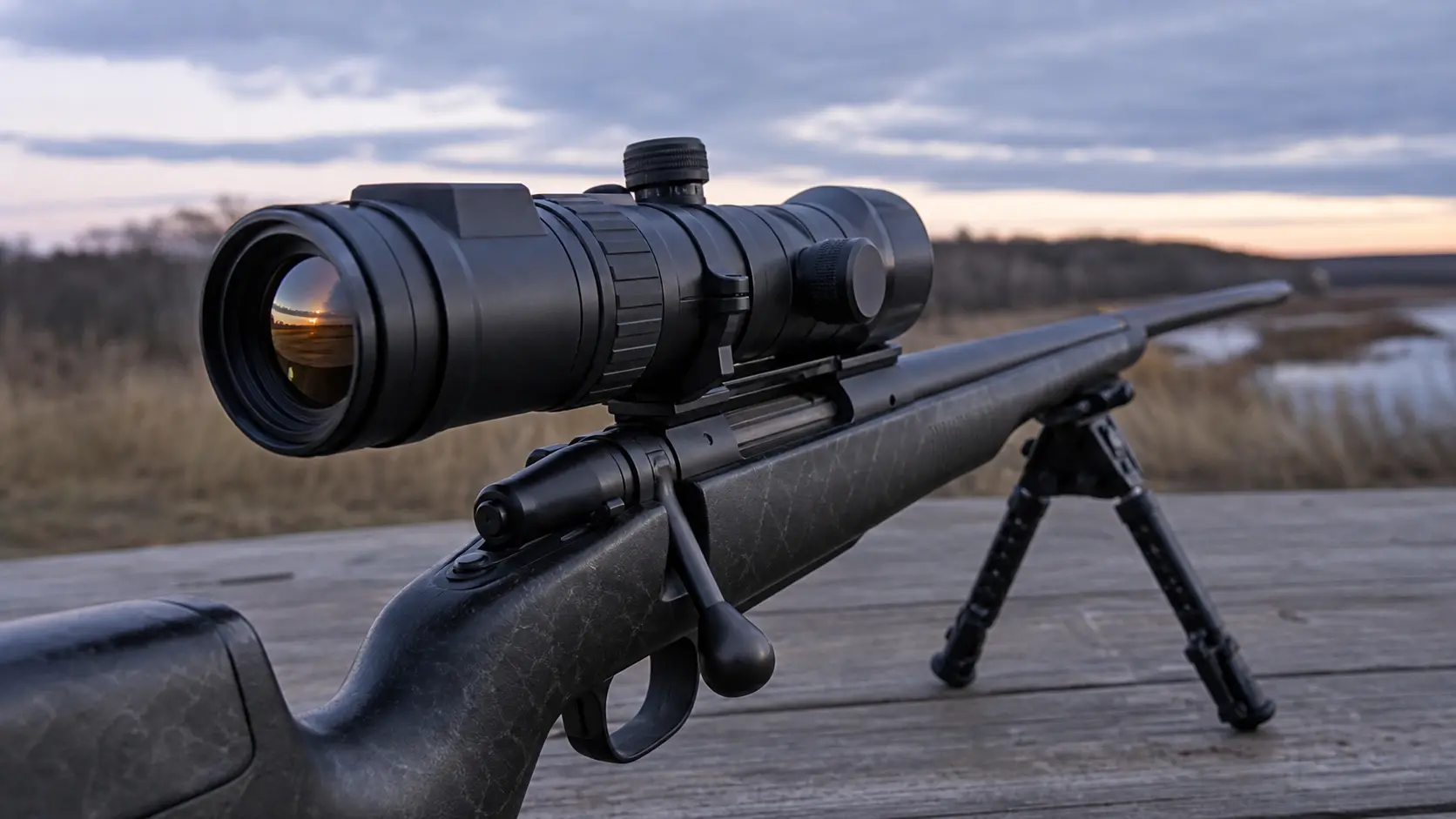
Thermal Scope Base Magnification Explained: 1x, 2x, 3x, 4x, 6x
Many thermal scope buyers focus on sensors first. It is easy to understand but can lead to costly mistakes. A 640 thermal scope with the wrong base magnification may feel inferior on the hunt compared to a 384 scope that better matches your hunting distance, terrain, and shooting style. Base magnification determines the starting image magnification of the optic before any digital zooming. It affects the scope’s field of view, animal acquisition rate, detail level at distance, and usability after dusk. The quick answer is straightforward. A low base magnification means wide FOV, fast target acquisition, and less detail on distant targets. A high base magnification means narrower FOV, more detail on distant targets, and more magnification. In hog hunting, 1x to 2x thermal scopes work great in brush. 2x to 3x thermal scopes are often best when you hunt coyotes and hogs. 3x to 4x scopes are appropriate in open fields and with longer distances. Above 5x and 6x, you enter a niche territory of specialized long-range optics.
Source reliability check
Multiple sources will be considered in this guide, rather than basing the comparison on a single manufacturer page. | Source | Reliability | What it confirms | Limitation | |—|—:|—|—| | FLIR lens selection guide | Very high | Long focal length results in a narrower FOV and makes distant objects occupy larger portion of the FOV | Focused on industrial use case | | AGM Rattler V2 product page and specs | High for specs | Same 384 sensor family can have different base magnification and FOV settings depending on lens and model: 25-384 uses 2x with 10.5° x 7.9° FOV, 35-384 has 3x with 7.5° x 5.6° FOV | Manufacturer source, naturally positive in nature about their products | | Pulsar Thermion 2 XP50 and LRF XL60 specs | High for specs | High-end thermal scopes combine several parameters into optimal systems: sensor type, lens, FOV, magnification, NETD and detection range | Examples come from one brand’s catalog | | ATN ThOR 5 XD specs and catalog | Medium-high | Even high-end scopes like 1280 can be offered as 2-20x, 3-30x and 4-40x models, each with distinct trade-offs | Catalog content can be somewhat promotional in nature | | Armasight Contractor 640 specs | High for specs | Bigger lenses show the trade-off between optical magnification, FOV and detection range | Limited to one specific product line and brand | | InfiRay Outdoor RICO manual/specs | High for specs | 35mm, 42mm and 50mm thermal scopes show how 2x, 3x and 4x magnification affect FOV and usage range | Limited to manual/spec sheet information only | | N-Vision HALO scopes | High for specs | An example of 25mm short-range and a 50mm long-range thermal optics in the same product family | Premium product line | Sources show the critical information consistently – high base magnification is not necessarily better. It is a trade-off between FOV and magnification.
What is thermal scope base magnification?
Base magnification is the initial magnification setting of the thermal scope when no digital zooming occurs. For instance, a 2-16x scope has a base magnification of 2x. Similarly, a 3-24x thermal scope has 3x of native magnification. The rest of the magnification range, above the base magnification number, is created by digital magnification. This distinction is important, as a thermal scope differs from a glass riflescope in its optical characteristics. In a typical daytime scope, increasing magnification increases optical magnification. In a thermal scope, the magnification is done digitally and does not increase the thermal sensitivity of the lens or increase resolution. Therefore, thermal scope magnification behaves differently, depending on the base magnification setting and the field of view. In practice, it is important to understand the impact base magnification will have on your ability to use the optic for hunting.
Base magnification vs field of view
FOV is the size of your image in angular units. Thermal scopes’ fields of view can be stated either in degrees or in feet at 100 yards. Lower base magnification generally equals wider FOV. Likewise, higher base magnification equates to a narrower FOV. This is not merely a subjective opinion – the relationship is apparent in specs. The 25-384 AGM Rattler V2 has 2x of base magnification, 10.5° x 7.9° field of view and a 25mm lens. The 35-384 Rattler V2 version features 3x of base magnification, 7.5° x 5.6° FOV and 35mm lens. In essence, the shorter lens has 10.5 degrees and 2x base magnification, while the longer lens features 7.5 degrees and 3x base magnification. This pattern is generally consistent when sensor format and optical design are comparable, as FLIR explains – the longer lens and optical magnification make the field of view narrower. It is important for you to realize what effect the narrower FOV will have on your ability to use thermal scopes in the field.
Why base magnification is crucial in thermals and how it differs from many buyers’ expectations
Unlike daytime scopes where you could decrease the magnification in case of a close target, thermal scopes do not offer anything similar to optical magnification reduction. When choosing a thermal scope with a higher base magnification, you will have it even when you do not need it. In fact, many hunters are frustrated by having too much magnification in their first thermal scope purchases. A 4x or 6x scope is great for spotting distant targets but will feel tight at close distances. A low-base scope will show less detail at range but allow you to scan and acquire targets easily. Instead of asking “How much magnification do I get?”, ask “Which base magnification lets me spot, track, identify and shoot my targets? “.
1x thermal scopes
1x is the widest and fastest field of view that a thermal scope provides. It is prevalent among compact thermals, helmet-compatible scopes, weapon clips and short-range thermal weapon sights. Best suited for:
- close-range hog hunting
- hunting in thick brush
- fast moving targets
- wide scans while moving
- helmet or handheld use
- rifles used up to 100 yards, maybe even less
Base magnification of 1x means that you will see a wide view. Therefore, you will see more animals at a glance, be able to track them better and have higher situational awareness. For instance, when you are hog hunting from feeders and your pigs scatter in different directions, 1x will let you track them effectively. 1x also means lower level of detail on distant targets. Therefore, thermal scopes with base magnification of 1x will detect distant animals but not necessarily allow you to identify them. You will probably need additional digital zoom, which means image degradation, particularly on lower resolution sensors. Get 1x thermal scopes if you need wide FOV and rapid target acquisition. However, a 1x thermal scope cannot be your primary long-range optic.
2x thermal scopes
One of the best base magnification values for a thermal scope hunting application is 2x. It allows you to see targets better at distance but also offers decent field of view for spotting and tracking. Best suited for:
- hog hunting
- mixed terrain
- short to medium coyote hunting
- beginner thermal hunters
- users who need one scope for scanning and targeting
- shooting up to 200 yards
AGM’s Rattler V2 25-384 model is a great example of a 2x scope – it has 10.5° x 7.9° field of view, 2x magnification and a listed detection range up to 1200 meters/yards on a 6-foot object. Many hunters will be served best with a thermal scope with 2x base magnification. A 640 thermal scope at 2x can be especially useful thanks to high resolution of the sensor allowing you more flexibility in zooming. However, for a hunter whose shots are taken beyond 250 yards, thermal scope base magnification 2x can be too little. Many thermal scopes can detect heat signatures beyond typical shooting distance, but recognition can prove to be problematic.
3x thermal scopes
3x is the middle value for thermal scope base magnification suitable for predators and hogs on long distances. Best suited for:
- hunting in open field and brush
- coyote hunting
- predator hunting
- longer hog hunting areas
- hunters already using a scanning scope
- shots up to 300 yards
In AGM’s Rattler V2 lineup, the 25mm and 35mm models differ in FOV and base magnification – while the first is 25-384 with 2x and 10.5 degrees, the latter is 35-384 with 3x and 7.5 degrees. This is consistent with InfiRay’s RICO models. 3x gives more target scale at distance while sacrificing FOV. It is also a good thermal scope base magnification if you are planning to combine your thermal scope with a separate scanner. In such situations, you will spot the animal with the monocular and then take a closer look with the thermal scope on your gun. The disadvantage of 3x magnification is the reduced FOV which makes it difficult to use for close shots.
4x thermal scopes
4x is the thermal scope base magnification value that is appropriate for long-distance shots. Best suited for:
- open country coyote hunting
- predator hunting in long fields
- known hunting spots
- shooting lanes
- hunting sites that attract animals to predictable positions
- users who constantly carry a thermal scanner separately
- long-range shooting of hogs from feeders
ATN, InfiRay and other companies offer 4x or higher magnification in some of their thermal scope options. As you can see, the increased base magnification makes distant animals appear larger and can help recognition. However, the disadvantage of higher magnification includes less FOV and less situational awareness. A 4x thermal scope will be useful when sitting behind a tree and aiming at distant predators but not when actively scanning and looking for them in brush. Therefore, choose 4x thermal scope only if your hunting environment allows it. Otherwise, you may experience difficulty using the optics.
5x & 6x thermal scopes
High thermal scope base magnification is represented by 5x to 6x models which require certain hunting conditions. Best suited for:
- long-range predator hunting
- open terrain
- known shooting lanes and locations
- advanced users
- hunters who carry a thermal scanner apart from their rifles
For many first-time thermal scope users, 6x base magnification is too much. On the other hand, for someone already familiar with thermals, 6x is a logical choice. As with any other magnification, higher base magnification gives more target scale at distance and can help recognition. However, the trade-off is reduced FOV and situational awareness which makes it a bad choice for close shots and scanning. For beginners, the best solution is 2x or 3x. Only after mastering this value will you be able to properly use a thermal scope of higher magnification.
Base magnification and sensor resolution
When discussing magnification, resolution matters too. A 384 sensor thermal scope with 2x base magnification can be perfectly adequate, but a 384 thermal scope at 4x base magnification may show you a large animal further but with a limited FOV and lower resolution during zooming. In contrast, a 640 thermal scope at 2x can offer more flexibility in hunting due to better resolution, even with base magnification being 2x. Higher resolution thermal scopes can maintain decent detail even when the magnification is relatively high. This explains why it is crucial to pay attention to not only thermal scope base magnification but also resolution of the sensor when choosing your next optic.
Base magnification and digital zoom
Digital zooming is an incredibly useful feature in thermal scopes but is also a double-edged sword. First, the digital zoom crops out part of the sensor image and enlarges the rest. It means that if you apply 2x digital zoom, your thermal scope FOV is now twice narrower and the target twice larger. Secondly, the more zooming you use, the more visible digital zoom effects. Picture-in-picture technology helps to overcome this problem by providing a smaller but high-magnification viewing area and preserving the initial FOV in a separate viewing window. The bottom line here is that no matter the technology, zooming reduces FOV of the base image and makes it harder to recognize objects that were not detected previously. Therefore, thermal scopes with lower base magnification but with better initial FOV will work better.
Base magnification and detection range
It is very important to understand the distinction between detection range and shooting or recognition distance in thermals. Higher base magnification often comes from a longer lens and narrower FOV, which can put more pixels on a distant target. But detection range still depends on sensor resolution, lens, pixel pitch, NETD, focus, and conditions. At the same time, detection range does not equal recognition or ethical shooting distance. It is determined by your ability to spot and identify animals and depends on environmental factors, such as humidity, fog, rain, vegetation, background temperature, target size, and focus. In conclusion, use detection range for approximate estimating of the thermal scope capabilities in terms of spotting targets but not for assessing the ability to use the optic for recognizing animals at distances.
Best base magnification by hunting style
Close hog hunting in brush requires 1x to 2x. Lower base magnification and wider FOV will be useful if the hunting grounds include both brush and open space. Coyote hunting at distances up to 300 yards can be served with base magnification of 2x to 3x. Open field shooting requires more base magnification to spot the target easier from a longer distance. A good thermal scope would be a model with base magnification of 3x to 4x, possibly higher. Only if your hunting sites are predictable and the targets are located far away can you consider thermal scopes with base magnification of 5x to 6x. Finally, if you need a one optic that can be used for both scanning and shooting, 2x or a low 3x magnification can be the best choice. If, however, you carry a thermal scanner separately, then 3x to 4x may be more suitable.
Common mistakes
The first mistake is trying to choose the thermal scope that boasts high magnification. However, the wider field of view will help you detect targets quicker and will be needed in many cases. The second mistake is judging thermal scope base magnification by the range of the entire magnification. For instance, a 2-16x and a 4-32x scope are not equal, despite having similar ranges. The third mistake is overlooking resolution when choosing the thermal scope with higher base magnification. Often times, a high-resolution thermal scope with a relatively low base magnification beats high base magnification and poor resolution. The fourth mistake is confusing detection range and recognition/shooting range. Thermal scopes can detect heat signatures further than they can recognize them. The final mistake is expecting to use one optic for every hunting situation. Hogs require different optics than coyotes.
Quick buying guide
Choose 1x if you hunt hogs or need the widest FOV possible. Choose 2x if you are uncertain which thermal scope you need. Choose 3x if you need additional distance and detection. Choose 4x if you hunt open fields, use a separate scanner, or watch predictable shooting lanes. Choose 5x to 6x if you have predictable shots from long distances.
Conclusion
Thermal scope base magnification is one of the key specifications of your future optics. Thermal scope base magnification defines the usability and effectiveness of the optic, as opposed to just making an image bigger. 1x is fast and wide but may lack detail on distant targets. 2x is best for general purposes and for beginners. 3x gives good balance between magnification and field of view. 4x is appropriate for long distances, while 5x and 6x are reserved for special cases only. Thermal scope base magnification and zooming cannot substitute proper selection of the thermal sensor resolution and the field of view. Therefore, when purchasing your next thermal scope, think about base magnification but not only. Pay attention to the sensor, detection range, lens type and field of view too.

Can You Use a Thermal Scope During the Day? Daylight Use/Sun Safety and Zeroing Tips.

Night Vision Range Explained: Detection, Recognition, Identification, and Real Hunting Distance

How to Set Up an IR Illuminator for Night Vision: Placement, Beam Width, and Field Mistakes