Best Thermal Scopes for Coyote Hunting 2026
The difference between a thermal scope that works on coyotes and one that doesn’t comes down to a few numbers most buyers ignore. Coyotes move fast, typically appear at 40 to 200 yards depending on your terrain, and their body temperature isn’t dramatically different from ambient air on warm nights. That creates real problems for thermal imagers with poor sensitivity.
Hog hunting gets most of the attention in night optics forums, but coyotes are a different problem. They’re smaller, faster, and smarter. A 320×240 sensor that’s adequate for a stationary hog at 100 yards will leave you chasing heat blobs when a coyote cuts across your field at 80 yards and disappears into brush. This guide covers what to look for and which thermal scopes actually perform in predator-specific conditions.
If you’re coming from the hog hunting world, you’ll find some overlap — but the priorities shift. Detection range matters less than target resolution at close to mid-range. Refresh rate matters more than on slower game. And sensor NETD rating becomes critical when air temperature climbs above 60°F and coyote signatures flatten out. For more on how thermal optics compare to night vision for predator work, see our breakdown of thermal vs night vision for hog hunting.
What Makes a Thermal Scope Work on Coyotes
Sensor NETD: The Number That Changes Everything in Warm Weather
NETD (Noise Equivalent Temperature Difference) measures how small a temperature difference the sensor can detect. Lower is better. A sensor rated at 35 mK detects finer thermal gradients than one rated at 50 mK — this directly affects how well you can pick up coyote body heat against warm ground.
In winter conditions, almost any modern thermal scope works on coyotes. The real separation happens from late April through October when ground temperatures approach or exceed ambient air. At that point, a 50 mK sensor starts losing coyote definition. A 25-35 mK sensor maintains a clean, distinct animal silhouette even on warm soil.
Resolution: 320×240 vs 640×480 for Coyotes
A 320×240 sensor puts 76,800 pixels on your target. That’s adequate for identification at 80-150 yards on a standard coyote-sized target. A 640×480 sensor quadruples that to 307,200 pixels and dramatically improves your ability to identify, range, and track smaller animals at distance.
If your coyote hunting happens inside 150 yards in relatively open country, a 320×240 sensor is functional. If you’re calling across fields at 200+ yards, or hunting terrain where shots develop quickly and you need rapid identification, the 640×480 sensor is not a luxury.
Refresh Rate: Why 50 Hz Matters on Moving Targets
Most commercially available thermal scopes run at 30 Hz or 50 Hz. The difference is meaningful when your target is trotting toward the call at 12 mph. At 30 Hz, fast-moving targets show visible image lag. At 50 Hz, the image tracks cleanly.
Regulations in some states cap thermal export devices at 9 Hz for military grade sensors. Hunting-grade thermal scopes sold commercially in the U.S. run 30-60 Hz without restriction, and 50 Hz is the standard to target for predator applications.
Magnification Range for Coyote Work
A 1-4× or 2-8× zoom range covers the realistic shot envelope for called coyotes in most terrain. Avoid fixed-magnification thermal scopes for coyote hunting — the ability to dial from 1× to spot an incoming animal at edge-of-light down to 3-4× for a precise shot is tactically important during a stand.
Variable digital zoom on thermal scopes is a feature, not a bug. Unlike optical zoom, digital zoom on thermal is a pixel interpolation, but it still improves practical usability compared to fixed magnification.
Top Thermal Scopes for Coyote Hunting
AGM Rattler V2 TS35-384
The Rattler V2 uses a 384×288 sensor with a 35 mK NETD rating, which puts it ahead of most thermal scopes in this price category for warm-weather coyote hunting. The 35mm lens provides a 9.8° field of view at base magnification (1.5×), with digital zoom to 12×.
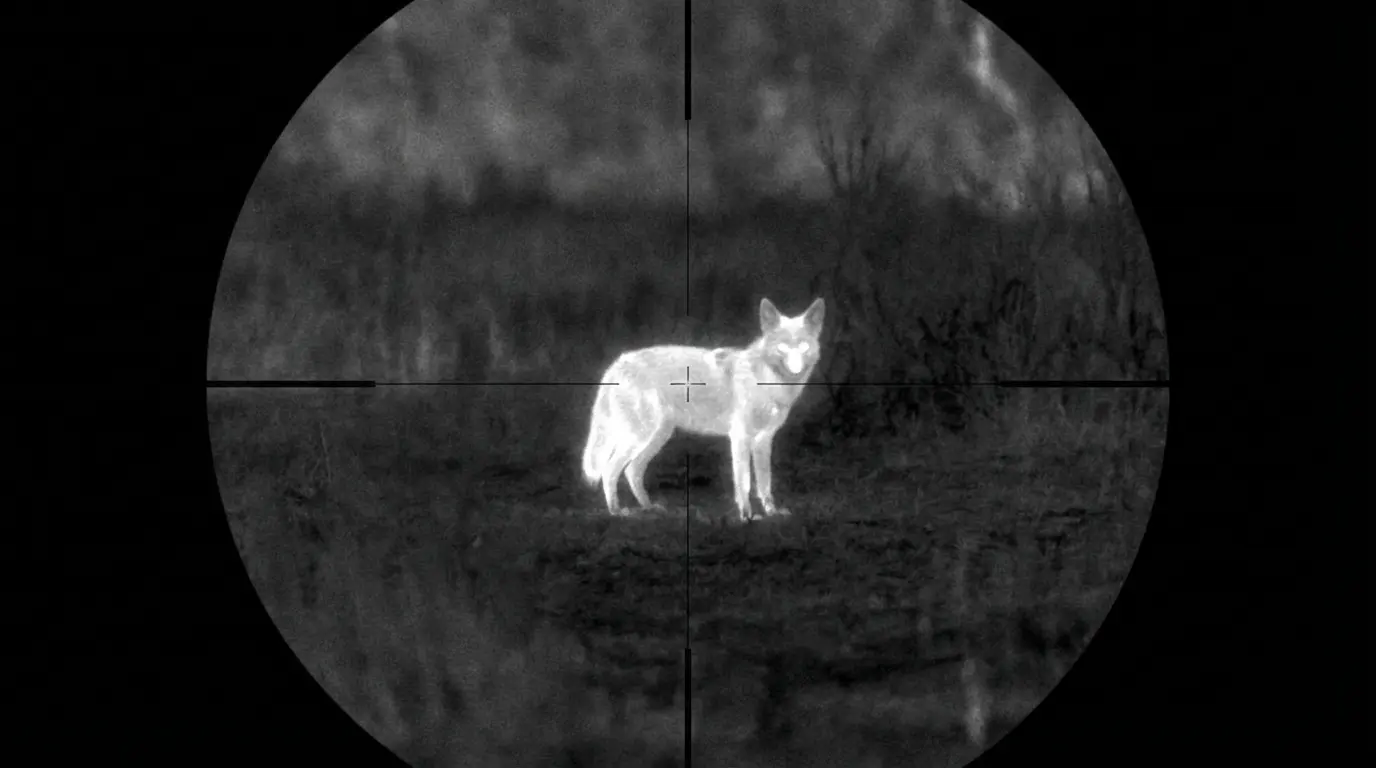
In practice at 100 yards, the AGM Rattler V2 delivers coyote silhouettes that show distinct leg and head separation — enough for a precise hold on a walking or slow-trotting animal. At 150 yards, small coyotes remain identifiable as coyotes rather than indistinct heat sources.
The refresh rate runs at 50 Hz in the current V2 generation, which addressed a significant criticism of the original Rattler. Framerate lag on moving targets was a documented issue with earlier firmware — it’s not present in V2.
Battery life runs approximately 6 hours on a single internal charge with the 18650 cell. That’s adequate for a full coyote night, though hunters running multiple stands over a long session should carry a spare cell.
Weight is 1.2 lbs without mount, and the profile is compact enough to fit on most hunting rifles without muzzle clearance issues. The included ballistic calculator handles zero offsets across temperature ranges — useful when your zero from a 45°F range session doesn’t hold on a 20°F night.
The AGM Rattler V2 is the most practical thermal scope for coyote hunters running a budget of ,200-,800.
AGM Secutor TS50-640
The Secutor represents the jump to a 640×480 sensor in the AGM lineup. This sensor provides a fundamental improvement in target resolution that changes the character of nighttime predator hunting at range.
At 200 yards on a stationary coyote, the 640×480 sensor in the Secutor resolves individual limbs clearly. Body shape, orientation, and approximate size are immediately readable — information that’s ambiguous on a 320×240 sensor at the same distance. For hunters consistently calling coyotes into the 150-250 yard band, this resolution improvement directly affects shot quality and positive target identification.
The 50mm objective paired with 640×480 delivers a 2.5° field of view at base magnification, with continuous digital zoom to 20×. Base magnification runs at 3.3×, which is near-ideal for coyote work — enough to see incoming animals immediately at close range while providing a useful image for precision shots.
The primary tradeoff is price. The Secutor TS50-640 sits at approximately ,200-,800 retail, nearly double the Rattler V2. For dedicated predator hunters who spend significant nights per season, the investment calculates reasonably. For occasional coyote hunters who use their thermal scope across multiple game types, the Rattler V2 delivers 80% of the capability at half the cost.
Pulsar Thermion 2 XQ35 Pro
The Thermion 2 series introduced an updated sensor package with a 384×288 sensor at 40 mK NETD in the XQ line. The 35mm lens at 2.5× base magnification and 50 Hz refresh rate makes this a capable predator optic, though the sensor NETD rating of 40 mK puts it behind the AGM Rattler V2 in warm-weather performance.
The Thermion 2 XQ35 Pro builds on Pulsar’s integration with the Stream Vision 2 app, which provides wireless remote operation, shot recording, and ballistic profiles via Bluetooth. The recording capability is genuinely useful — documenting stand locations, calling sequences, and shot opportunities provides data that improves future setups.
At ,600-,000, the Thermion 2 XQ35 Pro competes directly with mid-tier 384 sensor thermal scopes. Pulsar’s build quality and software ecosystem give it an edge for hunters who value post-hunt review. The sensor is slightly behind current-generation AGM models in thermal sensitivity, which shows on marginal warm-weather nights.
AGM Adder TS50-640 LRF
The Adder adds a built-in laser rangefinder to the 640×480 sensor thermal package. For coyote hunters who use ballistic reticles or dial for longer shots, having confirmed distance without breaking position to use a handheld rangefinder is a legitimate advantage.
The LRF integration gives accurate readings to approximately 1,000 yards on a reflective target, and 600-800 yards on a typical coyote-sized target in field conditions. At the distances where most coyotes are taken, the rangefinder provides ground truth for ballistic calculations rather than estimates.
This scope sits at ,000+ and is a premium purchase. The case for it centers on hunters who are making a lot of 150-300 yard shots on called predators and want maximum information at the moment of decision. See our full breakdown in the best thermal scope for predator hunting guide.
Thermal Scope Selection by Coyote Hunting Scenario
Under ,500, open-country calling inside 150 yards: The 320×240 sensor tier at 35-40 mK NETD handles this well. Focus on 50 Hz refresh rate and a variable 1-4× range.
,500-,500, mixed terrain, 50-200 yard shots: The 384×288 sensor tier (AGM Rattler V2, Pulsar Thermion XQ35) is the practical sweet spot. Better resolution than 320×240, without the price jump to 640 sensors.
,500+, serious predator hunter, 100-300 yard shots in varied conditions: The 640×480 sensor tier changes the game for consistent identification and shot placement at distance. The AGM Secutor TS50-640 is the value position in this tier.
Warm-climate hunting (southeast, Texas, year-round): Prioritize NETD rating above all other specs. In warm conditions, sensor sensitivity separates functional from marginal more than any other specification.
Calibration and Color Palette for Predator Work
Calibration matters. Thermal sensors drift with temperature, and most modern scopes auto-calibrate periodically. Some scopes let you manually trigger calibration — useful when moving between warm vehicle and cold field. A scope that audibly clicks through calibration at the moment a coyote appears at 150 yards is a problem. Know your scope’s calibration behavior and manage it.
Color palette selection affects detection speed. White Hot is standard for most predator hunters because it mimics how thermal sensors naturally represent body heat — bright white on dark background. Black Hot reverses this and can be useful in certain light conditions. Practiced hunters often switch palettes based on sky conditions and terrain.
For more on setup and zeroing, review our guide on best thermal rifle scopes under ,500 which covers zeroing and mounting procedures applicable across this tier.
Mount Height and Eye Relief
Thermal scopes typically require a lower mount than traditional riflescopes because the eyepiece doesn’t need the same eye relief accommodation — thermal scopes use a display screen with comfortable viewing distance rather than an ocular lens aligned to your eye.
Most thermal scopes specify 30-50mm optimal viewing distance from the eyepiece. Experiment with mount height and ring spacing to find the natural head position that eliminates scope tilt and provides a centered image.
A level scope is more critical with thermal than with conventional scopes because the display image has defined borders — even slight scope tilt is visible in the image frame, and over time it affects shooting accuracy on angled shots.
Practical Battery Management for Coyote Nights
Plan for power. Six hours of thermal operation drains most built-in batteries. A predator hunting night that runs from dusk to midnight on multiple stands benefits from a backup power strategy.
External USB-C power banks extend runtime on most current-generation thermal scopes without interrupting operation. A 10,000 mAh bank adds 4-6 hours depending on scope draw. In cold weather, both the scope battery and the external bank lose effective capacity — plan accordingly.
Temperature also affects zero slightly. A scope zeroed at room temperature will hold within acceptable accuracy in field conditions, but hunters demanding sub-MOA cold-weather accuracy should verify zero in conditions that match their hunting temperatures.
Final Assessment
The case for thermal over night vision specifically for coyote hunting is strong: thermal picks up body heat through light brush, works at ambient light levels that break NV performance, and doesn’t require illuminators that can alert sharp-eyed predators. If predators are your primary night-hunting target, thermal is the correct starting point.
The AGM Rattler V2 is the practical entry point for committed coyote hunters. The AGM Secutor TS50-640 is the upgrade path for those who’ve outgrown 384-class performance. Both represent the current state-of-market for the predator hunting application.

Can You Use a Thermal Scope During the Day? Daylight Use/Sun Safety and Zeroing Tips.

Night Vision Range Explained: Detection, Recognition, Identification, and Real Hunting Distance

How to Set Up an IR Illuminator for Night Vision: Placement, Beam Width, and Field Mistakes