Last updated: March 2026
Predator hunting at night is a different problem than hog hunting. Coyotes, foxes, and bobcats move quickly, present smaller target profiles, and often work at distances where pixel-level detail in the thermal image determines whether you make a clean shot or push the animal off the property. A thermal scope that performs adequately on stationary 200-pound hogs in a feeder field may give you a frustrating experience on a 30-pound coyote moving at 15 mph across a 200-yard pasture at 2 a.m.
This guide covers the best thermal scope options for predator and varmint hunting in 2026, what specs actually matter for this application, and how to match a scope to the terrain and target species you’re after.
For context on how thermal compares to traditional night vision for this type of work, the thermal vs night vision for hog hunting comparison covers the core tradeoffs between the two technologies. The same principles apply to predator hunting, with the additional consideration that thermal’s detection advantage at range becomes even more relevant when you’re looking for smaller animals in grass and brush.
Why thermal outperforms night vision for predator hunting
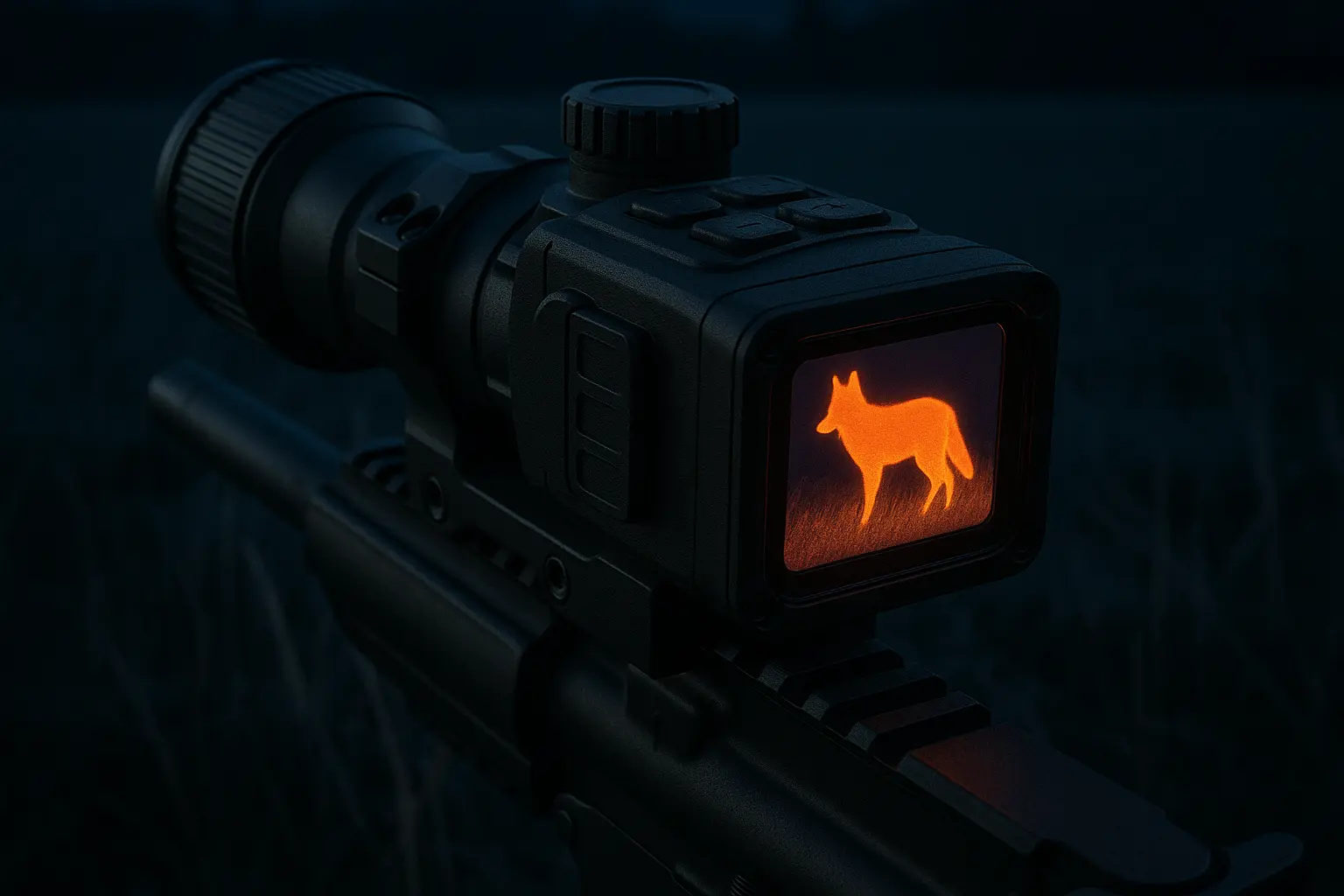
Predators are warm-blooded animals moving through cold ground cover. This temperature differential is thermal’s fundamental advantage — a coyote walking through knee-high grass at 300 yards shows as a bright heat signature against a cold background even when it is completely invisible to image intensification technology looking through the same vegetation. The animal does not need to be in the open for thermal to detect it.
Detection versus identification range is the practical limitation to understand. A quality thermal scope can detect a coyote-sized heat source at 500+ yards. Positively identifying the animal — confirming it is a coyote and not a small deer, a fox, or a domestic cat — requires getting close enough for the image resolution to show an identifiable body shape. At 200 yards with a 640×480 sensor and 50mm objective, identification is reliable. At 400 yards on a small predator, you are working at the limit of what most mid-range scopes can deliver. This matters for both shot ethics and for complying with regulations that require positive species identification before taking a shot.
Key specs for predator thermal scopes
Sensor resolution: 640×480 is the standard that separates mid-range from budget thermal scopes. At 640 resolution, a coyote at 200 yards presents enough pixels to read body posture, ear shape, and gait — the details that allow confident identification. 384×288 sensors are functional for hog hunting at close to medium range but often insufficient for predator identification at the distances where shots are practical on open terrain.
NETD: Net Equivalent Temperature Difference, measured in millikelvin (mK), indicates how small a temperature difference the sensor can detect. Lower is better. A sensor rated at 25mK or below will show fine thermal contrast — the edge between a coyote’s leg and the warm ground it walked across, the faint heat signature of a fox partially obscured by brush. Sensors rated at 50mK and above show obvious heat sources clearly but lose detail in low-contrast situations, which frequently occur during warm weather when ambient temperatures approach animal body temperature.
Objective diameter and detection range: A larger objective lens gathers more thermal radiation from the target, which translates to longer effective detection range. A 50mm objective on a quality 640-resolution sensor gives a theoretical detection range on a coyote-sized target of 700–900 yards. A 35mm objective on the same sensor drops that range to 450–600 yards. For hunting terrain with clear shooting lanes beyond 300 yards, the 50mm option is worth the size and cost premium.
Refresh rate: 50Hz refresh rate is the standard for tracking moving targets cleanly. Scopes limited to 25Hz show visible frame lag when tracking a running coyote, which disrupts the natural sight picture and makes leading a moving target significantly harder. Most quality scopes in the current market operate at 50Hz, but verify this for any unit you’re evaluating.
Top thermal scopes for predator hunting in 2026
AGM Rattler V2 35-384
The AGM Rattler V2 uses a 384×288 sensor with 12 micron pixel pitch and ships in a compact format that works on bolt-action rifles and semi-automatics without the forward weight balance that long-objective scopes create. The 35mm objective is a practical size for shot distances out to 300 yards on coyotes — the range that covers the majority of predator hunting scenarios outside of wide-open Western terrain.
The Rattler V2 uses a NETD below 35mK, which provides clean contrast in moderate conditions. In summer heat when ambient temperatures approach animal body temperatures, performance degrades as it does with all thermal scopes, but it remains functional for identification at typical hunting distances. The built-in laser rangefinder in the LRF variant eliminates the need to estimate shot distance in the dark — a genuine accuracy advantage for hunting at range.
AGM Rattler V2 50-640
The 640-resolution version of the Rattler V2 addresses the identification range limitation of the 384 sensor by doubling the horizontal resolution and providing finer detail at distance. A coyote at 300 yards on a 640 sensor presents a substantially more detailed image than on 384, allowing confident read of animal posture and size. For hunters who regularly work open terrain and take shots beyond 250 yards, the resolution upgrade is worth the cost difference.
The 50mm objective on this configuration also extends detection range meaningfully — the combination of 640 resolution and 50mm optics puts reliable identification on coyote-sized animals at 350-400 yards in good conditions. At that range, you need the confidence in identification that only comes from seeing enough detail to read the target’s body shape clearly.
AGM Adder V2 LRF 60-1280
The Adder V2 at 1280×1024 sensor resolution is the high-end answer to the detail question. At this resolution, the image on a coyote at 400 yards looks similar to what a 640-sensor shows at 200 yards. This matters most in two scenarios: extremely long-range work on open Western terrain where 400+ yard shots on predators are routine, and situations where the identification call is difficult — an animal partially obscured by brush, or a target that might be a fox versus a small coyote.
The 60mm objective with 1280 resolution creates a detection footprint that functions reliably beyond 1,000 yards on deer-sized targets and 700+ yards on coyote-sized targets. The scope is larger and heavier than the Rattler format, which matters for lightweight rifle builds but is a reasonable tradeoff for hunters focused on maximum effective range.
Reticle options and their relevance for predator hunting
Most current thermal scopes offer multiple reticle patterns and color options. For predator hunting, the practical recommendations are straightforward. A simple crosshair or duplex reticle in white or green provides fast target acquisition without cluttering the thermal image. BDC (bullet-drop compensating) reticles are useful if you have verified the actual drop values at distance with your specific load and zero — the preloaded BDC markings in most scopes are calibrated for popular centerfire loads but may not match your rifle’s actual trajectory precisely enough for shots beyond 200 yards.
Reticle color matters more in thermal than in standard optical sights. White reticle on a white-hot display mode is difficult to see against a bright heat signature. Black reticle against a white-hot background or using black-hot display mode eliminates this problem. Current AGM scopes allow switching both display polarity and reticle color independently, which lets you optimize the combination for specific conditions.
Zeroing and field use considerations
Thermal scopes require zeroing at the distance and temperature conditions you’ll use them. A zero confirmed at 100 yards in cold morning temperatures will shift as the barrel heats through a firing session — this is a characteristic of thermal optics that does not affect standard glass and is relevant to know before your first real-world use.
The one-shot zero function on most current thermal scopes — where you fire a round, mark the impact point on the display, and the scope adjusts to place the reticle on that point — simplifies the initial zero process considerably. Verify with a follow-up shot after using this function; it is accurate in most cases but confirmation is standard practice.
Battery management in cold conditions is a practical issue for winter predator hunting. Thermal scopes draw more current than image intensification devices, and cold temperatures reduce battery capacity. A scope rated for 8 hours of battery life at 70°F may deliver 4–5 hours at 20°F. Carrying a spare battery or external power bank rated for cold-weather use is standard procedure for all-night predator hunts in northern states.
Selecting the right scope for your predator hunting context
The terrain and shot distances that characterize your hunting determine which scope makes sense:
Close-range brush hunting (under 150 yards): A 384-resolution scope with a 25–35mm objective is sufficient. The target presents well at close range and the compact format works better in tight conditions. The Rattler V2 35-384 fits this profile.
Mixed terrain with shots to 300 yards: 640-resolution with a 35–50mm objective covers most of the scenarios you’ll encounter. The Rattler V2 50-640 or equivalent from the current product line handles this range reliably.
Open terrain with shots to 400+ yards: 640-resolution minimum, 50mm objective preferred, with verified trajectory data for your load at range. The Adder V2 format with 1280 resolution is the right choice if you regularly work at these distances and identification certainty at range is a priority.
For more information on getting the most from a thermal setup and what the technical specifications mean in real field conditions, the guide to choosing your first thermal scope covers these concepts in detail applicable to any predator hunting thermal purchase.
Summary
Predator hunting demands more from a thermal scope than hog hunting. The combination of smaller targets, faster movement, and the identification requirements that come with calling in animals at range pushes you toward higher sensor resolution, lower NETD, and appropriate objective diameter for your typical shot distances. The 640-resolution tier is the practical minimum for regular predator work on open terrain. The investment pays back in fewer missed identification calls, cleaner tracking of running animals, and confidence in shots at the distances where predators present themselves on the terrain you hunt.


