Best Thermal Scopes for Hog Hunting in 2026
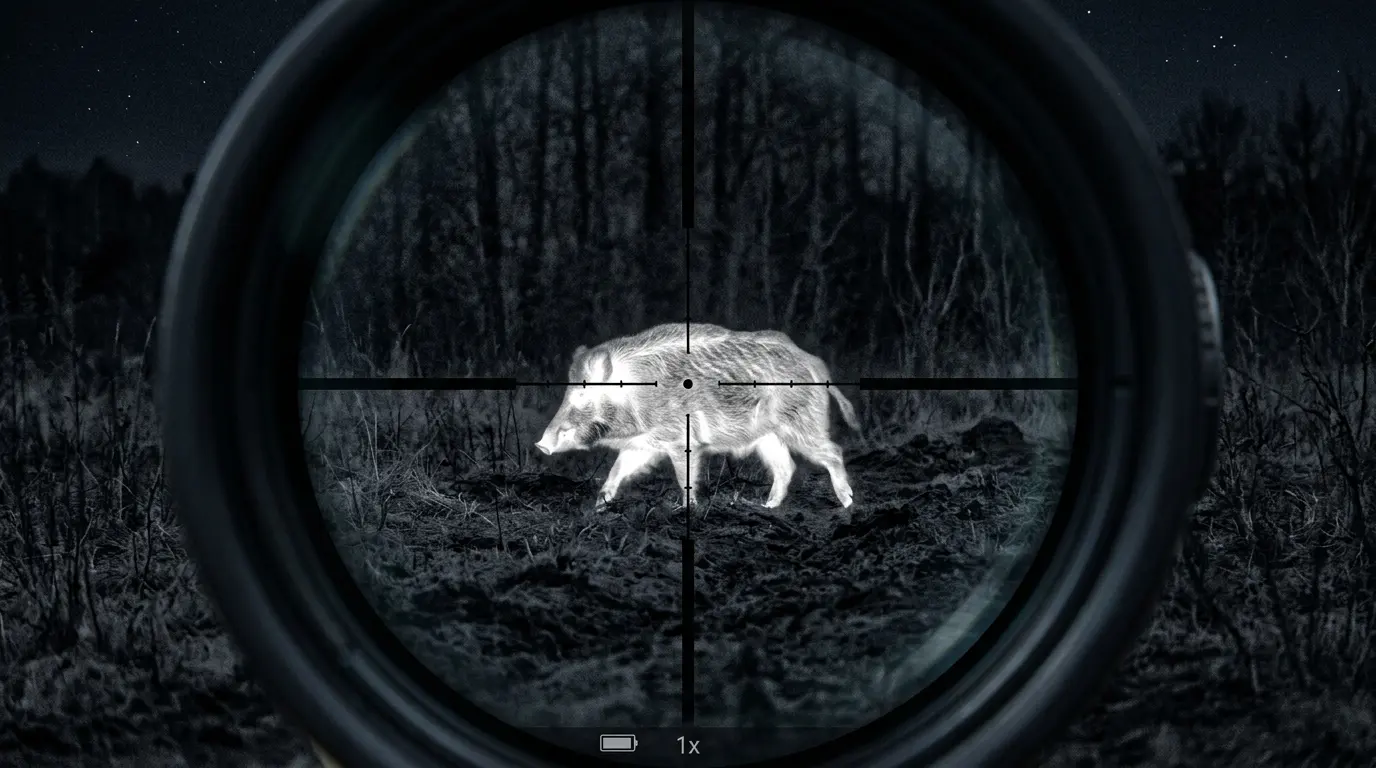
Hog hunting after dark is one of the few situations where thermal optics are not just helpful — they are the difference between a productive night and going home empty. Hogs blend into thick brush, move constantly, and work in groups spread across a wide area. Thermal imaging cuts through vegetation, fog, and darkness in a way no other technology matches. But choosing the right thermal scope matters just as much as having one.
This guide covers the best thermal scopes for hog hunting in 2026: what specs actually matter in the field, which models hold up under real hunting conditions, and what to skip. If you are still deciding between thermal and night vision for hogs, read our breakdown of Thermal vs Night Vision for Hog Hunting first. For clip-on options that mount behind your existing scope, see Best Thermal Clip-On Scopes for Hunting.
What Hog Hunting Demands From a Thermal Scope
Hog hunting creates specific conditions that not every thermal scope handles well. Before looking at specific models, understand what the work actually requires.
Adequate Detection Range
In open fields, hogs appear at 200 to 400+ yards. In wooded areas or river bottoms, shots rarely exceed 150 yards. Your scope needs to detect and identify hogs at the distances your terrain actually produces. Detection range (spotting a heat signature) is much longer than recognition range (telling a hog from a deer). Look for specs on both.
NETD Below 35mk
NETD (Noise Equivalent Temperature Difference) measures how sensitive the detector is to temperature differences. Lower numbers mean better sensitivity. For hog hunting, where animals may partially hide in brush and only part of their body is visible, a sub-35mk NETD detector picks up those partial heat signatures far better than a 50mk unit. If a spec sheet doesn’t list NETD, assume it’s not competitive.
Refresh Rate: 50Hz vs 30Hz
Hogs bolt fast when spooked. A 50Hz refresh rate tracks fast-moving targets without the motion blur that plagues 30Hz sensors. For still shots at relaxed hogs, 30Hz is workable. For running shots or when the sounder flushes, 50Hz is the right call.
Durability and Battery Life
Hog hunts run long — often 6 to 10 hours from dusk to dawn. A scope that dies at 3am is a problem. Look for 8+ hours of rated battery life, and check whether the unit accepts external power.
Top Thermal Scopes for Hog Hunting in 2026
AGM Rattler V2 TS35-384
The AGM Rattler V2 is the compact thermal that changed the sub-$2,000 market when it released. The 384×288 sensor with 17μm pixel pitch and sub-35mk NETD hits numbers that previously cost twice as much. The 35mm objective gives you a detection range of 1,350 meters on man-sized targets, which translates to reliable hog detection past 600 yards in open fields.
What makes the Rattler V2 work for hog hunting specifically: the sub-400g weight means it doesn’t fatigue your rifle setup during long carries through thick cover, and the 50Hz refresh rate handles fast-running hogs cleanly. The compact 155mm body length fits AR-pattern rifles without pushing your eye relief out of spec.
Battery life runs 7 hours on internal charge. The unit accepts USB-C charging in the field, so a small power bank extends that significantly. The quick-disconnect mount holds zero through rough handling.
AGM Adder V2 LRF 60-1280
If you need top-tier detection range and want integrated laser rangefinding in one unit, the Adder V2 LRF is the serious hog hunting platform. The 1280×1024 sensor with 12μm pixel pitch delivers significantly higher image resolution than 384-series sensors — at 400 yards, individual animals are clearly distinguishable rather than amorphous heat blobs.
The integrated 1000m laser rangefinder addresses a real hog hunting problem: in the dark, judging distance is harder than in daylight. The Adder V2 LRF removes that uncertainty. You range the target, the ballistic calculator feeds the hold-over, and you confirm the shot. For longer shots on open Texas senderos or large agricultural fields, that workflow matters.
The 60mm objective produces a 2.5-20x magnification range, which gives both the wide field of view needed to spot moving hogs and the magnification to take precise shots. Outdoor Life noted the Adder V2 LRF as a “quantum leap” for night hunting — that assessment holds for hog-specific use cases.
AGM Spectrum 4K LRF
The Spectrum 4K LRF occupies the top of the thermal scope ladder for hunters who want the best image quality available without going to military-grade pricing. The 640×512 sensor combined with 4K video recording, integrated WiFi, and a 1500m laser rangefinder creates a complete hunting platform rather than just an optic.
For hog hunting, the Spectrum 4K’s image quality advantage shows up at range. When you’re trying to identify a hog at 350 yards in a soybean field, the difference between 384 and 640 resolution is meaningful — you’re seeing more detail, making target identification faster and more confident.
The unit is heavier and more expensive than the Rattler V2. For hunters running compact rifles or doing lots of stalking, that matters. For hunters in blinds or on elevated stands over known feeding areas, the weight is a non-issue and the image quality advantage is worth it.
Pulsar Thermion 2 XP50 Pro
The Thermion 2 XP50 Pro is the most popular thermal scope in the U.S. deer and hog hunting market. The 640×480 sensor and 50mm objective produce excellent image quality, and the ergonomics integrate naturally with bolt-action and semi-auto rifles alike. Battery life hits 8+ hours.
The XP50 Pro runs a 50Hz refresh rate and 17μm pixel pitch with sub-40mk NETD. That’s slightly behind the Rattler V2’s sub-35mk spec, though real-world image differences are marginal in most field conditions.
The price point is significantly higher than the Rattler V2 for comparable core performance. You’re paying for the Pulsar ecosystem — app connectivity, profile management, and a well-established warranty support network. If those factors matter to you, the premium is justified.
Trijicon IR-HUNTER 35mm
Trijicon’s IR-HUNTER is built to a different standard — the construction quality and ruggedness exceed most hunting thermals, and the optical clarity is among the best in class. The price reflects that. For hunters who want an optic that will outlast everything else in their collection and don’t mind the investment, the IR-HUNTER deserves consideration.
For pure hog hunting value, though, the AGM options above deliver comparable performance at significantly lower cost.
How to Choose Between These Scopes
Match the Scope to Your Terrain
River bottom and dense brush: Detection range beyond 300 yards rarely matters. The Rattler V2 is the right call — compact, lightweight, excellent at close-to-medium range, and budget-friendly enough to mount on a dedicated hog rifle.
Open agricultural fields: Range and image quality matter more. The Adder V2 LRF or Spectrum 4K gives you the ability to identify and confirm hogs at 300-500 yards reliably.
Mixed terrain: The Rattler V2 handles most scenarios. If budget allows, the Spectrum 4K handles everything.
Consider Your Rifle Platform
A 6-pound compact AR with a heavy thermal scope becomes awkward to carry. The Rattler V2’s sub-400g weight is specifically an advantage here. Heavier bolt-action or larger platform rifles handle the added weight of the Adder V2 or Spectrum 4K without affecting handling.
Battery Strategy Matters
For all-night hunts, plan your power. The Rattler V2 and Adder V2 accept USB-C charging. Carry a 10,000mAh power bank and you’re covered for any length hunt. The Spectrum 4K uses a proprietary APS5 battery — carry spares.
Thermal Scope Setup for Hog Hunting
Getting a thermal scope zeroed correctly is not the same as zeroing a daytime rifle scope. Thermal zeroing requires specific techniques to account for point-of-impact shift at different temperatures and lighting conditions. Our complete guide on How to Zero Your Night Vision Scope covers the full process — the principles apply directly to thermal scopes.
Mounting Height
Most thermal scopes require higher rings than a standard riflescope due to the objective lens diameter. Verify clearance before purchasing rings. Standard 30mm or 34mm rings with appropriate height should work for most platforms, but measure against the specific scope you’re mounting.
Parallax and Focus
Thermal scopes don’t have parallax adjustment in the traditional sense, but the manual focus ring on the objective is critical. Set focus for your typical engagement distance before heading into the field. A blurry image at 200 yards when hogs are moving wastes your window.
Frequently Asked Questions
Do I need a dedicated thermal scope or will a clip-on work?
Both work. A dedicated thermal scope is optimized for the task and generally produces better image quality at equivalent price points. Clip-ons are more versatile — you can move them between rifles — but you’re adding complexity (two optical systems in series). For a dedicated hog rifle, a dedicated thermal scope is the cleaner solution.
What magnification do I need for hog hunting?
2-8x covers nearly all realistic hog hunting scenarios. Variable magnification scopes like the Rattler V2 (2.5-20x) or Adder V2 (2.5-20x) give you flexibility. Running full magnification for searching is a mistake — wide field of view at lower power spots movement faster.
Are thermal scopes legal for hog hunting in my state?
Night hunting hogs is legal in most states where hogs cause significant agricultural damage — Texas, Louisiana, Oklahoma, Georgia, and the Carolinas are common examples. Always verify current state regulations before hunting. Federal land rules differ from state land rules. Our guide to Night Vision Hunting Laws by State on NVGuide covers this in detail.
What is the effective range for hog hunting with thermal?
Recognition range (confidently identifying a hog vs. deer) with a quality 384-sensor scope runs 200-300 yards in typical conditions. With a 640-sensor scope, 350-400 yards is realistic. Detection range (seeing any heat signature) is 2-3x those numbers. Match your chosen maximum engagement distance to your scope’s recognition range, not detection range.
Final Recommendation
For most hog hunters, the AGM Rattler V2 is the right scope. It delivers sub-35mk sensitivity, 50Hz refresh rate, and genuine detection capability past 500 yards at a price point that makes outfitting a dedicated hog rifle reasonable. If you’re hunting large open properties and need maximum range and image quality, the AGM Adder V2 LRF with integrated rangefinding is the upgrade path that pays for itself in shot confidence.
Skip the underpowered entry-level thermal units. On a dark night with hogs moving fast through cover, you need a sensor that picks up partial heat signatures through brush and tracks movement cleanly. The price difference between a marginal unit and a capable one is the difference between a frustrating hunt and a productive one.

Can You Use a Thermal Scope During the Day? Daylight Use/Sun Safety and Zeroing Tips.

Night Vision Range Explained: Detection, Recognition, Identification, and Real Hunting Distance

How to Set Up an IR Illuminator for Night Vision: Placement, Beam Width, and Field Mistakes