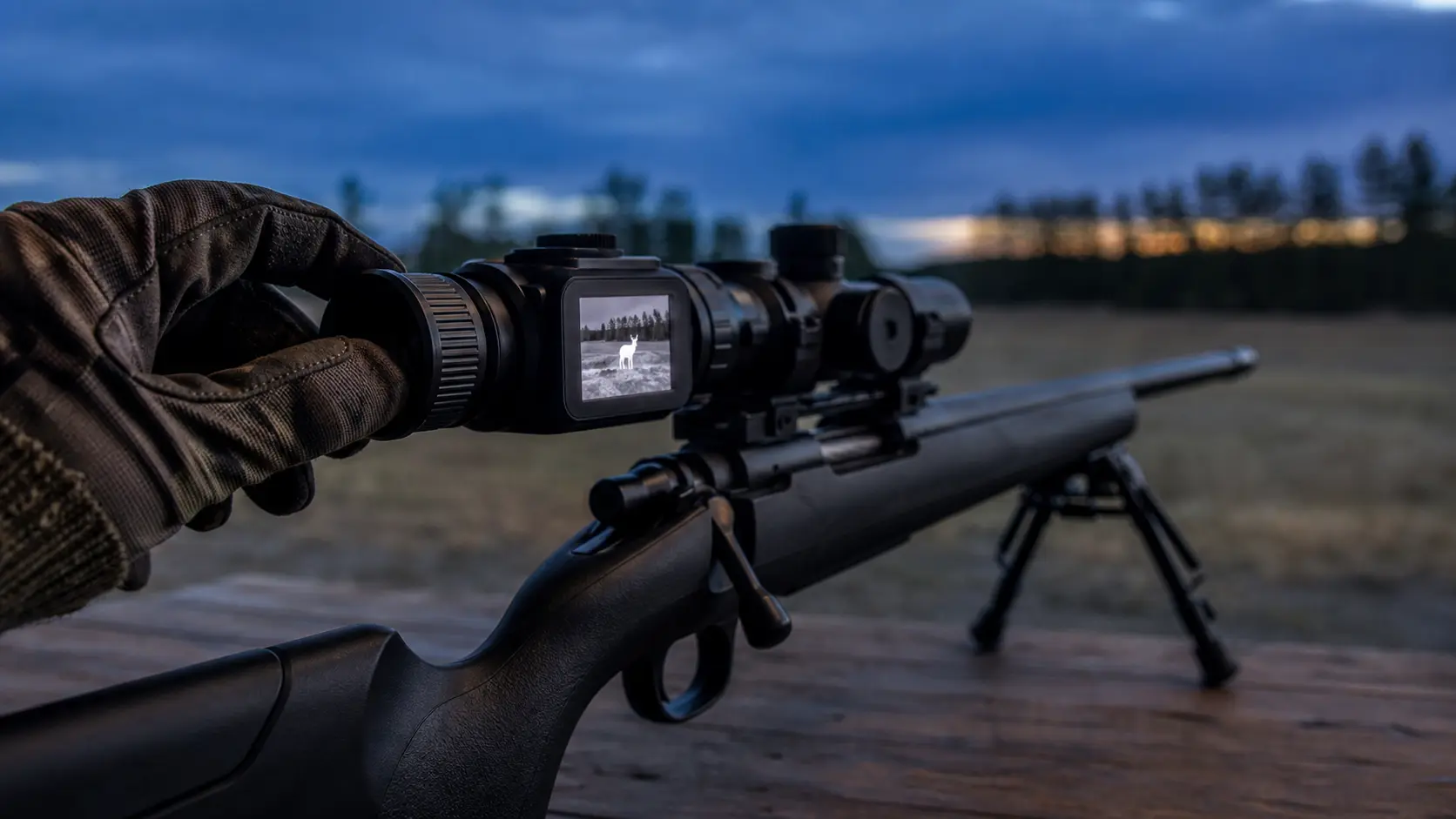
Thermal Scope Pixel Pitch Explained: 12 Micron vs 17 Micron for Hunting
By itself, smaller pixel pitch does not mean higher sensor resolution; it means the detector pixels are packed closer together, while sensor resolution is the pixel count.
When you’re selecting a thermal scope to compare, you may have noticed that they list pixel pitch either as 12um or 12 micron or 12µm, or 17um or 17 micron. It seems like a minor point on the spec sheet, but it is a point that will impact upon how the sensor, lens, magnification and image processing are integrated together.
The error is considering the thermal scope pixel pitch as a scoreboard. But smaller isn’t necessarily better. Bigger isn’t necessarily better. The good 12 micron thermal scope can be very sharp, compact and capable in the field. Even with a 17 micron thermal scope, a good image can still be obtained in hunting applications provided that the sensor sensitivity and optics are good.
Choosing the right micron number is not a matter of, “Which micron number wins? The question one needs to ask is: “What is the complete thermal system that provides me with the field of view, detail, contrast and identification range I need to hunt?”
The answer to this question is very simple: 12 Micron or 17 Micron for Hunting – BOTH!
Most hunters spending money on new thermal optics use 12 micron sensors these days. They enable manufacturers to design small scopes with useful base magnifications, reasonable lens dimensions and good spatial detail in a well designed system. Hence today you see the use of 12 micron sensors with many 384 and 640 thermal scopes.
A 17 micron thermal scope does not necessarily have to be considered “out of date. With similar sensor technology and comparable optics, larger pixels will collect more thermal signal per pixel and some older or premium 17 micron optics can be very usable. A well-built 17 micron device may appear superior to a cheaper 12 micron unit with so-so NETD, poor processing, or a mediocre display in wet, cool, or low contrast situations.
So practically, it’s not as if people somehow have to go with a lower micron number, it’s the better complete scope. Consider the thermal sensor pixel pitch in conjunction with the thermal scope resolution, NETD, size of the lens, base magnification, field of view, focus, display quality, refresh rate, battery system, and actual identification distance.
In a Thermal Scope, What is Pixel Pitch?
Thermal imaging pixel pitch is the distance between the center of one sensor pixel and the center of the next one. It is measured in microns and is the measurement unit of a micron. Simply put, it’s how close the thermal detector pixels are on the sensor.
A 12 micron thermal sensor has pixels 12 microns apart. A 17 micron sensor is the sensor that has pixels 17 microns apart. This spacing influences the detector’s physical dimensions, the lens’s projection onto the detector and the amount of detector area each individual pixel must receive thermal energy from.
The sensor geometry is the pixel pitch. It’s not a comprehensive picture quality tale.
What Does “Micron” Mean?
One micron is one thousandth of a millimeter. Write it as um, µm or micron on the product pages. You may see a scope listed as 12um, 12µm, 12 micron, 17um, 17µm, or 17 micron. In this context, those are simply other terms for pixel pitch.
What is important for a hunter is not the minutest measurement physically. The key is the interaction between that measurement and the lens, sensor resolution, magnification and thermal sensitivity.
The pixel pitch and the sensor resolution are different.
Note that pixel pitch is not the same as sensor resolution. A thermal scope sensors resolution class, e.g. 384, 640 or 1280, refers to the number of detector pixels present in the sensor. The distance between those pixels is known as Pixel Pitch.
A 640 sensor will typically provide more overall image information than a 384 sensor, while two 640 sensors (with 12 micron pixels and 17 micron pixels respectively) will be different. Physical size, lens combination, field of view and magnification may vary.
For the more in-depth breakdown on resolution, check out our guide to thermal scope sensor size. Pixel pitch is a part of that discussion, not the sole answer to it.
12 Micron Thermal Sensors: Pros and Cons
The 12 micron thermal scope is prevalent in the hunting market nowadays, as smaller pixel pitch allows hunters to create efficient devices with a smaller size. The smaller pixels allow for a smaller physical sensor with the same resolution, compared to a 17 micron sensor. This can help keep lens size and scope size and weight in check.
The practical field advantage is normally a consideration: if the sensor is 12 microns, then the base magnification, with a large-ish objective lens can be useful. This is important when shooting at night with a rifle. Even if the spec sheet seems impressive, there are some scopes that are too big, too nose-heavy or too tight on the picture that can be an issue.
Combined with a high-quality lens, strong NETD, clean processing, and good focus and display, 12 micron sensors can produce excellent 12 micron thermal scope image quality. They tend to be particularly prevalent in 384 and 640 class optics that target hogs, coyotes, or any combination of these properties.
The downside is that smaller pixels aren’t the magic bullets. If the NETD of the thermal scope is weak, the lens is soft, the display is poor, or the image processing smears detail, a 12 micron label won’t save the scope.
12 Micron Works For Hunters!
If you are looking for a modern rifle scope to fit your rifle that balances size, detail and magnification, then the 12 micron scope might make sense. It is a good match for hunters who either shift from stand to stand, scan fields, work around feeders or simply want a scope that doesn’t weigh down the rifle.
When hunting coyote and predators, 12 micron sensors can come in handy, as the smaller game requires greater clarity at more erratic ranges. The same applies to crop fields in which you might see heat well off in the distance but have to determine what it is before hitting it.
When comparing current generation scopes, 12 micron is generally a part of the common discussion. Just remember to consider it in terms of the lens, resolution, NETD and base mag.
Even a 12 Micron Scope can be disappointing.
Even a mediocre scope can still appear noisy, flat or washed out. This typically occurs when buyers try to look for one spec and overlook the other specs.
Be on the lookout for these vulnerabilities:
- The claims of high detection ranges with limited description of the conditions tested
- Weak or unstated NETD performance
- Low display resolution, which fails to display the sensor detail in a good manner
- Fixed focus that does not match your hunting distances
- Narrow field of view for close-range woods or fast-moving hogs
- Aggressive image processing for blockiness or artificial appearance of animals
Any 12 micron thermal scope should be tested in the field and not merely on a product tile.
17 Micron Thermal Sensors: its advantages and disadvantages.
The spacing between the pixels is greater in a 17 micron thermal scope. In many of the current hunting markets, 17 micron sensors are linked to older models or legacy high dollar sensors, but that is not to say they don’t work.
With all other sensor technology and optics equal, larger pixels are able to capture more thermal signal per pixel. That can make a difference in low contrast image behavior when the animal and background are not too different in temperature. Consider damp pastures, warm nights, foggy edges, or cool mornings when everything in the frame is close together thermally.
It comes at a cost of the size and design of the system. A 17 micron sensor is physically larger than a 12 micron sensor, and has the same resolution. The optical design could require a different lens size to achieve equivalent magnification and field. It may be a bulkier package, more expensive, or an older package.
17 Micron and Beyond
There is a point when it still makes sense to use a 17 micron scope, provided the entire device is of good quality. Occasionally, one encounters an old high quality lens with good glass and high quality and good low contrast performance in the used market. For static observation, ranch security, or hunting from a fixed stand, size and weight may not be as important as image comfort and image contrast.
It can also be a factor to take into account when hunting in low-contrast conditions. Fog, warm nights, humidity and rain can flatten a thermal image. Under those circumstances, it’s not just a 12um versus 17um thermal comparison, but the sensitivity of that sensor, the NETD, and the processing.
The 17 micron May is less attractive.
If the rest of the scope isn’t modern, a 17 micron scope might not be as appealing. Even if the sensor is respectable, an older scope with older firmware, lower display resolution, weaker battery systems, older recording features and bulkier housing can make the older scope feel behind.
Beware on the secondhand market. While a high quality 17 micron optic from years ago may still be useful, a dated optic that has insufficient support or options or whose history is unknown may not be a good buy.
Practical Field Comparison of 12 Micron and 17 Micron.
| Spec / Field Factor | 12 Micron | 17 Micron | What Hunters Should Actually Check |
|---|---|---|---|
| Image detail | Can offer very good spatial detail in small modern optics | Can still be good, particularly in higher quality systems | Compare actual image detail at the distances you hunt |
| Sensitivity / low contrast | Depends heavily on NETD, sensor generation and processing | Larger pixels may be useful when technology and optics are comparable | Check NETD, field reviews and performance in different weather conditions |
| Objective lens size and FOV | Often can achieve useful magnification with smaller objectives | May require larger objectives for the same feel | Compare objective lens size and actual field of view |
| Base magnification | Often higher for a given compact lens setup | Can vary widely by optical design | Read the listed base magnification and decide if it fits your terrain |
| Field of view | May feel more constricted based on the lens and sensor combination | May provide a different field of view based on sensor size | Check field of view in feet at 100 yards, not just magnification |
| Detection range claims | Can be high on spec sheets | Can also be high on spec sheets | Do not interpret detection range as identification range |
| Digital zoom | Works well with higher resolution sensors | May work well if resolution and processing are good | Judge by usable detail, not just the 2x/4x/8x labels |
| Size of scope & weight | Commonly used in compact rifle scopes | May be found in larger or older units | Consider rifle balance and long night comfort |
| Used-market value | Common in current models | May be good in older high-quality optics | Check warranty, support, battery condition and image quality |
Does Pixel Pitch have an impact on the Detection Range?
Yes, pixel pitch can influence the optics and sensor mathematics that determine range, image sampling, field of view and magnification. That doesn’t mean it is advisable to purchase a scope just because it says it can detect a larger number.
Often, the thermal scope’s detection range is based on an idealized situation and a large heat source. It can sometimes inform you that the device is able to detect a warm object at a distance. It is not a guarantee that you can spot a legal animal, determine orientation, nor determine legality behind it or make an ethical shot.
Detection, Recognition and Identification
There should be a distinction between detection, recognition and identification for hunters. Detection indicates that you have some idea that something warm is out there. Recognition: Identify the general class of object. Identification will allow you to make a safe field identification.
The micron number is not as important as that distinction. The number that hunters should be concerned with is a thermal scope identification range. To learn how it breaks down, read our guide to detection vs recognition vs identification.
While pixel pitch can help shape what the system can resolve, it does not replace your responsibility to identify the target.
Much Like the Age Old Debate of Pixel Pitch vs NETD – Which Matters Most?
Pixel pitch and NETD are two different characteristics. The sensor geometry is called the pixel pitch. NETD is the measure of thermal sensitivity, which is the ability of the system to distinguish small differences in temperature.
A scope with a good thermal scope NETD will be able to display more contrast under very challenging circumstances. This is particularly critical when the animal and background temperature is near. While pixel pitch can impact the sensor design, NETD, processing, lens quality and calibration all play a role in what is on display in the eyepiece.
If you’re still in the midst of learning thermal scope specs explained in plain language, don’t call pixel pitch and NETD an enemy. Without both in context, you’re out of luck.
The Reason for Low-contrast Weather and the change of the Answer
Warm nights, rain, fog, and humidity can flatten the appearance of thermal images. The heat may be the same in grass, brush, soil, trees and animals. On those nights, a scope that seems fine in cold dry conditions may perform less impressively.
That’s where thermal scope NETD comes into the picture. A lower NETD rating may mean a more sensitive system, however, the entire system must be evaluated. Image Processing can be a help or a hindrance. The focus can be defined or opened up. Detail can be shown or concealed by display quality.
384, 640 and 1280 examples of Pixel Pitch vs Sensor Resolution.
If the scope is adequate and the lens quality is good, 384 at 12 micron can be a viable and budget-friendly hunting scope. It can be lighter, smaller and sufficient for the hogs over feeders, trails and moderate field distances.
A 640 at 12 micron scope will provide more total image data. That can enhance details, field awareness, and also the usability of digital zoom. This can be the sweet spot if the budget permits.
The geometry of the sensor and the feel of the optical system of a 640 at 17 micron scope might differ. Even if it is a high quality device it can still create a very usable image. However, don’t assume it’s superior or inferior until you check the age, support, display, firmware, battery and warranty.
Again, higher-resolution 1024 or 1280 class sensors can offer more image data but the same principle applies, high resolution is not magic and comes at a price. Lens quality, NETD, refresh rate, processing, display and ergonomics remain important.
The Pixel Pitch and the lens size and base magnification.
The focal length of the lens, the size of the sensor, and the pixel pitch all contribute to the thermal scope’s “feel.” That’s why two scopes using similar sized lenses can differ in terms of their base magnification, field of view and target detail.
A larger objective lens can help with reach and magnification, but it may also restrict the field of view and increase weight. A smaller lens can be faster and lighter, but may not be able to provide sufficient detail for greater distances of identification. One aspect of this balance of the design is pixel pitch.
To get some context, check out our thermal scope lens size and thermal scope base magnification guides.
Why is the same lens different when it comes to the sensors?
Not all scopes will have the exact same view with a 35mm. What you see is a result of the sensor resolution, the actual sensor size, the pixel pitch, the software scaling, and the design of the display.
That’s why Field of View is important. A reduced image may hinder target acquisition when hunting in dense cover. When hunting open crop country, not enough magnification may leave you wanting more. Terrain is the key determinant when it comes to picking the best thermal scope for hunting.
Never purchase a product just because it has a low micron number!
NEVER purchase a scope for 12 micron. Don’t turn down a scope because it has 17 micron written on it. Purchase the optic that is right for your distance, terrain, rifle and ID requirements.
The micron number is not a conversation stopper, it’s a conversation starter.
The effect Pixel Pitch has on the Digital Zoom.
Digital zoom is an increase of the information coming from the sensor. Does not add details. That’s why higher resolution generally will look better when zoomed than lower resolution.
While pixel pitch helps determine the sampling of the optical system, the overall quality of the digital zoom depends on the overall sensor resolution, the focus of the system, the NETD of the sensor, the processing of the sensor, the display resolution, and the atmosphere. A high resolution scope with low power (2x) zoom may be more useful than a low resolution scope zoomed to the max.
Refresh rate is also important when animals are moving. A smooth image facilitates tracking and scanning, particularly on running coyotes, or hogs moving through gaps. If you are looking for the difference between 30Hz, 50Hz and 60Hz models, check out our thermal scope refresh rate guide.
Best Pixel Pitch in Hunting Scenario
Hunting for hogs over feeders and trails
A combination of either 12 micron or 17 micron will work for a thermal scope for hog hunting when going over feeders, trails or known areas. Look for field of view, quick target acquisition, accurate target distance and battery capacity. Hogs tend to travel in gangs, and a scope that allows you to see what’s going on is better than one that is too cramped.
Battery setup is important if you are going to be hunting all night. Consider how long the thermal scope battery life lasts before selecting a heavier, power-consuming optic.
Coyote hunting and Predator hunting is offered.
When it comes to a thermal scope for coyote hunting, detail is important due to the smaller targets and less predictable ranges. A 12 micron 640 class scope with the correct scope lens can be a good match, but if you can get the range of identification and the contrast, then a good 17 micron optic will do.
Base magnification, field of view and quality of the digital zoom are important factors to consider for coyote hunters.
Openfields and Crop Country
The lack of obstruction allows for reach, lens, and ID skills. Pixel pitch can be less important in determining resolution than the size of the lens, the useful base magnification and a higher resolution sensor. A large detection range doesn’t mean you should shoot outside your comfort zone!
Close Ranges, Brush and Dense Woods.
In woods and brush, field of view and target acquisition is a factor. A close-up, high magnification scope can be annoying if animals look close and are moving fast. The pixel size is not as important as the ability to see, locate and identify the animal in time.
Ranch Security & Property Scanning
When it comes to ranch security and property scanning, comfort is an issue. You can spend more time than you do shooting – observing. Other features such as a larger field of view, image stability, robust battery system and a clean low-contrast performance may be more crucial than the lowest micron.
Our guide on how to choose first thermal scope is the next step if you are looking to purchase your first ever optic.
In this Buying Advice segment, you will learn how to use Pixel Pitch to compare in a spec sheet.
Make pixel pitch just one of several points to compare. Prior to purchasing, please consult:
- Sensor resolution
- Pixel pitch
- NETD
- Objective lens size
- Base magnification
- Field of view
- Display resolution
- Refresh rate
- Manual / fixed focus
- Battery system
- Warranty and support
- Real field reviews from the same type of terrain.
Finally, pose one question about practical use: will this scope allow me to make a clear and safe identification at my normal hunting distance?
Here are some common pitfalls buyers should avoid when considering thermal pixel pitch.
When it comes to how small a micron is, the smaller is always better.
While a 12 micron thermal scope can be very good, the microns alone is not an assurance of the quality of images. The edge can be lost through a weak lens, bad focus, a noisy sensor or poor quality display.
In the absence of information on the new 17 Micron, it is best to assume that it is outdated junk.
Some 17 micron optics still work, particularly those that were manufactured as more expensive optics. Evaluate the entire device rather than the age of one spec.
NETD and Weather Conditions Ignored
Poor contrast weather can quickly reveal poor thermal performance. NETD and processing should be taken seriously if you are hunting while it’s humid, foggy, rainy, or warm down south.
Setting up a Detection Range for an ethical shoot.
Identifying a legal target is NOT the same as detecting heat. If the manufacturer makes range claims, take them with a grain of salt unless the assumptions used in testing are evident.
Comparing the specs of different brands without reading the whole system.
Other brands may make different assumptions, image processing, display and range claims. Clean does not always equal best field image.
Final Recommendation
The pixel pitch of the thermal scope is important but should never be the sole decision point on choosing or discarding a scope. There’s a reason that a lot of hunting optics are made using 12 micron sensors; they are used to create compact and capable hunting optics, with detail and magnification. Even a 17 micron thermal scope may be useful when the sensor, lens, NETD, processing and display are good.
Most hunters will prefer the better complete thermal system. Check pixel pitch versus thermal scope resolution, NETD, lens size, base magnification, field of view, focus, refresh rate, battery life and realistic identification distance.
When the spec sheet gets you in the field, able to quickly locate animals, confidently identify them, and make disciplined choices, it’s doing its job.

Can You Use a Thermal Scope During the Day? Daylight Use/Sun Safety and Zeroing Tips.

Night Vision Range Explained: Detection, Recognition, Identification, and Real Hunting Distance

How to Set Up an IR Illuminator for Night Vision: Placement, Beam Width, and Field Mistakes