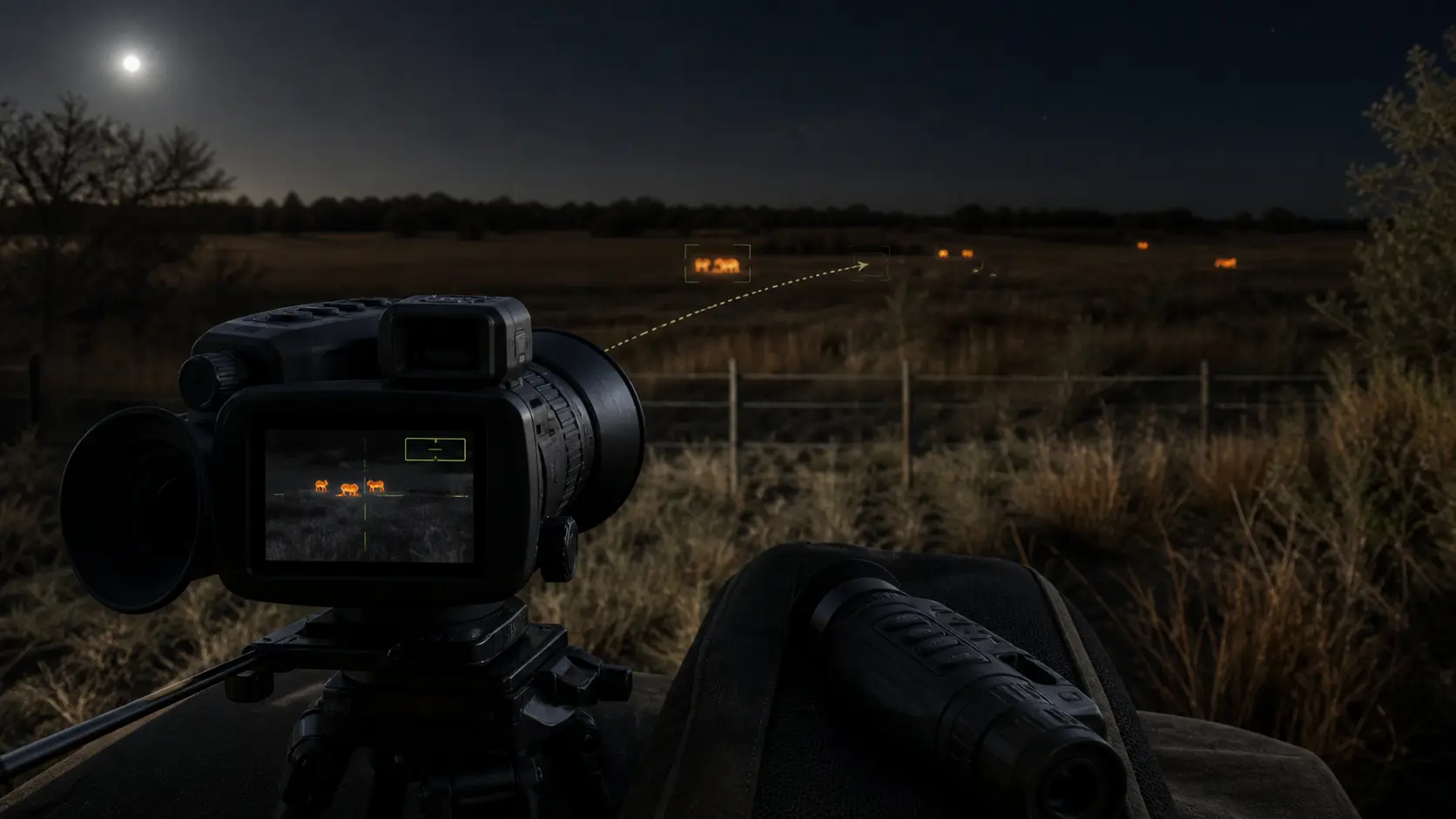
Thermal Scope with LRF vs No LRF: Is a Laser Rangefinder Worth It in 2026?
By 2026, built-in laser rangefinders have become much more common on mid- and premium thermal scopes. That does not mean every hunter needs to pay extra for it. An integrated laser rangefinder can be extremely helpful in the dark. Distance judgment through thermal is not an easy task. In open fields with minimal objects on the background and poor thermal contrast, you cannot tell if the target is 120 yards away or 220 yards. At the same time, a laser rangefinder increases the price, adds weight and additional electronics. You may be happy to use thermal without distance data if you mostly shot at known distances, at feeders, or in dense woods with plenty of reference points for estimating the range. This article compares thermal scopes with LRF vs no LRF in 2026 and outlines when a rangefinder is useful and when it is a waste of money.
Quick answer
Buy a thermal scope with a built-in LRF if you are going to shoot at distant targets, coyotes, multiple rifles, long-distance shots, or if the scope offers ballistic calculator features that benefit from range data. Choose a thermal scope without a built-in rangefinder if you shoot at hogs close to feeders, at known distances, or hunt in tight woods. It is also a good option for a lightweight scope, a budget-friendly optic, or for saving weight.
The main idea to keep in mind: a laser rangefinder cannot improve the thermal image itself. Instead, it provides an additional piece of information (distance), which, on many scopes, helps ballistic calculators suggest a point of aim.
What “LRF” means on a thermal scope
LRF stands for laser rangefinder. On a thermal scope, a built-in laser rangefinder measures distance to the target (or the object you range). In many models from current manufacturers, the measured distance may be displayed on-screen and used by an onboard ballistic calculator (if present). Examples of thermal scopes with an integrated laser rangefinder include:
- AGM Rattler V3 LRF (laser rangefinder included)
- Pulsar Trail 3 LRF (includes rangefinder and ballistic calculator support)
- ATN ThOR 6 LRF (features laser rangefinder and ballistic calculator)
- AGM Varmint V2 LRF (laser rangefinder included)
Exact implementations of laser rangefinding technology may vary depending on manufacturer. Also, laser rangefinder position may vary from scope to scope. For instance, AGM Rattler V3 LRF describes the rangefinder as “built into the lens”.
What “LRF” is not
A laser rangefinder cannot:
- improve thermal sensor resolution
- lower NETD
- extend thermal detection range
- make a blurry target identifiable
- replace target recognition and identification procedures
- correct bad zero of the rifle
- make an unethical shot legal
It is essential because a built-in rangefinder may sound like a magical add-on. However, it does not add any capabilities besides the ability to measure range. A built-in laser rangefinder is useless in case the image is so blurry and unrecognizable that the scope cannot distinguish the target properly. In other words, if you cannot tell what you are shooting at, knowing the distance to it does not help too much.
Why range judgment is hard at night
Range judgment may become even trickier compared to regular daylight glassing because:
- a thermal image does not provide color or details like grass, wires, textures, etc.
- an image is made with thermal contrast in mind, and visual depth cues do not apply
- distance calculation depends on image features and the user’s experience with thermal imaging
As a result, estimating distance becomes challenging in these cases:
- in flat fields
- in pasture or crops
- on snow-covered surfaces
- in fog or humid areas
- in unfamiliar territories
- with increased base magnification
- in situations when there are no reference points
An integrated rangefinder allows removing guessing from the equation. Instead of wondering whether a target is 180 yards or 280 yards away, you simply measure it with LRF and see the exact number in the crosshairs.
When thermal scopes with LRF are worth it
Coyote hunting
A rangefinder is highly useful for coyote hunting because of the small size of the target. It becomes even more valuable because:
- you have to hold over at some ranges
- estimating distance at night can be tricky
- you may be hunting over open fields or calling predators at a distance
A built-in laser rangefinder is definitely a great feature if you are a serious predator caller and shooter.
Open-field hog hunting
Even in case you hunt only for hogs, a laser rangefinder might be useful. At a range of 200 yards and above, distance judgment becomes tricky. With subsonic ammunition, slower rifle caliber, suppressed firearms, or a rifle that requires holdover, knowing the range is vital. However, in this particular case, you do not necessarily need a built-in rangefinder. If most of your shots are fired inside 150 yards or 200 yards at known distances, you can easily pre-range them. Also, a laser rangefinder is unnecessary if you mainly rely on feeders and know their distances.
Thermal long-range shooting
When using your scope on longer ranges, LRF becomes a significant advantage. Thermal detection range is not the same thing as the maximum shot distance, but it is obvious that you have already detected your target with thermal and decided on a shot. In this situation, exact distance data provided by LRF helps you make a correct ballistic adjustment. Also, thermal scopes equipped with an onboard ballistic calculator may use distance data obtained with a built-in LRF to adjust aiming references (like points of aim or holdovers) or to suggest a correction based on a profile of your weapon and cartridges.
Multiple rifles or multiple profiles
Another application for LRF and ballistic calculators is hunting with multiple rifles (and different ammunition types, or different load data). ATN mentions in its description that ThOR 6 LRF includes an integrated ballistic calculator that uses up to six custom ballistic profiles. Similarly, Pulsar Trail 3 LRF supports ballistics workflow with the help of the built-in rangefinder and Stream Vision Ballistics app. AGM Rattler V3 LRF features an onboard ballistic calculator. This is helpful if you are frequently switching rifles or ammunition types. Also, this feature may be valuable when using a thermal scope with a suppressed airgun or other types of firearm.
Shooting unknown distances
If you do not hunt on familiar territory with pre-known and pre-ranged distances, a built-in laser rangefinder may be a good thing.
When no LRF is still acceptable
Hog hunting with known distances
In case your shots are fired in close distances with known distance data, an integrated laser rangefinder may be a luxury. If your hunting spots are familiar, and you regularly go to the same places, you may want to spend your budget on improving thermal and ballistic capabilities, rather than wasting it on additional electronics.
Hunting in woods or tight spots
Hunting in tight spots is another reason to leave LRF aside. In this case, field of view and quick target identification might be more important than precise distance data. Thus, in addition to thermal capabilities, consider purchasing a thermal scope with a wide FOV for a smoother hunt.
Budget limitations
In case the thermal scope budget is limited, you might not be able to afford a built-in laser rangefinder and some other features, which can be useful. As a result, you should consider purchasing a higher-spec thermal scope without the LRF functionality.
Simplicity preference
Additional electronics can make your device more complicated and difficult to configure correctly. If you do not need them, leave them out.
LRF built into the scope vs a handheld device
A handheld rangefinder is a decent device when you hunt in daylight. However, in the darkness, a handheld laser rangefinder is not as convenient because of workflow reasons. A separate rangefinder forces you to:
- scan the territory with thermal
- put down the rifle
- search for the target on your handheld rangefinder
- take the rifle back
- acquire the target once again
With a thermal scope featuring an integrated laser rangefinder, you only have to range the target from within the scope. A built-in LRF is especially helpful in case the targets are moving or your buddy does not have a rangefinder.
However, a built-in LRF is tied to the rifle and scope. Unlike a standalone rangefinder, you cannot move it independently to range from another angle.
LRF built into the lens vs LRF as an external module
One of the biggest trends in scopes of 2026 is improved LRF design. In particular, one of the new developments is an integrated rangefinder. For instance, AGM mentions its Rattler V3 LRF to have the rangefinder “built into the lens”.
Similarly, Pulsar Trail 3 LRF uses an integrated rangefinder in a rugged monoblock. ATN ThOR 6 LRF also features built-in laser rangefinder on the models that have LRF. Advantages of an integrated rangefinder:
- sleeker profile
- less chances to snag it somewhere
- improved balance and weight distribution
- cleaner appearance
Downsides to consider:
- limited repairability options
- possible problems with calibration (if needed)
Useful or gimmick? Ballistic calculators explained
An onboard ballistic calculator is a very useful tool to assist the shooter in obtaining correct POI/holdover in a wide range of scenarios. However, to make the calculations effective, a ballistic calculator must receive all required data. Typically, a ballistic calculator will need:
- bullet weight
- muzzle velocity
- ballistic coefficient
- zero distance
- sight height
- environmental inputs (temperature, altitude, etc.)
- rifle and barrel length profiles
- correct input units
- range data
If one of the parameters provided by the user is incorrect, a ballistic calculator will generate incorrect results.
Thus, a ballistic calculator does not replace any of the standard processes of adjusting your weapon. Make sure you double-check all calculations and verify them in practice.
Angle compensation on thermal scopes with LRF
Some thermal scopes with LRF offer angle compensation as one of the features related to ballistic calculations. It means that a scope can perform more advanced operations to calculate the trajectory of the round. However, in case your scope does not support shooting in elevation angles, the feature will not benefit you.
If you hunt in hills, ranches, elevated stands, or on other uneven terrains, angle compensation can come in handy.
Which specs to compare before purchasing LRF
Do not buy a scope just because of an onboard laser rangefinder. Instead, compare the whole set of specifications before spending extra money on LRF. Consider these specs: | Spec | Explanation | |—|—| | Sensor resolution | Image detail | | Lens size | Magnification and FOV | | NETD | Performance in low contrast | | Base magnification | Field of view | | Max LRF range | Range capabilities | | Ballistic calculator | Advanced aiming | | Display resolution | Detail and clarity | | Battery life | Power consumption | | Mounting system | Recoil impact | | Warranty policy | Repair and services |
The laser rangefinder is a feature to consider but not the only thing to consider. Also, it may affect the other aspects of operation. Consider these factors and choose the model wisely.
Currently available LRF models in 2026
Here are the currently available examples of thermal scopes with integrated LRF:
AGM Rattler V3 LRF
AGM’s new Rattler V3 LRF is a powerful and modern example of a thermal scope with integrated laser rangefinder. AGM describes its new product as featuring 640×512 12-micron thermal sensor with <15mK NETD, 50 Hz frame rate, 50mm lens, 2560×2560 OLED display, 1,000 m built-in in-lens LRF, and onboard ballistic calculator.
Best match: hunters looking for a compact scope with built-in distance-measuring and ballistic capabilities.
Pulsar Trail 3 LRF
Pulsar Trail 3 LRF is one of the premium monoblock thermal scopes with an integrated laser rangefinder. According to Pulsar’s description, it features a built-in LRF up to 1200 m range with ±1 m accuracy. Pulsar Trail 3 LRF uses a 640×480 12-micron thermal sensor, F50/1.0 lens, 3x-24x magnification, 1920×1080 AMOLED display, ballistic calculator support via Stream Vision Ballistics app.
Best match: premium users who need advanced thermal hunting features in combination with LRF and other smart features.
ATN ThOR 6 LRF
ATN ThOR 6 LRF is an advanced thermal scope that offers lots of smart features, including an integrated rangefinder. In particular, ThOR 6 LRF models feature 640×512 sensors, 12-micron pixels, SharpIR AI image enhancement technology, Wi-Fi capability, LRF, and ballistic calculator with profiles.
According to ATN, ThOR 6 LRF allows measuring distance to 1000 meters with ±1 meter accuracy.
Best match: users who need the largest number of smart features and have no problems with managing the menu and profiles.
AGM Varmint V2 LRF
Despite the release of more premium models, AGM Varmint V2 LRF continues to be popular among hunters. According to the retail lists and AGM’s own description of its products, it uses 384×288 thermal sensor with 12-micron pixels, sub-20 mK NETD, 656 yard laser rangefinder, and onboard ballistic calculator.
Best match: hunters seeking an advanced thermal hunting scope with an integrated LRF.
LRF vs no LRF: by hunting style
Hogs over feeders
LRF is an extra but unnecessary. In case you always shoot at known distances (like feeder at 80 yards and field edge at 140 yards), you do not need LRF.
Open field hogs
In case you hunt at unknown distances, ranging can be useful. Also, if you encounter several pigs and need to fire rapidly, knowing the distances to targets can be important.
Coyotes
LRF can be extremely helpful here. Coyotes are smaller and faster, they can appear at an uncertain range. Ranging helps to eliminate mistakes in distance judgment.
Woods hunting
LRF is optional. Field of view, focus, and fast controls may be more relevant for hunting in tight spots.
Ranch security
LRF can be helpful. In case you need to know whether someone is 300 yards or 800 yards away from your property, LRF will be useful.
Deer recovery
LRF is not the primary feature to care about. Usually, when recovering a deer at night, a handheld thermal monocular can be used more effectively. Also, a thermal rifle scope cannot serve as a monocular.
Hog recovery
LRF does not play a big role here.
Common mistakes
Buying LRF but compromising on image quality
Do not purchase a thermal scope with LRF if the image is suboptimal and not enough for identification. In this case, range data does not help.
Assuming LRF equals to ethical hunting distance
A thermal scope with LRF shows the range to the target, but not the legality of the shot.
Forgetting to configure the ballistic calculator
Make sure your profiles are correctly configured. The calculator does not work properly if the input data is not accurate enough.
Not considering battery life of a thermal scope
LRF consumes power. Wi-Fi, display brightness, recording capabilities also need electricity. Consider how your budget affects battery capacity and usage time.
Purchasing excessive equipment for close-range hunting
A 1200 meter range LRF scope is a little bit exaggerated for close-range shooters.
Ignoring individual characteristics of each scope and its features
Not all LRF models offer the same range, the same integration level, reticle behavior, and ballistic calculation capabilities. Check the manual carefully.
When to buy thermal scope with LRF
Buy thermal scope with built-in LRF if:
- you often shoot at ranges farther than 150/200 yards
- you often hunt in open fields
- you have difficulty estimating the range with thermal scopes
- you use ballistic profiles
- you shoot at several different rifles or types of ammunition
- you need both distance and ballistic data in one device
- you hunt in unfamiliar spots
- you plan to buy an advanced thermal scope anyway
When to ignore the LRF functionality
Skip laser rangefinder if:
- most of your hunting occurs on known distances
- your budget is low
- you can find a better non-LRF scope for the same money
- you need to avoid complex electronics
- you prefer simplicity
- you already use a spotter with LRF
- you are unlikely to configure your ballistic profiles
Bottom line
A laser rangefinder can be an extremely helpful tool if you struggle with estimating the range of a target. If you are a long-range shooter or predator caller, an LRF scope may give you an advantage over other hunters and simplify the hunt process significantly. In case the majority of your shots are made at known or pre-ranged distances, an LRF scope can become an extra thing, which does not affect the hunt. Think about your needs first before making your decision.

Can You Use a Thermal Scope During the Day? Daylight Use/Sun Safety and Zeroing Tips.

Night Vision Range Explained: Detection, Recognition, Identification, and Real Hunting Distance

How to Set Up an IR Illuminator for Night Vision: Placement, Beam Width, and Field Mistakes