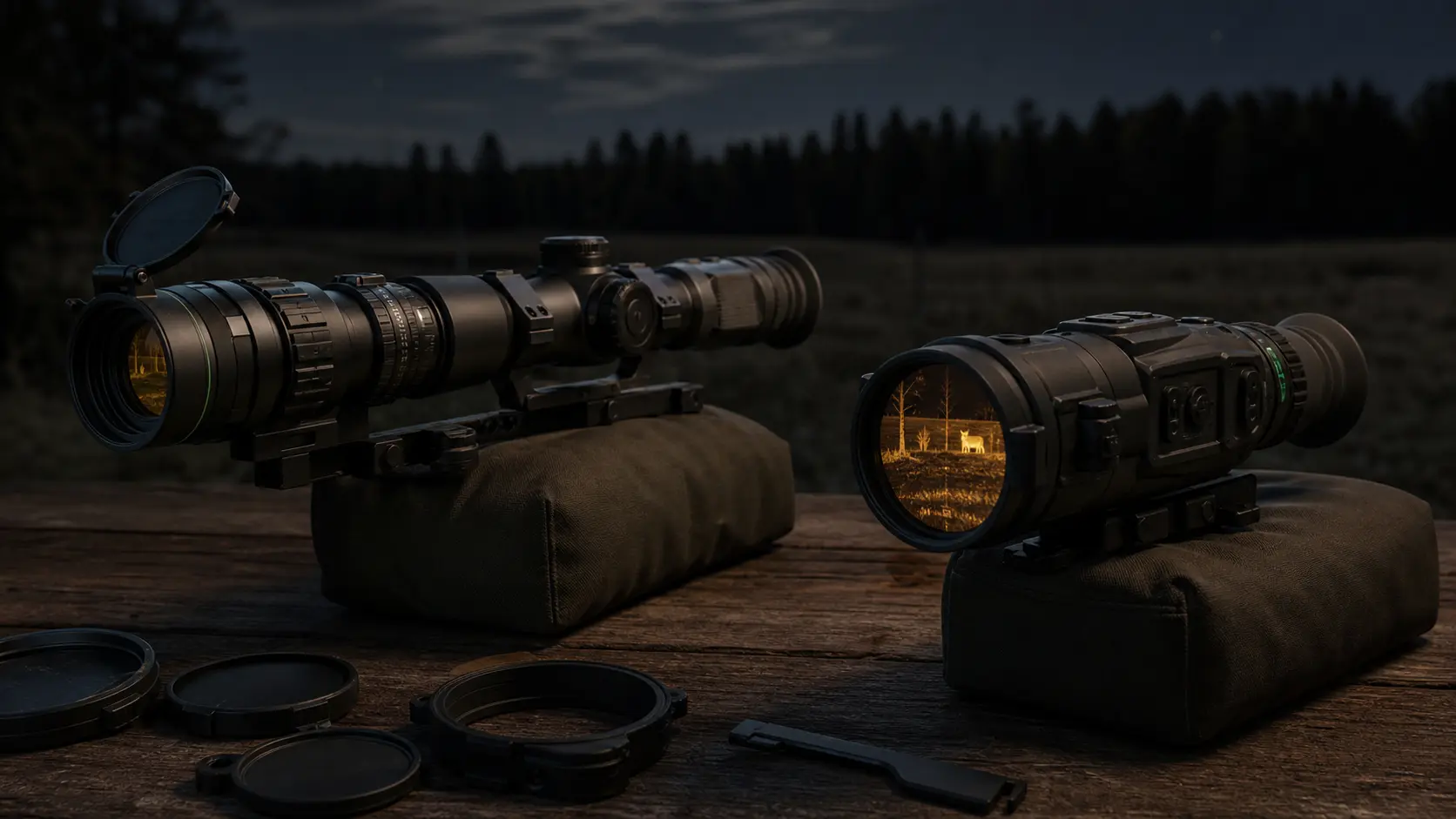
Thermal Clip-On vs Dedicated Thermal Scope: Which Setup Should Hunters Buy?
A thermal clip-on and a thermal scope solve the same problem – help you see at night. But they solve the problem differently.
A thermal clip-on sits in front of your regular day optic, turning it into a thermal optic. A thermal riflescope is a standalone scope with its reticle, zero, mount, magnification, and thermal image.
However, there are more important things to think about than just picture quality. It is about zero, mounting, magnification, day optic compatibility, scanning, price, and even rifle layout.
While clip-on can keep your day zero, reticle, rifle setup, and give you more flexibility overall, it is a more complex setup compared to a thermal riflescope. It requires adapter, alignment, zero check, etc.
In this article, we are comparing thermal clip-on vs dedicated thermal scope in 2026.
Quick answer
Choose thermal clip-on if you have a day riflescope you love, plan to switch between day and night, want to use the same device for several rifles, or retain the reticle and zero from your day sight.
Choose a dedicated thermal scope if you want simplicity, zero the thermal scope directly, benefit from built-in reticles and zero profiles, use controls faster, and reduce the number of mounting variables.
Rule of thumb: if you prefer simplicity, choose a dedicated thermal scope. In case you prefer flexibility but can deal with adaptability challenges, go for a thermal clip-on.
What is a thermal clip-on?
A thermal clip-on is a thermal image-producing module that connects in front of a riflescope.
Your day riflescope will stay on the gun. The clip-on attaches to the day riflescope in front of it via an adapter to the riflescope’s objective bell or rail mount in front of a day riflescope. You look through the day riflescope and get thermal images produced by the clip-on.
According to Pulsar, the Krypton 2 is a thermal imaging front attachment transforming a daylight riflescope into a thermal imaging riflescope. Their manual mentions the necessity of connecting the module to the lens of the riflescope with an adapter depending on the lens diameter.
AGM Rattler C V2 thermal image front attachment user guide highlights the need for a front adapter mounting system and Picatinny/Weaver rail mounting option. They mention that you should ensure that the adapter fits the day scope’s objective bell diameter.
What is a thermal clip-on? The thermal clip-on is an element of a larger system consisting of the thermal attachment, adapter, day riflescope, rifle mounting, and zero.
What is a dedicated thermal scope?
A dedicated thermal scope is a thermal riflescope without a day sight.
Unlike thermal clip-ons, dedicated thermal scopes are not attached to a day sight. That means no front adapter or day-scope alignment required. The scope has a magnification system and its own reticle.
The examples of such devices are AGM Rattler V3, Pulsar Thermion series, Pulsar Trail 3 LRF, ATN THOR 6, and Armasight Contractor.
Flexibility vs simplicity
Flexibility is a key feature of a thermal clip-on.
A thermal clip-on gives you the ability to keep your day riflescope, zero, reticle, and rifle layout the way they are. It lets you switch between thermal and day sight easily. You can also use a clip-on with different rifles, which is great if you hunt with several guns.
A dedicated thermal scope offers simplicity.
You install the scope, zero it, configure zero profiles, reticle profiles, magnification, and start hunting. You do not need any adapter and compatibility with another riflescope.
Point of impact and zero
Another important reason hunters like thermal clip-on is zero.
When you mount a clip-on in front of a day riflescope, your aim point is intended to remain the same, but it must be verified. Pulsar manual for Krypton 2 claims that the attachment was configured in a way that would not require any additional zeroing when attached to a properly zeroed riflescope. Moreover, in case of point of impact shift, it is possible to calibrate the display position.
AGM manual mentions that you may have to zero the day sight and attached clip-on, and suggests a way to ensure the repeatability of the zero by leaving the front adapter attached to the day riflescope.
Conclusion: it is possible to keep your day riflescope’s zero point with thermal clip-on. However, you need to ensure that.
Dedicated thermal scope zeroing
With dedicated thermal scopes, the process of zeroing is much easier.
You simply mount it to your rifle and start zeroing it according to its owner’s manual. Modern thermal riflescope manufacturers provide numerous zero profiles, reticle types, ballistic calculator, and often even built-in rangefinder and other ballistics-related tools.
Day optic compatibility
Day optic compatibility is among the biggest issues thermal clip-ons face.
When choosing thermal clip-on, you have to consider:
- day riflescope objective bell diameter;
- adapter compatibility with your riflescope;
- rail space;
- optical centerline height;
- magnification range of your day riflescope;
- focus and parallax adjustments of a day riflescope;
- reticle visibility;
- eye relief;
- mount repeatability; and
- whether your riflescope allows installing a clip-on.
AGM’s Rattler-C V2 manual claims that this thermal clip-on cannot be attached to scopes with focus rings on the objective lens housing.
Clip-on vs thermal scope: magnification limitations
Magnification is yet another misunderstood thing in regards to thermal clip-ons.
If you attach a thermal clip-on to your day riflescope, the riflescope itself magnifies the image produced by a thermal clip-on. If the riflescope magnification is low, this will work perfectly. At high magnification levels, thermal image can become pixelated, cropped, darker, or even unreadable.
iRay USA claims that RH25 V2 provides clip-on compatibility for optics up to 6x magnification.
In its Krypton 2 product manual, Pulsar mentions the need to maintain interface scaling and comfortable use of status and menu information when changing magnification of the day riflescope.
While some magnifications may work well and provide good results, a dedicated thermal scope will offer you optimized magnification and reticle, and therefore – a more consistent result.
Different thermal scope displays vs thermal clip-on image quality
While some hunters assume that image quality is the same across various thermal imaging devices, it is far from being true.
Firstly, image quality depends on thermal sensors: resolution, lens diameter, noise-equivalent temperature difference, etc. However, the quality of the image also depends on:
- day riflescope magnification;
- day riflescope image qualities;
- alignment;
- thermal clip-on focus;
- thermal clip-on brightness and contrast settings.
To compare thermal clip-on and thermal riflescope image quality, you should compare all the listed factors. Simply comparing thermal sensors is not enough.
Differences between thermal riflescope and thermal clip-on reticle
One of the main benefits of thermal clip-on is the possibility to retain your current reticle and zero.
However, you still need to ensure that thermal image and your day riflescope produce the right image overlay.
Conclusion: it is better to verify the aim point before hunting to be sure everything is fine.
Thermal riflescope vs thermal clip-on: mounting
Dedicated thermal scopes are attached to a rifle directly.
There are several mounting solutions for thermal clip-ons available:
- front objective adapter;
- bayonet adapter;
- Picatinny/Weaver rail mount in front of the day riflescope;
- quick release mount; and
- multi-purpose mount.
Each of these solutions has pros and cons. With the help of the front objective adapters, it is possible to retain the day riflescope configuration. Rail-mounted clip-ons are more rigid and robust, but require rail space.
If you mount clip-on frequently, mount repeatability becomes an issue.
Thermal riflescope weight vs clip-on thermal attachment
Thermal riflescope and thermal clip-on weight depends on the model, but there is something you should keep in mind.
Since a thermal clip-on adds extra weight in front of the day riflescope, it creates a nose-heavy balance. The thermal riflescope, in turn, adds extra weight to the rifle where it supposed to be installed.
Clip-ons are usually less convenient if you walk long distances while hunting.
Thermal clip-on vs dedicated thermal riflescope: workflow
Using a dedicated thermal riflescope is simple.
Just mount it, zero, configure zero profiles and settings and you are ready to start shooting. When dealing with thermal clip-on, you have to do more:
- ensure your day riflescope is zeroed;
- mount the clip-on with appropriate adapter;
- check zeroing; and
- check thermal clip-on point of impact with your day riflescope if necessary.
While the described process takes time and patience, it doesn’t necessarily make thermal clip-on worse than thermal riflescope.
Thermal riflescope vs thermal clip-on: scanning
Neither thermal riflescope nor clip-on will provide you a comfortable scanning experience.
Thermal riflescope, thermal clip-on and thermal sights will only show what direction the rifle points at. In terms of scanning, a handheld thermal scanner is more preferable. However, some thermal clip-ons can be converted into a thermal monocular or used in that capacity.
According to its official specifications, Pulsar Krypton 2 can be transformed into a 3x thermal monocular with the help of the special accessory – Pulsar 3×20 B. iRay’s RH25 V2 can also be used in this role.
What to use thermal clip-on for
The best cases when thermal clip-on is a good solution are:
- when you already have a quality day riflescope and want to preserve its zero and reticle;
- if you are going to use the same rifle during the day and night;
- if you want to have one thermal device for several rifles; and
- you are aware of the risks related to adaptation and mounting.
If the majority of your shots are within low or mid-range magnifications, thermal clip-on is definitely worth trying.
Where to use dedicated thermal scope
The best cases when thermal riflescope is a good hunting tool are:
- when simplicity is key;
- if you have a rifle designated for night hunting only;
- if you are buying a thermal riflescope for the first time; and
- when you do not want any compatibility or alignment problems.
Thermal riflescope vs thermal clip-on for hog hunting
For most hog hunting situations, a dedicated thermal riflescope will suit you better.
If your shots are of known or medium distance and done at night, the thermal riflescope will fit nicely. On the other hand, thermal clip-on may work better if you use your rifle in daylight.
If you shoot hogs at night, you might want to try installing the thermal clip-on on a rifle with a day riflescope.
Thermal scope vs clip-on thermal attachment for coyote hunting
Depending on a particular situation, a thermal riflescope or a thermal clip-on could be more efficient.
Predator hunters often run dedicated rifles with thermal riflescope, so the dedicated thermal riflescope is more popular here. However, you can also use the clip-on thermal attachment if you want to preserve day riflescope’s zero and reticle.
In case you call predators in, remember that coyotes are relatively small game, and a thermal clip-on will probably not allow you to spot them at high day riflescope magnification.
Rifle platform considerations
Whether to use thermal riflescope or thermal clip-on depends on a rifle platform to a certain extent.
For an AR-15, rail space may be a limiting factor, since thermal clip-on takes more room in front of the day optic. Also, you need to remember that your thermal clip-on might interfere with a suppressor or any other attachments you might use.
For a bolt-action rifle, rifle eye relief, objective bell diameter, rail space and mount reliability become critical parameters to consider.
If you use your rifle exclusively at night, a dedicated thermal riflescope is more convenient.
Thermal clip-on vs thermal monocular
Some hunters consider buying a thermal clip-on instead of purchasing a handheld thermal monocular.
As a rule, thermal clip-on can become your handheld thermal imaging device, but not always. Multi-functional modules, like Pulsar Krypton 2 with special accessory, and iRay RH25 V2 are capable of functioning in this mode. However, a dedicated handheld thermal scanner may be preferable.
Conclusion: if scanning is what you need, consider thermal monocular first.
How much does a thermal clip-on cost compared to thermal scope?
There is no universal answer to that question, as thermal clip-on and dedicated thermal riflescope prices greatly vary. Moreover, a thermal clip-on might require additional adapters or accessories, which increases the overall cost of the system.
Therefore, it may be cheaper or more expensive than a thermal riflescope depending on the following factors:
- rifle type and layout;
- day riflescope magnification range;
- your current rifle setup, and willingness to modify it; and
- how many guns and accessories you have.
If you already have several good riflescopes and want to add thermal capability to several of them, clip-on can be more cost-effective.
Top mistakes hunters make with thermal clip-on
Not verifying zeroing
Even if manufacturers say you do not need to zero a clip-on, you should still check the zeroing yourself.
Too high magnification of the day riflescope
At high magnifications, thermal clip-on image might look pixelated or narrowed. Do not forget about manufacturer recommendations for a magnification range.
Adapter compatibility and mounting issues
A thermal clip-on relies heavily on its adapter. Check its compatibility before buying anything.
Only thermal sensors resolution
Thermal image from the clip-on with the same sensors’ resolution as dedicated thermal riflescope may differ significantly.
Overlooking rifle balance issues
Adding more weight to the nose of the rifle is always problematic, no matter what you do with it.
Using rifle thermal device as a scanner
Handheld thermal scanner is more convenient for searching for game than thermal riflescope, even if the latter is a multi-functional device.
Buying thermal clip-on just because it seems simple
Thermal clip-on is flexible, not always simple.
Requirements for thermal clip-on
Before buying a thermal clip-on, please pay attention to the following features:
- day riflescope objective bell diameter;
- adapter compatibility;
- rail space;
- day riflescope magnification range;
- manufacturer recommended magnification;
- collimation or display alignment procedure;
- zeroing procedure;
- mount repeatability;
- whether it can be used as a handheld thermal monocular;
- battery and charging;
- warranty; and
- return policy.
Please note, if possible, test the clip-on thermal attachment with your actual day riflescope.
Thermal riflescope specifications
When buying a thermal riflescope, consider the following aspects:
- thermal sensors resolution;
- lens size;
- NETD;
- base magnification;
- field of view;
- zeroing profiles;
- reticle profiles;
- laser rangefinder (LRF);
- ballistics calculator; and
- warranty.
Conclusion
Thermal clip-ons and thermal riflescopes are both good choices for hunting.
A thermal clip-on offers flexibility and gives you a chance to keep your day riflescope, reticle and rifle layout. You can also use thermal clip-on with different rifles and day riflescopes, which gives more flexibility.
Thermal riflescope offers simplicity and convenience, as well as built-in reticles and zeroing profiles.
Choose a clip-on if flexibility matters more than setup complexity. Choose a dedicated thermal riflescope if you want the easier, cleaner night hunting setup.

Can You Use a Thermal Scope During the Day? Daylight Use/Sun Safety and Zeroing Tips.

Night Vision Range Explained: Detection, Recognition, Identification, and Real Hunting Distance

How to Set Up an IR Illuminator for Night Vision: Placement, Beam Width, and Field Mistakes