384 vs 640 Thermal Scope: Is the Upgrade Worth It For Hunting?
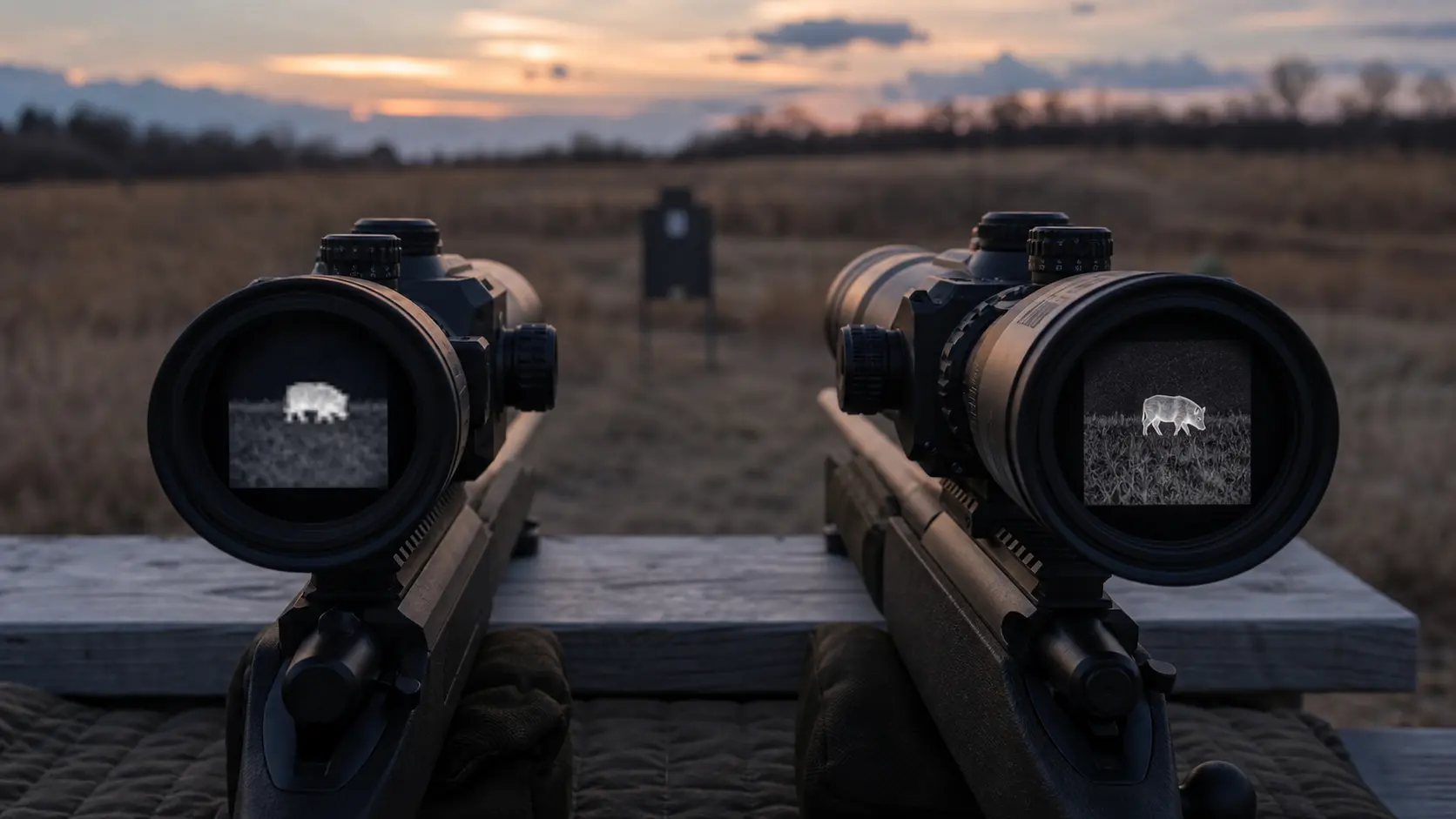
One of the very frequent purchasing questions in night hunting is the 384 vs 640 thermal scope debate. It’s also one of the most frequently misunderstood specs. A 640 thermal scope is not just a little sharper than a 384 scope. A 640×512 sensor has about 327,680 thermal pixels, while a 384×288 sensor has about 110,592 thermal pixels. It’s nearly three times the amount of thermal sensor data. That doesn’t necessarily mean that every hunter should go out and purchase 640. Resolution is not the only part of the sensor. Lens size, base magnification, FOV, pixel pitch, NETD, image processing, display resolution, mount quality, battery design, and hunting distance are all important. In this guide, you will learn what 384 and 640 thermal scope resolution really means, when 640 is worth it, when 384 will suffice, and how to avoid choosing the wrong optic to fit your terrain.
Quick answer
If you hunt in open fields, call coyotes, shoot beyond 200 yards, utilize digital zoom frequently, desire improved animal identification, or want a scope to grow with your hunting ability, purchase a 640 thermal scope. If you hunt primarily within 150 to 200 yards, hunt hogs over feeders, hunt lots of brush, are on a strict budget, or simply want a first-time thermal scope that doesn’t cost premium 640 money, a 384 thermal scope is for you. The basic rule is this: 640 will present more image detail and will be better suited for digital zooming, but a well matched 384 thermal scope with a good lens will outperform a poor 640 for close range hunting.
Source reliability check
This guide provides a comparison of several sources rather than a brand-only claim.
The bottom line is the same in all the sources: 640 sensors mean more detail and more digital zoom room, but the rest is up to the complete optical system. There is no credible source that backs up the idea that resolution alone makes the difference between a good and bad thermal scope.
What 384 and 640 mean
The numbers are based on the resolution of the thermal sensor. Typically a 384 thermal scope is equipped with a 384×288 sensor. Some brands and models have a 640×512 sensor, while others have a 640×480 sensor. A 384×288 sensor contains 110,592 thermal pixels. A 640×512 sensor contains 327,680 thermal pixels. A 640×480 sensor contains 307,200 thermal pixels. The largest benefit of 640 is that extra sensor data. More thermal information means the scope will be able to offer more detail in terms of seeing shape, legs, ears, body outline, movement and separation from the background. But that is thermal resolution and not display resolution. Even if the display on a scope is high resolution, the original thermal data may still be only 384×288. While the image may be easier to see with the display, it cannot add real thermal detail that the sensor was not able to capture.
Pixel count: why 640 is not just 1.6 times better
Many buyers see the numbers 384 and 640 and assume that 640 is roughly 67 percent more since 640/384 = 1.67. That’s just the horizontal resolution. The actual comparison is the number of pixels:
- 384×288 equals 110,592 pixels
- 640×512 equals 327,680 pixels
- 640×480 equals 307,200 pixels
Realistically, a 640×512 sensor is nearly triple the number of thermal pixels of a 384×288 sensor. That is why 640 scopes are generally much more detailed, particularly when zoomed. The extra detail doesn’t necessarily triple your ethical shooting distance. It enhances the image data that the scope has. But whether you can utilize that information is dependent on the target, lens, focus, weather, terrain, the level of magnification, and shooter judgment.
384 vs 640 image detail
The primary difference between 384 and 640 is the amount of image detail. A 384 scope will easily see warm animals. It can detect a heat signature the size of a hog, coyote, deer, dog, cow or person at normal hunting distances. There are numerous hunters that use 384 scopes every night and have success with them. A 640 scope provides a clearer outline and more body information, as well as movement interpretation and usable information, when the target is farther away. With coyotes, the added detail can assist you in interpreting body language and activity. On hogs, it can help to sort out groups of nearby animals. In brush, it can assist you in reading partial heat signatures in openings. It becomes more evident when:
- the animal is small
- the animal is far away
- the background is warm
- humidity reduces contrast
- you need to use digital zoom
- you won’t just detect but identify
The distinction may not be as striking up close. A good 384 thermal scope can be very useful within 75-100 yards, provided the lens and image processing are good.
The difference between detection, recognition and identification
Detection, recognition and identification are often confused by thermal buyers. Detection means you can see that there is a warm object out there. Recognition is when you can identify what general kind of object it is. Identification involves having sufficient confidence to determine what is being targeted and if it’s legal and ethical to shoot. A 640 sensor helps most in recognition and identification. Product pages can boast impressive detection range, but that doesn’t mean that’s the truth for shooting. A scope can show a heat signature much farther away than one can safely identify. For hunters, it’s not a question of “Can I see heat?” What matters is: “Is it possible for me to look at what I’m looking at and get it right?”
Field of view and lens size
Resolution is not stand-alone. Field of view and lens size are just as important. Depending on the sensor size and optical design, a 640 scope and 35mm lens could have a larger field of view than a 384 scope and 35mm lens. This more comprehensive perspective can help with scanning and tracking. With a 50mm lens, a 640 scope can sacrifice some FOV for further magnification and detail. A 384 with the wrong lens may seem too small or too large. This can also occur on a 640 scope that is fitted with the incorrect lens. That’s why it’s important to compare:
- sensor resolution
- lens size
- base magnification
- field of view at 100 yards, in degrees or feet
- pixel pitch
- display resolution
- NETD
- expectations for detection and recognition
Never purchase a 640 scope without considering the base magnification proper for your hunting area.
Digital zoom: when 640 pulls ahead
One of the best features of 640 is digital zoom. Thermal scopes typically “zoom” digitally. Zooming will narrow the image captured by the sensor and expand the remaining pixels. The digital zoom can get blocky quickly on a 384 sensor due to having fewer pixels. A 640 sensor has more pixels to work with, therefore 2x digital zoom is still more useful. This is important for coyote hunting, open field predator calling and any scenario where you’re trying to look at a critter before taking a shot at it. Thinking about it practically:
- 384 at base magnification works very well
- heavy digital zoom on 384 can drop off quickly
- 640 at base magnification is clearer
- typically 640 at medium digital zoom retains detail
Both resolutions can benefit from picture-in-picture, which allows both a larger aiming window and some field of view. However, it will not alter the original sensor resolution.
384 thermal scopes: where they make sense
A 384 thermal scope remains a good tool for hunters. Choose 384 if:
- the majority of shots are within 150 yards
- you hunt hogs over feeders
- you hunt in dense woods or brush
- the rifle should be kept light
- you’re purchasing your initial thermal scope
- you’re looking for a better lens or LRF instead of paying for 640
- your budget is limited
- you already have a separate thermal scanner
For many hunters, it is better to use a good 384 scope than buying the lowest priced 640 scope you can find. A good quality 384 image, mount, useful field of view, battery system and correct base magnification can be more important than having a larger sensor. 384 also works when the thermal scope isn’t the only tool you can use to observe. A 384 weapon sight may suffice if a handheld scanner is used to find the animals and the rifle scope is primarily for final range shots.
The 640 thermal scopes: when they make sense
If the additional detail makes a difference in what you can do in the field, a 640 thermal scope offers a worthwhile upgrade. Choose 640 if:
- you hunt coyotes or predators in fields that are open
- you have a tendency to shoot past 200 yards
- you use digital zoom frequently
- you need animal recognition to be improved
- you’re hunting a variety of terrain and need one scope to fill more needs
- you’d like a higher FOV, but want to sacrifice less detail
- you are capturing video and have an interest in video quality
- you want a scope you’ll be less apt to outgrow
In the case of serious predator hunters, 640 is typically the more comfortable option. Coyotes are smaller than hogs, move differently and are often engaged at longer distances. The additional pixels provide assistance for body outline, movement, and confidence. 640 also assists the open-country hunter in that animals can come from an unknown distance and there is less terrain for reference. The scope provides you more picture information in the process of deciding to range, stalk, call or shoot.
Hog hunting: 384 vs 640
If you’re going for hogs, 384 can be sufficient if you’re setting up something that’s going to be realistic. A quality 384 thermal scope will work well if hunting feeders, known trails, fields less than 150 yards, or dense brush. Hogs are relatively large heat targets. They tend to travel in clusters and many shots occur within practical 384 distances. 640 is more valuable if:
- fields are larger
- the shots are aimed at targets over 200 yards away
- pigs come into contact with livestock or non-target animals
- you need to separate individual animals in a group
- before shooting, you use digital zoom to see what you’re zooming in on
- humid or warm backgrounds make the image less clear
384 can be the value pick for a dedicated close range hog rifle. With a do-everything hog/predator rifle, 640 is more defensible.
Coyote and Predator hunting: 384 vs 640
Coyote hunting prefers 640 more than hog hunting. Coyotes are smaller, faster and can be observed from greater distances. In many places, they come in through open fields, pasture, cut crops or rolling terrain. You might be able to pick up on them early on, but you still need enough information about movement, orientation, and safe shot opportunity. With an appropriate lens, 384 can be used for coyote hunting within 150 to 200 yards. However, if coyote hunting is your main use case and the budget allows, the upgrade to 640 is easier to justify. It’s not just about the clarity of the photo. The advantage is self-assurance. You spend less time trying to guess what the heat signature is and more time making a clean decision.
Deer hunting and target identification
Much of this depends on local laws, seasons, techniques, and ethics in the use of thermal for deer hunting. Always check state regulations prior to employing thermal or night vision to hunt any game animal. From a pure-image aspect, 640 can perform better with deer-size animals at longer distances because 640 has more body detail. But it’s not just about sensor resolution; it’s about legality and identification standards. If exact identification, antler confirmation, sex confirmation or species confirmation in mixed environments is required, thermal alone may not be adequate to the task. Avoid taking shots that aren’t sure because of 640. Resolution is helpful but does not substitute for legal and ethical target identification.
384 vs 640 and base magnification
Both resolutions can be determined by base magnification. A low-base 640 scope can be a wonderful scanning and close to medium range hunting scope since it has a large FOV along with adequate sensor detail to zoom if necessary. Even if the detection range number is good, a high-base 384 scope can appear narrow and pixelated when zoomed. For many hunters:
- 384 with 2x to 3x base magnification is usable for mixed terrain
- 640 with 2x to 3x base magnification is very flexible
- 384 with high base magnification can be specialized
- 640 at high base magnification is better for open field and longer shots
Don’t compare 384 and 640 solely on the basis of the resolution specified in the headline. Compare as a system.
NETD, pixel pitch and image processing
NETD is an indicator of thermal sensitivity. The lower the NETD, the more temperature differences the device can detect, which will aid in low contrast scenarios like humidity, precipitation, fog, warm night, or a background that has been exposed to the sun. The pixel pitch has an impact on the sensor and lens behavior, typically 12 micron or 17 micron. Many of today’s thermal scopes use modern 12 micron sensors. Smaller pixel pitch can enable smaller optics and various FOV/magnification combinations, but yet again the complete system is the determining factor. Image processing matters as well. In some situations, a newer 384 thermal scope with very good processing and low NETD can perform better than a higher resolution older optic or an optic with poor processing. While resolution is crucial, it’s not the only spec that matters in terms of image quality. Before buying, compare:
- sensor resolution
- pixel pitch
- NETD
- lens aperture
- focus control
- display resolution
- refresh rate
- image enhancement settings
- warranty and firmware support
The cost: where the upgrade hurts
The biggest drawback of 640 is that they don’t come cheap. In most product lines, 640 is a lot more expensive than 384. If the scope is going to help you identify targets quicker, zoom digitally more effectively and work in more hunting scenarios, then it’s worth the extra price. However, if you are taking your shots less than 100 yards, then this additional cost may be better directed elsewhere. When it comes to spending the same amount, you might have to make a decision between:
- 384 with LRF vs 640 without LRF
- entry-level 640 vs 384 with a better battery system
- 384 with the correct lens and base magnification vs 640 with the wrong lens
- 384 plus scanner vs 640 scope only
Don’t make the assumption that 640 is always the better purchase. At times, a 384 scope with an external scanner is the best system. Sometimes it’s a 640 scope without a scanner. It’s all about the way you hunt.
384 with LRF vs 640 without LRF
This is an actual purchase conundrum. When you are shooting at unknown ranges, an inbuilt rangefinder is quite helpful. But LRF has no effect on the quality of the image. It only provides distance information. Knowing the range doesn’t solve the problem if you can’t identify the target clearly.
Choose 384 with LRF if:
- the vast majority of shots are medium range
- distance judgment is your main problem
- you shoot familiar ranges and need to increase your ballistic confidence
- the 384 image is already sufficient for you to identify your targets
Choose 640 without LRF if:
- the thing you need to worry about is image detail
- you hunt smaller predators
- you use digital zoom often
- you already have an accurate means to range distances
Either 640 with LRF is best, but it typically is more expensive.
Is 640 overkill?
In close range hunting, 640 might be too much. A potent 384 scope can be all you need if you’re trying to hunt hogs from a feeder 75 yards away. If you primarily shoot in dense foliage, the extra 640 detail might not be as significant as FOV, ergonomics, weight, and quick target acquisition. When it comes to versatility and adaptability, 640 is not too much. It is useful for different distances, smaller animals, bad conditions or more space to zoom. It’s not a question of “Is 640 better?” It usually is. The question to ask is “Will 640 make a difference in my hunting?”
Optimal choice according to the hunting scenario
Close hog hunting in brush: choose 384 unless you also want premium flexibility.
Feeders and known-distance hog hunting: select 384, particularly when money is an issue.
Mixed hog and predator hunting: choose 640 if feasible or a good quality 384 if most shots are moderate.
Coyote hunting in open fields: select 640.
Predator calling for longer ranges: select 640.
The first thermal scope that you use on a tight budget: choose 384 with good base magnification and good support.
One thermal scope for a number of rifles and scenarios: go for 640 if you have the money.
Use of heavy digital zoom: opt for 640.
Thermal scope with dedicated scanner: 384 can handle final aiming on the rifle if the scanner handles detection.
Common mistakes
The first error is that of purchasing 640 with the wrong lens. You can’t correct for a poor FOV or a base magnification which is not appropriate for your terrain with a 640 sensor. The second error is to think that 384 is out-of-date. Even today, the 384 thermal imaging scope has proven itself to be a powerful tool for many hunting distances. The third error is using detection range as the shooting range. Detection is not identification. The fourth mistake is ignoring digital zoom. If you frequently zoom, 640 is more important. The fifth error is focusing solely on the resolution and neglecting mount, battery life, warranty, focus, image settings and zeroing workflow. The sixth error is comparing old 640 with the new 384 without taking into account sensor generation and image processing. The seventh error is overlooking field of view. When animals are moving near, having a wider FOV may be more important than maximum detail.
Quick buying guide
Go with 384 if you prefer value, moderate hunting ranges and you can easily spot targets at your normal hunting range. If you’re looking for more detail, more useful digital zoom, better recognition at distance and a more encompassing scope for hunting, opt for 640. If the distance information is more important than additional detail in the image, select 384 with LRF. If you are looking for the most complete solution and the budget allows, select 640 with LRF. Think about the better complete system. Don’t just opt for the higher number of sensors.
Conclusion
Choosing between 384 resolution and 640 resolution thermal scope is essentially a matter of hunting distance, target size, land, budget and how much detail you want on the image. When it comes to image detail, digital zoom, target recognition, and hunting in the open, 640 is the superior sensor class. This is particularly useful for coyote and predator hunters who must be able to pick out smaller animals from a greater distance. 384 is still a great option for the hog hunter, for a feeder build, brush hunting, budget builds, and as a first scope. If the scope is good, with 384 resolution, the appropriate lens, a low NETD, a solid mount and correct base magnification, it can be very effective. When you can afford to purchase a well-matched 640 scope, it’s generally the safer long term purchase. Hunters who have moderate ranges should not feel disadvantaged while hunting with a good 384. The right thermal scope is the one that allows you to detect, recognize, identify and shoot with confidence in your real field conditions.

Can You Use a Thermal Scope During the Day? Daylight Use/Sun Safety and Zeroing Tips.

Night Vision Range Explained: Detection, Recognition, Identification, and Real Hunting Distance

How to Set Up an IR Illuminator for Night Vision: Placement, Beam Width, and Field Mistakes