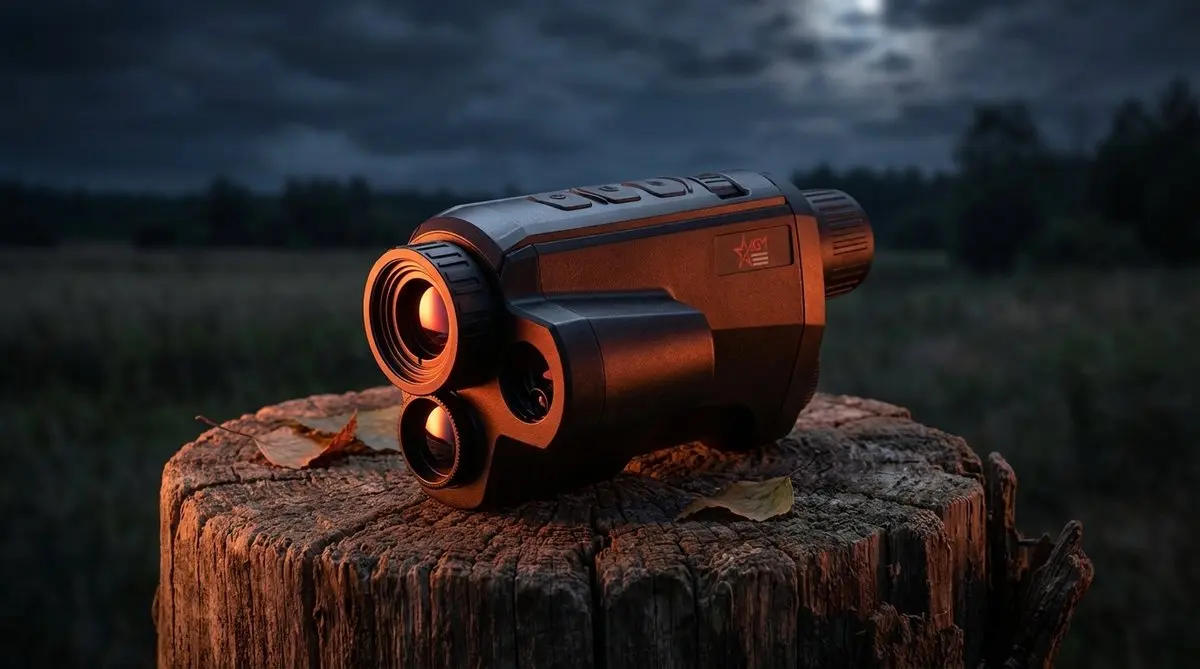
Best Thermal Binoculars for Hunting in 2026
What “Thermal Binoculars” Actually Means
There are three product categories that get lumped together under this name:
1. Fusion monoculars — These combine a thermal sensor with a standard CMOS camera sensor in a single unit. The image overlay shows thermal heat signatures on top of a real-world image. AGM’s Fuzion line is the best example. Technically a monocular form factor, but the fusion image makes it more useful for identification than a pure thermal unit.
2. Wide-FOV thermal monoculars — Standard thermal monoculars with wider fields of view, sometimes marketed as binoculars. These are still single-eye devices.
3. True thermal binoculars — Dual-sensor, dual-display units that produce a genuine stereoscopic thermal image. These exist (FLIR makes versions for military and law enforcement) but cost well over $10,000 and are not practical hunting purchases for most users.
For this guide, we focus on what’s actually usable and available: fusion monoculars and high-performance thermal monoculars that solve the “monocular fatigue” problem through image quality and ergonomics rather than dual-sensor architecture.
A user on r/ThermalHunting laid out the practical position clearly: “If I had to do it again, I’d still buy the Finder because of the price/performance ratio… after running a monocular for a couple of seasons, I’m very definitely saving my pennies for thermal binoculars.” That user’s point was about how you use the device, not just what it is. Wide FOV, quality display, and stable ergonomics matter more for extended glassing sessions than true dual-eye capability.
Why Hunters Upgrade to Thermal from Standard NV
If you’re coming from analog night vision, thermal adds the single most important capability for predator and hog hunting: detection regardless of ambient light. A standard NV device amplifies available light — no moonlight, no image. Thermal detects heat signatures. A coyote moving through dense timber on a moonless night shows up instantly on thermal where analog NV sees nothing useful.
The trade-off is identification. Thermal shows you heat signature and silhouette. Color palette can help distinguish species — hogs read differently than deer, coyotes from bobcats — but a $2,000 thermal unit won’t give you the fine detail of a good Gen 3 monocular. This is why experienced hunters often run both: thermal for detection, NV for identification and navigation.
As one r/Hunting user noted: “If you really want to be comfortable (and spend a ridiculous amount of money) get thermal binoculars (with built in range finder). Spotting through a monocular all night gets pretty annoying after an hour or two.”
The rangefinder point matters. Thermal binoculars with integrated LRF solve the problem of switching devices to get a range reading — you see the target on thermal, tag it with the rangefinder, and feed that data to your shooter. In a stand situation over a field, this is genuinely useful and reduces movement.
Our Picks
AGM Fuzion LRF TM25-384 — Best Overall
The Fuzion LRF is the most complete hunting thermal product in AGM’s lineup. It’s technically a monocular, but the fusion imaging capability and built-in laser rangefinder make it function more like an observation system than a standard thermal unit.
Sensor: 384×288, 12 micron NETD at 50Hz. The 384×288 resolution is a meaningful step above entry-level 160×120 and 256×192 sensors — you get enough detail to distinguish species at practical hunting ranges and read body language on approaching animals.
Fusion capability: The Fuzion overlays the thermal image with a 1920×1080 CMOS sensor feed. In practice, this means you can read terrain context (fence lines, brush edges, water) while simultaneously seeing heat signatures. Pure thermal doesn’t give you this — you’re interpreting a heat map. Fusion gives you heat map on top of a recognizable visual scene.
Laser rangefinder: Integrated LRF solves the workflow problem hunters have when they need to range a target detected on thermal. No separate ranging device, no movement to switch tools.
Magnification: 2.5x base with 8x digital zoom. At 2.5x, the FOV is workable for field scanning. Digital zoom to 8x is useful for verification at range but comes with the standard image quality penalty.
Other specs: IP67 waterproof, 5 hours battery on a standard 18650 (replaceable and rechargeable), USB-C for external power, 16GB internal storage, Wi-Fi for app connectivity, multiple color palettes.
The honest caveat: A user on r/NightVision made the pointed observation that “AGM took the low rate option with their Fuzion” — referring to a 25Hz vs 50Hz version debate. The LRF version is the 50Hz configuration. Verify you’re purchasing the 50Hz variant; the original Fuzion was 25Hz and the performance difference for moving targets at night is noticeable.
Best for: Predator hunters who want a single device that handles detection, identification, and ranging. Hog hunters running from elevated positions over fields. Anyone who wants to reduce the number of devices they’re switching between in the dark.
Check price on AGM Global Vision
AGM Asp-Micro TM160 — Best Entry Point for Thermal
If the Fuzion LRF is over budget, the Asp-Micro TM160 gets you into thermal for significantly less. The 160×120 sensor resolution means detection capability rather than identification capability — you’ll confirm “something is moving over there” rather than “that’s a coyote at 200 yards.”
For property scanning, hog detection at close range, and checking fields before a hunt, this sensor resolution is functional. For precise species identification at distance, it’s not.
Sensor: 160×120, 12 micron NETD
Magnification: 1x (some versions offer 2x clip-on front)
Format: Compact palm-held monocular
r/NightVision users consistently recommend this category as the threshold buy — get something in thermal, learn what it does, then upgrade when you know what you actually need. Starting with a $4,000 unit when you’re not sure thermal is right for your hunting style is a common and expensive mistake.
Best for: First-time thermal buyers, hunters who primarily need detection capability at short-to-medium range, backup detection unit when the main spotter is busy.
Check price on AGM Global Vision
Key Specs to Compare When Buying
Sensor resolution: 160×120 / 256×192 / 384×288 / 640×480. Each step up costs significantly more and gains noticeably in identification detail. For practical hunting at under 200 yards, 256×192 is workable. At 300+ yards, 384×288 or better.
NETD (Noise Equivalent Temperature Difference): Lower is better. 12 micron sensors are current standard. This measures how small a temperature difference the sensor can detect. Lower NETD = better performance in marginal conditions.
Refresh rate: 50Hz is the standard for smooth performance on moving targets. 25Hz shows visible judder when the animal or the unit moves. Worth verifying before purchase.
Lens size: Larger objective lens collects more thermal radiation. The Fuzion runs 25mm — a reasonable size for hunting applications without excessive weight.
Display: OLED displays have better contrast in cold conditions than LCD. Worth noting for hunters operating in temperatures below 20°F.
Battery: Proprietary batteries are an operational risk. 18650 standard cells (used in the Fuzion) can be purchased at any outdoor supply store. On a multi-day hunt, this matters.
Practical Questions Before You Buy
Is thermal legal in my state?
Most states that allow night hunting permit thermal imaging devices, but there are specific exceptions — New Hampshire, Arizona, and Colorado among them. Always verify current regulations before purchasing a thermal device for hunting use. State laws change, and several states have updated thermal regulations in the past two years.
Thermal or NV first?
If you only buy one device, thermal wins for pure hunting application — detection capability in any light condition is more valuable for most predator/hog hunters than the sharper image of analog NV in good ambient light. If you need to navigate terrain at night or want detail-identification capability, add NV as the second system.
What range do I actually hunt at?
This is the question most hunters don’t answer honestly when spec-shopping. If your hog stand is over a 60-yard bait pile, a 160×120 sensor is sufficient. If you’re glassing a 400-yard field, you want 384×288 minimum. Buy for your actual shooting range, not the maximum theoretical range spec on the box.
Do I need video recording?
If you’re filming content or want post-hunt review footage, built-in storage matters. The Fuzion LRF includes 16GB internal storage and Wi-Fi transfer. Simpler units may require external recording.
What to Skip
Digital NV binoculars marketed as “night vision” under $400 are a category to avoid for serious hunting applications. The CMOS sensors in this price range produce image quality that’s adequate for general observation but poor for identifying animals at distance in real field conditions. Several of these units were tested on r/NightVision threads in 2024-2025 and consistently underperformed their marketing claims in the field.
Consumer thermal units from brands with no presence in the professional or military thermal market — units with 10-year-old sensor technology repackaged in new housings — appear regularly at aggressive prices. The 12 micron sensor and 50Hz refresh rate are minimum specifications worth holding to.
Frequently Asked Questions
What’s the difference between thermal and night vision?
Thermal detects heat. Night vision amplifies available light. Thermal works in total darkness; night vision needs some ambient light. For a detailed technical breakdown, see How Thermal Imaging Works at NVGuide USA.
Can I use thermal binoculars during the day?
Yes. Thermal works regardless of ambient light conditions. The image changes character (less contrast in hot environments) but the device is fully functional in daylight. Many hunters use thermal for scouting during early morning and evening twilight.
Do thermal devices work in rain?
IP67-rated units (like the Fuzion LRF) are waterproof to 1 meter. Light and moderate rain is fine. Heavy precipitation introduces thermal noise in the image. Fog is more problematic than rain for thermal performance.
How long does the battery last in cold weather?
Lithium batteries perform better in cold than alkaline. The 18650 in the Fuzion is lithium-ion and handles cold well compared to the AA/CR123A cells in some NV devices. Carry a spare — actual cold-weather battery life is always less than the spec’d figure.
Content is for informational purposes. AGM product links direct to agmglobalvision.com. Specifications verified from manufacturer data sheets and product listings.

Can You Use a Thermal Scope During the Day? Daylight Use/Sun Safety and Zeroing Tips.

Night Vision Range Explained: Detection, Recognition, Identification, and Real Hunting Distance

How to Set Up an IR Illuminator for Night Vision: Placement, Beam Width, and Field Mistakes