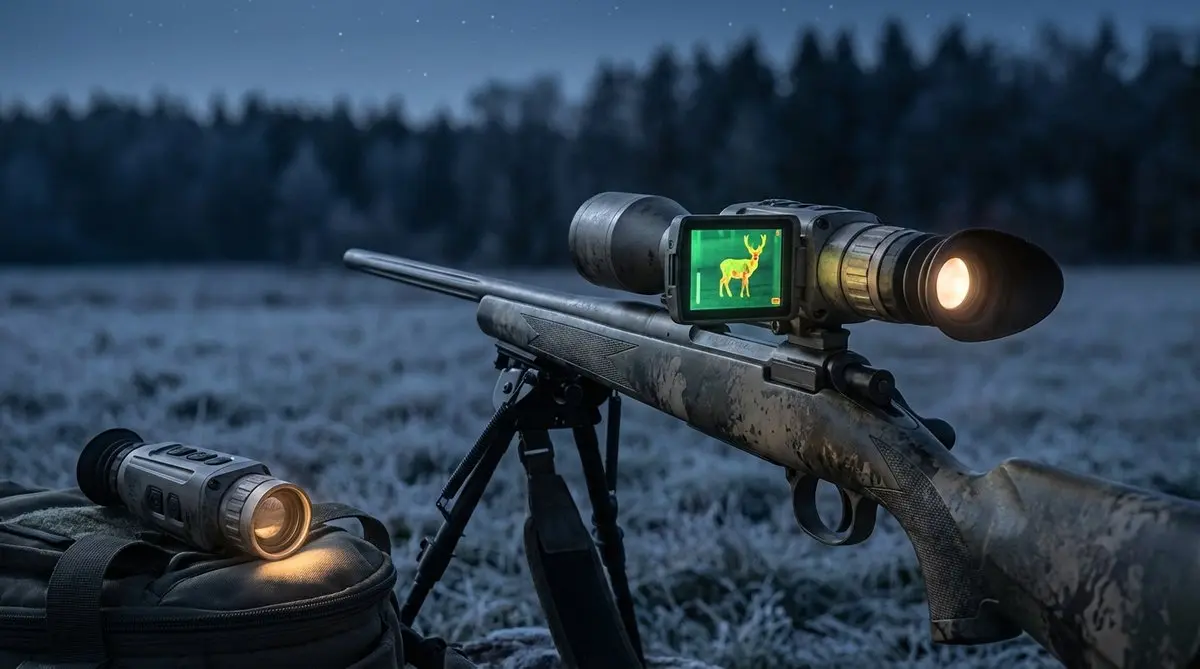
Clip-On Night Vision: How to Run NV on Your Existing Rifle Scope
A clip-on night vision device attaches in front of your existing daytime rifle scope and converts it into a functioning NV system. You keep your daytime zero. You keep your familiar reticle. You don’t need a second dedicated NV rifle. For hunters who hunt predominantly at dawn and dusk but occasionally need true nighttime capability, the clip-on approach avoids the cost and logistics of a dedicated NV scope.
The tradeoff is real: dedicated NV scopes outperform clip-ons in image quality at equal price points. A $2,000 dedicated thermal scope delivers better performance than a $2,000 clip-on mounted on a $500 daytime scope. But if you’ve already invested in high-quality glass and you want NV capability without replacing it, the clip-on calculation looks different. Review our thermal vs night vision comparison before deciding which technology fits your hunting application.
How clip-on night vision works
A clip-on unit mounts on a Picatinny rail or directly in front of your daytime scope’s objective lens. The NV device — whether analog image intensifier or digital/thermal — converts the scene into a viewable image, and your daytime scope’s magnification and reticle function normally on top of that image.
The result is a dual-use system. At dawn, you run the scope without the clip-on. After dark, you attach the clip-on and retain your established zero. No re-zeroing. No adjusting parallax. No switching between two complete rifle setups.
The catch with analog image intensifier clip-ons is magnification stack. If your daytime scope runs 6x and you mount a 1x NV clip-on, your effective magnification is still 6x — but the image quality of the analog tube determines how well that 6x delivers at night. Higher magnification from your daytime scope narrows field of view, which can hurt target acquisition speed at night. Most clip-on users find that pulling back to 1x–2x on the daytime scope optimizes the combination.
Analog vs thermal clip-on: which makes sense
Analog image intensifier clip-ons run the same Gen 2+ and Gen 3 tubes as dedicated NV scopes. Thermal clip-ons use an infrared sensor rather than ambient light amplification. The practical differences matter for hunting:
Analog clip-ons produce natural-looking images. Target identification using body shape, antler profile, and movement characteristics is intuitive. They don’t work in total darkness without an IR illuminator. They require ambient light — starlight, moonlight, or supplemental IR — to function.
Thermal clip-ons detect heat signatures regardless of ambient light. A thermal clip-on works in total darkness, dense fog (to a point), and through light brush. But thermal images look different than analog — targets appear as heat blobs rather than visually recognizable shapes, which changes how you work at night. Read our thermal vs digital NV guide for a full breakdown of identification differences.
For hog and coyote hunting where positive species identification is required, thermal can make identification harder at distance because shape cues are absent. For feral animal control where you know what you’re shooting at, thermal’s total-darkness performance is a significant operational advantage.
AGM clip-on options for 2026
AGM Secutor LRF TS75-384
The Secutor LRF TS75-384 is AGM’s flagship thermal clip-on, running a 384×288 sensor at 75mm focal length with integrated laser rangefinder. The 75mm objective delivers significant standoff range — target identification at 400+ yards in good atmospheric conditions is achievable. The integrated LRF removes the need for a separate rangefinding device when you’re working fields at night.
This unit is designed for hunters who take long-range shots at night and need accurate range data without breaking position to use a separate device. The combination of the 75mm objective, 384 sensor resolution, and integrated LRF in one clip-on package represents a serious hunting capability that was difficult to assemble a few years ago.
Check current pricing at AGM Global Vision
AGM Secutor TS50-384
The TS50-384 runs the same 384×288 sensor at a 50mm focal length — a significant reduction in price and size compared to the 75mm unit, with a corresponding reduction in effective identification range. For hunters working fields out to 200–300 yards, the 50mm objective is sufficient and the smaller form factor is operationally convenient.
Both Secutor units share the same sensor, so the core image quality is equivalent. The difference is effective standoff range determined by the objective lens. Choose based on your actual hunting distances, not the theoretical maximum of either unit.
Check current pricing at AGM Global Vision
Mounting and zeroing a clip-on
Mechanical attachment
Most clip-on units mount to a Picatinny or Weaver rail section in front of the daytime scope’s objective bell. Some units include a mounting bracket that slides over the objective lens housing. Verify your rifle has available rail space forward of the scope before purchasing — some rifle/scope combinations leave no usable rail in front of the objective.
The mounting interface needs to be secure and repeatable. A unit that shifts under recoil or doesn’t index consistently to the same position will drift your night-zero away from your daytime zero. Buy quality mounting hardware and torque fasteners to spec.
Night zero vs day zero
One of the major selling points of clip-on systems is zero retention. In practice, there is often a small offset between your daytime zero and your night-zero with the clip-on attached. This offset is consistent — the same clip-on mounted in the same position will produce the same offset every time. Verify your clip-on zero at night separately from your daytime zero. Record both. Understand the offset before you’re hunting.
See our complete guide to zeroing NV optics for the process in detail.
Parallax at close range
Clip-on units positioned several inches in front of the scope introduce a small parallax offset at close ranges. At distances beyond 50–75 yards this offset is negligible. At very close range — inside 25 yards — the offset can be meaningful. Know your setup and its limitations before hunting with it.
Operating a clip-on in the field
Magnification settings
Lower magnification on your daytime scope generally produces better results with a clip-on. High magnification narrows your field of view — already a challenge at night — and amplifies any image instability from the NV unit. Start at 1x or 2x and adjust up only if target identification at distance requires it.
Image adjustment
Thermal clip-ons have scene mode options — white hot, black hot, color palettes. For hunting, white hot and black hot are the two modes most hunters settle on. White hot shows warm targets as bright objects against dark backgrounds, which is the most intuitive for identification. Black hot reverses the palette, which some hunters prefer in bright environments because it reduces eye fatigue.
Adjust your thermal’s gain (contrast/brightness analog) for the ambient temperature. Hunting in 25°F air creates a larger differential between a warm animal and the environment than hunting in 75°F air. Lower ambient temperatures generally produce crisper thermal images with less gain adjustment required.
Removal and storage
Practice removing and reattaching the clip-on until it’s a muscle-memory task you can do without light. During a hunt, you may need to remove the clip-on for a daytime shot opportunity. A fumbled or slow clip-on removal costs you the shot. Practice at home until the process takes under 5 seconds.
What clip-on night vision won’t do
A clip-on doesn’t replace a dedicated hunting NV scope for hunters who hunt primarily at night. Dedicated units produce better image quality, have more purpose-built features, and eliminate the parallax and magnification complications of clip-on systems.
Clip-ons are a logical solution for hunters who already have invested in quality daytime glass and want to extend that investment into NV capability without replacing the scope. For hunters starting from scratch, the calculus favors a dedicated NV or thermal scope over a clip-on system at comparable price points.
Bottom line
The clip-on category has matured significantly. Thermal clip-ons in particular now offer hunting-capable performance at prices that the category couldn’t touch five years ago. If you’re running a quality daytime scope on a dedicated night hunting rifle, a thermal clip-on from AGM’s Secutor line turns that rifle into a legitimate night hunting system without re-zeroing or purchasing a second optic.
Understand the limitations before you buy: magnification interaction, parallax at close range, and the performance difference compared to dedicated NV scopes at equal price points. Buy within those constraints and the clip-on will do exactly what it promises.

Can You Use a Thermal Scope During the Day? Daylight Use/Sun Safety and Zeroing Tips.

Night Vision Range Explained: Detection, Recognition, Identification, and Real Hunting Distance

How to Set Up an IR Illuminator for Night Vision: Placement, Beam Width, and Field Mistakes