Night Vision for Home Security: Best Options 2026
Most people shopping for night vision home security are comparing the wrong things. They look at resolution specs and camera counts when the real question is simpler: do you need to identify people at distance, or do you need detection across a wide area? The answer drives everything — which technology, which price range, and which setup actually works for your property.
I’ve set up security systems at three properties over the past several years, including one rural spread where deer outnumber neighbors ten to one. Here’s what actually works, and where I wasted money.
Three technologies, three use cases
Before picking a product, you need to understand what each technology actually does at night. Our guide to how night vision technology works covers the physics in detail, but here’s the short version for security applications:
Standard IR cameras (most home security products)
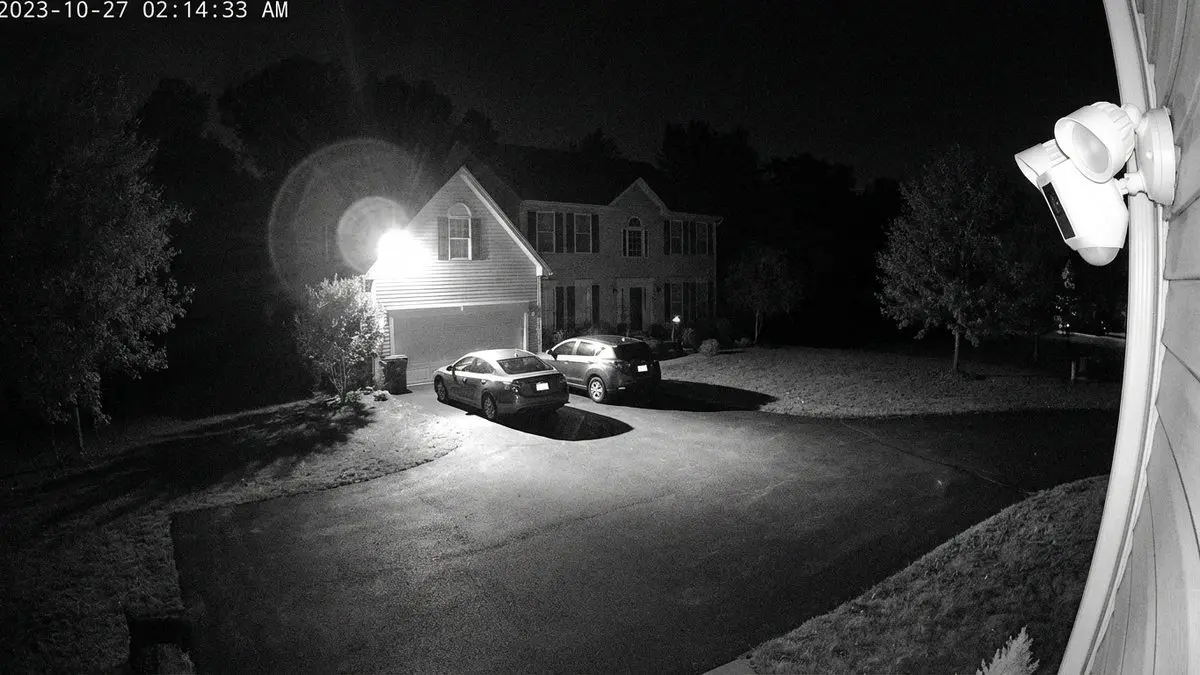
These use infrared LEDs to illuminate a scene, then capture it on a standard sensor. They’re inexpensive, widely available, and integrate with smart home systems. The problem: the IR illuminator range is usually 30–60 feet. Beyond that, you get a grainy blob where a person used to be. They also trigger constantly on animals, blowing leaves, and passing cars. If your main threat is someone approaching your front door, they’re fine. If you need to watch a 200-foot driveway, they’re not.
Dedicated image-intensifier NV cameras
These use the same tube technology as military goggles — photons get amplified rather than IR-illuminated. Range is genuinely useful: a good Gen 2 system can provide recognizable facial detail at 100+ feet with no supplemental IR. The trade-off is cost. A single quality NV camera starts around $800–1,200. A four-camera system is a serious investment. They also require some ambient light — on a completely overcast, moonless night in dense woods, performance drops. If you want to understand the tube technology behind these systems, our NVG buyers guide walks through Gen 1, Gen 2, and Gen 3 in detail.
Thermal cameras
Thermal detects heat signatures — no light required, zero. A person standing in total darkness 300 feet away shows up as clearly as in daylight. You will not miss movement. The trade-off: you can’t read faces, license plates, or text. Thermal gives you detection and rough shape; it does not give you identification. For perimeter monitoring, it’s hard to beat. For evidence that holds up in court, you’ll want a secondary camera. See our thermal buyers guide for a full breakdown of sensor resolutions and detection ranges.
Honest comparison table
| Technology | Useful range | ID capability | False alarms | Entry price (single camera) |
|---|---|---|---|---|
| Standard IR camera | 30–60 ft | Good (close range) | High | $50–200 |
| Dedicated NV camera | 100–200 ft | Good (medium range) | Medium | $800–1,500 |
| Thermal camera | 300–600 ft | Poor (shape only) | Very low | $400–2,000 |
Prices current as of early 2026. Verify with retailer before purchasing.
Specific models worth looking at
FLIR C5 Compact Thermal Camera (~$700)
Not a security camera per se — it’s a handheld thermal imager — but I mention it because many homeowners use one for a manual perimeter walk rather than a fixed install. Useful if you rent and can’t mount hardware. Detection range is solid for the price. Resolution (160×120) is enough to distinguish a person from a deer at 100 feet.
FLIR Quasar Premium IR (~$1,800–2,500 per camera)
Fixed thermal security cameras for serious installs. These are commercial-grade, and the price reflects it. Detection range exceeds 500 feet. If you’re protecting a warehouse perimeter or a large rural property, this is where the conversation starts. For most residential use, it’s overkill.
Hikvision DS-2CD2T47G2-L (~$180–250)
A competent standard IP camera with IR LEDs rated to 100m. In testing, effective identification range is closer to 25–30m. Good for porch, driveway entry, and garage. Integrates with most NVR systems. The 100m spec is detection of movement, not useful identification — be clear on that distinction when you’re buying.
Reolink RLC-810A (~$60–90)
Budget option that does what it says. 8MP, built-in IR, works with Reolink’s app and most third-party NVR software. Range is honestly 20–25 feet for identification. Fine for a front door. Don’t expect it to cover your back 40.
What doesn’t work (and why people keep buying it anyway)
Wireless cameras with battery power are convenient until they’re not. Cold weather hammers lithium battery life — a camera rated for 6 months of battery life in a marketing spec sheet may last 3–4 weeks in January. If you’re in a northern climate, wire your cameras or accept that you’ll be swapping batteries constantly.
Cloud-dependent systems with ongoing subscription fees are fine until the company pivots, gets acquired, or raises prices. If your entire security setup depends on a $10/month cloud service, build in a contingency plan. Local NVR storage gives you footage regardless of internet status or corporate decisions.
Setup tips that actually matter
Angle matters more than resolution. A 4K camera pointed at a 45-degree downward angle captures faces. A 4K camera pointed level at a driveway captures the tops of cars. Think about where faces actually appear in the frame.
IR illuminator placement affects everything. Many cameras with built-in IR create hot spots (overexposed areas near the lens) and dark corners. Adding a separate IR illuminator — positioned 6–8 feet from the camera — gives more even lighting and extended range. Budget $30–80 for a quality IR illuminator per camera location.
Overlay thermal with identification cameras at key chokepoints. A thermal camera on the fence line tells you someone crossed it. An IR camera at the door tells you who. Used together, you cover detection and identification without spending $2,000 per camera position.
Bottom line
There’s no single “best” night vision security camera. Standard IR cameras cover close ranges at low cost. Dedicated NV cameras give you range and identification capability at a real price premium. Thermal cameras give you detection in any conditions but won’t replace identification cameras. Most effective home setups combine thermal at the perimeter with standard IR cameras at entry points.
If you’re also thinking about handheld NV devices for walking your property at night, the principles around tube technology and generation quality are the same whether you’re buying a camera or a monocular.
Disclaimer: Prices listed are approximate and may vary by retailer and availability. Specifications based on manufacturer data; always verify current specs before purchasing.

Can You Use a Thermal Scope During the Day? Daylight Use/Sun Safety and Zeroing Tips.

Night Vision Range Explained: Detection, Recognition, Identification, and Real Hunting Distance

How to Set Up an IR Illuminator for Night Vision: Placement, Beam Width, and Field Mistakes