Best Thermal Scopes Under $3000 in 2026
Updated: February 2026
The $2,000-$3,000 range is where thermal imaging became a serious option for most hunters. A few years ago, $3,000 bought you a 384×288 scope and not much more. Today it buys you 640×512 resolution, built-in laser rangefinders, and sensors with 12μm pixel pitch that were exclusively in military budgets not long ago. These are the thermal scopes that justify that price range — ranked by what you actually get for the money.
Looking beyond this budget? See our best thermal scopes for hog hunting guide which covers options across all price tiers. For coyote-specific recommendations, check our best thermal scope for coyote hunting breakdown.
Our top picks
Best overall
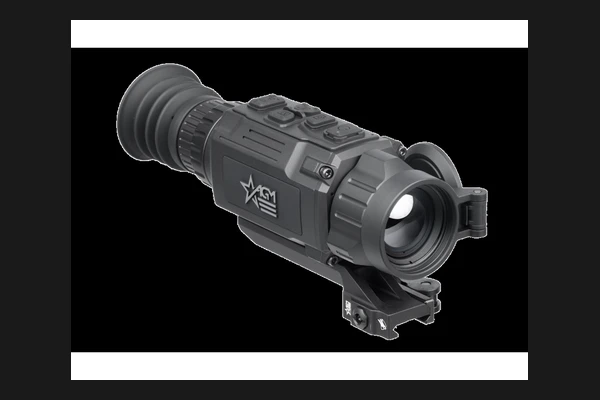
AGM Rattler V2 TS35-640
640×512 | 1,800m detection | $2,695
640 resolution for $305 under the ceiling. This is the reason the $3,000 budget makes sense right now.
Best with LRF
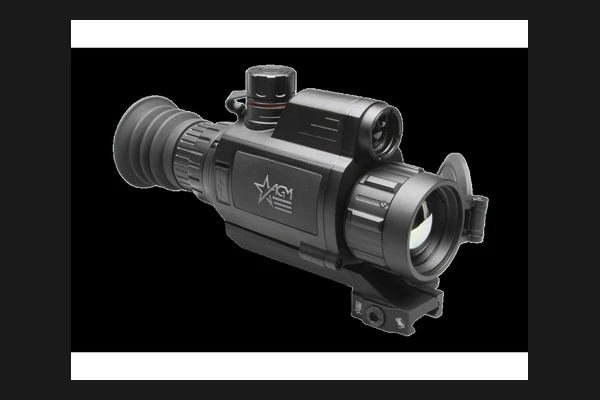
AGM Varmint V2 LRF TS35-384
384×288 | 1,400m detection | $2,195
Built-in laser rangefinder at $2,195. If you want LRF without going over $3k, this is the straightforward answer.
Best display
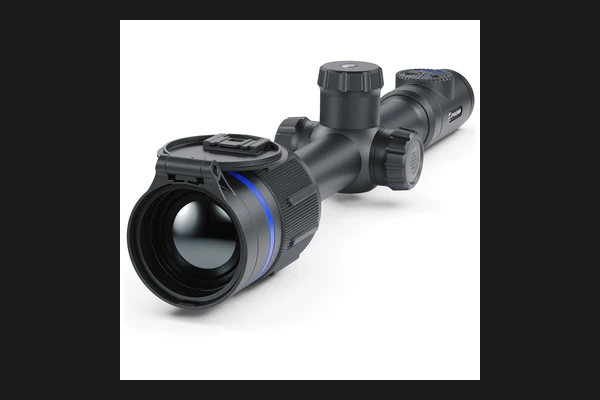
Pulsar Thermion 2 XQ35 Pro
384×288 | AMOLED display | $2,499
European build, AMOLED eyepiece, Pulsar’s warranty and service network. The non-AGM pick for those who want something different.
Why the $2,000-$3,000 range is the sweet spot
Three years ago, the under-$3,000 category was almost entirely 384×288 scopes with 17μm pixel pitch. 640 resolution meant spending $4,500 or more. That changed. The AGM Rattler V2 TS35-640 at $2,695 broke the ceiling, and now 640×512 is accessible to hunters who aren’t buying on a government contract.
What 640 resolution actually does is give you triple the pixels of 384×288. That translates to sharper edges at distance, cleaner ID on partially obscured targets, and better image quality in low-contrast conditions — warm nights, light fog, targets in brush. At 200 yards, both sensor tiers look fine. At 350-400 yards, the 640 image is notably clearer on a running hog or a coyote that’s hesitating at the field edge.
This range also includes built-in laser rangefinders for the first time. The AGM Varmint V2 LRF at $2,195 brings LRF integration under $2,500. A standalone quality rangefinder runs $300-$600 anyway, so the integration has real value for hunters who need both and don’t want two tools in the field.
Below $2,000, you’re back to 384 sensors with older pixel pitch or the new 320×240 budget options. Above $3,000, you’re into Pulsar XP50 Pro and similar — legitimate upgrades, but diminishing returns start showing up. For most hunters, the $2,000-$3,000 window hits the best combination of capability and price.
Comparison table
| Model | Resolution | Pixel Pitch | LRF | Detection | Price | Link |
|---|---|---|---|---|---|---|
| AGM Rattler V2 TS35-640 | 640×512 | 12μm | No | 1,800 m | $2,695 | Check price |
| AGM Varmint V2 LRF TS35-384 | 384×288 | 12μm | Yes | 1,400 m | $2,195 | Check price |
| AGM Adder V2 35-384 | 384×288 | 12μm | No | 1,400 m | $2,595 | Check price |
| Pulsar Thermion 2 XQ35 Pro | 384×288 | 17μm | No | 1,400 yd | $2,499 | Check price |
| ATN Thor 5 320 | 320×240 | 12μm | No | 2,200 yd | $1,795 | Check price |
| Pulsar Thermion 2 XQ35 Pro | 384×288 | 17μm | No | 1,400 yd | $2,499 | Check price |
| Bering Optics Super Hogster A3 | 384×288 | 12μm | No | 1,200 m | ~$2,499–2,799 | Check price |
Detailed reviews
AGM Rattler V2 TS35-640 — Best Overall
The straightforward case for this scope: it’s the first 640×512 thermal rifle scope that clears the under-$3,000 ceiling with meaningful margin. At $2,695 on AGM’s website, you have $305 of budget ceiling left over and you’re getting a sensor tier that used to be $4,500 minimum. The value shift happened, and this is the scope that demonstrates it.
Specs that matter: 640×512 resolution at 12μm pixel pitch, 50Hz refresh rate, 1,800-meter detection range, and 2×–16× magnification. The 12μm pixel pitch is the same architecture used in scopes twice the price. At 580 grams, it won’t torque your rifle’s balance. Battery life runs 9-11 hours depending on settings, which is a full night without drama.
In the field, the difference from 384 resolution is most obvious at 300-400 yards. A coyote or hog at the edge of a field comes in with defined edges rather than a soft heat blob. Target ID is faster, and shot placement decisions are more confident. In low-contrast conditions — warm nights, light fog, animals partially in brush — the 640 sensor maintains usable definition where the 384 starts losing ground.
For an in-depth look at this model, see our full AGM Rattler V2 review.
Best for any hunter who wants 640 resolution and has a $3,000 budget. This is what to buy unless you have a specific reason to go another direction.
AGM Varmint V2 LRF TS35-384 — Best with LRF
At $2,195, this is the LRF option that doesn’t require a $4,000 scope. The built-in laser rangefinder reads distance and integrates with the ballistic reticle — you range a target, the scope gives you the correct hold. For varmint hunters working at variable distances or deer hunters who want a thermal for predator control, eliminating a separate rangefinder step simplifies the shot process in the dark when fumbling with two tools is a liability.
The sensor is 384×288 at 12μm, 50Hz. Same core architecture as the Rattler V2 TS35-384, with the LRF hardware added. Detection reaches 1,400 meters. ID range for practical hunting is around 250-300 yards — adequate for most varmint and hog setups. The 3×–24× magnification range gives flexibility from scanning to detail work.
At $2,195, it’s $500 cheaper than the Rattler V2 TS35-640. The tradeoff is resolution: you’re getting LRF functionality instead of the 640 sensor upgrade. Whether that’s the right trade depends on your hunting setup. If you regularly work at unknown or variable distances where ranging matters, the LRF integration pays off. If you know your property and your ranges, save the money or put it toward the 640 sensor.
Best for hunters who hunt variable terrain or multiple properties where target distance is genuinely unknown until the animal shows up.
AGM Adder V2 35-384 — Best Traditional Tube Style
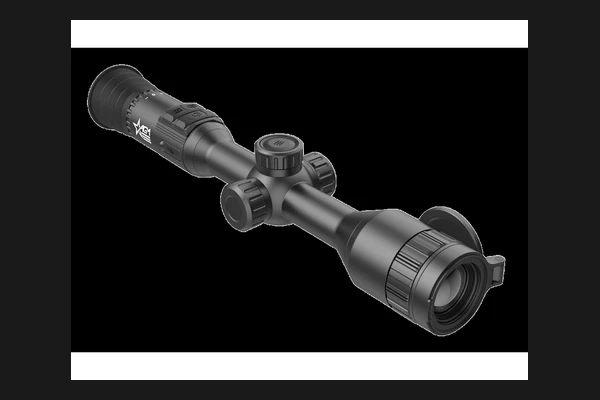
The Adder V2 runs the same 384×288, 12μm, 50Hz sensor platform as the other AGM 384 options but in a traditional 30mm tube form factor. For hunters who want a thermal that looks and handles like a standard rifle scope — tube body, eyepiece adjustment, conventional mounting — the Adder is the AGM answer. It takes standard 30mm rings, which means no special mounts or adapters.
At $2,595, it’s $620 more than the Rattler V2 TS35-384 for equivalent sensor specs in a different chassis. The traditional form factor has practical value: it transfers between rifles using standard rings without sourcing specialized mounting hardware, and the ergonomics feel familiar to hunters accustomed to conventional scopes. No learning curve on the mount setup.
Detection at 1,400 meters and the same 25mK NETD as the Rattler line puts the image performance on equal footing. You’re choosing tube-style handling over the Rattler’s more compact chassis. Both are valid choices — the Adder is the pick for hunters who want zero adaptation time on a new mounting system or who switch scopes between rifles regularly.
Best for hunters who mount scopes on multiple rifles and want conventional 30mm tube compatibility.
Pulsar Thermion 2 XQ35 Pro — Best Non-AGM 384
At $2,499, the Thermion 2 XQ35 Pro is the strongest 384-resolution alternative in this price range from a brand with established thermal credibility. Pulsar has been building thermal optics since before the hunting market exploded, and the Thermion 2 line reflects that experience in build quality and image processing.
The sensor is 384×288 at 17μm with a 50Hz refresh rate and detection range around 1,400 yards. The 17μm pixel pitch is a generation behind the 12μm found in AGM’s current lineup, but Pulsar compensates with mature image processing algorithms that produce a clean, high-contrast image. In practice, side-by-side comparisons show the Pulsar holding its own against 12μm 384 scopes at distances under 300 yards.
Where Pulsar differentiates: the Stream Vision 2 app for WiFi streaming and firmware updates, picture-in-picture zoom, 8 reticle options, and a track record of consistent firmware improvement. The 30mm tube form factor takes standard rings. Build quality and waterproofing (IPX7) are confidence-inspiring for hunters who abuse their gear in rain, dust, and cold.
Best for hunters who want a proven non-AGM thermal with strong software support and traditional tube ergonomics.
ATN Thor 5 320 — Best Smart Features
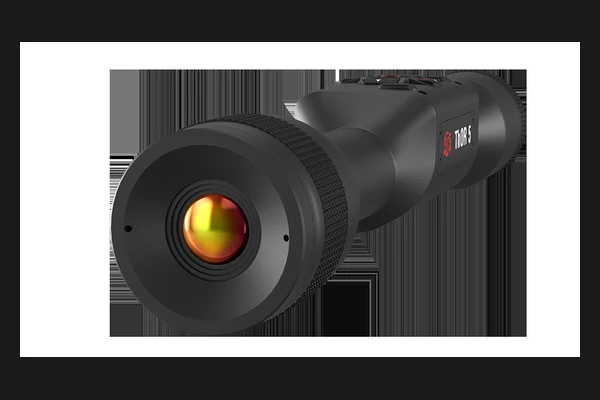
ATN’s fifth-generation processor is a real improvement over the Thor 4 platform. Faster boot, faster image processing, better app integration, smoother ballistic calculator operation. The Thor 5 at $1,795 is the most tech-forward option in this price range — video recording, WiFi streaming, shot logging, recoil-activated video all built in without an add-on module.
The honest limitation is the 320×240 sensor. Under 200 yards, it works. The 60Hz refresh handles movement cleanly, and the 12μm pixel pitch extracts more from the 320 sensor than older gen scopes did with the same resolution. But beyond 200 yards, identification becomes soft. The spec sheet shows 2,200-yard detection, which is accurate — at that resolution, you’re detecting a heat signature, not identifying a target.
For hunters who run technology-heavy setups — tracking harvest data, streaming hunts, running the ATN app — the Thor 5 has an ecosystem advantage. For pure image performance at this price, the AGM 384 options deliver more. The ATN wins when features matter more than sensor quality, which is a legitimate priority for some hunters.
Best for hunters who prioritize smart features, data logging, and ATN’s app ecosystem over resolution.
Pulsar Thermion 2 XQ35 Pro — Best Display
Pulsar’s AMOLED display is genuinely different from the LCD eyepieces in most thermal scopes at this price point. Higher contrast, faster response, and colors that look more natural under extended use. Hunters who’ve used the Thermion line and then looked through budget competition often cite the display quality as the most immediately obvious difference. That’s not marketing — AMOLED technology delivers real viewing advantages.
The 384×288 sensor at 17μm pixel pitch puts it behind the 12μm AGM options in image sharpness at extended zoom. Detection is 1,400 yards. At 2.5–10× magnification, the zoom range is narrower than some competitors, which limits extreme close work and very long-range scanning. The trade is sensor quality: 17μm at Pulsar’s image processing standard produces very clean images within its working range.
Pulsar’s warranty and service network is the other consideration. Five-year warranty with registration, US service centers, and a track record of honoring claims without excessive delay. For a scope you’re depending on for multiple seasons, that matters. At $2,499, it sits below AGM’s 640 option while offering a different set of advantages: display quality, warranty support, and the Pulsar build standard.
Best for hunters who value display quality, long-term warranty support, and European build standard over resolution at this price point.
Bering Optics Super Hogster A3 — Honorable Mention
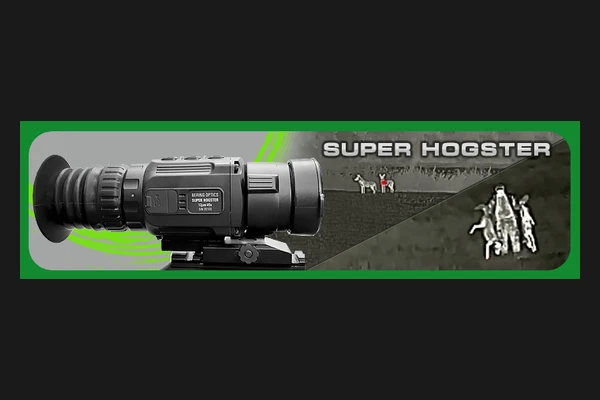
Bering designs the Hogster line specifically for night hunting, and that focus shows in a few ways: wide field of view for scanning and tracking, simple menu navigation, and fast-start ergonomics. The 384×288 sensor at 12μm and 50Hz handles hog and coyote work at typical engagement distances. At roughly $2,499-2,799, it occupies the same price space as the Pulsar Thermion 2 XQ35 Pro.
The wide FOV is the Hogster’s differentiated feature. Where some scopes require deliberate scanning sweeps, the Hogster’s wider field lets you cover more ground naturally. For hunters working feeders or bait sites where multiple animals may be moving simultaneously, that situational awareness has practical value. Battery life is the weakness: four hours on a single charge means carrying spares for any full-night session.
Bering has less US market presence than AGM, Pulsar, or ATN. Parts availability and service response are slower to access if something breaks. The scope itself is solid engineering — German optical lineage — but the after-sale support uncertainty is a legitimate factor when deciding between this and a more established brand at similar pricing.
Best for hunters who specifically want wide FOV and don’t mind managing battery logistics for extended sessions.
384 vs 640: how to decide
The core decision in the $2,000-$3,000 budget is whether to spend at the top of the range for 640 resolution or buy a 384 scope with money to spare. There’s no universal answer, but the decision factors are clear.
Choose 640 resolution if your shots routinely exceed 250 yards, you’re hunting open terrain (agricultural fields, open plains, river bottoms with long shooting lanes), or target identification accuracy is a priority. The AGM Rattler V2 TS35-640 at $2,695 is the only 640 option that fits this budget, and it fits comfortably.
Choose 384 resolution if your shooting happens inside 250 yards — thick brush, dense timber, typical feeder setups — or if you want additional functionality like LRF integration and you can get a 384 + LRF for less than the 640 alone. The AGM Varmint V2 LRF at $2,195 and the Rattler V2 TS35-384 (see our under-$2,000 guide) are both strong choices in this camp.
Pixel pitch matters alongside resolution. All the AGM options run 12μm, which is the current performance standard. The Pulsar Thermion 2 XQ35 Pro runs 17μm — a slightly older pixel size that delivers a clean image but can’t match the sharpness of 12μm at the same resolution count, especially at extended digital zoom.
Once you’ve selected a scope, zeroing it correctly determines whether the specs matter at all in the field. See our complete guide to zeroing thermal scopes for step-by-step instructions.
Frequently asked questions
Is 640 resolution worth the extra money under $3,000?
For most hunters who shoot past 200 yards, yes. The AGM Rattler V2 TS35-640 at $2,695 delivers 640×512 resolution for $720 more than the 384 version. The 640 sensor gives you triple the pixels, which translates to sharper target identification at 300-400 yards and better image quality in low-contrast conditions. If your shots happen inside 200 yards, the 384 is fine and you pocket the difference. If you hunt open country or routinely engage targets at 250+ yards, the 640 upgrade is worth it.
What is pixel pitch and why does it matter?
Pixel pitch is the physical size of each individual sensor pixel, measured in micrometers (μm). Smaller pixel pitch means more pixels fit in the same sensor area, which generally produces sharper images. 12μm is the current performance standard in thermal scopes — all the AGM options on this list run 12μm. Older sensors run 17μm (the Pulsar Thermion 2 XQ35 Pro, for example). At the same resolution count, 12μm delivers a crisper image, especially when you use digital zoom. It’s a spec worth checking when comparing scopes with identical resolution numbers.
Should I get a built-in laser rangefinder in my thermal scope?
It depends on whether ranging is a regular part of your hunting process. For hunters who work the same property and know their distances, LRF integration doesn’t add much over knowing the yard markers on your land. For hunters who cover multiple properties, hunt variable terrain, or take shots at unknown distances regularly, the integrated rangefinder removes a step and reduces the chance of ranging errors in the dark. The AGM Varmint V2 LRF TS35-384 at $2,195 is the most accessible LRF option under $3,000.
How long do batteries last on thermal scopes under $3,000?
Most modern thermal scopes in this range run 6-11 hours on a charge. The AGM Rattler V2 TS35-640 typically runs 9-11 hours. The Pulsar Thermion 2 XQ35 Pro uses a dual-battery system that extends to around 10 hours total. The ATN Thor 5 runs about 8 hours. The Bering Optics Super Hogster A3 is the exception at around 4 hours — a spare battery is essential for any extended session. For full-night hunts (5-7 hours), most options on this list will get through the night without a swap. Always carry a charged spare.
Is the Pulsar Thermion 2 XQ35 Pro worth it vs. the AGM Rattler V2 TS35-640?
They cost about the same — $2,499 for the Pulsar versus $2,695 for the AGM. The AGM gives you 640×512 resolution and 12μm pixel pitch. The Pulsar gives you 384×288 and 17μm pixel pitch but adds an AMOLED display (significantly better eyepiece than most competitors), a 5-year warranty, and Pulsar’s established service network. If raw resolution and detection range are the priorities, the AGM 640 wins. If display quality and long-term warranty support matter more, the Pulsar case is valid. Most hunters who will rely on this scope for 5+ seasons should at least consider the Pulsar’s warranty advantage.
What warranty do thermal scopes under $3,000 carry?
Pulsar offers a 5-year warranty with product registration — the longest standard warranty in the class and they’re known for honoring it quickly. AGM provides a 3-year warranty across their lineup with US-based service. ATN’s warranty varies by product but typically covers 2-3 years. Bering Optics offers 4-6 years depending on the product. For a scope you’re planning to run hard for multiple seasons, warranty terms are a legitimate purchase factor — a thermal scope left for service for two months during hunting season isn’t worth any spec advantage.
Final recommendation
The default answer in the $2,000-$3,000 range is the AGM Rattler V2 TS35-640 at $2,695. 640 resolution in this budget didn’t exist two years ago. It exists now, it comes from a brand with an established US support network, and it runs a 12μm sensor that outperforms older thermal hardware at higher price points. For most hunting applications, this is the right call.
If LRF integration is a priority and you can work with 384 resolution, the AGM Varmint V2 LRF TS35-384 at $2,195 saves money and solves the ranging problem at the same time. The $500 difference from the 640 version buys LRF functionality and leaves cash for other gear.
For hunters who want an alternative to AGM and are willing to trade some resolution for display quality and warranty length, the Pulsar Thermion 2 XQ35 Pro at $2,499 is a legitimate option. Pulsar’s five-year warranty and AMOLED display are real advantages. You’re giving up the 640 sensor upgrade, but you’re getting a premium build backed by the best warranty in the category.
Check current price on AGM Rattler V2 TS35-640
Pairing your rifle scope with a handheld spotter? Our thermal monoculars buyer’s guide covers the best options to build a complete thermal kit. For a full brand breakdown at this price tier, see our night vision brands guide.
Last updated February 2026. Prices and availability may change. This page contains affiliate links — we may earn a commission if you purchase through our links, at no extra cost to you.