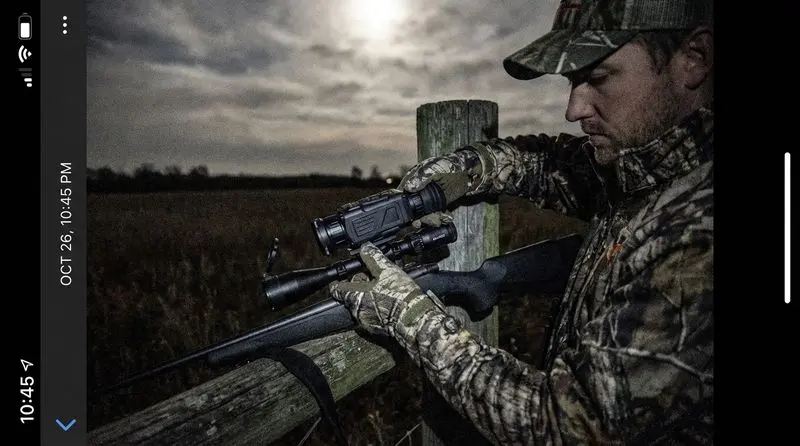
Best Thermal Clip-On Scopes for Hunting in 2026
The thermal clip-on category has changed. What started as a military-only solution — bulky, expensive, finicky — has become viable for hunters who want thermal detection without replacing their existing optics.
The premise: mount a thermal device ahead of your daytime scope, and the thermal image projects through your existing reticle. Pull it off at first light, and your zero is exactly where you left it. One rifle, one setup, one zero to maintain.
Thats the appeal. The reality involves compatibility quirks, image quality tradeoffs, and a price range that spans from “almost reasonable” to “requires a second mortgage.” Heres what to actually buy in 2026 — and what to avoid.
How thermal clip-ons differ from dedicated thermal scopes
A dedicated thermal scope replaces your optic entirely. You get a purpose-built system with integrated reticle, dedicated magnification, and a sensor designed to work with that specific display. These are cleaner in operation — one zeroing process, fewer variables.
A clip-on sits in front of your existing scope. Your scopes reticle overlays on the thermal image. You keep your existing optical clarity for day use and need only one zero for both scenarios.
In practice, the “one zero” claim depends on how well the clip-ons image registers with your scopes focal plane. Budget clip-ons can introduce enough shift at distance to matter. Higher-end units are much more consistent. For more context on standalone options, see our thermal scope buying guide.
What actually matters in a thermal clip-on
Sensor resolution: 384×288 is the entry point for hunting. 640×480 is a meaningful step up for anything beyond 200 yards. At 12 micron pitch, 640-pixel sensors give you identification-quality detail, not just blob detection.
NETD: Below 35mK is where thermal images look good in real conditions. Above 50mK, you lose contrast when ambient temperature is close to animal body temperature — exactly the scenario youll face during warm early-season hunts.
Objective lens diameter: Most clip-ons run 35-50mm. Larger objectives gather more thermal energy, which helps at range — but also require more front-of-scope clearance, a constraint that eliminates some setups.
Frame rate: 30Hz or 50Hz. At 30Hz, youll notice slight motion lag tracking a moving animal. At 50Hz, tracking feels natural. If youre spot-and-stalk hunting through dense cover, 50Hz is worth the premium.
Digital zoom: Useful for identification, not for shooting. Thermal digital zoom degrades image quality fast. Treat native magnification as your practical limit.
Top picks for 2026
AGM Rattler TC35-384 — Best mid-range clip-on
The Rattler TC35-384 runs a 384×288 sensor with 12 micron pitch and sits at a price point that serious hunters can justify. The image is cleaner than most competitors at this sensor resolution — NETD comes in around 25mK, better than spec sheets claim for many competing units.
The refresh rate (50Hz) and compact form factor make it work for hunting. At 0.45 kg, it doesnt dramatically shift your rifles balance point. Battery life runs around 6.5 hours — enough for most night hunts, though carrying spares never hurts.
Compatibility is broad. It fits most 40-56mm objective bell diameters via included adapter rings. The unit also works as a standalone handheld, which adds flexibility.
Where it falls short: past 250 yards in dense vegetation, small animals start blending into background. For hog hunting where shots are often closer and targets larger, this doesnt matter much. For predator work where youre calling coyotes at 300+ yards, youll want more sensor.
AGM Secutor TC50-640 — Best for serious range work
The jump to 640×480 sensor resolution is real. At 50mm objective, the Secutor TC50-640 more than doubles identification range compared to 384-pixel sensors — and that identification range (knowing what youre looking at, not just that something is there) is what matters in the field.
This unit runs a 12 micron pitch sensor with NETD around 20mK. In cool conditions where animal heat stands out clearly against ambient, the image is excellent. In warm weather, the better NETD keeps you in the game longer than budget alternatives.
The tradeoff is weight and size. At around 0.65 kg and 185mm length, this changes how the rifle handles. Test with your actual mount before a hunt.
Budget option: sub-$1,000 clip-ons
If budget is the primary constraint, sub-$1,000 clip-ons from various manufacturers deserve a look — with realistic expectations. Sensor resolution is typically 256×192 at 17 micron: enough to detect animals at moderate range, not enough to confidently identify species at 200+ yards. Frame rate runs 25Hz on most budget units, adequate for stationary targets but noticeably laggy on moving animals.
These work for close-range hog hunting over bait. They dont replace a quality clip-on for predator work.
Compatibility: the variable nobody likes to talk about
The most common complaint with clip-on thermals is misalignment — the thermal image doesnt register cleanly with the scopes point of impact.
This happens because the clip-on adds an optical element between your eye and the target. Even small tolerances in manufacturing or ring fit can introduce image shift. At 100 yards this may be acceptable. At 300 yards, a 1 MOA shift means a 3-inch offset between where youre holding and where the thermal says the animal is.
What reduces this problem: quality clip-on units with precision-machined mounting systems, scope tubes with consistent outer diameter, re-zero verification after first mounting, and not swapping the clip-on between rifles without rechecking zero. The thermal vs. NV hog hunting comparison covers practical range expectations in more detail.
Scope pairing considerations
Objective bell clearance: The clip-on needs to clear the objective bell. Measure your objective bell outer diameter — not just the lens size, the outer diameter of the housing.
Eye relief: Adding a clip-on shifts your focal plane. Some setups work fine; others require adjusting eye position in a way that changes your cheek weld. Test before youre in the field.
Variable magnification: Clip-ons generally work better at lower magnification. At high magnification, any optical aberration from the clip-on interface is magnified along with the target. Most experienced clip-on users run 1-4x when using thermal.
Field maintenance
Thermal clip-ons need the same care as any precision optic. The germanium objective lens is more fragile than glass — never store without the lens cap. When running in rain or heavy fog, verify your units IP rating: IP67 handles submersion, IP65 handles rain and spray.
Battery contacts on clip-ons tend to corrode faster than dedicated scopes because of more handling. Clean contacts periodically, especially before long-term storage. The thermal scope maintenance guide has a full field care checklist.
Who should actually buy a thermal clip-on
The clip-on makes most sense for hunters who already own a quality daytime scope theyre satisfied with, hunt in conditions requiring both day and night use on the same rifle, and want to avoid re-zeroing between scenarios.
It makes less sense for hunters starting from scratch — a dedicated thermal scope often costs less and performs better — or for anyone who needs to swap the unit between multiple rifles regularly.
Final recommendation
For most hunters entering the thermal clip-on category in 2026, the AGM Rattler TC35-384 hits the right balance of performance, size, and price. The 384 sensor wont satisfy predator hunters working at distance, but for hog, deer, and general predator applications inside 250 yards, its capable without requiring a re-zero.
If range is a priority and budget allows, step up to the Secutor TC50-640. The image quality difference is real and worth the premium for hunters where precision identification at range matters.
Whatever you buy: test the mounting fit with your specific scope before you need it in the field. The clip-on category rewards preparation and punishes assumptions.

Can You Use a Thermal Scope During the Day? Daylight Use/Sun Safety and Zeroing Tips.

Night Vision Range Explained: Detection, Recognition, Identification, and Real Hunting Distance

How to Set Up an IR Illuminator for Night Vision: Placement, Beam Width, and Field Mistakes