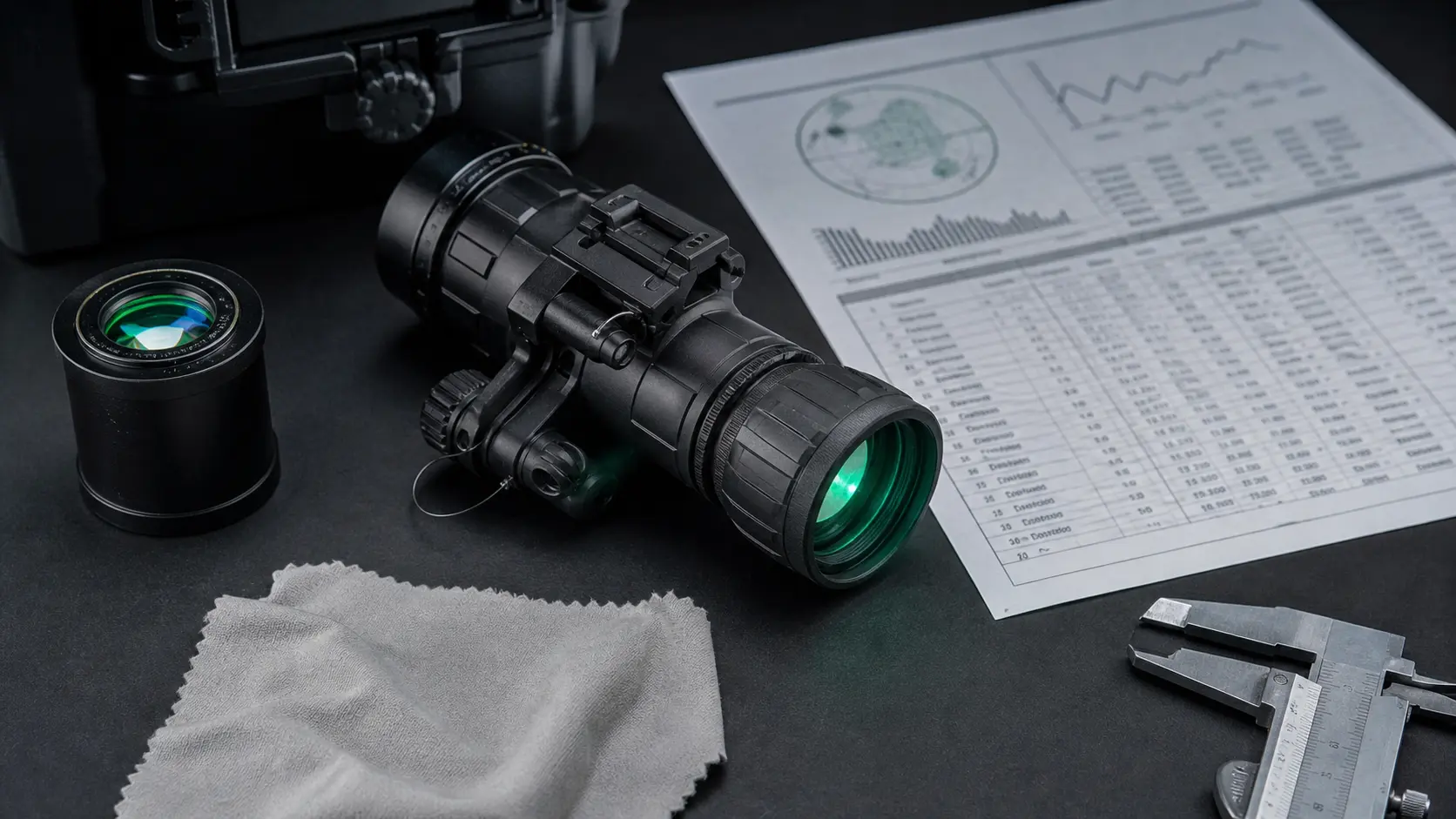
Night Vision Tube Specs Explained: SNR, FOM, EBI, Halo, Resolution
When it comes to night vision buyers love simple specs: high FOM. High resolution. Low EBI. Low halo. Clean tube. No spots.
That works nicely until two tubes with equal FOM specs appear different in practice or a seller markets “high spec” gear without providing a datasheet. The reality is that night vision tubes cannot be judged by one number. They can be described through a combination of specs, measuring sharpness, noise levels, performance around bright light, and cosmetics.
This guide breaks down the specs that matter when buying night vision gear in 2026, focusing on PVS-14s, NVGs, and night vision scopes.
Source reliability check
This article compares information from multiple source types:
| Source | Reliability | Best use | Limitation |
|---|---|---|---|
| L3Harris Gen III tube guide | Very high | Physics of Gen III tubes, SNR, halo, FOM limitations, gain life | Manufacturer information, biased towards L3Harris products |
| Elbit America MX-11769 tube page | Very high | Capabilities of Gen III tubes, PVS-14 compatible tube info, minimums | Product information, not datasheet |
| Exosens / Photonis ECHO data | Very high | Formula for FOM, ranges for commercial tubes, note on green vs white phosphor | Photonis/Exosens branded information |
| Exosens / Photonis 4G data | Very high | FOM, SNR, resolution, fast autogating, spectral range | Product-specific information |
| Hoffman Engineering ANV-126A test set | High | Measurement capabilities of this tester: resolution, gain, current, defect analysis, high-light resolution | Test equipment information |
| DHS / NIJ night vision technical notes | High | Independent explanations of night vision terms | Some dated, but valuable nonetheless |
| General dealer/buyer guides | Medium | Application of tube information to buyer decisions | Less authoritative than manufacturer or government information |
Inconsistent source comparison leads to one consistent conclusion: FOM is useful, but it is not all there is to night vision tubes. Any buyer interested in performance needs to read SNR, resolution, EBI, halo, gain, and blemishes.
Quick Answer
Most important specs:
- SNR: Signal-to-noise ratio. Higher SNR is better. One of the best low-light specs.
- Resolution: in line pairs per millimeter (lp/mm). Higher means sharper, if you can use the extra detail.
- FOM: resolution x SNR. Handy shorthand, but not comprehensive.
- EBI: equivalent background illumination/input. Lower EBI is better.
- Halo: light ring around bright lights. Lower halo is better around headlights, houses, street lights, and weapon lights.
- Gain: brightness amplification. Not necessarily higher is better if it adds noise and reduces durability.
- Blemishes/Spots: cosmetic issues with tube image. Where the blemish appears can matter as much as its size.
Remember one thing while buying: FOM is not the whole story!
What Is a Night Vision Tube?
Image intensifier tubes are the key components of analog night vision. Light goes into the objective lens, hits the photocathode and gets converted into electrons. Then it is amplified by the MCP (microchannel plate), and converted back into visible light in the phosphor.
That is why the quality of a tube makes such a difference: the housing, the mount, the lenses, the helmet are important, but the tube determines how clean, bright, sharp, and usable the image will be.
A “Gen 3 PVS-14” can be amazing, average, and disappointing, based entirely on the tube installed.
SNR: the Most Important Spec
SNR stands for signal-to-noise ratio.
In layman terms, SNR indicates how much usable signal your tube produces, as opposed to electrical noise.
Tubes with higher SNR tend to have a cleaner image even in low light. That matters a lot if you plan to navigate through heavy tree coverage at night, scout fields under a new-moon sky, or hunt at dusk in very dark conditions.
A tube with good SNR but mediocre resolution might look clearer than one with stellar resolution but terrible SNR under poor lighting.
Practical SNR ranges:
| SNR | Meaning |
|---|---|
| Under 20 | Usable, but will produce more noise in dark conditions |
| 20-24 | Average/usable to good, depending on the exact tube type and price range |
| 25-28 | Good performance for civilians |
| 29-32 | Very good civilian performance, great in low light |
| 33+ | Premium performance, even more noticeable in extreme dark |
SNR should not be considered in isolation. EBI, halo, and cosmetics matter a lot.
Resolution: the Sharpness, But Not the Whole Picture
Resolution is usually expressed in line pairs per millimeter or lp/mm. In simple terms, it means how sharp your tube will be.
Common resolutions include 57, 64, and 72. A tube that can display 72 lp/mm resolution is able to detect finer details than one with 64 lp/mm, in laboratory settings. Does that mean 72 is always better?
Absolutely not.
Why? Because resolution is useless if there is too much noise in the picture. An overly noisy image will not allow you to detect details regardless of how high resolution is. A low-resolution image in the dark may have more details to see due to high SNR.
Example:
- Tube 1: 72 lp/mm resolution, 25 SNR
- Tube 2: 64 lp/mm resolution, 30 SNR
Tube 1 has higher measured sharpness. Tube 2 is more likely to provide useful image in the field, despite lower resolution. That is why the two specs are so tightly linked, especially when looking for practical results.
Civilian users usually get enough resolution from a 64-lp/mm tube. 72 and above can be worth considering if you can afford more for other specifications as well.
FOM: useful shorthand, inadequate final spec
FOM means figure of merit.
Formula for FOM:
FOM = resolution x SNR
So the FOM for a tube with 64 lp/mm resolution and 30 SNR is 1,920.
The usefulness of FOM comes from its ability to quickly classify tube performance.
But FOM can conceal a lot of details. Example:
- Tube 1: 72 lp/mm resolution, 25 SNR -Over 1,800 FOM
- Tube 2: 60 lp/mm resolution, 30 SNR -Over 1,800 FOM
Both have FOM of 1,800, but tube 1 is more capable of resolving images, whereas tube 2 has higher SNR. Which tube is better? Depends on the purpose.
Manufacturer and expert sources always point at using multiple metrics, instead of one. That is because performance depends on several connected aspects: resolution, SNR, halo, EBI, gain, durability.
FOM ranges:
| FOM | Practical interpretation |
|---|---|
| Under 1,400 | Budget/older performance range |
| 1,400-1,800 | Civilian performance |
| 1,800-2,100 | Civilian performance range |
| 2,100-2,500 | Premium civilian performance range |
| Over 2,500 | High-performance range for civilians |
Even a high-FOM tube might not be your best choice if it has bad halo, bad EBI, lots of blemishes, or poor warranty support.
EBI: Dark Performance Metric People Forget About
EBI means equivalent background illumination or input.
This is essentially noise your night vision tube creates when no useful light is reaching its photocathode.
EBI is important because in conditions when your image intensifier has nothing else to amplify but its own noise, it creates additional problems.
It makes contrast worse. Additionally, it tends to become more visible in hot environment.
Therefore, EBI is relevant if you want to hunt in a warm climate and dense foliage.
Practical EBI interpretation:
| EBI | Meaning |
|---|---|
| Under 0.5 | Great civilian performance |
| 0.5-1.0 | Excellent |
| 1.0-1.5 | Good |
| 1.5-2.5 | Usable, but not ideal |
| Over 2.5 | Avoid unless price and use case justifies it |
Keep in mind that EBI is not the only low-light metric. In fact, a tube with slightly lower SNR but higher EBI can be more functional.
Halo: What Happens Around Bright Lights
Halo is a light glow around bright sources, such as headlamps, houses, street lamps, etc.
Lower halo means a more focused glow around the light source. It is important because in dark environments halo may obscure smaller objects near a light source.
Halo may matter more if you hunt around ranches or farm fields, because you might need to look near houses or buildings with lights turned on. That could happen when you follow a nocturnal animal to a food station.
Practical halo ranges:
| Halo | Meaning |
|---|---|
| Under 0.7 | Outstanding halo |
| 0.7-0.9 | Great halo |
| 0.9-1.0 | Good halo |
| 1.0-1.2 | Usable, but halo may become bothersome around lights |
| Over 1.2 | Be careful with such tubes |
Halo is more important for users hunting near built areas. For example, hunting on the outskirts of suburbs may require you to look around lighted houses.
Gain: Important But Not as Simple As That
Gain is the amplification of light, resulting in an overall brighter image.
Higher gain means brighter image. However, that is not always better. Too much gain can create a very bright picture with more noise in it.
Gain is also not the same as manual gain in a monocular. It is a property of a tube.
A Note On Photonis/Exosens And Their Gain Numbers
Be careful when comparing Photonis / Exosens gain numbers against L3Harris or Elbit numbers. Unless you know the exact numbers, you cannot just compare them directly, because different manufacturers use different technologies for their tubes.
L3Harris and Elbit sell mostly Gen 3 night vision tubes which use gallium arsenide (GaAs) photocathode.
Photonis / Exosens sell a line of so-called 4G tubes that are not technically Gen 3. In other words, they are Gen 3 + (4th generation), not Gen 3. Yet they have many of the same features as L3Harris tubes: good resolution, fast autogating, small halo, and wide spectral range.
This means that comparing Photonis/Exosens gain numbers against L3Harris gains might show lower Photonis values because of different units. For example, the Exosens ECHO datasheet measures gain in cd/m²/lx, while L3Harris usually lists cd/fL.
Do not dismiss Photonis tubes just because of a seemingly lower gain number in the datasheet.
Photocathode Sensitivity: Important But Not The Only Spec
Photoconductive sensitivity describes how effectively your tube reacts to incoming light.
One of the reasons Gen 3 tubes are so good at low light and near-infrared conditions is photoconductive sensitivity provided by GaAs photocathode.
Elbit America and L3Harris emphasize the importance of GaAs technology in their datasheets.
Photonis 4G tubes use so-called Hybrid Multi-Alkali (HyMa) technology instead. While it prevents 4G tubes from being called Gen 3, HyMa technology can achieve very high image intensification.
Ultimately, however, buyers should remember that a night vision tube is much more than just photocathode: phosphor, microchannel plate, gain amplification, optics, and power supplies also play important roles.
Datasheets of quality night vision tubes consider all these parameters in addition to photocathode.
White Phosphor Vs Green Phosphor: Is There Any Difference?
White phosphor and green phosphor refer to the color of phosphors used for creating the tube image.
In general, white phosphor is easier to tolerate during long sessions, which is why it is preferred by many users.
However, Photonis / Exosens claims that P43 green and P45 white phosphor produce no noticeable differences in lab settings. The company adds that phosphor choice depends only on end-user preferences.
It does not mean that each green phosphor tube is equivalent to a white phosphor one. Each of the colors can be combined with high or low resolution, SNR, EBI, halo, and so on.
Do not buy a tube based only on phosphor type. Choose according to the datasheet.
Blemishes, Spots, Zones
Blemishes refer to imperfections appearing on the tube image.
Different types include spots, peppering, or fixed marks. Some blemishes are more tolerable than others.
Most inspection systems divide tube images into zones. The zones determine the location of the blemishes.
- Zone 1: central part of the image, where imperfections are most disruptive
- Zone 2: middle zone
- Zone 3: peripheral zone, where blemishes are less disruptive
Used night vision tubes require careful blemish evaluation because they usually come without datasheet. The seller should provide photos showing tube image in low light conditions against a dark background.
Autogating & Bright-Light Handling
Autogating is a mechanism that adjusts the power supply of the tube in response to light change.
The process allows night vision gear to operate around bright lights without producing excess glare or causing image disruption.
For night vision hunters who need to move around dark forest, vehicle lights, houses, moon-lit spaces, and shady tree lines, autogating is crucial.
Autogating is also the reason why Photonis/Exosens tubes are so well-regarded by civilians. Fast autogating and minimal halo make these tubes more convenient to work with, even though gain number might be lower in some cases.
Nonetheless, autogating cannot protect a tube from damage or excessive stress caused by operating in bright light conditions. Never treat analog night vision gear like it was made for bright daytime.
Ideal Spec Sheet For Hunting
What would a great tube look like for hunters?
Civilian-grade:
- SNR: 28+
- Resolution: 64 lp/mm +
- FOM: 1,800+
- EBI: Under 1.5 preferable
- Halo: Under 1 preferable
- Zone 1 clear
- Datasheet from reputable manufacturer
- Trusted builder/dealer
For low-light hunting:
- SNR: 30+
- Resolution: 64-72 lp/mm
- FOM: 2,000+
- EBI: 1.0+
- Halo: Under 0.8
- Clean cosmetics
- Reputable builder/dealer
For budget night vision tubes, some of the above parameters may not meet those criteria. However, you cannot settle for any tube that does not have a datasheet from a trusted source.
Comparing Two Night Vision Tubes
Step-by-step process:
- Determine the manufacturer and type of tube.
- Verify datasheet corresponds to the exact model.
- Compare SNR specs.
- Compare EBI and halo specs.
- Compare resolution specs.
- Calculate FOM if not provided.
- Determine the units of measurement for gain.
- Inspect zones for blemishes/peppering.
- Consider manual gain requirements.
- Compare warranty and build quality.
Example:
| Spec | Tube 1 | Tube 2 |
|---|---|---|
| Resolution | 72 | 64 |
| SNR | 25 | 30 |
| FOM | 1,800 | 1,920 |
| EBI | 1.8 | 0.7 |
| Halo | 1.1 | 0.8 |
In this example, the Tube 1 has higher resolution than Tube 2. However, Tube 2 offers better SNR, higher FOM, lower EBI, and lower halo. Thus, in field conditions Tube 2 is expected to provide a better result than Tube 1.
Potential Red Flags In Purchasing Night Vision Tubes
Watch out for sellers who say the following things:
- “High spec” but refuse to give specs
- “No blems” but will not give clear pictures
- “Mil spec” without indicating the tube type
- “Gen 3” without manufacturer information
- “White phosphor” as if it was a guarantee of quality
- “Great FOM” without providing other numbers
- “Highest gain” without mentioning the units
- “Looks clean to me” without giving blemish zones and image
- “No returns” on a used item
For used tubes, the datasheet and image are equally important as the description in the listing.
Best Internal Links Related To This Topic
This article supports the following pages:

Can You Use a Thermal Scope During the Day? Daylight Use/Sun Safety and Zeroing Tips.

Night Vision Range Explained: Detection, Recognition, Identification, and Real Hunting Distance

How to Set Up an IR Illuminator for Night Vision: Placement, Beam Width, and Field Mistakes