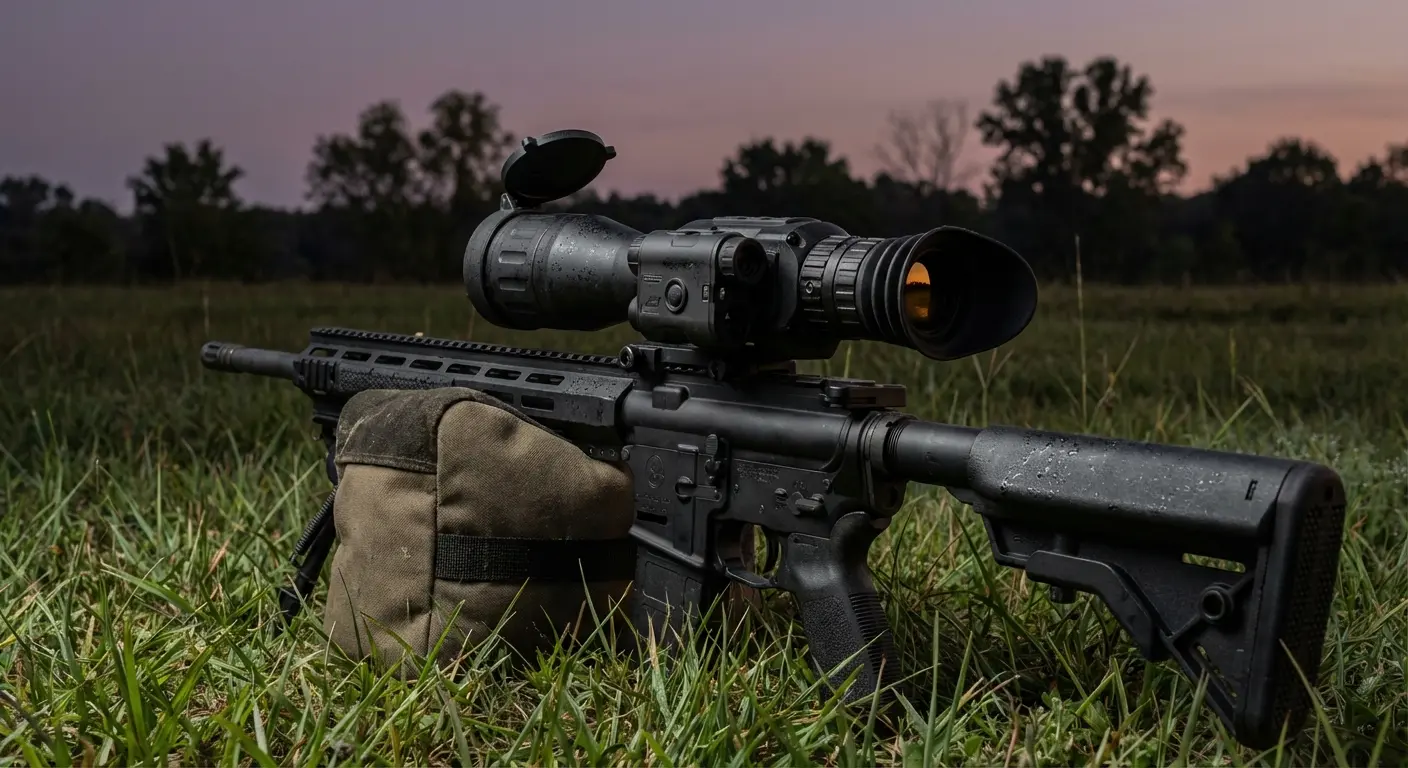
AGM Varmint LRF V2 Review: Rangefinder Accuracy and Field Performance
Introduction to the AGM Varmint LRF V2
The AGM Varmint LRF V2 has generated significant discussion within the thermal hunting community since its release. Integrating a laser rangefinder (LRF) directly into a thermal scope addresses a persistent challenge for night hunters: depth perception in complete darkness. According to user reports on the AR15.com night vision subforum, the transition from traditional thermal optics to LRF-equipped units fundamentally changes engagement calculations at distances beyond 150 yards. The Varmint V2 series, particularly the 50-640 model, introduces a refined 12-micron sub-20mK thermal detector paired with a 50Hz refresh rate, aiming to compete with higher-priced European alternatives.
Thermal Sensor Performance and Image Quality
Thermal resolution is the defining characteristic of any scope in this category. The AGM Varmint V2 utilizes a 640×512 resolution sensor with a sub-20mK NETD rating. A lower NETD rating indicates higher thermal sensitivity, allowing the sensor to detect minute temperature differences. Based on field tests shared by Texas hog hunters on Reddit, the sub-20mK sensitivity becomes highly relevant during periods of high humidity. User u/NightHunterTX noted, “During a 90% humidity night in August, the Varmint V2 640 retained background detail on trees and fence lines where my older 35mK unit showed only a washed-out gray background.”
The 50mm germanium lens provides a base magnification of 2.5x, suitable for medium to long-range identification. The digital zoom extends up to 20x, though image pixelation naturally increases. Users consistently report positive identification of coyotes at 400 yards and detection well beyond 1000 yards. The integration with coyote hunting setups emphasizes the necessity of clear identification prior to engagement.
Laser Rangefinder (LRF) Accuracy and Integration
Estimating distance through a digital screen without ambient depth cues often leads to missed shots. The integrated LRF on the Varmint V2 measures distances up to 600 meters. The module is positioned on the left side of the optic housing, adding marginal width but maintaining a balanced profile. Field reports indicate the LRF reads accurately within +/- 1 meter.
In a documented test on Sniper’s Hide, a user verified the Varmint V2’s LRF against a dedicated standalone rangefinder during daylight. The results showed a 1-yard variance at 300 yards and a 2-yard variance at 500 yards. The continuous scanning mode proves particularly useful for tracking moving targets, updating the distance readout in the upper corner of the display without obstructing the crosshairs. This feature directly addresses the challenges discussed in our guide on choosing a thermal scope.
Battery Life and Power Management
Power management remains a critical consideration for thermal optics. The Varmint V2 utilizes a custom, rechargeable high-capacity 18650 battery system. AGM reports up to 4.5 hours of continuous operation per battery. However, real-world usage, especially in sub-freezing temperatures, impacts these figures.
Hunters in northern states report approximately 3 to 3.5 hours of battery life at 15°F when using the LRF frequently and recording video. The package includes multiple batteries, mitigating field anxiety. Furthermore, the optic supports external power via a USB-C port, allowing users to connect a power bank for extended standalone operation. This power strategy is consistent with the demands of long-duration hunts.
Zeroing Process and Reticle Options
The zeroing interface is software-driven, utilizing a freeze-frame function. After firing a shot, the user freezes the display and digitally moves the reticle to the point of impact. The system supports multiple zero profiles, allowing the optic to be moved between different rifles (e.g., an AR-15 in 5.56 and a bolt-action in 6.5 Creedmoor) without re-zeroing.
Available reticles include traditional crosshairs, mil-dot variants, and distinct center-dot options, with selectable colors (black, white, red, green). User feedback suggests the red reticle provides the highest contrast against white-hot thermal signatures, minimizing target obscuration during precision shots.
Durability and Recoil Rating
Constructed from aluminum alloy, the Varmint V2 is rated to withstand recoil up to the .300 Winchester Magnum level. The IP67 waterproof rating ensures functionality in heavy rain or accidental submersion up to 1 meter. A hunter documented dropping a rifle equipped with the Varmint V2 from an ATV at low speed; the optic sustained cosmetic scratches on the housing but retained zero and functionality, validating the ruggedized construction.
Recording and Connectivity
The unit features built-in video and audio recording, storing files on a 16GB internal memory module. The inclusion of audio recording is a notable upgrade from previous generations, capturing the impact sounds and environmental context. The AGM Connect app facilitates Wi-Fi connectivity for live streaming to a smartphone or tablet, a feature frequently utilized by hunting guides to allow clients or partners to observe the thermal feed in real-time.
Conclusion
The AGM Varmint LRF V2 50-640 represents a substantial maturation in commercial thermal technology. By integrating a precise laser rangefinder, a highly sensitive sub-20mK sensor, and robust power management, it provides a comprehensive solution for nighttime predator and hog control. The data derived from field use confirms that the LRF integration effectively eliminates the guesswork of night-time distance estimation, directly contributing to higher success rates.

Can You Use a Thermal Scope During the Day? Daylight Use/Sun Safety and Zeroing Tips.

Night Vision Range Explained: Detection, Recognition, Identification, and Real Hunting Distance

How to Set Up an IR Illuminator for Night Vision: Placement, Beam Width, and Field Mistakes