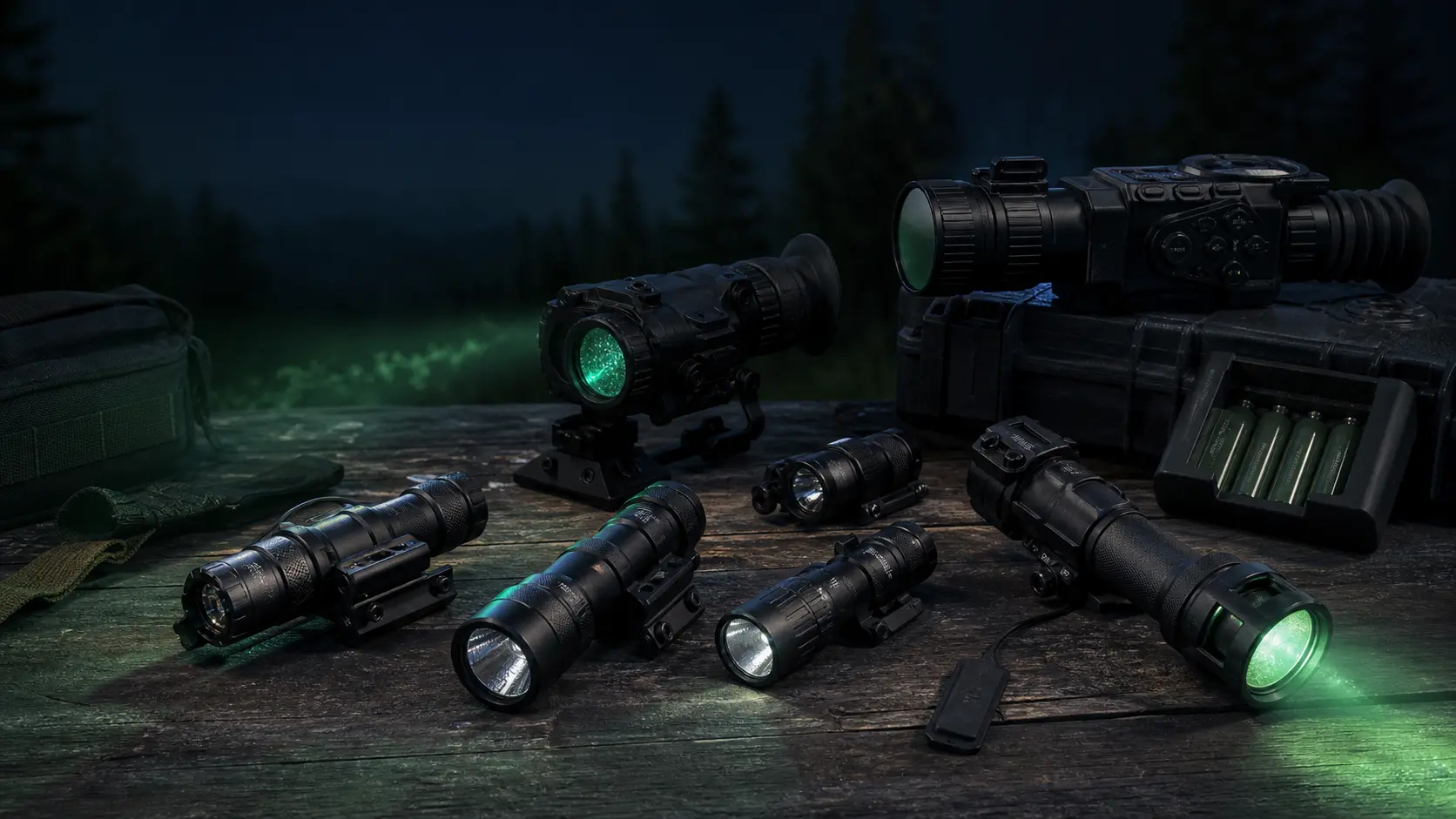
Best IR Illuminators for Night Vision in 2026: What Actually Works
There is a big misconception about IR illuminators being some sort of magical device for turning any cheap rifle scope into super night vision tech. They are not. An IR illuminator is an infrared flashlight that allows your night vision device to see better than your eyes do.
The problem is that in one setup it might make an older Gen 1 or Gen 2 device, a Gen 3 tube in poor ambient light, or a low-end digital scope much more usable at night. In another setup, an illuminator will wash out your picture, give you a narrow tunnel of light, or just add useless weight and bulk to your rifle.
The biggest mistake many hunters make is choosing the brightest IR illuminator they can find. In some cases, that works out fine. In others, it fails hard. A quality illuminator has to match your hunting needs, terrain, range, and night vision gear.
Quick picks
| Use case | Best fit | Why |
|---|---|---|
| Rifle-mounted dual white/IR light | SureFire M640V Scout Light Pro Infrared | White light and IR in one durable rifle light |
| Pistol or compact rail setup | Streamlight TLR-VIR II | White light, IR illuminator, and IR laser in a compact package |
| Integrated laser/IR aiming module | Holosun LS321R | Visible laser, Class 2 IR laser, and IR illuminator in one unit |
| Long-range handheld or rail-mounted IR | AGM Sioux 850 | High-output 850nm LED, adjustable beam, rechargeable 18650 |
| Pulsar digital night vision users | Pulsar Ultra-X850S or Ultra-X940S | Designed for compatible Pulsar Digisight and Forward devices |
| Helmet or handheld utility | Armasight Watchman | Rechargeable 18650, adjustable field of view, three output levels |
What an IR illuminator actually does
As a rule, night vision scopes require some sort of light source to produce a clear picture. Analog image intensifier tubes amplify existing light. Digital night vision sensors need infrared illumination even more often.
These devices become particularly useful when there is not enough useful ambient light: heavy cloud cover, dense tree canopy, deep shadow, or no-moon conditions. An IR illuminator creates additional illumination in the scene that your device can pick up.
From your point of view, the infrared flashlight will look almost invisible. For a night vision scope, it acts like a regular handheld flashlight.
This is particularly true for:
- digital scopes
- Gen 1 and Gen 2 night vision devices
- clip-on digital scopes
- scanning in woods or brush
- identifying animals at moderate distance
- improving video quality for digital scopes
On the other hand, it is less useful in these situations:
- thermal scopes
- high-end Gen 3 night vision under sufficient ambient light
- close-range scanning when a regular low-power IR flood is enough
Thermal scopes do not require infrared illumination because they operate differently. They detect heat instead of reflected infrared light produced by an illuminator.
850nm vs 940nm
Most hunters should prefer 850nm.
According to AGM’s Sioux data sheet, 850nm is the default choice for most night vision applications and it might produce a slight red glow on direct exposure. At the same time, 940nm is considered invisible to the eye while having a smaller maximum illumination range: 600 meters for the Sioux 940 against 1,000 meters for the Sioux 850.
Pulsar’s Ultra-X850S and Ultra-X940S show practically the same difference. The Ultra-X850S is an 850nm LED with up to 800mW optical power, while the Ultra-X940S is a 940nm LED with up to 700mW optical power. Both devices are made specifically for compatible Pulsar digital night vision devices.
Use 850nm if you need more power and range. Use 940nm if stealth and reduced visible glow are the priority.
LED vs laser IR illuminators
Both LED and laser illuminators are used by hunters. LED variants are usually durable and friendly for scanning purposes. Laser or VCSEL-style IR illuminators can throw a more focused and powerful beam. At the same time, they require extra care.
FDA laser guidance states that laser products must be classified by hazard and include warnings and information about output and safe use. Invisible infrared beams deserve even more caution because the user does not get the same visual warning cue as with visible light.
Do not treat an invisible infrared beam like any other source of light. Always use caution and read the manufacturer’s instructions regarding any potential dangers of laser products.
Rule of thumb: if you are using a laser-based IR illuminator, read the manual and do not aim the device at people, vehicles, aircraft, reflective surfaces, or anything except targets you are permitted to shoot.
Product notes
SureFire M640V Scout Light Pro Infrared
SureFire M640V is one of the safest options for hunters looking for a tough rifle light with the ability to switch to IR illumination. According to SureFire’s product information, this device produces 350 lumens of white light and 120mW of IR output. Its main power supply consists of two lithium 123A batteries, and the M640V includes a low-profile mount suitable for MIL-STD-1913 and M-LOK rails.
Best for: serious rifle hunters who need dual white light and IR illumination capability.
Tradeoff: not the most cost-effective choice if all you need is basic IR illumination.
Streamlight TLR-VIR II
This is a compact weapon light with white light illumination producing up to 300 lumens, an 850nm IR illuminator with 600 mW/sr radiant intensity, and an 850nm Class 1 IR laser. It works with a single CR123A battery and Streamlight lists 1.5 hours of white-light runtime and 12 hours in IR illuminator/laser mode.
Best for: pistols and compact carbines used with night vision goggles.
Tradeoff: this IR illuminator is better suited for close-to-medium range applications.
Holosun LS321R
Holosun describes the LS321R as a visible red laser aiming module with a coaxially mounted Class 2 IR laser and IR illuminator for night vision devices. The body is made from 7075 aluminum alloy. The mount is a quick-release Picatinny mount, and the power supply consists of a single CR123 battery.
Best for: users who want visible laser, IR laser, and IR illumination in one integrated civilian module.
Tradeoff: this aiming module includes IR illumination, but it is not a dedicated standalone long-range IR flashlight.
AGM Sioux 850 & Sioux 940
AGM Sioux is a dedicated IR illuminator without aiming functions. The AGM Sioux 850 is an 850nm illuminator with 1,000mW output and up to 1,000 meters of illumination range. The AGM Sioux 940 is a 940nm illuminator with 800mW output and up to 600 meters of illumination range. Both illuminators feature beam divergence adjustment from 4 degrees to 35 degrees and use an 18650 rechargeable battery.
Best for: dedicated IR illumination with adjustable beam width and strong long-range output.
Tradeoff: it can produce too much illumination at close range.
Pulsar Ultra-X850S & Ultra-X940S
These illuminators are not universal rifle attachments. They are designed for specific Pulsar digital night vision devices. As mentioned above, the Pulsar Ultra-X850S is an 850nm LED with 800mW optical power. The Pulsar Ultra-X940S is a 940nm LED with 700mW optical power.
These illuminators are designed for compatible Pulsar models such as Digisight Ultra N450/N455, Digisight Ultra LRF, Forward F455, and Forward FN455 devices.
Best for: Pulsar digital night vision users.
Tradeoff: they cannot serve as universal illuminators for every scope type.
Armasight Watchman
Armasight Watchman is a compact portable IR illuminator with 850nm LEDs, adjustable output with three levels, adjustable field of view, and an included 30mm ring. The kit also includes an extended tape switch tail cap, 18650 rechargeable battery, and charging cable.
Best for: IR illumination when using both night vision and thermal optics in the same hunting setup.
Tradeoff: adjust your mount and switch type beforehand to make sure your rifle or helmet setup can fit the kit.
How to choose
First things first: choose an IR illuminator according to the problem you want to solve. The same goes for any other hunting accessory. Instead of sticking to your favorite brand, consider these criteria to find the best IR illuminator.
If you plan to use digital night vision with an IR illuminator for hunting, take the following factors into account:
- 850nm wavelength to get more brightness and distance.
- Beam divergence adjustability if you plan to use the device in different environments.
- Rechargeable 18650 power source for long hours of hunting.
- Do not mount an illuminator on your rifle unless you are permitted to hunt nocturnally in your area.
- Start with the lowest power setting and increase the power level gradually.
Legal notes for hunters
Since an IR illuminator can fall under various categories, such as artificial light, night vision equipment, infrared equipment, or laser devices, always make sure it can be legally used for your hunting purpose.
California mammal hunting regulations, for example, define night vision equipment to include infrared or similar light used with an electronic viewing device.
Before mounting an illuminator on your rifle, consider the following:
- Is night hunting allowed in this particular state?
- Is artificial light allowed in your hunting location?
- Is infrared light or night vision equipment permitted in this particular area?
- Are weapon-mounted lights allowed in this state?
- Do public-land unit rules or local firearm discharge laws add extra restrictions?
Do not assume IR is legal because it is invisible.
Common mistakes
Opting for 940nm for maximum range
940nm is stealthier, but that does not mean maximum distance. For range and maximum brightness, 850nm is usually the better choice.
Using too much IR at short distances
A powerful illuminator can produce excessive brightness, wash out your image, and cause an image intensifier tube to engage autogating. Use the low power output setting initially and increase it only when necessary.
Ignoring beam divergence
A narrow beam reaches farther, while a wide beam is more convenient for scanning. To cover both aspects, choose an illuminator with adjustable beam divergence.
Comparing the same figures of technical specifications
Each company provides specifications in different measurements. Some companies provide output in mW, others use mW/sr, and others use optical power. These numbers are useful, but they are not always a clean apples-to-apples comparison.
Bottom line
Choosing the best IR illuminator is subjective because everything depends on your preferences, equipment, and hunting purpose. Hunters who need a durable rifle light should look at the SureFire M640V. When using a pistol or compact rifle, the Streamlight TLR-VIR II is the better fit. Users who want an IR illuminator and laser sight in one unit should consider the Holosun LS321R.
If you are looking for a dedicated IR illuminator without aiming functions, AGM Sioux models make more sense. For compatible Pulsar Digisight and Forward devices, it is better to stick with Pulsar’s own Ultra-X850S or Ultra-X940S illuminators. When you need both thermal and night vision capability in the same setup, the Armasight Watchman is a practical utility option.

Can You Use a Thermal Scope During the Day? Daylight Use/Sun Safety and Zeroing Tips.

Night Vision Range Explained: Detection, Recognition, Identification, and Real Hunting Distance

How to Set Up an IR Illuminator for Night Vision: Placement, Beam Width, and Field Mistakes