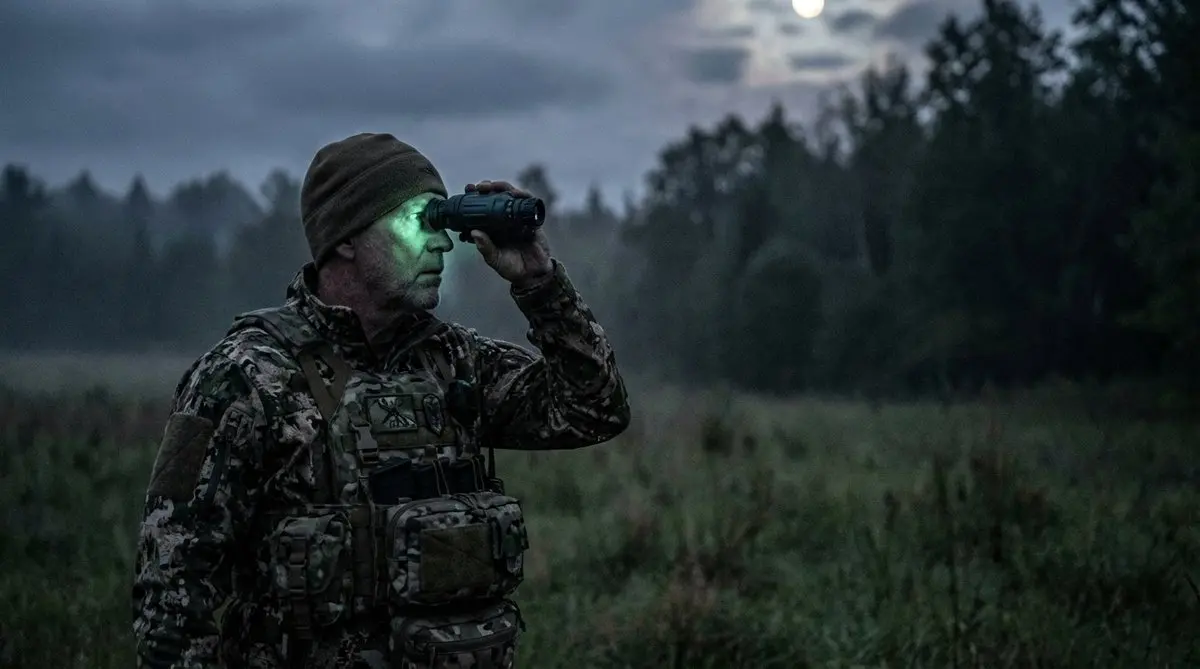
Best Night Vision Monoculars for Hunting in 2026
A night vision monocular does one thing a binocular or a rifle scope can’t: it frees your shooting hand while keeping your non-dominant eye dark-adapted. That single design choice changes how you work at night. Understanding what separates a useful monocular from an expensive paperweight is worth your time before you hand over the money.
If you’re also weighing binoculars against monoculars, our best night vision binoculars guide covers that comparison in depth. And if this is your first NV purchase, start with how to choose your first night vision device before diving into this list.
What makes a hunting monocular different
Observation and identification are the primary jobs of a handheld monocular. You’re glassing fields, scanning treelines, or checking a bait site — tasks that don’t require a magnified reticle but do require fast target acquisition and enough resolution to tell a hog from a coyote at 200 yards.
The key specs to evaluate before anything else:
- Generation: Gen 1 is acceptable for close-range observation. Gen 2+ handles most hunting scenarios. Gen 3 is the benchmark for serious use in low-light. See our Gen 2 vs Gen 3 breakdown if you’re unsure which tier makes sense for your situation.
- Objective lens diameter: Larger lenses gather more ambient light. 50mm–60mm lenses dramatically outperform 26mm units when moonlight is minimal.
- Magnification: 1x is standard for monoculars designed for walking or scanning. Higher magnification narrows field of view and amplifies shake.
- Figure of Merit (FOM): This single number combines resolution and signal-to-noise ratio for image intensifier tubes. Higher is better. Budget units start around 800; serious hunting units run 1,200–1,600+.
- IR illuminator: Built-in IR emitters extend useful range when starlight or moonlight alone isn’t enough. Check beam spread and power before assuming the built-in unit covers your actual use case.
- Size and weight: You’ll carry this for hours. Under 14 oz is manageable. Over 18 oz starts to fatigue an outstretched arm quickly.
Best night vision monoculars for hunting in 2026
AGM Wolf-14 NL2 — Best overall
The Wolf-14 NL2 runs a Gen 2+ image intensifier tube with a 51mm objective lens and a FOM rating that competes with lower-tier Gen 3 units. At 1x magnification with the standard objective, the field of view is wide enough to track a moving animal across a field without losing orientation. The 51mm lens pulls in enough ambient light that you’ll run the built-in IR illuminator primarily on pitch-black nights rather than relying on it as a crutch.
Build quality is military-grade. The housing is waterproof and takes contact drops without cracking. Battery life runs approximately 40 hours on a single set of AA batteries, which is a significant operational advantage over units requiring CR123As in cold weather.
The eyecup relief is generous enough for glasses wearers. The controls — power switch and IR toggle — are positioned where gloved hands can work them without looking down. That design discipline matters when you’re watching a tree line and don’t want to break your scan to fiddle with buttons.
Check current pricing at AGM Global Vision
AGM ASP-Micro NL1 — Best compact
The ASP-Micro NL1 weighs under 9 oz and packs into a jacket pocket. It runs a 26mm objective lens — a real tradeoff against larger units — but the Gen 2+ tube compensates with solid low-light performance for its class. This monocular is built for scouting trips where you want NV capability without the weight penalty of a full-size unit.
The short eye relief is the main limitation. Users with glasses need to confirm fit before relying on this as a primary unit. For hunters who carry bare-eyed or use contacts in the field, it disappears into kit and performs reliably across a full season.
The built-in IR illuminator runs at two power settings. The lower setting handles moderate ambient conditions without washing out the image. The high setting extends identification range in total darkness by roughly 50 yards compared to ambient-only mode.
Check current pricing at AGM Global Vision
AGM PVS-14 NL2 — Most versatile
The PVS-14 form factor is a standard for good reason. This unit runs as a handheld monocular, mounts to a head harness for hands-free use, or clips in front of a daytime scope with appropriate adapters. The AGM PVS-14 NL2 carries a Gen 2+ tube with a FOM that edges toward the lower range of Gen 3 performance at a significantly lower price point.
Versatility is the core argument for the PVS-14 form factor. Buying one unit that serves as a monocular, a helmet-mounted NVG, and a weapon-mounted clip-on is more cost-efficient than purchasing separate dedicated devices for each role. See our complete PVS-14 guide for a full breakdown of mounting options and use cases.
The 1x magnification and 40-degree field of view are standard for PVS-14 units. Add a 3x or 5x objective lens adapter if you need more range for glassing — the standard objective lens handles identification at 100–150 yards in good conditions.
Check current pricing at AGM Global Vision
Other options in the market
Pulsar, ATN, and Nightforce all produce monoculars in this category. Pulsar’s Axion and Helion lines have strong reputations for thermal handheld units — not image intensifier NV. ATN’s OTS series runs thermal as well. For analog NV monoculars competing directly with the AGM units above, L3Harris and Elbit produce Gen 3 units at significantly higher price points. Those units perform better in absolute low-light conditions, but the price gap is wide. For most hunting applications, the AGM Gen 2+ units cover the requirement at a realistic budget.
How to evaluate a monocular before buying
Define your primary use case
A monocular used for 50-yard bait site checks needs different specs than one used to scan 400-yard fields for deer movement. The 26mm compact units handle close-range observation reliably. For long-range identification, you need the 51mm+ objective lenses and the best FOM you can afford.
Match your lighting conditions
Hunters in areas with regular moonlight or starlight can run lower-end Gen 2+ tubes effectively. Hunters working dense timber or overcast nights need higher-quality intensifier tubes and IR illuminator range. Be honest about your actual hunting environment before settling on a budget tier.
Consider head-mounting
A monocular worn on a head harness leaves both hands free for navigating terrain, calling, or handling a firearm. Most hunting monoculars accept standard J-arm mounts. If hands-free use is important to you, verify the monocular you’re evaluating has a standard mount interface before purchasing.
Think about battery logistics
Units running AA or AAA batteries are operationally simpler than those requiring CR123A cells. AA batteries are available at any gas station. CR123As require planning or a resupply kit. In cold weather, battery capacity drops — plan accordingly with either chemistry.
Maintenance basics
Keep lens caps on when not in use. Image intensifier tubes degrade from exposure to bright light sources — never point a powered monocular at direct sunlight or vehicle headlights. Store in a dry environment; silica gel packs in your case help in humid climates. Clean objective and ocular lenses with lens-safe cloths only. Avoid aerosol cleaners near the housing seals.
What you’ll actually use it for
Talk to hunters who run monoculars regularly and the pattern is consistent: they use them more than they expected. Checking a field before entering. Scanning a shooting lane before settling in. Navigating back to the truck after a late retrieve. The monocular gets carried every time because its size doesn’t punish you for having it available. The larger the unit, the less often it actually leaves the truck.
That calculus matters when you’re deciding between a full-size unit and a compact. A compact monocular in your pocket is worth more in practice than a full-size unit that stays in the bag because you didn’t want to carry it.
Bottom line
For most hunters buying their first NV monocular in 2026, the AGM Wolf-14 NL2 covers the requirement with margin. It’s not the cheapest option and it’s not the most expensive — it sits in the tier where performance is genuinely useful and the price doesn’t require a long justification. If budget is tight, the ASP-Micro NL1 works for close-range use. If versatility across multiple roles matters, the PVS-14 form factor justifies the investment by serving three functions in one package.
Whatever you buy, use it before the season. Running a new NV monocular for the first time in a hunting situation — when you’re tired, cold, and need information quickly — is not the time to learn its controls.

Can You Use a Thermal Scope During the Day? Daylight Use/Sun Safety and Zeroing Tips.

Night Vision Range Explained: Detection, Recognition, Identification, and Real Hunting Distance

How to Set Up an IR Illuminator for Night Vision: Placement, Beam Width, and Field Mistakes