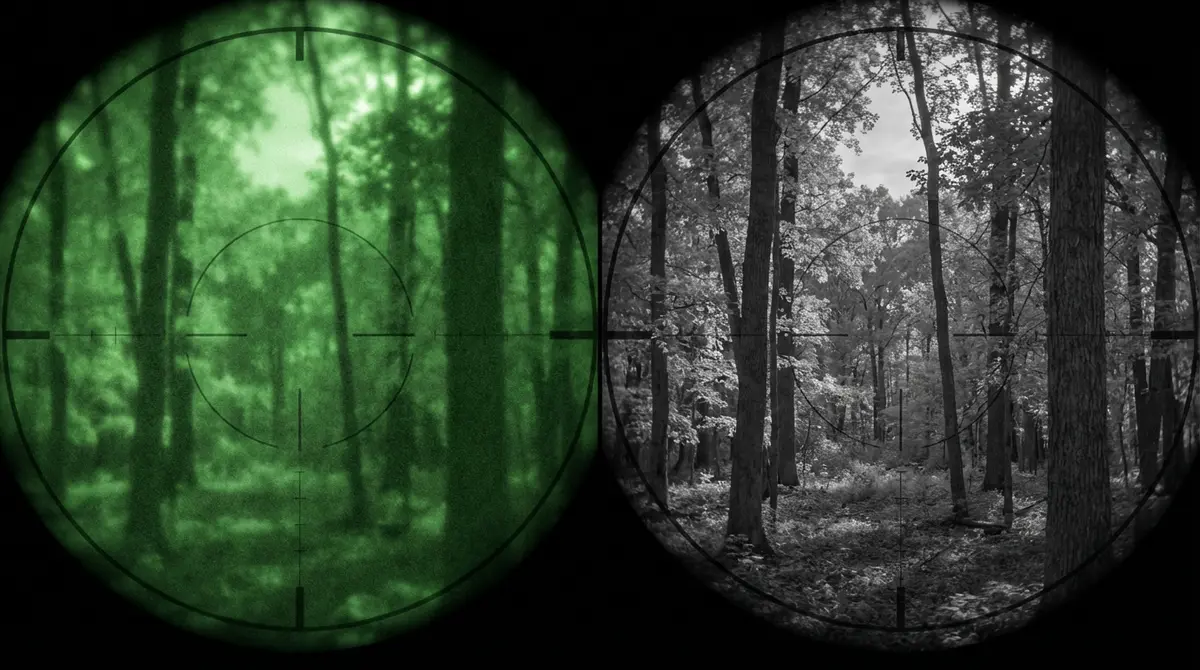
Gen 2+ vs Gen 3 Night Vision: Which Should You Buy in 2026?
The technology difference between Gen 2+ and Gen 3 is real. If you want the full technical breakdown — photocathode types, microchannel plate specs, signal-to-noise ratios — that’s covered in our Gen 2 vs Gen 3 technology guide. Read that if you want to understand how the tubes work.
This page is about the buying decision. Which one do you actually need, what do specific options cost, and is the Gen 3 premium justified for your situation.
The price gap, stated plainly
Gen 2+ monoculars and PVS-14 style devices run $1,200–1,800 new. Gen 3 PVS-14 builds from reputable tube suppliers run $2,800–4,000 new, depending on tube grade and build quality. That’s a $1,500–2,000 difference for a single device.
On a dual-tube setup (binocular/goggles), the gap doubles. Gen 2+ binoculars are $2,500–3,500. Gen 3 dual-tube rigs start at $5,500 and go to $9,000+.
That’s not a marginal difference. It’s a fundamentally different budget conversation. And the answer to whether it’s worth it depends entirely on how and where you use night vision.
Spec comparison at a glance
| Specification | Gen 2+ | Gen 3 |
|---|---|---|
| Photocathode | Multialkali | Gallium arsenide (GaAs) |
| Photocathode sensitivity | ~400–600 µA/lm | ~1,200–1,800 µA/lm |
| Signal-to-noise ratio (typical) | 17–22 | 23–30+ |
| Tube life | ~5,000 hours | ~10,000–15,000 hours |
| Passive performance (no IR) | Quarter-moon minimum for hunting | Works in overcast / near-zero ambient |
| New price range (monocular) | $1,200–1,800 | $2,800–4,200 |
| ITAR restrictions | Not subject to ITAR (non-US tubes) | ITAR-controlled (US Gen 3 tubes) |
What Gen 2+ gets you: the AGM Wolf-14 NL1
The AGM Wolf-14 NL1 is the clearest example of what Gen 2+ delivers at the top of its category. It uses a Gen 2+ image intensifier tube, available in green or white phosphor, runs on a single AA battery for 40+ hours, and costs around $1,400–1,600 depending on configuration.
In the field, it performs well under moonlit conditions. Half-moon or better, clear sky, open country — the Wolf-14 gives you a clean image at 200 yards without any IR illuminator. Animals are identifiable. Shooting with a compatible scope is straightforward.
Where it shows limitations: overcast nights, new moon, dense timber. In these conditions the tube struggles passively and you need an IR illuminator to push performance. With a quality IR — Surefire Vampire, MAWL, or similar — Gen 2+ performance in low ambient light is significantly better. That’s an additional $200–600 depending on what you choose.
White phosphor on the Wolf-14 is worth the slight price premium if it’s available. The grayscale image is easier to read for most hunters, and edge definition on animals is marginally better than green phosphor in mixed terrain. Not a dramatic difference — but if you’re already spending $1,500, the extra $100–150 is worth it.
Who should buy the Wolf-14 NL1 or equivalent Gen 2+:
- Your first night vision device and you want to learn the platform before committing to Gen 3 prices
- You hunt primarily under moonlight in open terrain
- You run an IR illuminator as standard equipment anyway
- Budget ceiling is around $1,500–1,800 all-in for the device
- You’re adding a handheld observation device to a thermal rifle scope setup
What Gen 3 gets you: PVS-14 builds
A Gen 3 PVS-14 uses a gallium arsenide photocathode that pulls light more efficiently from the environment. The practical result: it works passively — without any IR illuminator — in conditions where Gen 2+ requires one. Overcast sky with no moon. Dense timber. Pre-dawn darkness in the trees.
The tube life is also meaningfully longer: 10,000–15,000 hours versus about 5,000 for Gen 2+. For most recreational hunters this is a secondary consideration — you’re not burning 500 hours a year — but it matters for resale value and long-term ownership cost.
Reputable Gen 3 PVS-14 builds come from a short list of tube manufacturers: L3Harris, Elbit, and a few others. The devices themselves are assembled by various companies using these tubes. What varies is tube grade — SNR (signal-to-noise ratio) and FOM (figure of merit) scores determine actual performance. Don’t buy Gen 3 without knowing the tube specs. SNR above 25 and FOM above 1,800 are the floor for serious use.
New Gen 3 from reputable builders: $2,800–4,000. Used Gen 3 with documented tube specs: $2,200–3,000. The used market is legitimate for Gen 3 — military surplus and LEO trade-ins are common, tube hours are often moderate, and the price-to-performance is better than buying new Gen 2+.
Who should buy Gen 3:
- You regularly hunt in low-ambient-light conditions — overcast nights, new moon, heavy timber
- You want passive operation without an IR illuminator (no IR signature)
- This is a long-term investment and you won’t buy again for 10+ years
- You’re building a full system — helmet mount, dual tubes eventually, NVG-compatible optics
- You’ve already owned Gen 2+ and know exactly what you want out of the upgrade
Decision tree: which generation fits your situation
Primarily hunts hog feeders in South Texas brush country: Get thermal. Neither Gen 2+ nor Gen 3 traditional NV competes with thermal for detecting animals through dense vegetation. The Gen 2+ vs Gen 3 question is almost secondary to the NV vs thermal question in heavy brush.
Hunts open land under consistent moonlight, calls coyotes: Gen 2+ handles this well. The Wolf-14 NL1 or comparable Gen 2+ unit with white phosphor is capable at the distances and conditions you’re dealing with. Save the $1,500 difference for a suppressor or a thermal monocular for spotting.
Wants one device that works in every condition, all year: Gen 3. The low-light performance gap is real and it shows up exactly when you need it most — the overcast October hunt when the moon is down at 3 AM.
Is new to night vision and unsure how much they’ll use it: Start with Gen 2+. The AGM Wolf-14 NL1 at $1,400 is a legitimate tool, not a consolation prize. You’ll learn what you actually need from a night vision device. If you outgrow it in two years, Gen 2+ holds reasonable resale value and the upgrade path to Gen 3 is clear.
Wants dual tubes (binoculars/goggles): Budget Gen 3. The depth perception and situational awareness of binocular night vision is transformative for navigation, and at that investment level, Gen 3 tube life and performance is worth the premium. Gen 2+ binoculars exist, but the price difference at dual-tube level makes Gen 3 the better long-term decision.
The used Gen 3 option
Worth its own section because it changes the math significantly. Used Gen 3 PVS-14 devices with documented tube specs — mid-grade L3Harris or Elbit tubes, green or white phosphor — are available in the $2,200–2,800 range from reputable dealers and forums.
A used Gen 3 with 3,000–4,000 hours still has 6,000–11,000 hours of tube life remaining. For a hunter putting in 50–100 hours a year, that’s decades of use. The image quality is indistinguishable from new at mid-grade specs.
What to check when buying used: ask for the spec sheet showing SNR and FOM. Inspect the tube for blemishes — cosmetic blemishes affect viewing quality; look through the device in a dim room before buying. Verify the auto-gating function works — gates should respond quickly when you point the device at a bright light and away from it.
At $2,200–2,600 for used Gen 3 versus $1,400–1,600 for new Gen 2+, the difference is $800–1,000. For the majority of hunters, that’s the real question — is Gen 3 performance worth $800–1,000 more than Gen 2+ performance? In low-light conditions, the answer is yes. In good-light conditions, no.
Tube grade benchmarks for used Gen 3
When shopping used Gen 3, these are the minimum numbers worth considering:
| Tube grade | Minimum FOM | Minimum SNR | Typical used price | Good for |
|---|---|---|---|---|
| Grade B | 1,000–1,400 | 20–23 | $1,500–1,900 | Navigation, observation in decent light |
| Grade A | 1,400–1,800 | 23–26 | $2,000–2,600 | Hunting, security, all-condition use |
| Premium / near-Mil | 1,800–2,100+ | 26–30 | $2,700–3,400 | Heavy cover, near-zero ambient, demanding use |
Grade B is not a bad tube — it’s a tube that missed military acceptance for reasons that often don’t matter in recreational use. Minor cosmetic blemishes in the corner of the image are common. But if your primary use is hunting in genuinely dark conditions, Grade B tubes will disappoint. Spend the extra money for Grade A.
Accessories: budget these separately
The tube is the main cost but not the only one. Factor in:
- Mount (helmet or weapon): $100–350 depending on quality and configuration
- IR illuminator: $200–600 for a quality unit. Gen 3 needs it less, but even Gen 3 benefits from active IR in pitch-dark conditions
- Sacrificial lens cover: $30–50. Protects the objective lens from scratches and mud. Buy two
- Batteries: CR123A for most PVS-14 style devices. Stock up, especially if hunting in cold weather where battery life drops by 30–40%
Budget 20–25% above the device price for a functional setup. A $1,500 Gen 2+ device realistically costs $1,800–1,900 to run in the field. A $3,000 Gen 3 device is $3,600–3,750 fully equipped.
ITAR and legal considerations
U.S.-made Gen 3 image intensifier tubes are controlled under the International Traffic in Arms Regulations (ITAR). This means:
- Domestic ownership is fully legal for U.S. citizens
- You cannot take a Gen 3 device out of the country without an export license — this includes Canada and Mexico
- Gen 2+ and Photonis tubes are typically not ITAR-controlled, making them practical for international travel
- Selling a Gen 3 device to a non-U.S. person is illegal without proper authorization
This matters more than most buyers realize. If you travel internationally for hunting or work, a Photonis-based device or a Gen 2+ device is the practical choice. If you stay domestic, ITAR doesn’t change your day-to-day use at all.
Brand and build quality notes
The tube quality matters more than the housing brand for night vision performance. L3Harris and Elbit are the two most common Gen 3 tube manufacturers available to civilian buyers, and both produce reliable mid- and high-grade tubes.
For Gen 2+, AGM builds consistent quality at competitive prices. The Wolf-14 line has a strong reputation for matching spec sheet performance in real-world use — the tube specs you see in the product listing generally hold up.
Avoid unbranded or suspiciously cheap Gen 3 claims. If a device claims Gen 3 performance at Gen 2+ prices, it’s either misrepresenting the tube generation or it’s a low-grade tube that won’t perform. Ask for documentation.
For a full breakdown of brands and where they fit in the market, the night vision brands guide covers the major players and what each specializes in. If you’re building a full night vision kit, start with our NVG buyers guide for the full category overview.
The bottom line
Gen 2+ is a capable tool at a real price point. The AGM Wolf-14 NL1 at $1,400 gets most recreational hunters where they need to be, especially under decent ambient light conditions. If you’re starting out or hunting primarily in good-light conditions, it’s a legitimate buy — not a compromise.
Gen 3 is better in every measurable way, and the low-light performance gap is significant in the conditions where it matters. If you hunt year-round, in variable conditions, and you want a device that performs consistently regardless of moon phase or cloud cover, Gen 3 is the right investment. The used market makes it more accessible than new prices suggest.
The worst outcome is buying Gen 2+ because you think that’s all you can afford, then spending $3,500 on Gen 3 two years later because you’re frustrated with Gen 2+ limitations. If Gen 3 is in your five-year plan, the math usually favors buying it once at a stretched budget rather than buying Gen 2+ twice.
Related reading:
- Gen 2 vs Gen 3 Night Vision: Technology Guide (nvguideusa.com)
- Night Vision Goggles Buyers Guide 2026
- Night Vision Brands Guide 2026
- PVS-14 Night Vision: The Complete Civilian Guide
- Best NVGs Under $3,000: Budget PVS-14 Builds
For application-specific advice on using Gen 2 or Gen 3 in the field, the NV hunting guide covers which generation works best for different game and terrain.
Can You Use a Thermal Scope During the Day? Daylight Use/Sun Safety and Zeroing Tips.
Night Vision Range Explained: Detection, Recognition, Identification, and Real Hunting Distance
How to Set Up an IR Illuminator for Night Vision: Placement, Beam Width, and Field Mistakes