Best Night Vision Rifle Scopes Under $1,500 in 2026
The $1,500 ceiling on night vision rifle scopes used to mean settling for Gen 1 image quality, short battery life, and limited detection range. Thats changed. In 2026, the price-to-performance ratio at this tier has shifted enough that a buyer with realistic expectations can get a capable setup for predator and hog hunting without the $3,000+ price tag.
The key word is “realistic.” Under $1,500 means accepting tradeoffs. Understanding exactly where those tradeoffs land — and whether they matter for your specific use case — is what this guide covers.
The landscape at this price point
Night vision rifle scopes under $1,500 fall into roughly three categories:
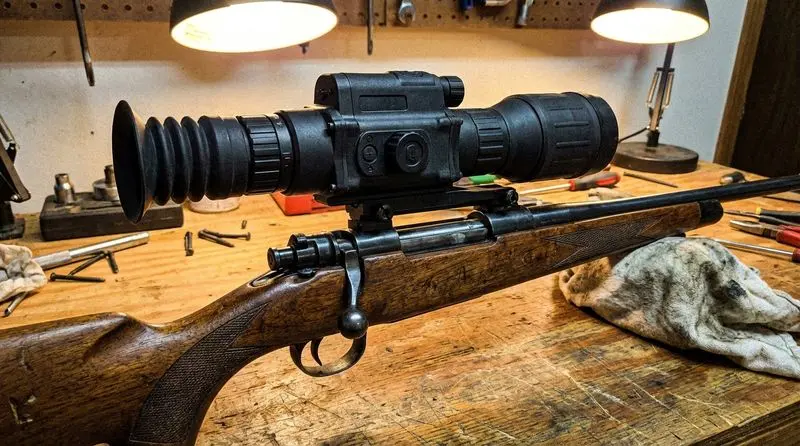
Digital night vision with integrated IR: These use a CMOS or CCD sensor paired with a built-in infrared illuminator. The better units produce 1080p or 4K recorded video and workable hunting image quality out to 150-200 yards.
Gen 1+ tube-based scopes: Older generation image intensifier technology. Detection range is limited, images are grainy in low light, halo effects around light sources are significant. Digital alternatives have surpassed them at this price point in 2026.
Hybrid systems: An NV monocular ahead of an existing scope. Similar to thermal clip-ons but using image intensification instead of thermal sensing. Best suited to buyers who already own a quality scope.
For most buyers, digital night vision is the right category.
What the specs actually mean
Sensor resolution: 1080p vs 4K matters primarily for recorded video quality, not real-time viewing. The eyepiece resolution is often the limiting factor. Dont buy purely on sensor spec — find sample video footage at night to gauge actual image quality.
IR illuminator range: Manufacturers publish maximum range figures under ideal conditions. Real hunting conditions — dense vegetation, humid air, scattered foliage — cut that range significantly. A scope rated to 300m IR range might deliver reliable identification to 150m in a wooded environment. Budget for that gap.
Detection vs. recognition vs. identification range: Detection range (something is there) is always much longer than identification range (I know what that is). For hunting, identification range is the number that actually matters.
Battery life: Digital NV scopes pull more power than analog alternatives. Real-world battery life at full IR power often runs 4-6 hours. For an all-night hog hunt, carry spares or plan for a recharge.
Recoil resistance: Not all digital NV scopes handle recoil equally. Check the caliber rating carefully, especially if youre running anything above .308.
Top picks under $1,500
ATN X-Sight 4K Pro — Best all-around digital NV scope
The ATN X-Sight 4K Pro has been on the market long enough to have a known track record. Early reviews were mixed due to software instability; updated firmware has addressed most of the serious issues, though ATNs reputation for software quirks hasnt entirely disappeared.
What you get: 4K sensor, integrated ballistic calculator, Bluetooth connectivity, video recording, and recoil-activated video to capture shots youd otherwise miss. At full IR power, practical identification range in clear conditions runs to around 150-200 yards — adequate for most hog and coyote applications.
The ballistic calculator is legitimately useful once youve programmed your load data. For the comparison between digital NV and Gen 2/3 tube performance, the Gen 2 vs Gen 3 breakdown covers where digital NV fits in the larger picture.
The limitation everyone knows: ATN X-Sight scopes run warm and occasionally restart in field conditions. Always bring a phone for backup and dont rely solely on app connectivity during critical moments. When running normally, the image quality is good. When it isnt, the experience is frustrating.
AGM Clarion 4K — Reliable alternative with cleaner software
The AGM Clarion 4K entered the market as a more stable alternative to the ATN lineup. Software is less feature-rich but also less prone to the bugs that have followed ATN through multiple firmware revisions. The tradeoff is losing the ballistic calculator and connectivity features — for hunters who just want a scope that works without troubleshooting, thats an acceptable trade.
Image quality is comparable to the X-Sight 4K in most field conditions. Battery life runs slightly longer due to lower processing overhead. If youve had negative experiences with ATNs software reliability, the Clarion is worth considering.
AGM Rattler V2 — Best for hog hunting specifically
The AGM Rattler V2 is a dedicated thermal scope rather than image-intensification NV, and it sits right at the $1,500 ceiling for some configurations. Worth including here because buyers comparing NV vs thermal need to understand what the thermal option looks like at this price.
The Rattler V2 runs a 384×288 sensor with 12 micron pitch. Detection range is substantially better than digital NV at equivalent price points. Identification range at realistic hunting distances is adequate for hog and deer.
The limitation thermal always carries: warm-weather performance depends on temperature differential. On a 90°F Texas night, a hogs thermal signature is less distinct. On a 40°F night, its obvious. Know your typical hunting conditions before deciding.
Budget option: Sightmark Wraith 4K Max
The Sightmark Wraith 4K Max sits below $600 and undercuts the competition significantly. The image quality reflects the price — noisy in low light, limited resolution at the eyepiece level. But for close-range hog work over bait inside 100 yards, it functions adequately.
The mount system is solid, recoil handling is good through at least .300 Win Mag, and the included IR illuminator covers the distances where the image is useful. A reasonable entry point before committing to a $1,000+ scope.
Dont expect to identify coyotes at 200 yards. Expect to see large animals clearly inside 100 yards and detect them to maybe 150. Thats the honest performance window.
Digital NV vs thermal at this price range
Digital NV advantages: Color imaging with integrated illuminator, better video recording quality, more useful in warm weather where thermal contrast is low, more natural visual representation for hunters new to NV.
Thermal advantages: Detects animals in total darkness without relying on an illuminator beam, works better in rain and fog, detection range is longer at equivalent price points, no IR beam that could alert animals.
For mixed-use hunting across seasons and conditions, thermal gives more consistent performance. For hunters running feeders or bait stations at known distances, digital NV at this price range is capable and costs less.
Mounting considerations
Night vision rifle scopes need solid mounts. Repeated recoil accelerates mount failure faster than with daytime scopes. Check that your Picatinny rails match the scopes mount (Weaver rails have different cross-slot dimensions), verify ring height clears the barrel, and follow manufacturer torque specs on ring screws — over-torquing damages scope tubes, under-torquing allows movement under recoil.
The night vision zeroing guide covers scope-specific zeroing for NV setups, worth reading before your first night hunt.
What to realistically expect
Under $1,500, youre buying a capable hunting tool with known limitations:
- Reliable identification range: 100-200 yards in clear conditions
- Detection range: 300-400 yards for large animals
- Battery life: 4-6 hours at full IR — plan for resupply on all-night hunts
- Software/reliability: variable — read current owner reviews, not just professional tests
The buyers who report the most satisfaction with sub-$1,500 NV scopes are the ones who understood what they were buying before they bought it. The gear works. The question is whether it matches your specific hunting scenario — and if you read this far, youre positioned to answer that honestly.

Can You Use a Thermal Scope During the Day? Daylight Use/Sun Safety and Zeroing Tips.

Night Vision Range Explained: Detection, Recognition, Identification, and Real Hunting Distance

How to Set Up an IR Illuminator for Night Vision: Placement, Beam Width, and Field Mistakes