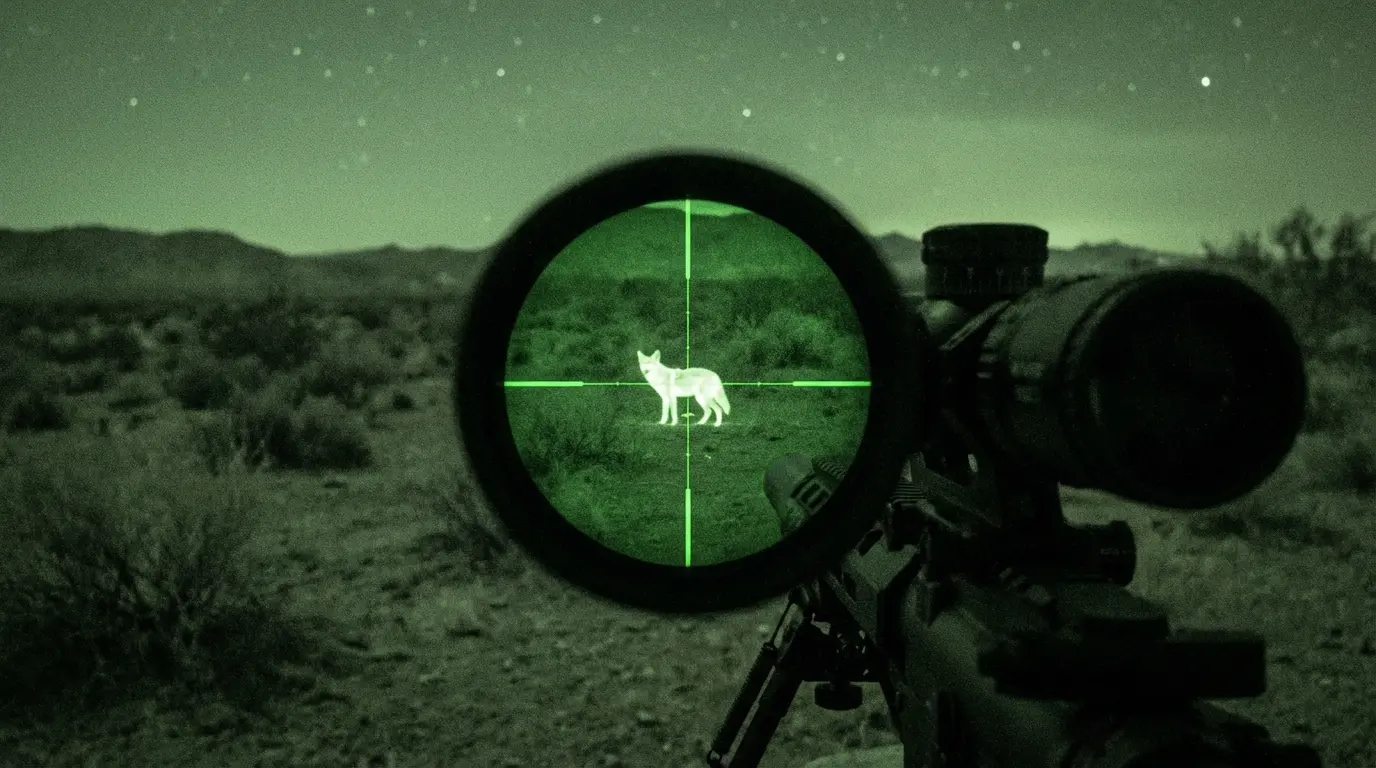
Best Night Vision Scope for Coyote Hunting 2026
Coyote hunting after dark is a different game than deer season. You are calling predators to you, often in open terrain, waiting for a silhouette to materialize at the edge of your IR illuminator. The wrong scope turns that into a frustrating exercise. The right one makes 200-yard shots routine.
This guide covers the top night vision scope options for coyote hunting in 2026 — evaluated on detection range, image clarity in real field conditions, and how each performs when a coyote hangs up at 150 yards and gives you three seconds to decide.
If you’re deciding between thermal and digital night vision for predator work, the framing matters. Coyotes are lean, their heat signature is thinner than a hog’s, and they move fast. That changes the calculus on sensor selection. We break that down in detail in our thermal vs. digital night vision guide for coyote hunters.
—
What Coyote Hunters Actually Need from a Night Vision Scope
Before looking at hardware, understand the use case. Coyote hunting typically involves:
- Calling sequences: You are stationary, calling in an animal that may approach from 400 yards or 40. The scope needs fast target acquisition.
- Open terrain to moderate cover: Plains, agricultural edges, river bottoms. Detection range matters more than in tight timber.
- Shot distances: 50–250 yards is typical. Anything over 300 yards at night requires a serious thermal setup.
- Low ambient light: New moon hunts are common. Your scope must perform without relying on ambient starlight.
Gen 3 image intensifier scopes remain viable for close-range work and have better natural color rendering in low light, but thermal has taken over serious predator hunting for a reason: coyotes glow. Heat signature cuts through heavy brush, fog, and flat terrain in a way that analog tubes simply cannot replicate.
The core question is budget. Under $1,500, digital NV with a good IR illuminator is the practical choice. Above $2,000, thermal becomes accessible with dedicated coyote-hunting performance. Above $3,500, you get fusion or long-range thermal capable of 400-yard identification.
—
Top Night Vision Scopes for Coyote Hunting in 2026
1. AGM Rattler V2 TS35-384 — Best Overall Thermal for Predator Hunting
The AGM Rattler V2 is the scope that changed how mid-range thermal hunting works. A 384×288 sensor at 35mm focal length gives you a balance of detection range and field of view that suits coyote calling perfectly. At 150 yards, animal body heat shows as a clear, defined target — not a blob.
The 50 Hz refresh rate is the reason hunters prefer it over cheaper options with 25 Hz. When a coyote cuts across an opening at a trot, 25 Hz introduces stutter. The Rattler V2 tracks movement cleanly.
Specs:
– Sensor: 384×288, 12 µm
– Refresh rate: 50 Hz
– Focal length: 35mm (also available: 25mm, 50mm)
– Detection range: up to 1,350m (vehicle class)
– Weight: 680g with battery
Field performance: Multiple r/nightvision users have confirmed deer and coyote identification out to 250+ yards with the TS35. The digital zoom is usable to 4× before image quality degrades meaningfully.
Verdict: If you hunt primarily open terrain in the 50–250 yard band, the Rattler V2 TS35 is the most cost-effective dedicated thermal coyote scope on the market. AGM’s direct pricing keeps it below competitors with similar sensor specs.
—
2. Pulsar Thermion XQ38 — Best Mid-Range Performance
The Thermion XQ38 is Pulsar’s core product for hunters who want plug-and-play reliability without chasing the absolute top of the spec sheet. Installed directly on a rifle like a conventional scope, it runs off two CR123A batteries with a second internal battery as backup.
Where the Thermion XQ38 earns its place is image processing. Pulsar’s algorithms handle edge definition better than most 384-sensor scopes at this price. Coyote outlines at 180–200 yards are clean — you can read body position and determine shot placement without guessing.
Specs:
– Sensor: 384×288, 17 µm
– Refresh rate: 50 Hz
– Focal length: 38mm
– Magnification: 2.5–10×
– Battery life: 4.5 hours (internal + CR123A)
Field performance: The XQ38 has a strong track record in hog and coyote applications. It handles temperature inversions — common in early morning winter hunts — better than lower-cost options. See our full thermal scope comparison for hogs in our thermal vs night vision for hog hunting guide.
Verdict: At its street price, the Thermion XQ38 competes directly with the Rattler V2. Pulsar’s build quality and customer support give it an edge for hunters who put serious hours on their equipment. The slight edge in image processing is worth the premium for calling-intensive hunts.
—
3. ATN Thor 4 384 — Best for Video Recording and Connectivity
The ATN Thor 4 is the choice if you hunt with a partner watching on a tablet or run a YouTube channel. It records 4K video internally and streams via Wi-Fi to a paired device, all while running as a functional thermal rifle scope.
For pure hunting performance, the Thor 4’s ballistic calculator and one-shot zero are genuinely useful features rather than marketing gimmicks. The built-in laser rangefinder version eliminates hold-over guesswork on marginal shots.
Specs:
– Sensor: 384×288
– Video: 4K internal recording
– Connectivity: Wi-Fi, Bluetooth
– Built-in rangefinder: available in LRF version
– Battery life: 10+ hours (internal, plus AA backup)
Limitations: The ATN platform runs Android-based software. Early units had reliability issues that ATN has largely addressed with firmware updates, but the processing-heavy features occasionally cause lag. Pure hunting performance is slightly behind Pulsar and AGM at equivalent sensor resolution.
Verdict: If you need the recording and connectivity, ATN Thor 4 is the best-built option in that category. If you just want to kill coyotes, there are simpler and more reliable choices.
—
4. ATN X-Sight 4K Pro — Best Digital Night Vision Option Under $700
Not everyone needs thermal. For hunters in humid, warmer climates where thermal performance is reduced, or those hunting with a budget ceiling around $700, the ATN X-Sight 4K Pro with a dedicated IR illuminator is a legitimate coyote hunting setup.
The X-Sight 4K records in 4K, has ATN’s smart ballistic calculator, and recoil-activates recording automatically. Paired with a 940nm IR illuminator at 50–100 yards in open fields, coyotes show up clearly. At 200+ yards, you need a powerful IR lamp or the image degrades.
Critical limitation: Digital night vision, including the X-Sight 4K, does not provide passive thermal detection. You are limited by your IR illuminator’s range. Coyotes can potentially see 850nm IR illuminators. Stick to 940nm.
For those on the fence between digital and thermal, our Gen 2 vs Gen 3 night vision comparison covers how image intensifier technology stacks up against digital alternatives.
Verdict: The X-Sight 4K Pro is the gateway scope for hunters who want night vision capability without the thermal price tag. Real-world performance is adequate for close-to-medium range calling setups.
—
Thermal vs. Digital for Coyote Hunting: The Honest Breakdown
| Factor | Thermal | Digital NV |
| Detection range | 300–800m | 100–200m (IR-dependent) |
| Performance in fog/rain | Moderate | Poor |
| Coyote visibility through brush | High | Low |
| Price floor (usable quality) | ~$1,400 | ~$400 |
| Requires IR illuminator | No | Yes |
| Passive hunting (no light emitted) | Yes | No |
For serious predator hunters running multiple nights per season, thermal pays for itself in effective hunting time. Thermal lets you hunt fields and draws without illuminating your position. Digital NV forces you to commit to an IR cone that animals may detect.
—
Magnification: What Range Do You Actually Need?
Coyote hunting is not long-range precision shooting in most contexts. The animal is moving, often trotting or loping, and your window is tight. These magnification ranges cover 95% of real-world calling situations:
- 2–6×: Works for most open field calling within 200 yards
- 4–8×: Better for agricultural fields and terrain with 250+ yard openings
- 8×+: Only justified if you regularly set up for 300+ yard shots
The trap hunters fall into is over-magnifying at night. Higher magnification narrows field of view, makes target acquisition slower, and amplifies scope shake. A 3× thermal view covering a wide field of view is more useful than a 10× view when a coyote breaks from cover 60 yards away.
—
Battery Life in Cold Weather
Coyote hunters work in January at 15 degrees. Battery performance in thermal scopes drops significantly in cold. Real-world expectations:
- AGM Rattler V2: rated 5 hours, expect 3–3.5 hours at 15°F
- Pulsar Thermion XQ38: rated 4.5 hours combined, performs closer to spec in cold due to internal battery
- ATN Thor 4: rated 10+ hours, cold reduces to 6–7 hours typically
Carry spare batteries. CR123A cells in a chest pocket maintain charge better than batteries stored in a pack.
—
Recoil Tolerance: Which Scopes Survive Hard-Recoiling Rifles
Predator hunters often run .22-250, .243, and .308. Some run .223 on coyotes for lower pelt damage. All AGM and Pulsar thermal scopes are rated for .308 recoil and have proven track records on hard-recoiling calibers.
ATN’s scopes have an auto-recoil video activation feature that tells you they’re built for recoil, and field reports confirm they hold zero adequately on standard hunting calibers.
Avoid running any thermal scope on calibers over .308 without checking manufacturer specifications. Magnum rifle recoil has destroyed thermal units.
—
Our Recommendation
For most coyote hunters: AGM Rattler V2 TS35-384.
It hits the intersection of detection range, image quality, and price that no other scope currently matches. The 50 Hz refresh rate matters when animals are moving. The 35mm focal length covers open terrain calling situations without being overpowered for fields under 300 yards.
Step up to the Pulsar Thermion XQ38 if you want slightly sharper image processing and a conventional scope form factor with better cold-weather battery management.
If budget is the primary constraint, run the ATN X-Sight 4K Pro with a quality 940nm IR illuminator — you will give up range and passive hunting capability but gain a functional night hunting system for $600–700 total.
—
Frequently Asked Questions
What is the effective range of a thermal coyote scope?
A 384-sensor scope like the AGM Rattler V2 TS35 provides reliable animal detection to 300–400 meters in open terrain. Shot-quality identification (body position, shot placement) is realistic to 200–250 meters for most hunters.
Can coyotes detect infrared illuminators?
Coyotes cannot see 940nm IR illuminators. They may potentially detect 850nm illuminators in some conditions. Thermal scopes require no illuminator — they detect heat, not reflected light.
Is a thermal scope worth it for coyote hunting?
If you hunt more than 10–15 nights per season, thermal pays for itself in effectiveness. Detection is passive, range is greater, and you can identify animals through light brush. For occasional hunters, quality digital NV with IR is adequate.
What magnification do I need for coyote hunting at night?
2–6× covers the majority of calling situations. Higher magnification narrows field of view and slows target acquisition. Most experienced predator hunters run thermal at 2.5–4× for calling setups.
Do thermal scopes hold zero on .22-250?
Yes. .22-250 is significantly lighter recoil than .308, and all major thermal scope brands are rated for .308. Zero retention on .22-250 is not an issue with quality thermal scopes.

Can You Use a Thermal Scope During the Day? Daylight Use/Sun Safety and Zeroing Tips.

Night Vision Range Explained: Detection, Recognition, Identification, and Real Hunting Distance

How to Set Up an IR Illuminator for Night Vision: Placement, Beam Width, and Field Mistakes