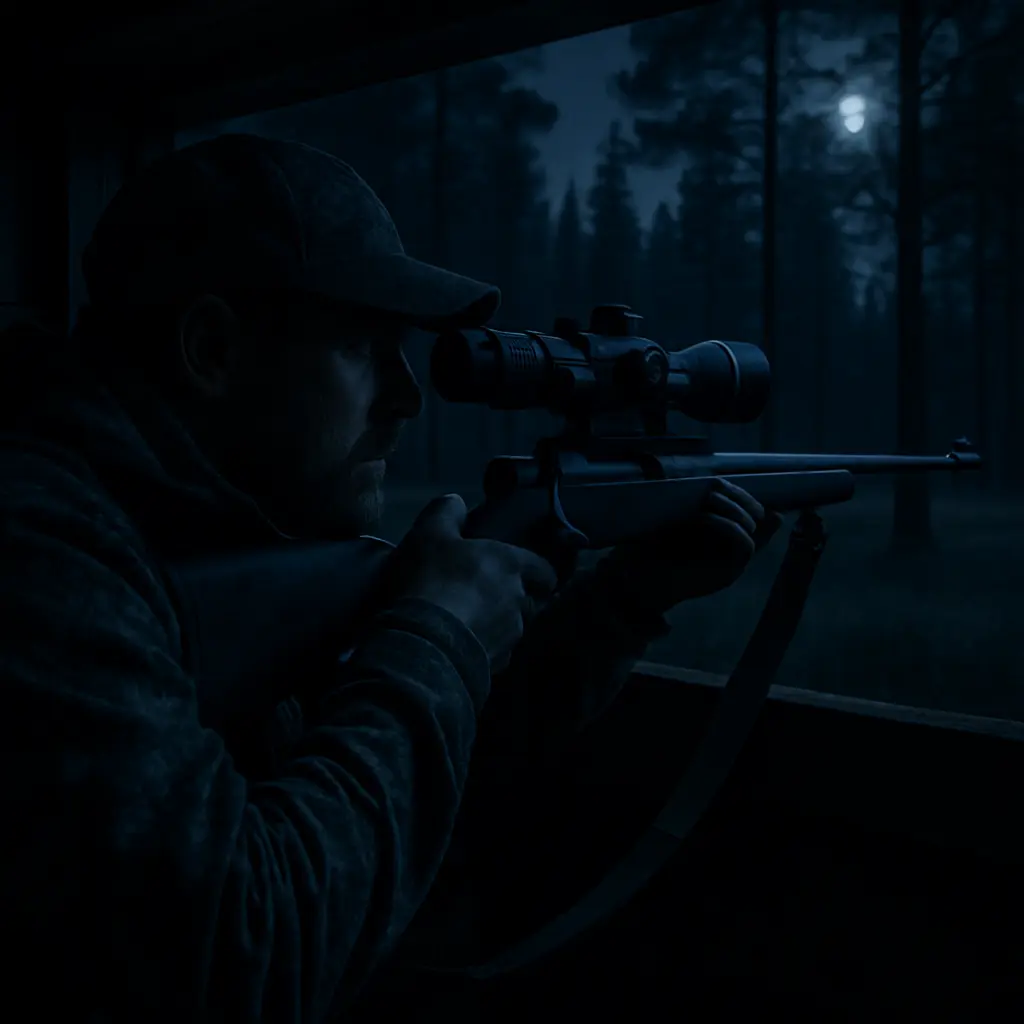
Best Night Vision Scope for Deer Hunting 2026: What Actually Works
Night vision for deer hunting is a narrower category than it sounds. Deer hunting has specific legal, ethical, and practical requirements that separate it from hog hunting or predator control work. The state laws matter — in most states night hunting for deer is either heavily restricted or outright illegal — and the technical requirements are different when you’re judging antler score at distance under low light rather than simply detecting a target.
Before you purchase anything in this category, confirm the regulations in your specific state. Our night vision for deer hunting: thermal vs analog guide covers the legal landscape and the tradeoffs between technology types in detail.
This guide focuses on the specific optics that perform best for legal deer hunting applications: late-season low-light hunting before legal shooting light ends, spotting and scanning deer activity at distance, and identification of target-quality animals under marginal light conditions.
Night Vision for Deer Hunting: What the Regulations Actually Say
Most U.S. states prohibit hunting deer with artificial light, which includes IR illuminators. This effectively bans the use of active night vision (any device requiring an IR illuminator) for taking deer in the majority of jurisdictions. However, passive night vision — devices that amplify available ambient light without projecting any IR — occupies a different legal category in many states.
The practical implication: in states that allow thermal optics for deer (a growing number as thermal prices have dropped), thermal is often the correct choice because it does not require an IR illuminator. In states where low-light hunting with passive NV is permitted before/after shooting hours for scouting rather than taking, a Gen 3 monocular or clip-on serves that role.
Always verify state law before purchasing for this application. The information in this guide covers the optics themselves; legal compliance is your responsibility.
For a complete discussion of how thermal and analog technologies differ for deer specifically, read our thermal vs night vision deer hunting comparison.
What Matters for Deer Hunting Night Vision
Deer hunting presents different technical demands than predator hunting:
Identification capability at range. You need to determine buck vs doe, and in many cases assess antler score, at distances where a thermal or NV scope needs genuine identification capability. Detection range doesn’t matter here — you need to identify. This pushes the requirement toward higher-resolution optics.
No active illumination in most jurisdictions. If your state prohibits artificial light for deer hunting, you need either passive Gen 3 NV that works on ambient starlight/moonlight, or thermal imaging that detects body heat without projecting light.
Reliability in cold weather. Deer hunting in the rut runs through November in most of the country, which means sub-freezing temperatures, battery drain, and optics that need to function correctly in cold. Battery life specifications are almost always measured at room temperature — expect 30–40% reduction in real field conditions at 20°F.
Daytime usability. Many night vision scopes that function well after dark perform poorly as day scopes. Deer hunting often involves transitional light — dawn and dusk — where the scope needs to handle a wide dynamic range without washing out.
Best Night Vision Scopes for Deer Hunting 2026
1. AGM Rattler V2 TS35-384 — Best Thermal for Deer
The AGM Rattler V2 in the 35mm, 384-resolution configuration is the most practical thermal option for deer hunters operating under $1,500. A 384×288 VOx microbolometer with a 35mm germanium lens produces enough resolution to identify a mature buck at 300 yards under average atmospheric conditions.
NETD of <35mK gives it the thermal sensitivity to distinguish a deer from ambient background even in dense brush where the animal’s outline is partially obscured. This matters specifically for deer hunting, where animals move through wooded terrain rather than the open fields common to hog hunting.
The Rattler V2’s 12-micron pixel pitch — compared to the older 17-micron units — produces a visibly sharper image at given ranges. For a deer hunter who needs to identify antler configuration before pulling the trigger, that resolution step-up is material.
Battery life runs approximately 7 hours on the internal rechargeable pack, which covers a full-day hunting session. The unit is fully waterproof and rated to −40°C operational temperature.
Read the complete field analysis in our AGM Rattler V2 review.
Check price at AGM Global Vision
2. AGM Adder V2 LRF 60-1280 — Best Long-Range Deer Thermal
For hunters who glass open fields and need to identify animals at 400+ yards before making a shot decision, the AGM Adder V2 LRF 60-1280 is in a different class. A 1280×1024 microbolometer with a 60mm lens produces identification capability well past the 300-meter range of the Rattler V2.
The integrated laser rangefinder accurate to ±1m matters for deer hunting specifically because holdover at 350+ yards requires precise range data. The combination of long-range thermal detection and accurate ranging in a single package eliminates the need for a separate rangefinder in the field.
The tradeoff is cost and size. This is a serious investment for a dedicated tool. For hunters who have the budget and regularly engage targets past 300 yards in open terrain, the performance justification is straightforward.
Our AGM Adder V2 LRF in-depth review covers field performance in detail.
Check price at AGM Global Vision
3. AGM Spectrum 4K-Mini — Best Digital for Close-Range Deer
In states where digital NV is legal for deer hunting and active illumination is permitted, the AGM Spectrum 4K-Mini provides the best resolution per dollar for close-to-medium range deer work. The 1280×1024 sensor identifies a deer clearly inside 200 yards, which covers most wooded stand situations.
The 940nm IR illuminator option is a significant advantage for deer hunting versus the standard 850nm — the 940nm wavelength is outside the visual spectrum of deer, reducing the likelihood of spooking animals with illuminator glow. On the 850nm setting, deer have shown wariness in response to illuminator lens reflection at close range.
For a complete discussion of this unit’s capabilities see our AGM Spectrum 4K-Mini review.
Check price at AGM Global Vision
4. ATN Mars 4 384 LRF — Best Mid-Range Option
The ATN Mars 4 384 with LRF function sits between the entry-level Rattler and the premium Adder in both performance and price. A 384×288 microbolometer with ATN’s current-generation processing produces a clean image at deer-hunting ranges, and the rangefinder integration enables the ballistic calculator function if you’re using ATN’s software ecosystem.
The Mars 4 has shown more consistent performance than ATN’s earlier thermal products, which had firmware reliability issues. Current production units with updated firmware have addressed the main complaints from early adopters. Battery life runs approximately 10 hours, which is competitive for the class.
Read our complete field test in the ATN Mars 4 review.
Comparison Table
| Scope | Type | Resolution | Identification Range | Battery | Best For |
|---|---|---|---|---|---|
| AGM Rattler V2 35-384 | Thermal | 384×288 | ~300m | 7hr | Budget thermal |
| AGM Adder V2 LRF 60-1280 | Thermal | 1280×1024 | 500m+ | 8hr | Long-range open terrain |
| AGM Spectrum 4K-Mini | Digital | 1280×1024 | ~200m | 6hr | Close-range, 940nm option |
| ATN Mars 4 384 LRF | Thermal | 384×288 | ~280m | 10hr | Mid-range, ATN ecosystem |
Thermal vs. Digital Night Vision for Deer: The Short Answer
For deer hunting, thermal is almost always the better choice:
No IR illuminator required — thermal works without projecting any light, which matters legally in most states and ethically in all of them.
Detection in dense vegetation — thermal picks up body heat through brush that would block reflected IR in a digital system. Deer in wooded terrain present a harder target for active-illumination digital systems.
Cold-weather detection advantage — in November and December when temperatures drop, the temperature differential between a deer’s body (98°F) and ambient air widens, making thermal detection easier, not harder.
Identification at range — quality thermal systems identify deer at longer ranges than equivalent-cost digital systems because the contrast between animal and background is higher.
The main argument for digital over thermal for deer hunting is cost. At the sub-$600 price point, the Sightmark Wraith 4K digital scope outperforms any thermal available at that price. If budget is the primary constraint, digital is a functional option for close-range wooded hunting.
Key Questions Before You Buy
Is night vision legal for deer in your state? Most states prohibit it. Thermal in a passive configuration occupies a different regulatory category in some states — check your specific law.
What range are you shooting? Inside 200 yards in wooded terrain: Rattler V2 is sufficient. Open fields at 300+ yards: Adder V2 LRF is the correct tool.
Do you need a day/night scope or dedicated night optic? If you want one scope for all conditions, digital (ATN X-Sight, Spectrum 4K) handles daylight better. Dedicated thermal scopes are night/low-light tools.
What is the temperature range you’ll be hunting in? Below 20°F, thermal performance improves (higher differential) but battery life decreases. Plan accordingly.
Wrapping Up
Deer hunting with night vision is a narrower, more legally constrained application than hog or coyote hunting. The right scope depends on your state’s laws, your typical engagement range, and whether thermal or digital technology fits your situation.
For the majority of deer hunters in states where thermal is permitted for low-light or all-night use, the AGM Rattler V2 35-384 represents the best entry point: genuine thermal capability at a price that makes sense for a tool used on specific occasions rather than every night of the season. For open-country hunters who routinely identify animals at 300–500 yards, the AGM Adder V2 LRF is the professional option.
If you’re zeroing whichever scope you choose, the night vision scope zeroing guide walks through the full procedure for both thermal and digital systems.

Can You Use a Thermal Scope During the Day? Daylight Use/Sun Safety and Zeroing Tips.

Night Vision Range Explained: Detection, Recognition, Identification, and Real Hunting Distance

How to Set Up an IR Illuminator for Night Vision: Placement, Beam Width, and Field Mistakes