Pulsar Thermion XQ38 Review: The New Mid-Range Masterpiece?
The arrival of the Pulsar Thermion XQ38 2.5-10x Thermal Riflescope was arguably the most anticipated event in the thermal optics world for 2020. Having spent significant time behind the eyepiece, I believe it isn’t just hype—this may well be the best all-around, mid-level thermal riflescope Pulsar has ever produced.
Pulsar has combined a new 384×288 17-micron sensor with a versatile 2.5x base magnification to create an optic that thrives in virtually any terrain. At a price point of around $3,300, the XQ38 offers a feature set that leaves very little to be desired. For a more budget-friendly thermal option, see our AGM Rattler V2 review starting at just $945.
Thanks to Outdoor Legacy Gear, we had the opportunity to run this new unit side-by-side with its predecessor, the now-discontinued Thermion XM38, to see exactly what has changed.
The Evolution: XQ38 vs. XM38
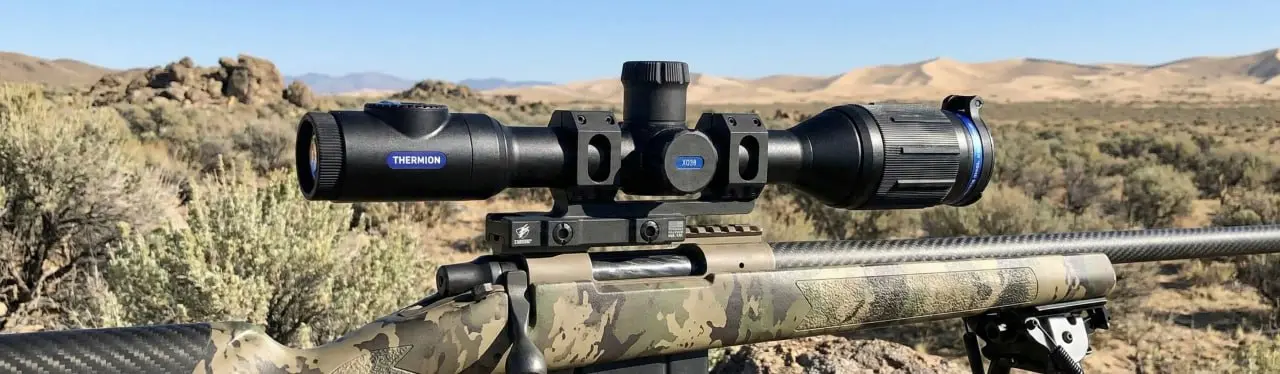
The Thermion XQ38 isn’t just a new model number; it is a total internal reinvention of the XM38. Externally, they look nearly identical—both sport the sleek 30mm tube design, though the XQ38 now shares the same objective bell size as its big brother, the XQ50. But the real story is on the inside.
The “Soda Straw” Problem Solved The primary difference lies in the sensor and magnification. The older XM38 utilized a 320×240 12-micron core with a high 4.0x base magnification. While 4x sounds great for long-range, it created a narrow field of view that made scanning difficult—often referred to as looking through a “soda straw.”
The new XQ38 switches to a 384×288, 17-micron thermal core with a 2.5x base magnification.
- The Result: A massive expansion in your viewing area. The field of view has jumped from a cramped 30 feet (on the XM38) to a sprawling 54 feet at 100 yards. This is nearly double the viewing area, which is a game-changer for scanning fields or tracking moving hogs.
Image Boost and <40mK Sensitivity The new core boasts an NETD rating of <40mK (Milli-Kelvin), enhanced by Pulsar’s “Image Boost Technology.” In layman’s terms, this means the sensor is incredibly sensitive to minute temperature differences. Instead of seeing a thermal “blob” against a washed-out gray background, the XQ38 separates the heat signatures. You can distinguish individual trees, rocks, and bushes. Even on “bad thermal nights”—when high humidity or rain typically washes out the image—this increased sensitivity helps you detect game at longer ranges with surprising clarity. If you’re deciding between thermal and digital night vision, our comparison guide breaks down the key differences.
Features Snapshot
The XQ38 is packed with the digital ecosystem Pulsar is famous for:
- Recording: Internal video (MPEG4) and audio recording with 16GB of internal storage.
- Connectivity: StreamVision app support for smartphone streaming and updates.
- Durability: IPX7 fully waterproof rating and recoil resistance up to .375 H&H and 12-gauge.
- Visuals: Full-color AMOLED display, Picture-in-Picture mode, and multiple color palettes.
- Zoom: 2.5-10x digital magnification (4x zoom range).
Real-World Battery Life Testing
Battery anxiety is real when you are miles from the truck. The Thermion uses a dual-power system: one internal battery (3000 mAh) and one replaceable Pulsar APS2 battery (2000 mAh). When the replaceable battery dies, the scope instantly switches to the internal one without shutting down.
The Bench Test: I turned the unit on at room temperature (approx. 65°F) and let it run continuously. The scope lasted for over 5.5 hours on a single charge of both batteries.
The Hunt Test: On a warm summer night hunt, we were active from 8:00 PM to 11:00 PM. I was recording video frequently, using standby mode during downtime, and powering down during truck rides. The external APS2 battery finally tapped out and switched to the internal battery around 10:30 PM.
Critical Advice: While the battery life is solid, Pulsar only ships the unit with one APS2 battery. You need to buy an extra Pulsar APS3 battery. The APS3 is taller (requires the included extended cap) and holds more charge. Invariably, you will forget to charge the unit, or a hunt will go long. Having that backup battery in your pocket is non-negotiable. For more battery and maintenance tips, see our NVD care guide.
Warning: Some hunters use external power banks connected via USB. Be extremely careful. The Thermion uses a Micro-USB port, which can be fragile. Walking through the woods with a cable hanging out of your scope is a recipe for snapping the connector. If you break that port, you cannot charge the internal battery.
Ergonomics and Controls
Pulsar has arguably the best user interface on the thermal market. If you are transitioning from a traditional glass scope, the layout will feel familiar.
The Triangle Grid: The buttons for Power, Recording, and Magnification are located on top of the eyepiece in a small triangle formation. This geometry makes them easy to identify by touch in total darkness. You don’t need to be a trumpet player to operate them; they are distinct and responsive.
The Controller Knob: On the left side of the turret housing sits the controller knob. This handles all deep menu functions (brightness, contrast, profiles). It is far superior to button-mashing through menus. A simple turn and click gets you where you need to be.
Focus Ring: The objective focus is a wide, rubber-coated ring at the front. It is easy to grip with your non-shooting hand, though I found it a bit stiff to turn. However, the flip-up lens cover is high quality and does a great job protecting the glass.
Visual Experience: Palettes and Reticles
The XQ38 carries over the robust customization options from previous years.
- Color Palettes: You have the standard White Hot and Black Hot, plus Red Monochrome, Rainbow, Ultramarine, Violet, and Sepia. I found myself using Sepia frequently—it is very easy on the eyes during long scanning sessions while still making heat signatures pop.
- Smart Reticles: The scope includes scalable reticles (like First Focal Plane scopes). As you zoom, the reticle scales with the image, ensuring your holdovers remain accurate at any magnification power.
Field Performance: The “Sweet Spot”
After testing, it is clear that Pulsar listened to hunters. The 2.5x base magnification is the “Goldilocks” zone—not too zoomed in, not too wide.
The FOV Advantage: The 54-foot field of view cannot be overstated. Hunting coyotes often requires quick scanning. With the old XM38 (30ft FOV), you felt like you had tunnel vision. With the XQ38, you can effectively scan a large area without needing a separate handheld monocular. If you are on a budget and can’t afford a scanner and a scope, the XQ38 is versatile enough to do both.
Zoom Clarity: Often, 384-resolution scopes fall apart when you zoom in. That wasn’t the case here. Thanks to the <40mK sensor, bumping the magnification to 5.0x (double base) still provided a sharp image.
- Example: Looking at a feeder 100 yards away, I could clearly see the corn levels and the motor legs. Looking at a power pole 125 yards away, the edges were sharp and defined.
- Example: On a deer at 170 yards, the velvet on the antlers was clearly visible at base magnification.
Likes & Dislikes
What I Liked:
- Base Magnification: 2.5x is perfect for mixed terrain (woods vs. open fields).
- Wide Field of View: It makes tracking running hogs and scanning for coyotes significantly easier.
- Simplicity: The controls are intuitive. You can go from “off” to “recording a shot” in seconds.
- Video Quality: The internal recording is excellent and easy to transfer to PC or phone.
What I Would Change:
- Battery Bundle: It should really come with two batteries (preferably an extra APS3) right out of the box.
- Charging Port: It is time for Pulsar to retire Micro-USB and move to USB-C. The reversible design is stronger and easier to plug in at night.
How does Pulsar compare to the competition? Our night vision brands guide breaks down every major manufacturer — including Pulsar’s full lineup relative to AGM and ATN.
Final Verdict
Whether you are hunting hogs in tight brush or coyotes in open pastures, the Pulsar Thermion XQ38 gets the job done. By fixing the field of view issues of its predecessor and upgrading the image quality, Pulsar has created what I believe is the best mid-priced thermal riflescope you can buy today.
Pulsar Thermion XQ38 Specifications
- Lens: 38mm / F1.2
- Sensor Resolution: 384×288
- Refresh Rate: 50 Hz
- Pixel Pitch: 17 µm
- Thermal Sensitivity: <40 mK (NETD) with Image Boost
- Detection Range: 1,500 Yards
- Field of View: 54 ft at 100 yds
- Magnification: 2.5-10x
- Display: High-Resolution AMOLED
- Waterproof: IPX7
- Battery Life: 4-7 Hours Continuous (Internal + Replaceable)
- Recoil Rating: Up to .375 H&H, 9.3×64, and 12ga
- Connectivity: 2.4GHz Wifi (Stream Vision App)
- Warranty: 3 Years Factory Warranty
Related Articles

Can You Use a Thermal Scope During the Day? Daylight Use/Sun Safety and Zeroing Tips.

Night Vision Range Explained: Detection, Recognition, Identification, and Real Hunting Distance

How to Set Up an IR Illuminator for Night Vision: Placement, Beam Width, and Field Mistakes