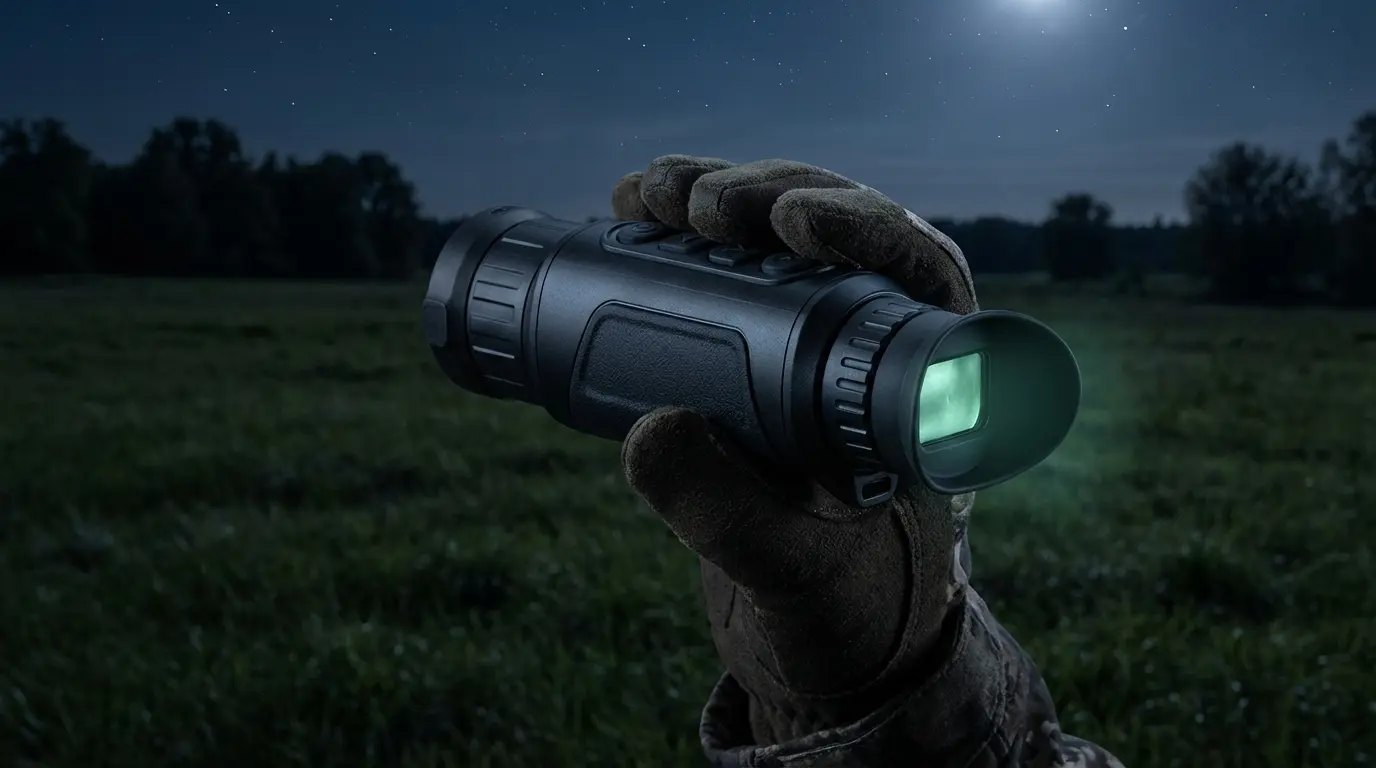
Best Budget Thermal Monocular 2026: Top Picks Under $600
The $600 ceiling used to mean compromise. Thermal monoculars under $600 in 2019 were 240×180 sensors with low refresh rates and image quality that made reading animal behavior difficult. That changed. By 2024, 256×192 sensors, 25 Hz refresh rates, and competent mobile apps arrived at the sub-$600 price point. By 2026, a few units broke the $600 floor with specs that would have cost $1,200 three years ago.
This guide covers the best budget thermal monoculars currently available, what you actually get at each price tier, and which applications each unit handles well.
For context on how budget thermal fits into the broader category, our complete night vision monocular guide covers both thermal and digital options across all price ranges.
—
What “Budget Thermal” Actually Means in 2026
Budget thermal monoculars fall into three tiers:
Sub-$300: Entry-level units with 256×192 sensors, 25 Hz refresh rates, and limited detection range (200–400m for human-sized objects). These are adequate for short-range scouting and observation tasks. Not suitable for rifle mounting or extended field use.
$300–$450: Mid-entry tier. Better image processing, occasionally 384×288 sensors, and more reliable construction. Detection range reaches 500–700m in favorable conditions.
$450–$600: The current sweet spot. Units here compete with what $800–$1,000 bought two years ago. 384-sensor models appear in this range. Detection range extends to 800m+.
—
Top Budget Thermal Monoculars in 2026
1. AGM Fuzion LRF TM35-384 — Best Under $600
The AGM Fuzion LRF is the unit that defines what budget thermal has become. A 384×288 sensor, built-in laser rangefinder, and 35mm focal length sit at a price point that was unreachable three years ago.
The integrated rangefinder — accurate to 800m — is the feature that elevates this above similarly-priced monoculars. For hunters scouting deer on agricultural fields, being able to range a heat signature without reaching for a separate tool changes how you work a field.
Specs:
– Sensor: 384×288, 12 µm
– Refresh rate: 25 Hz
– Focal length: 35mm
– Built-in LRF: up to 800m
– Detection range: 1,350m (vehicle class)
– Weight: 400g
– Battery life: 5 hours
Limitations: The 25 Hz refresh rate (versus 50 Hz on premium models) is noticeable when tracking running animals. For stationary observation and scouting, it makes no difference. For use as a hunting spotter before a shot, it is more than adequate.
Verdict: No other sub-$600 thermal monocular includes a laser rangefinder with 384-sensor performance. If you scout fields and need range data, the Fuzion LRF is the obvious choice.
—
2. AGM Fuzion TM35-384 — Best Value Without LRF
The Fuzion TM35 is the non-rangefinder version of the unit above. Sensor and optics are identical; you give up the LRF and gain slightly lower weight and a reduced price point that often falls under $500.
For hunters and observers who already carry a dedicated rangefinder, the TM35 is the more sensible purchase. The sensor performance is identical, and the image quality difference between this and the LRF version is zero.
Verdict: If you have a rangefinder, buy the TM35 and save $80–100 over the LRF version. The thermal image is the same.
—
3. Pulsar Axion XM30F — Best Budget Option from Pulsar
Pulsar’s entry-level line, the Axion series, represents a different engineering approach than AGM. The XM30F uses a smaller 12.5 µm sensor with a 30mm focal length. The sensor resolution is 320×240.
Where the Axion XM30F earns its place: image processing. Pulsar’s algorithms produce sharper edges and better contrast management than raw sensor specs suggest. At 200 yards, a standing deer is clearly defined. The app integration (Stream Vision 2) is the best in this price tier — reliable, feature-rich, and updated consistently.
Specs:
– Sensor: 320×240, 12.5 µm
– Refresh rate: 50 Hz
– Focal length: 30mm
– Detection range: up to 1,300m
– Battery life: 4 hours
– Weight: 170g (lightest in category)
Where it wins: The 50 Hz refresh rate and 170g weight make the Axion XM30F the best budget thermal monocular for use on the move. Hunters who glass while walking or work brushy terrain benefit from the lighter package.
Where it falls short: 320×240 sensor is outspecified by 384-sensor alternatives at similar prices. AGM’s Fuzion series offers more resolution for the money.
Verdict: Choose the Axion XM30F if you prioritize Pulsar’s app ecosystem, lighter weight, and 50 Hz refresh. Choose AGM Fuzion if raw sensor resolution and range performance matter more.
—
4. InfiRay Clip CL42 — Best Clip-On Option Under $600
The InfiRay Clip CL42 occupies a unique position in this category: it mounts in front of any existing daytime optic, converting it to a thermal sight without replacing the scope. For hunters who already own quality glass and want to add thermal capability for specific night applications, this is the most cost-efficient path.
The CL42 uses a 400×300 sensor with a 42mm focal length. Image quality is competitive with the AGM Fuzion series. The clip-on design means zero/return-to-zero is handled by the underlying optic — you do not re-zero for thermal.
Specs:
– Sensor: 400×300
– Focal length: 42mm
– Refresh rate: 25 Hz
– Compatible: works in front of 1–12× day optics
– Detection range: 1,400m
Limitations: As a clip-on thermal, the CL42 adds length and weight to your existing setup. It is not a standalone monocular in the traditional sense — it requires an underlying optic to function as a rifle scope.
Verdict: If you want to add thermal to an existing day scope without buying a dedicated thermal rifle scope, the CL42 is the most capable option under $600. For standalone observation, the Fuzion series is more practical.
—
5. AGM Asp Micro TM160 — Best Sub-$300 Option
At the bottom of the budget range, the AGM Asp Micro TM160 is the honest answer to “what can I get for under $300 that actually works?” The sensor is 160×120 — low resolution by any measure — but the 2.6× fixed magnification and compact format make it functional for close-range scouting.
At 100 yards, human-sized objects are detectable and identifiable. At 200+ yards, you are identifying heat signatures, not reading animal behavior. For checking field edges from a truck or scanning before a predator setup at ranges under 150 yards, it does the job.
Specs:
– Sensor: 160×120
– Refresh rate: 25 Hz
– Focal length: 16mm
– Detection range: 680m (vehicle class)
– Weight: 100g
Verdict: Buy this if $300 is a hard ceiling and you need any thermal capability. Understand the limitations: sub-300-yard effective performance, low image resolution, and limited detail identification. Do not expect 400-yard deer scouting performance.
—
Sensor Resolution: Why It Matters and What to Expect
| Sensor | Resolution | Effective ID Range | Best Use |
| 160×120 | Very Low | 100–150m | Close-range check, backups |
| 320×240 | Moderate | 200–300m | General scouting, observation |
| 384×288 | Good | 300–500m | Field scouting, hunting |
| 640×480 | High | 600m+ | Professional, long-range work |
The jump from 320 to 384 provides meaningfully better image quality at the distances hunters actually use. Most serious hunters buying in this price range should target 384-sensor units even if it means stretching the budget.
—
Refresh Rate: 25 Hz vs 50 Hz
Budget monoculars frequently ship with 25 Hz refresh rates. For observation and scouting tasks, 25 Hz is adequate. The limitation appears when:
- Tracking running animals (deer at full sprint, coyotes cutting an opening)
- Using as a spotter while a running animal crosses your field of view
- Scanning rapidly across terrain
For stationary observation — the primary use case for a budget handheld monocular — 25 Hz is not a practical limitation. If you plan to mount the monocular or use it as an active hunting tool while scanning quickly, the extra budget for 50 Hz is worth it.
—
Internal Links for Context
Before buying, review the full thermal binocular options if you are considering two-eye observation. Our thermal binoculars for hunting guide covers how binocular vs monocular thermal compares for detection and fatigue over long glassing sessions.
—
Battery Life: Real-World vs Rated
Budget thermal monoculars are typically powered by proprietary battery packs or standard cells. Real-world performance versus rated specs:
| Unit | Rated | Real-World Cold (~15°F) |
| AGM Fuzion TM35 | 5 hrs | 3–3.5 hrs |
| Pulsar Axion XM30F | 4 hrs | 2.5–3 hrs |
| AGM Asp TM160 | 4 hrs | 2.5–3 hrs |
Carry a spare battery or power bank for hunts over 3 hours. The Pulsar Axion’s APS battery system allows hot-swap without losing settings.
—
Which Budget Thermal Monocular to Buy
- Best overall performance under $600: AGM Fuzion LRF TM35-384 (rangefinder included)
- Best value without rangefinder: AGM Fuzion TM35-384
- Best for weight and app ecosystem: Pulsar Axion XM30F
- Best clip-on conversion: InfiRay Clip CL42
- Best under $300: AGM Asp Micro TM160 (know the limitations)
—
Frequently Asked Questions
What is the minimum sensor resolution worth buying for hunting?
320×240 is the practical minimum for hunting applications. 256×192 and below provide limited identification range and make reading animal behavior difficult. Stretch to 384×288 if possible.
Can I use a budget thermal monocular as a rifle scope?
Handheld thermal monoculars are not rifle scopes and are not designed for recoil. The InfiRay Clip CL42 is a clip-on designed for use with a primary optic. Dedicated thermal rifle scopes are a separate product category.
How does fog affect budget thermal monoculars?
Dense fog reduces thermal performance significantly. Heat signatures at 300m may become undetectable in heavy fog. Light haze has minimal effect. This applies to all thermal — not specific to budget units.
What’s the difference between 12µm and 17µm pixel pitch?
Smaller pixel pitch (12µm) allows more pixels in the same physical sensor size, improving resolution. 17µm sensors can achieve good sensitivity with fewer pixels, which some manufacturers argue improves low-contrast image quality. For budget buyers, the practical difference is minor compared to the overall sensor resolution and lens quality.
Is a budget thermal monocular enough for coyote hunting?
For calling setups under 200 yards, a 384-sensor budget monocular is a functional spotting tool. It will not replace a dedicated thermal rifle scope with 50 Hz refresh. Use it to locate and identify, then confirm shot placement with a more capable optic.

Can You Use a Thermal Scope During the Day? Daylight Use/Sun Safety and Zeroing Tips.

Night Vision Range Explained: Detection, Recognition, Identification, and Real Hunting Distance

How to Set Up an IR Illuminator for Night Vision: Placement, Beam Width, and Field Mistakes