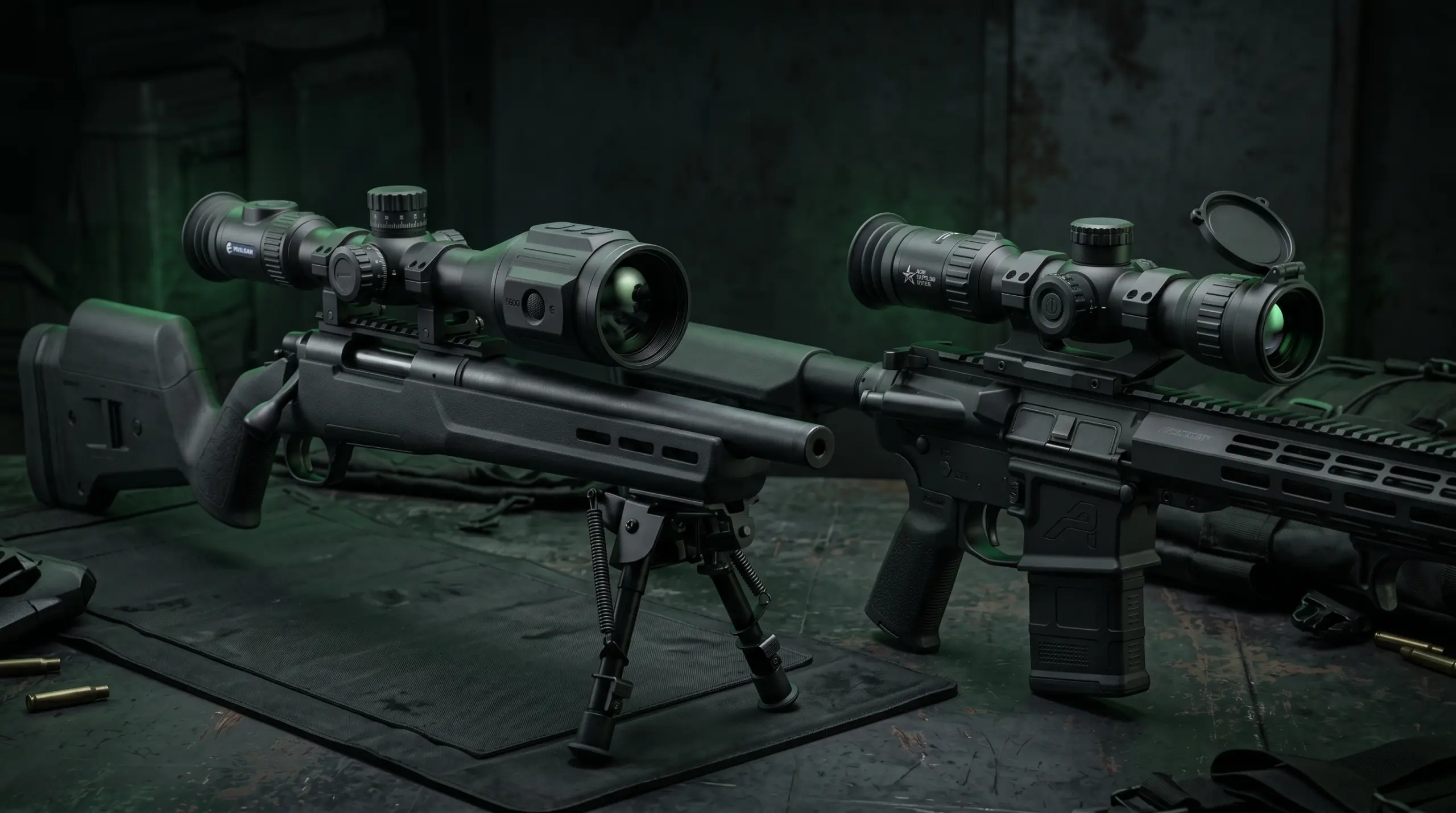
AGM Rattler V2 vs Pulsar Thermion: Which Thermal Scope Wins for Hunting
But which one actually works better when you are sitting in a blind at 2 AM, hogs moving through brush at 180 yards, wind in your face? That is the comparison that matters. Not spec sheets. Not marketing language. Real field performance.
This article breaks down both scopes across the categories that matter to hunters: image clarity, battery life, mounting, warranty coverage, and price. No fluff, no favorites. Just an honest look at where each scope wins and where it falls short.
Quick Comparison Table
| Feature | AGM Rattler V2 | Pulsar Thermion |
|---|---|---|
| Resolution | 384×288 (12 micron) | 384×288 or 640×480 (17 micron) |
| Refresh Rate | 50 Hz | 50 Hz |
| Detection Range | Up to 1,350 yards | Up to 1,475 yards (XQ38) |
| Magnification | 2-16x (base 2x) | 1.5-12x (XQ38) / 2-16x (XP50) |
| Objective Lens | 25mm | 38mm (XQ38) / 50mm (XP50) |
| Battery | Internal Li-ion, USB-C | APS2 / APS5 removable |
| Battery Life | Up to 9 hours | Up to 10 hours (APS5) |
| Weight | 12.3 oz (350g) | 26.8 oz (760g) |
| Mount | Standard 30mm rings | 30mm rings or Weaver/Picatinny |
| Recoil Rating | .308 / 12 gauge | .375 H&H / 12 gauge |
| WiFi | Yes (AGM Connect app) | Yes (Stream Vision 2) |
| Warranty | 3 years | 3 years |
| Price Range | $899 – $1,299 | $1,499 – $2,499 |
AGM Rattler V2: Strengths and Weaknesses
What it does well
The Rattler V2’s biggest selling point is its size. At 12.3 ounces, it is one of the lightest thermal scopes you can mount on a rifle. If you have ever carried a heavy rig through timber for three hours, you know why that matters. Weight matters more than most people admit before their first real season with thermal.
The 384×288 sensor with 12-micron pixel pitch delivers sharp image quality for the price bracket. AGM’s image processing has improved noticeably over the first-generation Rattler. Color palettes are useful, and the hot spot tracking feature works reliably out to about 200 yards on hog-sized targets.
Battery life hits around 9 hours in practice. That covers a full night of hunting with juice to spare. USB-C charging means you can top it off from a truck or portable battery pack during a break. The AGM Connect app is functional, though not as polished as Pulsar’s Stream Vision.
Mounting is straightforward with standard 30mm rings. Zero holds well on .308 and lighter calibers. The Rattler V2 is not picky about ring height or eye relief, which makes it forgiving if you are switching between rifles.
Where it falls short
The 25mm objective lens limits light gathering compared to the Thermion’s 38mm or 50mm options. At extended ranges (beyond 250 yards), target identification gets harder. You can detect heat signatures well past 400 yards, but telling a hog from a deer at that distance requires more glass than the Rattler V2 carries.
The menu system takes getting used to. Buttons are small, and navigating settings with gloves on is frustrating. AGM’s documentation is also thinner than it should be. Expect to spend time on YouTube figuring out features that should be explained in the manual.
Internal battery means you cannot swap in the field. If it dies, you are done until you charge it. For most hunters this is not a dealbreaker, but for guides running multiple nights back to back, it is worth considering.
Field performance
In cold weather (below 20 degrees Fahrenheit), the Rattler V2 holds up reasonably well. Startup time is about 5 seconds. Image calibration (NUC) is quick and does not require breaking your shooting position. The reticle options cover most hunting scenarios, and the zeroing process is intuitive once you learn the menu.
For hog hunting inside 200 yards, the Rattler V2 gives you everything you need. It is fast on target, light enough to run on an AR-15 without throwing off balance, and the image quality is sufficient for positive identification in most conditions.
Pulsar Thermion: Strengths and Weaknesses
What it does well
The Thermion’s strongest advantage is its objective lens. The XQ38 carries a 38mm lens; the XP50 steps up to 50mm. More glass means better target identification at range. If you hunt open terrain where shots regularly exceed 250 yards, this difference is real and measurable.
Pulsar’s Stream Vision 2 app is arguably the best companion app in the thermal optics market. Firmware updates go through the app. Photo and video recording stream directly to your phone. The interface is clean and responsive. For hunters who want to review footage or share it, Stream Vision 2 saves time.
The removable APS2 and APS5 battery system is a genuine advantage. Carry a spare battery in your pocket and you are never stuck with a dead scope. Hot-swapping takes about 10 seconds. For extended hunts or multi-day trips, this matters.
Recoil rating up to .375 H&H Magnum means the Thermion can handle heavy-hitting calibers without losing zero. If you shoot a hard-kicking rifle, this is peace of mind that the Rattler V2’s .308 rating does not quite match.
Where it falls short
Weight. The Thermion XQ38 sits at 26.8 ounces, nearly double the Rattler V2. On a lightweight hunting rifle, that weight is noticeable. It changes the balance and can affect off-hand shooting for hunters used to a day scope.
Price is the other obvious drawback. The XQ38 starts around $1,499. The XP50 pushes past $2,000. You are paying for the larger objective lens and the Pulsar ecosystem, and whether that premium is worth it depends entirely on how and where you hunt.
The Thermion’s traditional scope form factor is a pro for some and a con for others. It looks like a conventional scope, which is nice for aesthetics, but the housing is bulkier than compact designs like the Rattler. It also sits higher above the rail, which may require higher rings or adjustable mounts.
Field performance
The Thermion excels in open country. At 300+ yards, the larger objective lens delivers noticeably better image detail than the Rattler V2. For predator hunters working coyote stands at distance, this is where the Thermion justifies its price tag.
NUC calibration on the Thermion is smooth and fast. The picture-in-picture mode (available on higher models) is useful for precision shots without losing the wide field of view. Zero retention after removal and remount is solid, though always verify before hunting season.
Cold weather performance is strong. The Thermion has been tested reliably in sub-zero conditions. Startup is slightly longer than the Rattler V2 (about 7 seconds), but image stability is excellent once warmed up.
Head-to-Head: Image Quality, Battery, Mount, Warranty, Price
Image quality
Both scopes use 384×288 thermal sensors (the Thermion XP50 offers a 640×480 option). At close range (under 150 yards), the difference is minimal. Both scopes identify targets clearly. Beyond 200 yards, the Thermion’s larger objective lens pulls ahead. The Rattler V2’s 25mm lens is a limitation that no amount of software processing can fully compensate for.
If most of your hunting happens inside 200 yards (hog hunters in thick brush, for example), you will not see a meaningful image quality gap. For open-terrain predator hunting, the Thermion wins this category.
Battery
The Thermion’s removable battery system is a clear advantage for long hunts. The Rattler V2’s internal battery is convenient for casual use but limits you on multi-day trips. Both scopes deliver similar battery life on a single charge (9-10 hours). The difference is that the Thermion lets you extend that indefinitely with spare batteries.
Mount
The Rattler V2 wins on mount simplicity. Standard 30mm rings, low profile, easy to set up. The Thermion works with 30mm rings too, but its larger housing often requires taller rings. Both hold zero well on appropriate calibers. The Thermion gets the edge on heavy-recoil rifles.
Warranty
Both companies offer 3-year warranties. AGM has improved its customer service reputation over the past two years, though some users still report slow turnaround times. Pulsar’s warranty service through US distributors is generally reliable. This category is roughly even.
Price
The Rattler V2 comes in $400 to $1,200 cheaper depending on the Thermion model you compare it against. For hunters on a budget, or those who want a dedicated thermal for a second rifle, the Rattler V2’s price point is hard to argue with. The Thermion charges a premium for its larger objective lens, removable battery system, and the Pulsar app ecosystem.
Verdict: Which Scope for Which Hunter
Best for hog hunting
AGM Rattler V2. Hogs are usually engaged inside 150 yards in brushy terrain. You do not need a 38mm or 50mm objective lens for that. The Rattler V2’s lighter weight means less fatigue on long walks to the stand, and the price leaves room in your budget for a good IR illuminator or other gear.
Best for predator hunting
Pulsar Thermion. Coyote and bobcat hunters often work open terrain with shots at 200-400 yards. The Thermion’s larger objective lens and better image detail at range make a real difference when you are trying to distinguish a coyote from a domestic dog at 300 yards in low contrast conditions.
Best value / best budget pick
AGM Rattler V2. At $899 to $1,299, the Rattler V2 delivers thermal imaging performance that would have cost $3,000+ five years ago. For hunters who want to get into thermal without selling a rifle to fund it, the Rattler V2 is the most capable option in this price bracket. It is not perfect, but the performance-to-price ratio is strong.
Frequently Asked Questions
Can the AGM Rattler V2 handle .308 recoil?
Yes. AGM rates the Rattler V2 for .308 Winchester and 12 gauge shotgun recoil. In practice, zero holds well on .308 semi-auto and bolt-action rifles. If you are shooting heavier calibers like .300 Win Mag or .338 Lapua, the Pulsar Thermion’s higher recoil rating (.375 H&H) provides a larger safety margin.
Is the Pulsar Thermion worth the extra money over the Rattler V2?
It depends on your hunting style. If you hunt open terrain at 250+ yards, the Thermion’s larger objective lens delivers measurably better image detail at distance, and the removable battery system is an advantage for long sessions. If you hunt primarily inside 200 yards in brush or timber, the Rattler V2’s lower price and lighter weight are probably the smarter choice.
How do these scopes compare in cold weather?
Both perform well in cold conditions down to roughly -4 degrees Fahrenheit (-20 Celsius). The Rattler V2 starts up slightly faster (about 5 seconds vs. 7 seconds for the Thermion). Neither scope suffers from significant image degradation in cold weather, though battery life drops somewhat in extreme cold. Carrying a USB-C power bank (Rattler V2) or spare APS batteries (Thermion) is a good practice for winter hunts.

Can You Use a Thermal Scope During the Day? Daylight Use/Sun Safety and Zeroing Tips.

Night Vision Range Explained: Detection, Recognition, Identification, and Real Hunting Distance

How to Set Up an IR Illuminator for Night Vision: Placement, Beam Width, and Field Mistakes