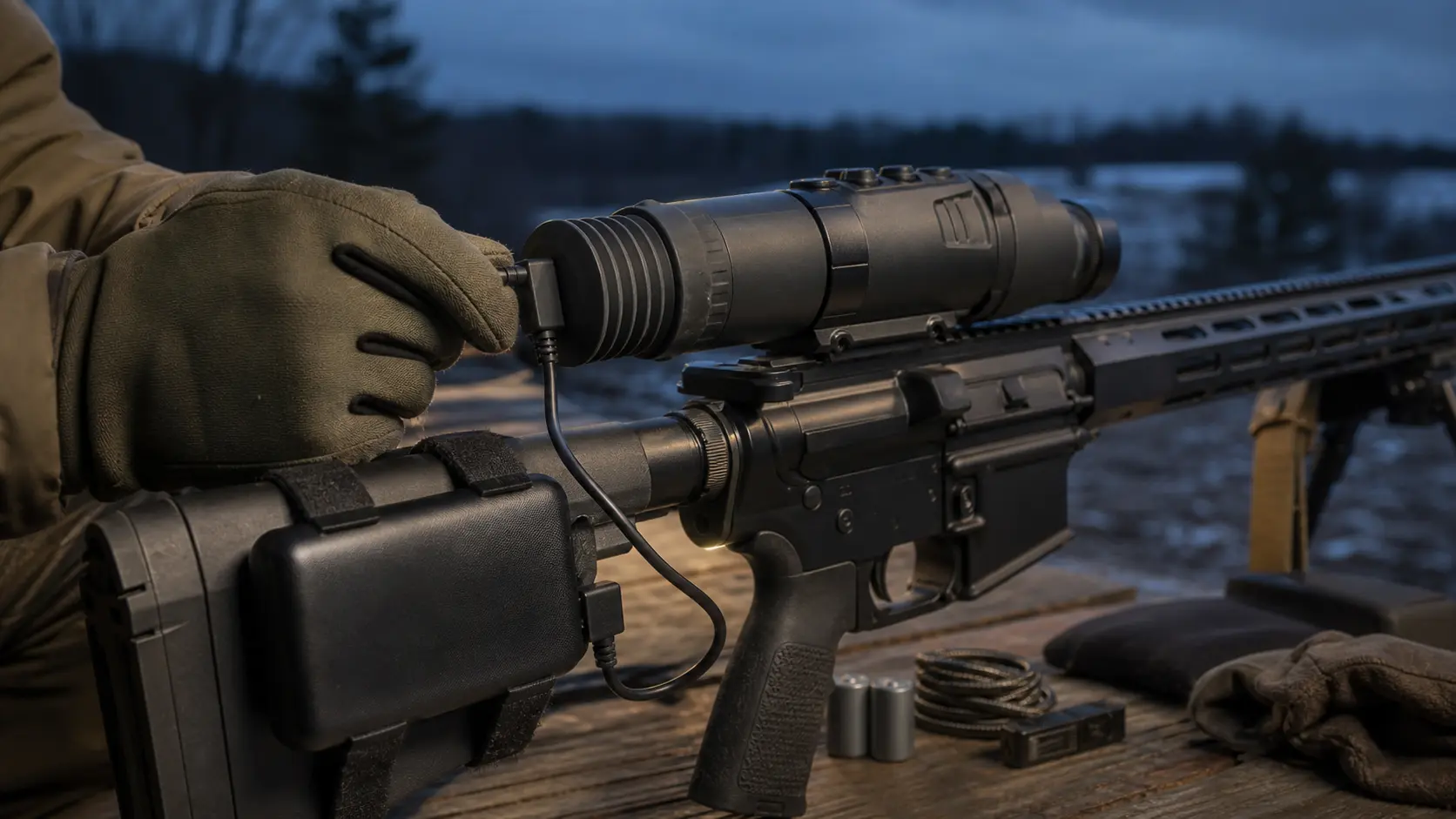
Thermal Scope External Battery Packs Explained: USB-C Power Banks, Cable Routing and Cold Weather
If you’re going to be out for a long night, a thermal scope external battery pack can be the thing that saves your evening. It can also be the cause of cable snags, stressed out USB-C ports, and scopes turning off with recoil.
My preference is external power when a hunt really requires it: long feeder sits, cold weather, all-night hog control, guide work, coyote stands where there is a lot of scanning, or video heavy setups. Not my fav as a blind add on. A battery pack adds weight, cables, port covers that need to be secured, and one more connection to endure brush, gloves, darkness, rain and a weary hunter.
Put simply, think about thermal scope USB-C power in the following order: Manual first, field setup second, test before hunt. Not all USB-C thermal scopes are created equal.
To conclude, yes, external battery packs for thermal scopes can be used but are not necessary.
When runtime is more important than simplicity, an external battery pack should be used with a thermal scope. The thermal scope power bank or rail mounted battery will be useful while on a long sit, on a cold weather hunt, recording, using Wi-Fi or apps, repeated stand up sessions and with older scopes that have poor battery life.
For short hunts, the spare internal batteries might be easier. But if your scope utilizes easy-to-change thermal scope rechargeable batteries, 18650 batteries, CR123 batteries, or a manufacturer battery pack, it may be cleaner to carry spares than to run a cable from the rifle.
It is a trade-off that is both real:
- Useful runtime can be increased with external power.
- It introduces cable routing, exposure of ports, balance modifications and snag risk.
- The scope is subject to the exact scope manual.
- Not all cables or power banks are necessarily safe, just because they have USB-C.
If you have not tried out the whole thermal scope external battery system at home, at the range and in hunting gear, then it’s not ready for hunting.
What exactly is a Thermal Scope External Battery Pack?
A thermal scope external battery pack is any external battery pack that connects to the thermal scope via USB-C, Micro-USB, round DC, proprietary cable or a model-specific accessory. Some use a common pocket power bank. Others use a stock pouch, a rail mounted battery pack thermal scope setup, a Picatinny battery pack thermal scope accessory or a manufacturer brand thermal scope pack.
It’s not simply "more battery." The objective is power that is reliable and does not affect the rifle.
Power Bank vs Rail-Mounted Battery Pack
A pocket thermal scope power bank can be easily found and is easily rechargeable. May perform well from the blind, tripod or static position with the cable running from the jacket pocket or pack. On the other hand, is the movement. Pulling the cable can be caused by standing up, turning and by picking up the rifle with the pack in your pocket while the rifle is on a tripod.
The battery pack is a rail mounted or stock mounted thermal scope battery pack, which remains with the gun. That can help to clean the cable management, particularly on a tripod or AR-style rifle. The negative is weight and size. A large pack will alter balance, hinder control of the rifle, hinder support hand, or make rifle awkward in window, saddle clamp or pack.
When a manufacturer’s battery accessory is available, it may be the cleanest fit, though it must be remembered that the same factors as stated above – scope model, input, mount, cable clearance, weather – must be considered.
External power and charging are not always the same thing.
Many hunters get caught up here. Power and charging don’t necessarily match.
There may be a scope running on some that is connected. Some may be an internal battery charger. Some may do both. Some may have charging, operating, temperature, cable or port limitations. Depending on the model, a USB-C port may be used for power input, file transfer, firmware updates, charging, or any combination of these functions.
Avoid making an assumption the basis for a hunt. Refer to the manual for your specific scope, battery and cable. Before connecting a new power setup, check the manual or consult the manufacturer or dealer if it’s unclear.
USA Night Vision’s Thermal Scope Battery Life Guide 2026 is a helpful companion for wider runtime planning. This guide is geared towards the external power setup.
Before you plug in, you need to check for compatibility.
Prior to using an external battery for the thermal scope, four parameters are to be verified: voltage, current, connector and operating mode.
The voltage and current specifications are needed.
The power supply must be compatible with the scope’s power requirements. Don’t infer based on the cable’s form. A USB-C connector does not indicate what the scope can accept, what the power bank can provide, and whether the scope supports a particular charging profile.
Check the manufacturers input specification. Look for voltage, amperage or watts, cable type and any external battery pack cautions. If the scope has removable batteries, determine if external power is used to bypass, charge or supplement the batteries.
That’s the problem with USB-C: it is not always universal.
The convenience of thermal scope USB-C power doesn’t stop at the connector. The port behavior is under the control of the device. For external power, one scope can be powered via USB-C. The other might use it primarily for transferring information or charging. Another scope can only be powered externally via a particular cable or mode.
Hence, I don’t say any USB-C battery pack will work. It’s not guaranteed.
The cable type and connector shape.
Thermal scope power cable is more important than hunters think. The straight connector may extend and become bumped. A right-angle connector can be used to route cleaner…only if it is the right direction on your rifle. A thick cable is tough, but in cold conditions it can be too hard. Although a thin cable is easy to run, it might be weak near the connector.
Never route a cable so that the connector is subjected to the recoil stress. With the plug acting like a handle or lever, the port is in danger. A greater expense is usually the cost of the port damage than a better cable.
Internal Battery, Replaceable Battery, and External Power Interaction
Thermal scopes have various kinds of batteries. Some come with built-in rechargeable packs that are sealed. Others have detachable packs. Some are equipped with thermal scope 18650 battery packs, CR123 batteries or proprietary rechargeable batteries. Some power inside and out in a certain order.
It is not only a matter of "Will it turn on? Explain what happens in each of the following cases: external pack is disconnected, internal battery is low, scope is recording, standby is used, and the scope temperature decreases.
How much capacity do you need? mAh, Wh and Real Runtime
Confusing capacity claims. The mAh on a thermal scope power bank is actually quite simple, but it relies on voltage and conversion losses. When listed, it’s better to compare by Watt-hours (Wh).
Even so, don’t assume that a printed capacity is an actual time for hunting. Actual battery life for real-use conditions will vary according to the scope, the intensity of the display, the amount of work the sensor and processor have to do, whether recording, using Wi-Fi, pairing with an app, using a rangefinder, refresh rates, stand-down time, battery condition, quality of the cable, and temperature.
One of the major factors is the weather: cold weather. Batteries in a thermal scope cold weather battery plan should be expected to have a shorter useful life than a warm room test; particularly for older batteries, or if not enclosed in a wind protected area.
The only runtime that counts is your tested runtime. Adjust the scope and pack, set the brightness level that you hunt with, turn on the features you use and let her rip. If you’re using standby, recording, Wi-Fi or an app, try those too. The standby mode and the start up time of thermal scopes is what USA Night Vision’s guide to thermal scope standby mode helps with.
Spare Internal Batteries vs External Battery Pack.
When it comes to the thermal scope, the answer to the question, internal battery or external battery is simplicity in the field.
Spares internal batteries are typically more suitable for short stands, good weather, no-frills rifle rigs, and scopes that easily swap batteries. They also help to maintain the cleanliness of the rifle and eliminate cable issues. If you hunt a couple of stands after work, and your scope’s normal hunting time also includes nighttime, an external pack might not be necessary.
External power is more suitable for an all-night hunt for hogs, a cold weather predator hunt, guide work, tripod sits, recording sessions or any scope with a short runtime. When the cost of a dead battery pack is greater than the cost of the added complexity, a thermal scope battery pack for hunting makes sense.
Many hunters use a hybrid approach by relying on the internal battery, then switching to an external battery if required and having a spare cable/removable battery just in case. Redundancy is helpful, provided one knows how the scope will react in the event of failure of one power source.
External battery packs can be mounted horizontal or vertical.
The position of the battery should not oppose the rifle.
Pack mounted Picatinny/M-LOK can be secure and repeatable, particularly on AR-style rifles. Avoid contact with the charging handle, ejector, bolt movement, sling attachment, tripod clamp and support-hand grip. Never install a battery in such a way as to obstruct the focus ring, the menu buttons, the lens cap or the battery compartment.
Stock pouches can be effective as they allow the weight to be close to the shoulder. They may also impede cheek weld, eye position or length of pull. Head position is NOT free if it moves due to battery pouch.
Pocket carry is handy when shooting from a blind or from a static tripod, but must have enough free cable for recoil and movement. Pack in jacket pocket can pull hard when standing, rotating, or shouldering the rifle.
Balance matters. A large external battery can cause the rifle to feel stable on a tripod, but to feel bad offhand. If you have an already large suppressor, large objective thermal, sling and tripod clamp, adding more weight forward may slow everything down.
Refer to USA Night Vision’s blog post on how to mount a thermal scope for details.
When it comes to cable routing, most hunters get this part wrong.
External power tends to either work or not work at thermal scope cable routing.
Avoid contact with the bolt, charging handle, trigger area, safety, magazine release, ejection port, focus ring, tripod head and sling. The cable should not overlap moving controls or be located where your hand will reach it in low light situations.
Allow some "slop" for the recoil and body movement. A cable that is tightened can disconnect or pull on the rifle or place strain on the USB-C port. Excessive slack is also an issue as loops snag brush, tripod knobs, blind windows, pack straps and sling hardware.
Use gloves, coat and the sling which is mounted on the rifle while testing the routing. Turn the tripod to the left and right. Repeat the exercise without the rifle loaded. Shoulder it. Stand to sit. If a cable is moving across a control while any of that is happening, correct the cable prior to hunting.
USA Night Vision’s thermal scope tripod setup guide delves deeper into the topic of rifle balance and cable clearance if you’re tripod specific.
External Power in Cold Weather
Cold weather is not good for any power plan. Batteries can provide reduced usable battery life. Cables stiffen. When it comes to dealing with gloves, it’s harder with Port cover. Connectors that fit well at home can get uncomfortable if your fingers are chilled.
When possible, store extra batteries or small power banks in a warm area, such as an inside pocket. Avoid unsafe methods of heating, do not charge cold batteries (unless recommended by the battery manufacturer), and do not ignore battery warnings in the scope or charger.
In addition, a USB-C battery pack for a thermal scope needs to pass a cold test. Place the pack and cable in cold environments like your hunt and test to ensure the cable still fits well, the power bank remains awake, the scope is powered, and you can handle the setup with gloves.
Rain, Snow, Dust and USB-C Port Covers.
Weather exposure is modified by external power. Even if the scope is weather rated with its port covers closed, it does not mean that it is rated the same with a scope cable plugged in and a thermal scope USB-C port cover open.
Wet cable connections differ from a closed housing. Water from rain/snow melt, wet brush, dust, mud, and condensation are all able to flow into areas that are normally closed. If the IP rating is stated for the port open, use it only as such, do not presume it is valid for other configurations.
The rain decisions for thermal scope external power should be conservative. If there are going to be any days of heavy rain, wet brush, blowing snow or muddy conditions, then spare internal batteries may be the better option. Before depending on any open port arrangement in terrible climate, it is important to read USA Night Vision’s guide to thermal scope waterproof ratings (IP67 rain cold weather).
Recording, WiFi, Apps and External power.
Thermal scope battery will be depleted by recording, use of Wi-Fi, pairing with apps, screen brightness, using the rangefinder and by leaving the battery on for a long time. It is great for video hunts, guide work, shooting reviews, content creation, and lengthy hunts on the hogs or coyotes where the scope is awake for hours.
However, a battery pack cannot replace an app with poor performance, a suboptimal firmware process, a full storage card or a faulty cable, or sloppy setup habits. Test the complete workflow with video or app control with it plugged in to external power: record, stop, play back, pair the app, wake from standby, and check the files.
See USA Night Vision’s guide to thermal scope video recording, Wi-Fi, apps, and RAV for smart-feature power planning and the guide to thermal scope firmware updates and apps, zero profiles.
If you are having external power issues, see Troubleshooting External Power Problems.
If the scope won’t start when powered from the pack, begin with the manual. Make sure that the scope is suitable for external operating, the output mode is compatible, and the cable is not charge-only or damaged. If a scope requires a specific cable, use a known good cable of that type.
Check scope connector angle, cable slack, battery mount and port stress if the scope turns off during recoil. A loose pack or a tight cable can be the culprit when things are going good on the bench, but not at the port.
If the power bank shut down, it may not be happy with the load pattern. Some power banks have low load shut off or sleep mode. Check the scope’s precise fit before hunting, particularly if it pulls different in the standby mode.
In cold weather when power is sporadic, inspect battery temperature, connector seating, cable stiffness and old batteries. Don’t jump to conclusions about the optic. Cable and pack issues may appear to be scope issues. When shutdowns begin to seem random, USA Night Vision’s Thermal Scope Troubleshooting Guide comes in handy.
Buying Checklist
When purchasing a thermal scope battery pack or cable, make sure to check:
- The exact external power specification in the scope manual.
- Whether the scope will be powered by an external source, powered by an internal charge or both.
- Voltage, current, connector type, and cable required.
- A cable which is rugged, field manageable and has the proper shape for your rifle.
- A mount with no obstruction to controls, ejection, bolt travel, ejection sling use or tripod movement.
- Not only the highest mAh figure on the label, but runtime in hours.
- Weight and balance of the actual rifle.
- Weather plan is up, port covers are open.
- Alternate plan if the cable, pack or port has a problem.
What’s best for thermal scope battery packs for coyote hunting might not be the best thermal scope battery packs for hog hunting. For a mobile user, it might be appropriate to use less equipment and fewer cables. A man in a blind hunting the hog can take more battery for longer running time.
Common Mistakes
The most frequent error is to think that any USB-C power bank is safe. The second is disregard for the manual, since the plug fits.
There are other errors, all equally functional:
- Using a cable across a moving control.
- Not allowing any play for recoil.
- Leaving too much slack to catch brush or tripod hardware.
- Operation of external power in rain with port covers open, no manufacturer support.
- Purchasing excess battery and causing rifle imbalance.
- Not testing for recording, Wi-Fi, standby, and app behavior.
- When the cable or power bank is weak, blame the scope.
The external power supply should provide greater reliability. Simplify it if it makes the rifle more difficult to handle, more difficult to weatherproof, or less dependable.
Field Setup Checklist
Before the hunt use this checklist:
- Check the input specification in the manual.
- Power scope, internal batteries, external batteries, scanner, call and phone.
- Check the cable, connector and scope port.
- Seal unused port covers.
- Securely install the battery.
- Keep the cable clear of controls, ejection, trigger area, sling and tripod head.
- Allow sufficient "slop" for recoil and movement.
- Test the rifle from standing and sitting positions, tripod, blind and vehicle adjacent position (legal).
- Check stand-by, recording, Wi-Fi and App usage on connection.
- Bring a spare cable or battery.
- Do not use exposed wet connections unless manufacturer indicates otherwise.
Final Takeaway
Thermal scope external battery packs are reliability tools and not magic upgrades. Can be used to prolong length of any hunt, cold night, recording sessions, and static setups. It can also introduce new failure points if the power bank is incorrect, if the cable is incorrect, if the mount is incorrect, if the port cover is incorrect, and if the weather plan is incorrect.
Always begin by reading the manual. Connect the power source to the scope. Cable like recoil, brush, gloves, darkness are real. Test the entire set-up prior to the hunt. If you are looking for a simple night with minimal hassles, spare internal batteries may be the answer. Whether it’s extended hog hunts, cold coyote stands, guide hunting or video heavy hunts, a proven external power setup keeps the scope going when it’s needed most.

Can You Use a Thermal Scope During the Day? Daylight Use/Sun Safety and Zeroing Tips.

Night Vision Range Explained: Detection, Recognition, Identification, and Real Hunting Distance

How to Set Up an IR Illuminator for Night Vision: Placement, Beam Width, and Field Mistakes