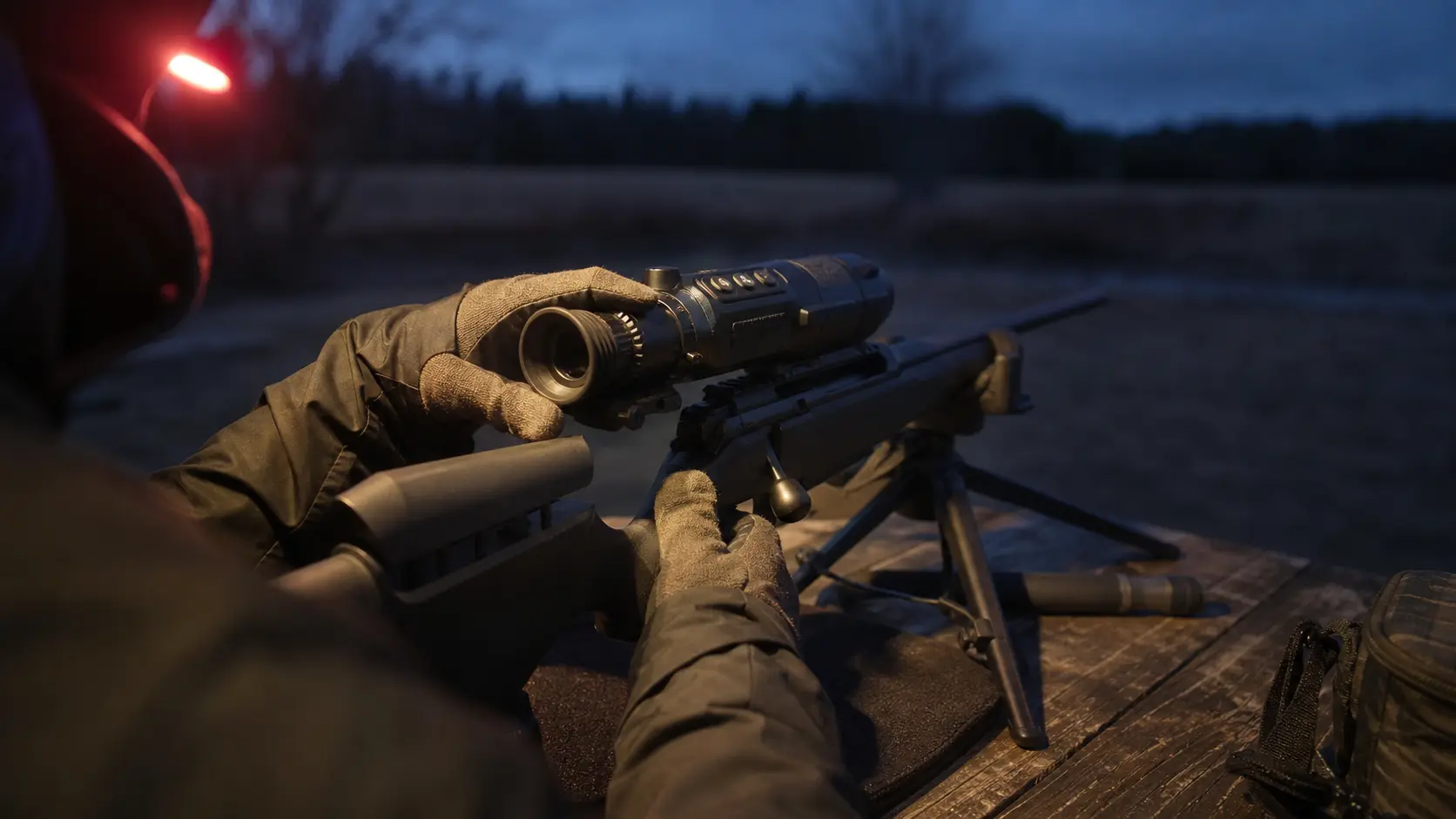
Eyebox, Exit Pupil, Scope Position and Cheek Weld for Night Hunting explained in terms of thermal scope eye relief.
Eye relief is a relatively unimportant feature until the rifle is brought up in the dark and the scope’s eye piece isn’t where the eye was expecting it. You experience black borders, blurring of the picture when you move your head, extension of the neck or movement of the cheek weld.
This is not typically a sensor issue, most of the time. It typically is a dedicated thermal scope fit issue – scope position, stock length, mount height, eyepiece focus, cheek weld, recoil clearance or how the rifle fits you in real hunting positions. This article is not referring to clip-on thermals, but dedicated thermal scopes.
Quick Answer: How should the eye relief of thermal scope be set?
Thermal scope eye relief should be set with the rifle handily placed in front of your face, your eye immediately finding the screen without a search, the full display should be visible, your cheek should weld with the rifle, the controls should be accessible, and recoil clearance should be safe.
No one inch is the same for all thermal scopes, rifles, stocks, mounts and shooters. The first is to use the manufacturer’s published thermal scope eye relief distance for the specific model and to double-check it from the actual hunting spots in which it will be used. See USA Night Vision’s guide to how to mount a thermal scope 2026 for the larger mounting process.
The 30-Second Setup Rule
Unload the rifle, clear the chamber and clear ammo off work area. Wear the jacket, gloves, hat, glasses or suppressor setup you would normally wear.
Shoulder the rifle with your eyes closed. Get comfortable in your regular cheek weld. Open your eyes. When you get the full display without crawling the stock, lifting your cheek, or rolling your neck you are close. Otherwise, try to fine tune the scope position, stock length, and/or mount height before considering the optical sucks.
What Is Eye Relief on a Thermal Scope?
Eye relief is a distance from the eyepiece of the thermal scope to one’s eye at which the image can be viewed. A scope with a dedicated thermal sensor isn’t an optical daylight scope. The sensor forms an image, electronics processes it, and you see the image on an internal display via the eyepiece.
This is why thermal eye relief might be different than the eye relief during the day. The actual sensation varies with the eyepiece, display size, rubber eye-piece, brightness, diopter range, shape of housing and height of mount. The display component of that system is explained in USA Night Vision’s guide to thermal scope display resolution. The guide to thermal image settings is helpful as well if screen brightness or contrast is not comfortable in a blind.
Eyebox, Exit Pupil, and Scope Shadow: What Hunters Actually Notice
Eye relief is distance from front to back. Thermal scope eyebox is the actual 3D distance around the display within which you can move your eye slightly while maintaining comfortable viewing. If the eyebox of the thermal scope is too small, black borders, loss of image, vignetting of the thermal scope or a disappearing image can occur when the head is moved slightly.
Thermal scope exit pupil is trickier. The term exit pupil is a classic concept for glass optics, and should not be blindly adopted in the advice of how to buy a thermal scope. A dedicated thermal still has a viewing window and eyepiece behavior, but, the internal display provides a different experience for the shooter.
Apply background knowledge of exit pupil. Field questions are:
- Can I see the full display from my normal cheek weld?
- Can the image be used when the person moves their head slightly?
- Is it possible to mount the optic in the rifle’s natural location (at the handles)?
An eclipse or shadow in the scope, black edges, or lost screen typically indicate head position, scope distance, eyecup pressure, stock length, mount height, or cheek weld.
Where To Place A Thermal Scope.
The answer to “how far back to mount thermal scope” is simply the eye relief specification from the manufacturer, then positioning your thermal scope mounting point to accommodate the rifle on your body without crowding your face, covering controls, creating recoil risk, or straining the thermal scope neck.
Avoid setting it just from a bench. A bad hunting set up can be concealed by a bench as it supports the rifle and body position is artificial. Test the rifle from a standing position, sitting, kneeling, prone, blind, shooting sticks and any legal vehicle rest position you use.
AR-15 and AR-10 Thermal Scope Eye Relief
Thermal scope eye relief for AR-15s also has its issues. The stock adjusts. There is not enough space for receiver rails. Charging handle must clear your hand, usually while wearing gloves. The height of the thermal scope must match the stock. A suppressor can alter balance causing the rifle to settle differently.
If you are constructing a devoted AR thermal rifle, USA Night Vision’s best thermal scope for AR-15 web page is a great place to begin.
First set the stock length and then place the optic. The same scope may feel like it’s too close when you zero when the stock is extended but hunt with it collapsed due to a jacket.
Charging handle clearance is important as well. A rear mounted thermal will make an AR-10 or AR-15 more difficult to operate in the dark, particularly with gloves on.
The height of the mount should drop your line of sight down to an eye level position behind the display. Too low, then you break your face on the stock. Too high and your weld is a floating chin weld. The aim is to provide a stable thermal scope sight picture that is repeatable on contact with the stock.
Bolt-Action Thermal Scope Eye Relief
Bolt-action rifles have bolt handle clearance, heavier recoil, stock comb height, ring spacing, and may give less flexible mounting room.
If the thermal scope is set too far back, it may be blocking the bolt handle or your knuckles when you’re rapidly cycling. Work the bolt from your own shooting stance before you declare the set up to be complete.
The greater the recoil, the more important it is for clearance to be correct. Anything larger than a mild AR-15, such as a .308, 6.5 Creedmoor, .300 Win Mag or 12 gauge slug setup, should be treated with greater caution. Avoid crowding the eyepiece simply to make the screen look bigger. Optic durability is discussed in USA Night Vision’s thermal scope recoil rating guide here.
A cheek riser can be used if the stock comb is too low, but it can also be used to camouflage a poor choice of mount height. Use it only if it will provide you with a repeatable thermal scope cheek weld.
Eye Relief, Diopter, and Focus Are Not the Same Thing
These three are always getting in a mess.
Diopter sharpens the display, reticle and menu to your eyes. A distance objective focus renders the subject scene sharp at distance. Eye relief allows you to position your eye at the proper distance from the eyepiece. To adjust the thermal scope diopter, if the reticle and menu are not clear, rotate the dial. Adjust objective focus if animal or field edge is soft. Check out USA Night Vision’s blog on thermal scope fixed focus vs manual focus for more information.
A bad diopter setting cannot be corrected by moving the scope. You can’t compensate for a scope that is too far forward. A sharp display doesn’t sound so good if your eye is not at the usable viewing distance.
The relationship between Eye Relief and Shooting Consistency and Zero Confidence.
Eye relief alone doesn’t directly affect point of impact. A digital zero does NOT move due to an uncomfortable head.
However, poor eye relief will make your shooting less consistent. If every time is different, the time to acquire the zero will increase and one might feel that the zero is questionable, when in fact it is the body position, the comfort of the mount, or the repeatability of the set-up.
To zero troubleshoot, fire live and test the mount, rifle profile, ammunition and reticle setting. Check out USA Night Vision’s guide to thermal scope reticle zeroing.
After the shot, comfortable viewing distance is also beneficial. Follow-up shots on a hog, particularly if hunting a small group of hogs at a feeder or in a field, rely on maintaining control of the rifle. Check out USA Night Vision’s best thermal scope for hog hunting for thinking about hog-specific setup.
Step-by-Step Setup Checklist
Follow this checklist whenever you mount, remount or move a dedicated thermal scope:
- Unload the rifle, clear the chamber, and clear ammunition from work area.
- Priority for stock length, particularly on AR platforms.
- Put the scope at the manufacturers eye relief distance.
- carry the rifle on the shoulder with closed eyes and then open the eyes and look at the rifle’s alignment on the display.
- Hunt out of the tripod, sticks, sitting, prone, blind, standing, kneeling, and legal vehicle rest.
- Inspect charging handle, bolt handle, focus ring, buttons, battery door, lens cap and cable routing in the dark with gloves.
- Lock the mount, rings, rail or optic to the manufacturer’s torque specifications.
- zero with live fire following any position change of the scope.
Here are some common eye relief mistakes.
A thermal scope that is set back too far can obscure your face, affect the charging handle or bolt, create a risk of recoil, and make the rifle feel cramped. A thermal scope that is set too far forward will result in neck strain, floating cheek weld, slow target acquisition and loss of the display window.
Another pitfall is bench comfort. Try shooting the rifle from where the Hog & Coyotes appear.
Don’t assume a problem with the sensor resolution is to blame either. For soft images, verify focus and diopter. If nothing appears on the display, inspect eye relief / eyebox. If target acquisition does not seem fast enough check the position of the mount, field of view and cheek weld. The image window and target acquisition are complementary as explained by USA Night Vision’s guide to thermal scope field of view.
There are a few things to look into before buying a thermal scope.
Review published eye relief distance, eyepiece comfort, rubber eyecup design, glasses compatibility, mounting interface, receiver rail space, mount height options, weight and balance, focus ring placement, and button access.
Digital Zoom is not a remedy for eye relief. It does not physically move the eyepiece or change the scope mounting position, it merely enlarges the image that is being displayed. USA Night Vision explains the difference in its thermal scope digital zoom guide: 2x, 4x, 8x.
Final Takeaway
Thermal scope eye relief isn’t just a comfort spec. It has an impact on sight picture, speed, cheek weld, recoil clearance, and rifle confidence.
Set up scope to manufacturer’s specifications and then test it from field hunting positions. If anything doesn’t feel "right", adjust the eye relief, the eyebox, the mount height, stock length, diopter, focus, and/or body position before blaming the sensor.
FAQ
What is a good eye relief on a thermal scope?
The model-specific distance at which the entire display can be viewed comfortably with a natural cheek weld and safe recoil clearance is good eye relief. Look at the manufacture’s manual or product page rather than using a universal inch number.
Are there any eyeboxes on thermal scopes?
Yes, practically speaking. There is a three dimensional area in which your eye is capable of seeing the screen comfortably and not the same as all the different daylight conditions.
Why is there a black line around the edge of my thermal scope?
Black edges typically indicate head position, scope distance, eyecup pressure, mount height, stock setup or cheek weld. Also test for diopter and display brightness.
Is a thermal scope better at a rear distance than a daytime scope?
Not automatically. Adjust the thermal scope to the manufacturer’s eye relief and your actual shooting position.
Does digital zoom affect the thermal scope eye relief?
No of course not physically. Unlike an optical zoom changing magnification, digital zoom will enlarge the image on the screen without moving the eyepiece or altering the scope’s mounting position. Always check model-specific behaviour in manual.
Does poor eye relief cause my zero to be off?
May lead to an inconsistent head position, rushed aiming and inconsistent shooting. On its own does not alter the digital Zero. However, checking the mount, rifle profile, ammunition, reticle setting and live-fire groups are still required for true zero issues.
What is the more important eye relief, a .308 or a 12 gauge thermal?
Yes. Clearance becomes more important on heavier-recoiling rifles and shotguns, such as .308, 6.5 Creedmoor, .300 Win Mag and 12 gauge slug setups. For the specific optic and rifle combination, consult the manufacturer for eye relief and recoil guidelines.

Can You Use a Thermal Scope During the Day? Daylight Use/Sun Safety and Zeroing Tips.

Night Vision Range Explained: Detection, Recognition, Identification, and Real Hunting Distance

How to Set Up an IR Illuminator for Night Vision: Placement, Beam Width, and Field Mistakes