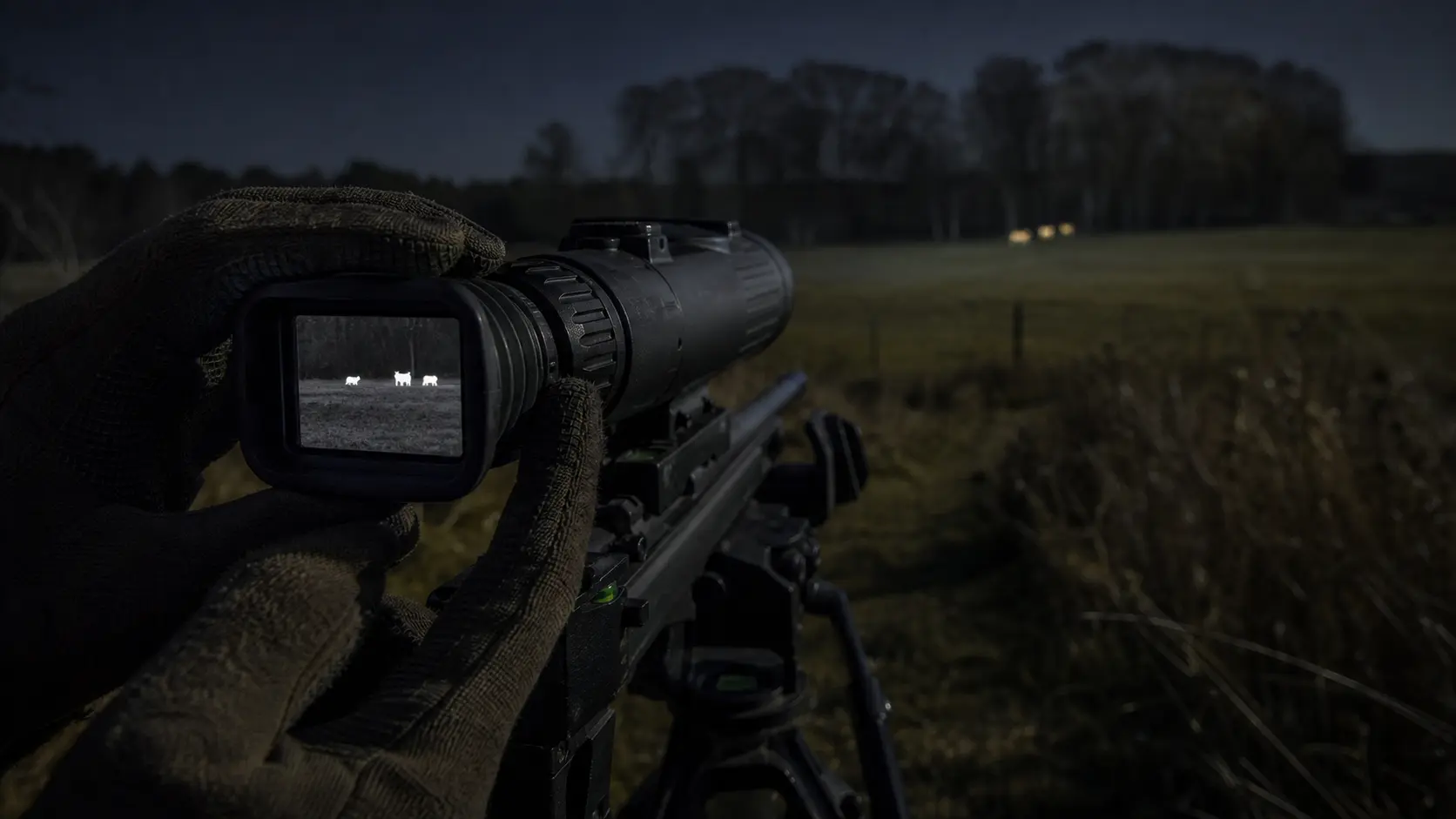
Thermal Scope Digital Zoom Explained: 2x, 4x, 8x, Image Quality, and Hunting Range
Quick Answer: Is Thermal Scope Digital Zoom Really Helpful?
Thermal scope digital zoom is helpful, but it’s not free range. It can assist you when the base thermal image of the target is already good to check a shot position, and to verify what you see. It isn’t going to provide real sensor detail or enhance the lens, nor will it automatically boost ethical ID range.
Most hunters prefer 2x as the magnifying power that is most effective for them. This helps to make the animal easier to inspect without destroying the image or field of view too quickly. 4x is helpful in good thermal scope conditions if the image is clean and the rifle is placed at a stable rest. At lower magnifications 4x on lower resolution optics begins to become soft and blocky. Use caution when treating 8x or greater. However, a large heat signature does not equate to an animal having been identified.
When shopping for scopes, don’t make your decision based on the highest zoom that is advertised. But base magnification and sensor resolution, size of the lens, pixel pitch, NETD, focus, image settings, field of view, and weather are more significant than just "up to 16x" on a spec sheet. Base mag first and zoom later if you see something interesting; do not identify based on screen size.
What Is Digital Zoom on a Thermal Scope?
Digital Zoom on a Thermal Scope is just what it sounds like.
The digital zoom on a thermal scope allows one to enlarge a portion of the image already captured by the thermal sensor. It’s similar to cutting out a piece of a digital image and stretching the image of that piece out to fill the screen. The animal looks larger, even though the scope is operating on the same sensor data.
That’s the layman’s term for thermal scope zoom explained, which involves modifying the display’s view. It does not cause the sensor to gather more heat information.
Digital Zoom vs Optical Magnification
Many people get misled by the term thermal scope optical zoom vs digital zoom. Most thermal rifle scopes have a fixed optical system that is mated with a native or base magnification, and then have digital zoom steps added on.
The lens projection onto the sensor is modified by optical magnification. Digital zoom will enlarge what the sensor captured. That translates to digital zoom often coming at a price of clarity as you zoom in the field.
Base Magnification Comes First
The magnification of the base is the first thing to be considered.
Your scope offers the purest magnification at base magnification. Typically it offers the largest field of view and the best scanning image. USA Night Vision’s guide to thermal scope base magnification is a recommended read, as thermal scope base magnification vs digital zoom is one of the best buying trade-offs.
Digital zoom simply magnifies the base image’s softness, narrowness, poor focus and low resolution.
What Happens to Image Quality When You Zoom In?
As you zoom, the image that the target shows up on the screen is bigger, but there are fewer sensor pixels representing the scene. That’s why there are many complaints regarding thermal scope image quality zoom. When using the base magnification, you are using the entire image. At 2x, the scope is zooming in on a smaller crop. At 4x and 8x, the crop becomes more aggressive, becoming chunky at the edges and losing the fine detail.
This is the reason for most of the thermal scope pixelation. Not necessarily a fault. In many cases, the sensor, lens, focusing, processing and conditions themselves are what is visible.
Why 2x Usually Looks Better Than 4x or 8x
2x is often the best balance. A bigger animal picture with plenty of field of view to see the action and read the situation. The 4x results are highly dependent on the resolution of the sensor, the quality of the lens, the focus and the weather conditions. On 8x, think critically. The picture may be larger, but useful may not be the case.
Why Zoom Can Make Heat Blobs Look More Convincing Than They Are
Digital zoom is deceiving, as size equals certainty. A questionable heat source, that’s larger on zoomed view, may appear more animal like. That is not sufficient for ethical identification. Zoom is not a solution if you cannot evaluate shape, behavior, movement, surroundings, and safe backstop.
2x, 4x, and 8x Digital Zoom: Field Comparison
| Zoom Level | Best Use | Image Quality Impact | Good For | Be Careful If |
|---|---|---|---|---|
| No digital zoom / base magnification | Scanning, initial discovery, moving animals | Clearest image and broadest field of view | Hog groups, feeders, brush, ranch security | Base magnification is too high for close work |
| 2x digital zoom | Inspecting a found target | Moderate clarity loss, often useful | Most hunting, shot placement checks, hogs and coyotes | Focus is soft or weather is low contrast |
| 4x digital zoom | Closer inspection from a steady position | Noticeable detail loss | Open fields, good 640-class optics, clean conditions | Using 256/384 sensors or handheld wobble |
| 8x digital zoom | Short inspection when the base image is strong | Heavy softness or pixelation is common | Limited use on strong systems | You are trying to identify from zoom alone |
| 16x or highest advertised magnification | Used rarely for specialty purposes or for specification comparison | Frequently compromised | High native data combined with good lens and processing | The advert says it’s free detail |
Does Digital Zoom Really Increase Detection Range?
No. Digital zoom doesn’t extend the range of sensor hot spot detection. Detection depends on the resolution of the sensor, the size of the lens, the NETD of the detector, the size of the target, the weather conditions, the background contrast, and the image processing used.
Digital zoom can be useful once a heat source is detected for further inspection of the heat source, but it will not gather new information from the target heat source. In the case of a sensor that failed to record sufficient detail, zooming will only display its inadequacy.
Detection vs Recognition vs Identification
This is explained in more detail in USA Night Vision’s guide to detection, recognition and identification range of a thermal scope. Detection means seeing a heat source. Recognition is having a good idea of what it might be. Identification translates into an ethical and confident call. Zoom can only support recognition or identification when the original image has sufficient detail.
Digital Zoom vs Sensor Resolution: 256, 384, 640, and 1280
The resolution of the sensors will have an influence on the tolerance of the zoom as more native pixels give the scope more information before the picture breaks down. USA Night Vision’s guides to thermal scope sensor size and 384 vs 640 thermal scopes are the right background reading here.
256 Sensors and Digital Zoom
While a 256 sensor can operate at base magnification in the correct setting, too much digital magnification on thermal scopes becomes unwieldy very fast. Don’t rely on 2x being a magic bullet; use it to be cautious.
384 Sensors and Digital Zoom
The 384 sensor is a typical compromise. On most 384 thermals, 2x is feasible. The 4x is very dependent on the lens, focus, NETD, and conditions. If the weather is warm and humid and the contrast is low, it might not be detailed enough to be of any significance.
640 Sensors and Digital Zoom
The 640 quality sensor is more forgiving since it begins with more image data. If you’re wondering how much zoom for a thermal scope is feasible, 640 can offer a combination of a clear base image, a usable 2x and occasionally 4x. But 640 isn’t magic. Lens, display, focus, firmware and weather are still important.
1280 Sensors and High Zoom Claims
A 1280 sensor would be better able to cope with higher zooms, as it has more native data. However, the whole system has to be robust. The more pixels the better; they don’t negate the need for careful identification.
Digital Zoom vs Base Magnification
There is no such thing as one best thermal scope magnification, it depends on the terrain and the target. The maximum digital zoom is not the only part of the system.
Excessive base magnification will negatively affect close range hunting for wild boars as you have a smaller field of view around feeders, brush and groups of animals. However, if the base magnification is too low, coyotes may be more difficult to assess at a distance in an open area. Digital zoom suggests a degree of flexibility; it can’t save the bad base magnification selection.
When it comes to thermal scope zoom for hog hunting, many times it is better to have a base or 2x zoom for groups, moving animals, and follow up tracking. 2x, and sometimes 4x, can be useful for thermal scope zoom for coyote hunting to observe smaller animals at longer distances, if the base image is sufficiently detailed.
Digital Zoom vs Lens Size, Pixel Pitch, and NETD
The digital zoom should be evaluated along with the other specifications. USA Night Vision has written about lens size, pixel pitch and NETD because these specs help determine the fundamental image.
A bigger lens can allow for longer range viewing, but may decrease FOV, increase base magnification, weigh more and be more expensive. The zoom factor alone should not be used to determine the pixel size, but should be considered in relation to the sensor resolution and lens design. NETD is important in low contrast weather conditions as humid, rainy or warm nights can flatten the image. Digital zoom will not improve weak contrast; it will enlarge it.
Digital Zoom and Focus: Why a Soft Image Gets Worse Fast
The zoom magnifies focus errors. What may appear to be a slightly soft target at 1x may appear to be less than desirable at 4x. When zooming in on the details, refocus the scope if it has the ability to manually focus the objective. The answer to this is explained in USA Night Vision’s guide to fixed focus vs manual focus thermal scopes.
Also know the difference between diopter and objective focus. If the reticle or menu is fuzzy, it’s likely a diopter issue. An objective focus problem typically is a soft animal, tree line or field scene.
Digital Zoom and Field of View
Digital Zoom is a zoom that shrinks the scene being viewed. It may be larger, but it is missing the context. That is important when managing hogs, coyotes, livestock, fence lines, and safe backstop awareness. The companion topic to this guide is USA Night Vision’s Thermal Scope Field of View Explained.
While hunting for hogs, don’t tunnel into one hog as the group is moving. All the above is in a context that can be found in hog hunting thermal scope guide, but the field rule is: scan, zoom, then zoom back out.
2x and occasionally 4x may be helpful for coyote hunting to check out body shape in open country. A coyote hunting thermal scope guide can help inform the purchasing process.
Base magnification for ranch security. First look for evidence on roadways, barns, fence lines, livestock grounds and field borders. Do not zoom unless you have identified something of interest.
Digital Zoom and Shot Placement
Digital zoom may be used to aid in placement of shots after the animal is identified and when the image is stable. One of the best uses of thermal rifle scope zoom.
When Zoom Helps
- Target is already identified.
- Rifle is on a stable rest or tripod.
- Focus is sharp.
- Thermal contrast is clean.
- The resolution of the sensor is adequate for the level of zoom.
When Zoom Hurts
- The object is in motion.
- Identification is uncertain.
- Focus is soft.
- Warm, humid, rainy or low contrast weather conditions.
- You have lots of zoom and a low resolution sensor.
Common Mistakes Hunters Make With Thermal Scope Digital Zoom
Buying the Highest Advertised Zoom Number
"Up to 16x" is not 16x useful. First compare the base image.
Using Digital Zoom as a Substitute for Sensor Resolution
Digital zoom is not the same as sensor resolution. Pay careful attention to the 384 vs 640 thermal scope digital zoom if a lot of zooming is expected, particularly for open field or coyote views.
Judging Identification From a Bigger Heat Blob
The larger isn’t the same as the more clear. Never target based only on increased target size in a heat signature.
Forgetting That Zoom Narrows Field of View
Certainly a narrow view can mean loss of situational awareness with hog groups, moving coyotes, livestock and ranch security work.
Zooming Before Focus, NUC, and Image Settings Are Correct
Don’t assume it’s the zoom’s problem if your focus or NUC or image settings are not correct. The thermal image settings and NUC calibration guides are covered by USA Night Vision since they play a basic role in zoom clarity.
Purchase Advice: What About All of the Digital Zoom?
Digital zoom is important, but don’t let it be the deciding factor. Use these rules:
- Focus on high base image rather than max digital zoom.
- On budget 256 units, and many 384 units, 2x is the reasonable zoom range.
- Quality 640 units: 2x useful, 4x useful in good conditions.
- If you’re using a 1280 unit, zoom might be more feasible, but only if the lens, the display, the firmware and the focus system are good as well.
- Don’t opt for a lesser optic simply because it has a larger digital zoom number.
When it comes to hunting, the best thermal scope magnification is the one that allows for the rapid location of game, responsible identification, tracking, and a clean shot when conditions are right.
Field Checklist: How to Use Digital Zoom Without Fooling Yourself
- Begin on base mag.
- When looking for something, find it first, then zoom in for a closer look.
- Refocus before assessing detail.
- Maintain control of NUC and image settings.
- Before jumping to 4x or 8x, use 2x.
- To observe how animals move, zoom out.
- Zoom should not be used as the sole identifier for positive ID.
- Use zoom only for confirmed shot placement, after identifying the target.
- Test image quality in real-world conditions, not just a store or backyard test.
Final Takeaway
Digital zoom is just a tool, not free range. It can assist the hunter in checking out a target, focus the vision, and maximize the use of a clean thermal image. It can’t produce details that the sensor didn’t capture.
Select the proper base magnification, sensor resolution, lens size, NETD, focus system and field of view first. Then use digital zoom as an add-on feature. A high quality 640 thermal at medium zoom can be far more helpful than a weaker optic whose number is being strapped to its max.
FAQ
Does digital zoom make a thermal scope image less good?
Yes. It does not add any detail to the sensor image, but rather magnifies part of it, and as the level of zoom increases, it can make the image softer or more pixelated.
Is 2x digital zoom sufficient for hunting?
Yes, for many hunters. Typically 2x is the best magnification as it allows the viewer to examine the subject without losing out on image quality or field of view too rapidly.
Is 4x digital zoom useful on a 384 thermal scope?
Sometimes. This varies with lens quality, lens focus, NETD, weather and strength of the base image. It goes rough quick on a 4x on a 384, if the conditions are bad.
Is 8x digital zoom useful, and is it really necessary?
In limited instances, it can be helpful; hunters should be wary. Many scopes have an 8x magnification that will enlarge an image but not necessarily aid in practical identification.
Is the thermal detection range greater with digital zoom?
No. It can potentially assist with examining a detected heat source, but still range of detection is dependent on the sensor, lens, NETD, target size, weather and contrast.
What is thermal scope base magnification vs digital zoom?
The initial view of the optic is base magnification. Digital Zoom magnifies the image that has been captured by the sensor.
Which thermal scope is better for digital zoom, 640 or 384?
Typically, 640 would begin with higher sensor data. However, lens, focus, NETD, display, firmware and weather do still play a role in the final image.
Is zooming in a good idea prior to shooting a thermal scope?
Once the target has been identified and the rifle is steady. Zooming should be used to find the correct shot placement, not to make guesses about what the target might be.
When zooming in on my thermal scope, why do some areas become pixelated?
Digital zoom zooms in a smaller portion of the image captured by the sensor. The higher the zoom, the less resolution that will be available of the animal and background, causing the picture to be blocky or soft.

Can You Use a Thermal Scope During the Day? Daylight Use/Sun Safety and Zeroing Tips.

Night Vision Range Explained: Detection, Recognition, Identification, and Real Hunting Distance

How to Set Up an IR Illuminator for Night Vision: Placement, Beam Width, and Field Mistakes