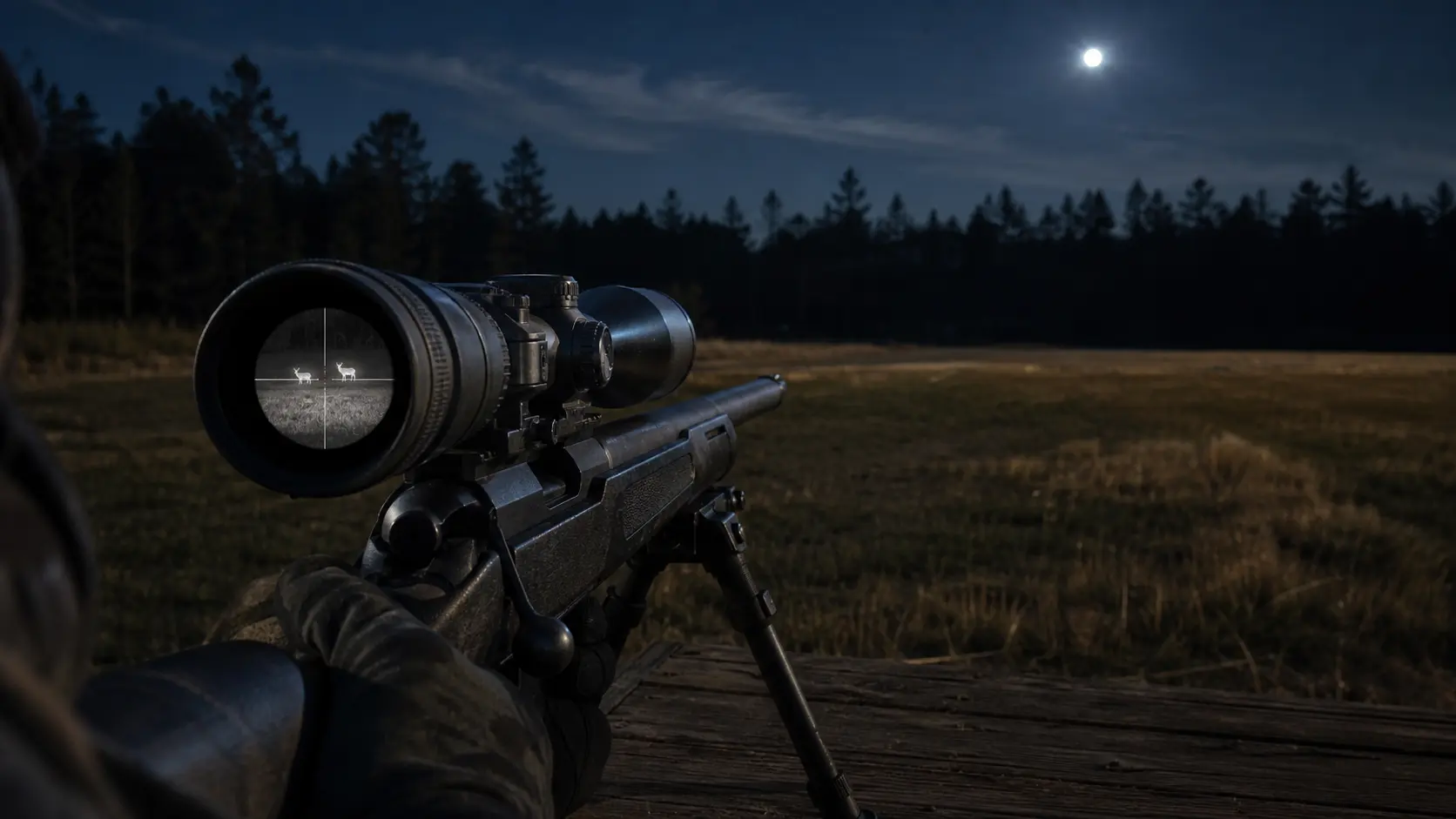
Thermal Scope Reticles Explained: Crosshairs, Zero Profiles, Holdover, and Hunting Use
The simplest answer: For most thermal hunters, the best reticle is the one that works best for them. Most hunters will want to start with a clean, simple thermal scope reticle that won’t obscure the animal or clutter the picture. A plain thermal scope crosshair or feeders-clean hunting reticle typically is the most useful reticle for thermal scope use over feeders, in tight lanes and when encountering fast hog or coyote situations.
If one optic is used between different rifles, ammunition loads, suppressor setups or zero distances, multiple thermal scope zero profiles are useful. They are only valuable, however, if you verify the active profile prior to each hunt. Shooting on the incorrect profile may result in a miss shot or unsafe shot.
Thermal scope holdover marks, BDC references, mil dots, ballistic tools, etc., can help after range confirmation, zero verification, target ID, and safe backstop discipline, but should not be relied upon as a substitute. The best thermal rifle scope reticle to use is the one you can see clearly, trust under recoil, and not lose that awareness of the field.
What is a Thermal Scope Reticle?
Thermal riflescope reticles are aiming references that appear on the display of a thermal scope. In a traditional glass scope the reticle is typically etched or manufactured into the optic. For many thermal scopes the reticle is a digital overlay that is managed by the scope’s menu and by the scope’s firmware.
The digital design provides hunters with greater flexibility, but also with greater setup options. Model specific options include reticle style, color, brightness, zero position and stored profiles. If reticle footage is important to you, note that some scopes might work differently with recorded video.
The side of the topic on step-by-step sight in is available if you need it; use this guide in conjunction with Thermal Scope Reticle Zeroing Explained.
Digital Reticles vs Traditional Scope Reticles
There are two different types of reticles: digital and traditional scope reticles. Digital reticles aren’t just the old school crosshairs on a screen. They rely on screen legibility, on how the firmware acts and on the menu configuration as well as on the electronics powered by batteries. That means that you need to test the reticle using the same palette, brightness, contrast and zoom size you will use at night.
A sharp looking reticle in the house may be too cluttered in the field for brush and cattle and fences and wet ground and multiple heat signatures. Reticle set up is not just a menu setting, it’s part of your hunting system.
Why Reticle Visibility Is Different in Thermal
Thermal can have different reticle visibility than traditional optics. A night hunting reticle should remain visible on hot animals, on cold backgrounds, bright sky, tree lines and brush, and on various thermal palettes. If the light is white hot, the reticle can be obscured when looking at a bright hog. Black Hot: Dark reticle can blend in with the animal.
Reticle visibility is related to your overall thermal scope settings. What you see depends on the focus, the contrast, the screen brightness, the palette selection and the behavior of the NUC. Read Thermal Image Settings Explained for help with setting up your image.
The most popular thermal scope reticle types include the following:
Thermal scope reticles may differ from model to model and brand to brand – do not assume that all thermal scope optics have the same names, mark spacing or profile behavior. Nonetheless, there are some typical choices for most hunters.
Simple Crosshair Reticles
Most hog and coyote hunters should start with a simple crosshair. Easy to use and to understand, and is quick and clean under pressure. A clean center aiming point will help keep your focus on the animal, not the menu feature you’ve selected, when a sounder steps out or a coyote hangs up for a few seconds.
Duplex-Style and Hunting Reticles
Duplex-type thermal scope reticles provide a familiar sight picture for daytime scope hunters. That can be a heavier outside post, cleaner inside or a design that naturally draws your attention to the aiming point. They can perform well but avoid having thick parts obstructing small targets at range.
Mil-Dot, MOA and Hash-Mark Reticles.
Repeatable holdover and wind references can be made with a thermal scope mil dot reticle, MOA reticle, or hash-mark reticle. These reticles are best suited for shooters that are familiar with subtensions and confirm actual hits at range.
Don’t be overgeneral. With digital optics, there may be magnification and display behavior that may influence the usefulness of marks in practice. Always test your particular scope first before using any mark as a reliable point of aim.
BDC and Ballistic Reticles
A thermal scope BDC reticle can be helpful when the rifle, load, velocity, zero distance and target range are close to the reticle’s assumptions. Not all BDC marks are generic. Those marks can deceive you if you swap out ammunition, attach a suppressor, swap the optic or shoot at undocumented range.
Reticle Color, Brightness and Screen Clutter
The most prominent reticle isn’t necessarily the most effective reticle. Another possible distraction is a reticle that jumps off the screen, taking your eye off of animal shape, legs, head position and background.
Reticle Color: White Hot and Black Hot
Depending on the model, the thermal scope reticle color options may be a combination of red, green, white, black, and multi-color. The color will be determined by what color palette you are working with and the background. Test color of test reticle in white hot and black hot, not just in the house.
When the Reticle Is Too Bright
Thermal scope reticle brightness should be high enough to be read quickly, but not so high that it blooms, obscures detail or tires the eye. This is important on coyotes and other small predators. With longer distance shots, a bright center dot or thick crosshair may obscure excessive area of the chest, particularly when using digital zoom.
Clutter on Small Targets Avoidance
The situation deteriorates as the targets diminish in size, brush becomes denser and zoom increases. What seems comfortable at "base" may feel like it is too heavy at 4X or 8X digital zoom. See Thermal Scope Digital Zoom Explained for more information on that tradeoff.
What is a Zero Profile and When Does it Matter?
Thermal scope zero profiles are stored zero configurations. A profile can be for a rifle, load, zero distance, reticle setting, or other data. When making assumptions about how profiles work, always consult the manual of your optic.
One Rifle, One Load
For the use of one rifle, one load, one mount and one zero distance, one confirmed profile might suffice. It’s not a drawback, it’s a strength. The simpler it is, the easier it is to check and the less confusing it will be in the dark.
More than one rifle, suppressor, or ammunition load.
Multiple profiles are important if one optic is moved from one rifle or set-up to another. Perhaps you had one profile for your .223/5.56 AR-15, another for your .308, another for your suppressed, and another for a different bullet weight.
Use profiles if applicable and make sure to clearly name them, document them and verify them at the range. Note that mounting changes zero as well; if switching optics between rifles please read How to Mount a Thermal Scope.
Risk of Hunting on the Wrong Profile
The worst profile error is to hunt on the incorrect profile that is active. Add a profile check to pre-stand routine. Check rifle and load, suppressor on, zero profile and reticle prior to exiting the truck. If there were any changes, check zero before hunt.
Holdover and Range and Ballistic Features
As distance increases, targets decrease in size and range uncertainty increases, thermal scope holdover becomes more important. For known distance shots, a simple crosshair will suffice. In an open field, long lane or predator stand with varied terrain, the use of holdover marks and ballistic aids becomes more useful.
When Holdover Matters for Hog Hunting
If the distance is known and is close, holdover may not be a factor for a thermal scope used for hog hunting over feeders. Hogs can be found at less predictable distances in crop fields, senderos or open pastures. This can be aided by a clean holdover reference, but only once you have confirmed actual effect with your rifle and load.
When Holdover Matters for Coyote Hunting
A thermal scope for coyote hunting often needs more precision. Coyotes are smaller than hogs, may stop farther out, and have a smaller vital zone. A reticle that obscures the chest or confuses the positions of the holds is not a good fit.
A clear center aiming point and range discipline trumps a complicated grid for many callers. More experienced shooters may prefer to use a verified mil, MOA or hash reference.
Technology to integrate LRF and Ballistic Calculator.
Some thermal imaging devices also integrate laser rangefinding, ballistic calculation and adjusted aiming references. These features may be helpful, but are dependent on the model; useful for open country hunters.
The accuracy of a thermal scope ballistic calculator is dependent upon the data contained within the calculator: Rifle, load, velocity, zero, range, environment assumptions, and chosen profile. It should aid your process, not supplant it. When you are in a dilemma on whether to pay for rangefinding or not, check Thermal Scope LRF vs No LRF.
Understanding why a Thermal Reticle May Appear Off-Center After Zeroing
New users might be surprised and confused by a thermal scope reticle which is not centered after zeroing. With some digital optics, zeroing is done through a menu that will adjust the reticle or aiming reference inside the scope. Even if the rifle is zeroed and the manufacturer states that’s how the rifle is supposed to act, a slightly off-center reticle may not necessarily indicate that the scope is faulty.
When Off-Center Is Normal
An off-center appearance may be normal following digital zeroing, if mount alignment, rail position or rifle geometry needed to be adjusted. The real issue is whether or not the rifle prints in the location the reticle indicates and does so reliably.
Check Mount or Re-Zero When:
If the reticle is dramatically out of alignment, zero is not being maintained, impacts are causing the reticle to move erratically, mount appears loose, scope has been removed from rifle, or rifle has been hit hard, check the mount or re-zero. For related set-up checks, refer to Thermal Scope Recoil Rating and Caliber Compatibility and Thermal Scope Eye Relief.
The optimal reticle setting depending on the hunting scenario.
Hog Hunting Over Feeders
Use a simple visible reticle, zero confirmed, no clutter. Reticle features should come after image quality, FoV, mounting, battery life and recoil compatibility. You can check out wider situations of buying by reading Best Thermal Scopes for Hog Hunting in 2026.
Moving Sounders and Follow-Up Shots
If the hogs run away, a busy reticle slows you down. Field of view, simple aiming, and rapid target reacquisition is more important than a complicated grid of holdover. Match the reticle to the appropriate view window on a terrain: Thermal Scope Field of View Explained.
Coyote and Predator Calling
Use a reticle which allows for accurate placement, but does not obscure the animal. Over-thickening, over-brightness, and unverified holdover references can negatively impact confidence on smaller targets. For additional insights into purchasing context, please refer to Best Thermal Scopes for Coyote Hunting 2026.
Ranch security and Property Work
Unless you are intentionally shooting at a measured distance, avoid using a fancy reticle when working around the ranch or your property. The work involves a lot of observation, identification and decision-making. When a screen is cluttered with a lot of stuff on the reticle, it is more difficult to see around gates, livestock areas, equipment yards and tree lines.
Thermal Scope Reticle Comparison Table
| Reticle / Feature | Best For | Strength | Weakness | Field Advice |
|---|---|---|---|---|
| Simple crosshair | Most hog hunters, close shots, first time thermal buyers | Easy to use, easy to trust, easy to learn | Limited hold references | Great starting point, add complexity as needed |
| Duplex-style hunting reticle | Hunters who are accustomed to the traditional type of scopes | Familiar sight picture | Can become dense when aiming at small targets | Check at normal zoom level |
| Mil/MOA hash reticle | Experienced shooters, longer shots | Repeatable holds | Understanding and verifying the marks must be done | Confirm real impacts at distance |
| BDC-style reticle | Known rifle/load/range setups | Simple drop references | Generic marks can be misleading | Treat BDC like verified, not universal |
| Ballistic calculator / smart aiming aid | LRF-equipped or precision-minded hunters | Supports range-based aiming data | Bad data equals bad holds | Verify inputs, profile, and impact |
| Multiple zero profiles | Shared optics, multiple rifles or loads | Saves set-up configurations | Wrong profile can spoil the shot | Name and confirm profiles before hunting |
Purchase Advice: What features of a reticle are worth paying for?
Pay for core thermal performance first, pay for the clarity. Each minute behind the scope is affected by sensor resolution, size of the lens, NETD, refresh rate, display quality, focus control, field of view, durability, battery life and mounting support.
A clear reticle that you use, is better than a ‘feature menu’ reticle that you never practice with. If you want to change to a different rifle, load, suppressor, or zero distance you need multiple zero profiles and are willing to pay for them. Ballistic data is more valuable to the open country hunter or those with LRF optics and willing to test data at the range.
Don’t purchase a lesser thermal for a complicated reticle system. Target ID and shot confidence are more important in real hunting than menu depth.
Thermal Reticles – Common Hunters’ Mistakes
Selecting a Reticle That Sounds Good in the Menu but Won’t on the Field
Menus are clean. Fields are not. Test reticles outdoors, at night time, on actual backgrounds and with frequent zoom levels.
Forgetting to Confirm the Active Zero Profile
If your optic is profiled, be sure to verify the profile that is turned on before the hunt. Make it as easy as acknowledging ammunition.
The use of Holdover Marks without actual impact results
Holdover is only relevant once you have the knowledge of where bullets are going to land. Confirm with the rifle, load, suppressor combination and distances to be used.
Turning Reticle Brightness Too High
Make sure the reticle is not overpowering but still visible. If it obscures detail or takes focus off of the animal, turn it down.
When the Reticle is Getting the Blame when it is Really FOCUS, NUC, Mounting, or ZERO
Sometimes, a fuzzy picture or odd impact shift is not a reticle issue. Don’t throw the blame at the reticle design, check focus, NUC, image settings, mount torque, rail fit, recoil compatibility and zero.
Before the hunt: Field checklist
- Verify rifle, load, suppressor and zero profile.
- Check the style, color and brightness of the reticle.
- Check Zero not only in the menu, check it at the range.
- Review mount screw and return to zero assumptions.
- Check the visibility of the test reticles in White Hot and Black Hot.
- Try various base and digital zoom settings.
- If it is important, check the video recording to see if it contains the reticle.
- Re-check following firmware updates, battery changes, hard bumps or scope removal.
Final Takeaway
Thermal scope reticles are not for show. They impact on speed, confidence, target identification, follow up shots and shot discipline. Simple beats complex, and verified beats untested, for most hunters.
Always use a "clean" thermal scope reticle, verify your zero, maintain control over your brightness, and add only holdover marks, BDC reference points, multiple profiles and ballistic aids when they are necessary for your hunting. The best reticle is not the one that has the most features. It is the one that will assist you to make a clean shot that you can confirm when the field is dark and the pressure is on.

Can You Use a Thermal Scope During the Day? Daylight Use/Sun Safety and Zeroing Tips.

Night Vision Range Explained: Detection, Recognition, Identification, and Real Hunting Distance

How to Set Up an IR Illuminator for Night Vision: Placement, Beam Width, and Field Mistakes