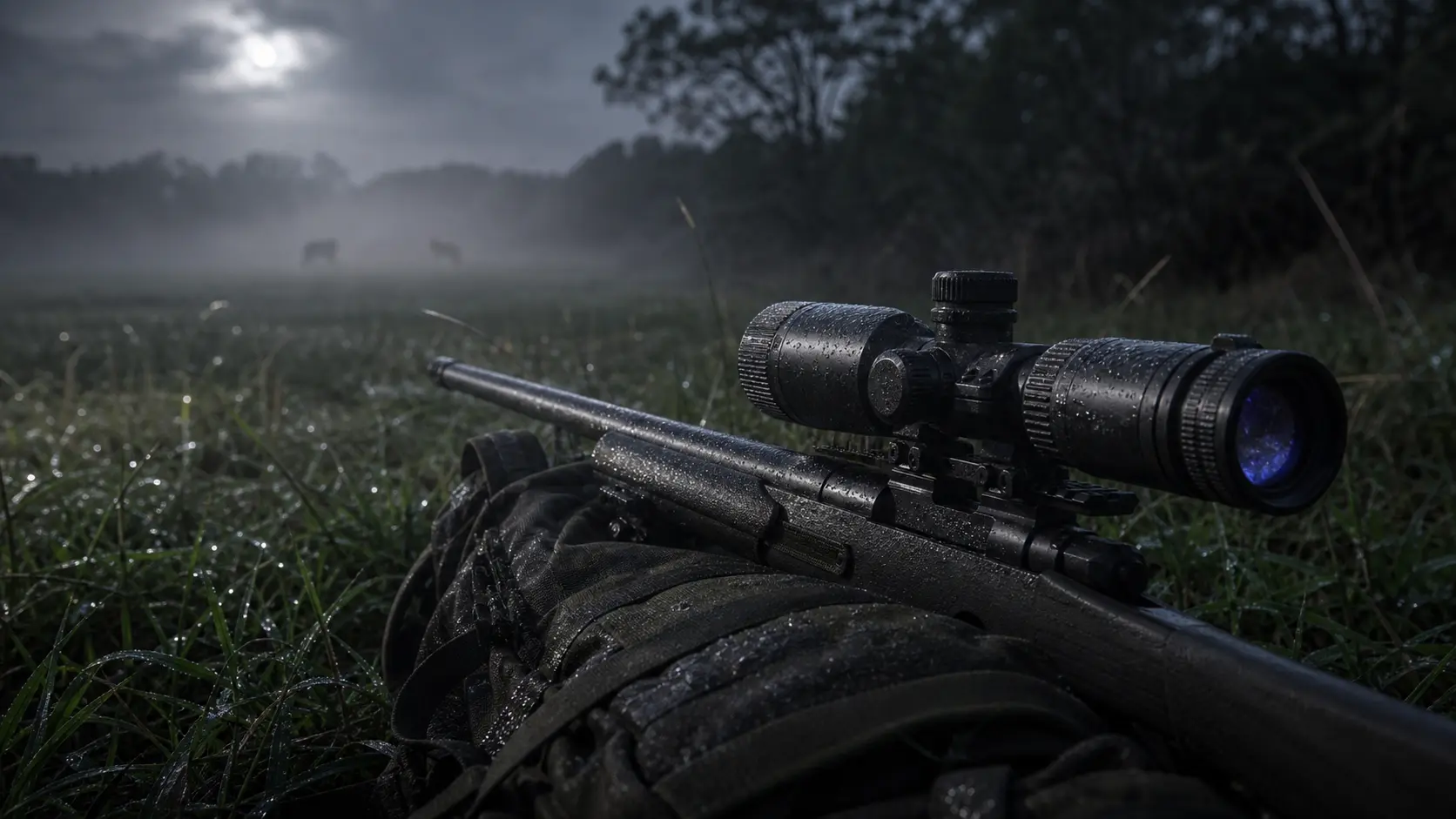
Thermal Scope NETD Explained: What mK Sensitivity Really Means for Hunting
One of the most critical specs hunters will see on product pages and one of the most easily misinterpreted is “Thermal scope NETD.” A scope may be listed as <20 mK, <25 mK, <35 mK, or <50 mK. The lower the number, the higher the thermal sensitivity, but not necessarily the best scope for your rifle, terrain or budget.
In the field, the most important factor is when conditions become challenging: when the temperature difference between an animal and the background is not great, when the grass is wet, when it's humid, when it's hot at night, when the background is foggy, when it's drizzling, when there's brush, etc. When a lesser sensor begins to show a flat or noisy appearance, adding a low NETD thermal scope can help maintain separation and edge detail.
The “standard trick” is to use NETD to determine sensitivity and judge the whole optic. Zero reliability, battery life, mounting, warranty, display quality, refresh rate, processing, focus, base magnification, lens size and resolution still matter.
What is NETD of a Thermal Scope?
Noise Equivalent Temperature Difference is the term for NETD. In simple terms, it's the minimum temperature difference that a thermal detector can distinguish from image noise, given the specified test conditions. Millikelvin (mK) is a unit used to measure NETD.
If you are asked the question, “what is NETD thermal imaging?” – the answer is this: NETD indicates the capability of the sensor to detect small temperature differences before they are masked by noise. Not the detection range or resolution. It is a measure of sensitivity to temperature.
It is better to have a lower mK. If the measurement is comparable, and the rest of the scope is well constructed, a 25 mK unit should have a greater sensitivity than a 50 mK unit.
Better is Lower NETD?
Yes. The lower the NETD the higher the thermal scope sensitivity. When the animal and background temperatures are near each other, a 20-25 mK sensor is generally more sensitive than a 35-50 mK sensor.
The highest quality thermal scope images are not achieved by just having NETD. A scope that has an excellent thermal scope mK rating can still disappoint if the optics are weak, the processing is bad, the base magnification is not user-friendly, the display is low resolution, or the focus action is poor.
To read mK Numbers on a Spec Sheet
These ranges are meant to give practical buying guidance, but they are not guarantees.
| NETD Rating | Practical Meaning | Best Fit |
|---|---|---|
| <20 mK | Excellent sensitivity | Premium hunting, humidity, low contrast |
| 20-25 mK | Very strong | Serious hog and coyote hunting |
| 25-35 mK | Good to workable | Mid-range scopes, general hunting |
| 35-50 mK | Budget, older, or less sensitive class | Clear nights, shorter ranges |
| >50 mK | Limited by modern standards | Only if the price and use case are very narrow |
The 25 mK thermal scope is a good aim. If the system is solid, then a 35 mK thermal scope can help. A 50 mK thermal scope will perform well in clear, high contrast situations, but not so well in humid and warm conditions where the ground and all scene details are not sufficiently contrasted.
The reason why NETD Claims are not apples to apples.
The NETD for a specific manufacturer test method may be different with different lens types, aperture, calibration, processing, display quality, firmware, and stated conditions. The two scopes listed with the same NETD thermal scope spec can vary in different pastures.
Therefore, I consider NETD to be a serious filter, not a final decision. Make a comparison with resolution, size of the lens, base magnification, pixel pitch, return policy, and real field reviews.
The importance of NETD for hunters.
There are a lot of reasons why hunters buy thermal besides to see a bright blob. Real work is detection, recognition and ethical identification. The best thing most have to learn from NETD: when you need shape, edge detail and separation of a background in poor contrast.
If you're on the other side of that decision, check out USA Night Vision's guide to detection, recognition and identification range. NETD can be helpful with that process, but is not a substitute for target ID discipline.
Warm nights and a lack of contrast.
The summer hunt for hogs is an example. Dirt, rocks, brush, trees and hay bales can all retain heat after a hot day. A hog is still different from the background, but the difference may be much smaller than it would be on a cold night.
This is where the low NETD thermal scope can come into play. You might also find more detail in the body and a clearer outline with far less of the grey dullness that renders everything indistinct.
The arrival of humidity, fog, drizzle, and wet vegetation.
Thermal scope humidity performance is important in the real world. Thermal contrast can be diminished and images washed out by moist air, fog, drizzle and wet grass. Low NETD assists in those situations, but will not cause heavy fog or rain conditions to act as clear air.
A hunter who hunts river bottoms, coastal country, wet fields or humid South terrain should focus more on thermal sensitivity mK than a hunter who hunts mainly in cold and dry open terrain.
Coyotes, Hogs, Deer and Small Targets.
Coyotes are smaller, faster and can be seen near brush lines. Hogs can roam in stubble, grass, and/or timber edges. The smaller or covered animals are the ones that require sensitivity more than it seems on a clean spec sheet.
As well as when you're scanning, it's important to have better sensitivity to separate the legs, ears, head position and body shape before the shot.
NETD vs Thermal Resolution: Which has more significance?
Resolution is a solution to a different problem than NETD. Resolution gives detail. NETD is used to distinguish small temperature differences.
A 256 class scope is not detailed. A 384 sensor is a feasible upgrade. The 640 sensor provides more detail and more digital zoom. A 1280 class sensor is great, but requires quality sensitivity, lens and processing too.
If you want a more detailed breakdown, check out USA Night Vision's guide to thermal scope sensor size and the 384 vs 640 thermal scope comparison.
384 With Good NETD vs 640 With Average NETD
If you have to choose one, your terrain should be first. High quality 384 with NETD is very helpful in tight woods, small fields, and short ranges. If you're in an open area, a 640 might be worth it for longer shots, and if shots are frequently zoomed, open country is a plus.
Remembering that one spec is not always the winner. There is a trade-off between thermal scope resolution and the sensitivity. A clean 384 image in humid conditions can outwit a noisy higher-resolution image; a robust 640 can be used to show more ID detail when distance is the factor.
What Digital Zoom Reveals.
Digital zoom increases the image size the sensor recorded. It doesn't add any new detail. As you zoom in, weak sensitivity, lack of focus, noise and aggressive sharpening are more apparent.
NETD, Pixel Pitch, Lens Size, Base Magnification
The thermal scope sensor specs are combined. NETD is significant, but so are the objective size and f-number (when available), the pixel pitch, the base magnification, field of view, processing, and display resolution.
Lens and Aperture
The lens directs heat energy to the detector. A larger or better lens can improve practical performance, but it also affects weight, cost, field of view and base magnification. A scope with a high base mag can be very detailed on a stationary target, but feel too tight while scanning. See thermal scope base magnification for this tradeoff.
Pixel Pitch
The detector pixel pitch is the distance between the detector pixels, which is sometimes quoted as 12 micron or 17 micron. Buyers know that it is not a matter of one number being always better than the other. The issue is dealing with the relationship between the size of the sensor, the focal length of the lens, the field of view and how sensitive the scope is when it is finished.
Image processing and display quality.
Thermal scope image quality is influenced by sharpening, contrast algorithms, NUC/FFC correction, brightness, palette, display resolution and tuning the firmware. A good sensor can look poor if it is not focused properly or the contrast is incorrect. USA Night Vision takes care of that with thermal image settings.
What NETD Rating Will Hunters Seek?
In clear, high-contrast situations, budget thermal scopes in the 35-50 mK range might be able to work at short distances or on known bait trails or locations. Realize the conditions of humidity, zoom and long identification distances.
A good range for mid-range hunting scopes is 25-35 mK. This range will be suitable for a lot of hog and predator hunters with a good resolution, lens size, base magnification and processing.
With premium scopes, anything under 25 mK is more compelling. It is particularly appealing at or below 20 mK for low contrast weather, humid nights and longer observations.
When the NETD is less important than other specs.
Easy nights are those that are not affected much by NETD: cold air, dry conditions, open fields, warm animal out of cover. In those situations, the resolution, size of the lens, field of view and magnification can be factors.
In other circumstances, other specifications might be equally relevant when:
- Detail at distance is needed.
- Heavy digital zoom is used.
- You need to be able to scan across the landscape and require field of view.
- Running animals are tracked and smooth thermal scope refresh rate is required.
- A thermal scope with LRF vs no LRF could be compared.
- All-night runtime, or robust mounting or zero retention is required.
The image is aided by the use of NETD. It is not a panacea for all hunting problems.
How to Compare Thermal Scopes by NETD Before Buying
In Step 1, compare the NETD within the same resolution class.
Compare 384 to 384 first, then 640 to 640. Once you have done that, make comparisons between classes. This maintains the buying decision cleaner.
Make sure that the lens is the correct size and has the appropriate base magnification.
Avoid using just the sensitivity of a thermal scope as a criterion for selection. A 25 mK scope with the wrong field of view might not be as helpful as a 35 mK scope that fits your terrain.
Next, read the Field Reviews for Humidity and Warm-Weather Performance (Step 3).
Check hunter reviews in like situations. Note comments made about warm nights, fog, drizzle, wet vegetation and animal separation.
Step 4: Acknowledge the Terms of Return Policy and Warranty
Return policy and warranty are important if you can't test the optic before purchase. Thermal scope is a thermal optic, electronic device, software platform and rifle mounted tool.
The following are some of the common mistakes that buyers make when purchasing a thermal scope.
The first one is assuming that the lowest NETD always beats. This isn't always the case, but it does help when poor lens choice, weak resolution, awkward magnification, bad focus, or unreliable zero are not the problem.
The second error is literal comparisons of manufacturer claims. Follow the thermal scope mK rating, not a jury's verdict.
The third error is assuming that thermal can see through heavy fog, rain or wet brush as it would in clear air. Low NETD can be useful in low contrast; it has no effect on the atmosphere.
Another frequent error is blaming the sensor before checking focus, brightness, contrast, palette, NUC/FFC timing, and display setup.
The fifth error is to forget about the hunt. The range of sensitivity, resolution, field of view, battery life, and refresh rate required may vary depending on the type of coyote caller, hog hunter over feeders, and/or the ranch owner scanning from a UTV. If you're in the beginning stages, you should check out how to pick your initial thermal scope.
FAQ
Can 25 mK be a good thermal scope?
Yes. For hunting purposes a 25 mK thermal scope is a good level of sensitivity, provided that the scope has sufficient resolution, lens, magnification, processing and display quality.
Does 35 mK suffice for hunting?
Often, yes. Clear higher contrast moments can benefit from a 35 mK thermal scope. It may not be as tolerant in humidity, fog, drizzle, warm temperatures or dense vegetation.
Is 50 mK bad for a thermal scope?
Not necessarily, but it's more limited by modern standards. In clear weather, a 50 mK thermal scope might still be able to be used at shorter ranges, but purchasers should be aware that there is a risk of poor low-contrast performance.
Does NETD impact detection range?
NETD will impact the contrast of the target with the background, particularly in low contrast. It does not directly substitute for the range factors of the lens size, sensor resolution, target size, weather, and display quality.
If I should go for higher resolution or better NETD?
Pick on the grounds of the terrain. Resolution gives detail. NETD provides a small temperature difference. It's always a good idea to have a balanced scope rather than a scope that is only winning one spec.
Final Takeaway
NETD is simply a sensitivity spec, most importantly, when the scene is difficult to read. Differences between good and excellent NETD may not be striking on a cold, dry night out with a hot animal. It can make the image more usable on a warm humid night with wet grass, brush, fog or low thermal contrast.
If you're in for serious hog and predator work, 25-35 mK would be a reasonable middle ground. If <25 mK, this is strong. If <20 mK, this is premium. Compare resolution, lens size, field of view, base magnification, refresh rate, image processing, zero reliability, battery life, warranty and real field performance.
For hunting-specific product direction, pair this NETD guidance with USA Night Vision's guides to the best thermal scopes for hog hunting and thermal scopes for coyote hunting.

Can You Use a Thermal Scope During the Day? Daylight Use/Sun Safety and Zeroing Tips.

Night Vision Range Explained: Detection, Recognition, Identification, and Real Hunting Distance

How to Set Up an IR Illuminator for Night Vision: Placement, Beam Width, and Field Mistakes